Archives
BUS 113 Midterm 1
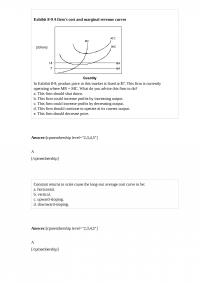
Exhibit 8-9 A firm’s cost and marginal revenue curves In Exhibit 8-9, product price in this market is fixed at $7. This firm is currently operating where MR = MC. What do you advise this firm to do? a. This […]
BUS 132 Midterm 1
A farm can produce 10,000 bushels of wheat per year with 5 workers and 13,000 bushels with 6 workers. The marginal product of the sixth worker for this farm is: a. 10,000 bushels. b. 3,000 bushels. c. 500 bushels. d. […]
BUS 159
Which of the following statements concerning the supply of labor is true? a. The wage rate has no effect on the supply of labor. b. The labor supply curve is downward sloping. c. The supply of labor is determined by […]
BUS 197 Quiz
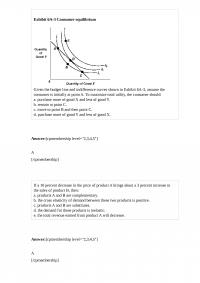
Exhibit 6A-3 Consumer equilibrium Given the budget line and indifference curves shown in Exhibit 6A-3, assume the consumer is initially at point A. To maximize total utility, the consumer should: a. purchase more of good X and less of good […]
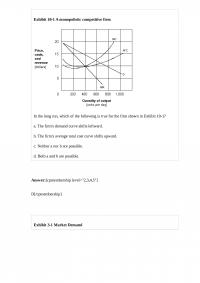
BUS 199 Exhibit 101 A monopolistic
Exhibit 10-1 A monopolistic competitive firm In the long run, which of the following is true for the firm shown in Exhibit 10-1? a. The firm’s demand curve shifts leftward. b. The firm’s average total cost curve shifts upward. c. […]
BUS 248
Which of the following is true at the point where diminishing returns set in? a. Both marginal product and marginal cost are at a maximum. b. Both marginal product and marginal cost are at a minimum. c. Marginal product is […]
BUS 301
What type of economic analysis is limited to testable, verifiable statements? a. Macroeconomics. c. Positive economics. b. Entrepreneurial economics. d. Normative economics. Starting in 1964, the U.S. government has defined the poverty line as income at or below ________ the […]
BUS 364 Quiz 3
The horizontal summation of individual demand curves gives: a. a supply curve. b. a Phillips curve. c. a market demand curve. d. the quantity supplied. e. a production function. If the minimum points of all the possible short-run average total […]
BUS 375 Quiz 3
Karl Marx published: a. Das Kapital. c. The Wealth of Nations. b. General Theory of Communism. d. Capitalist Manifesto. If a box of Swiss chocolate priced at 100 francs can be purchased for $50, the exchange rate is: a. 0.50 […]
BUS 382
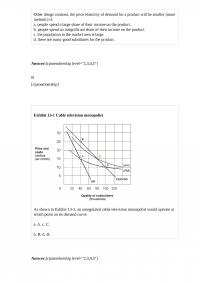
Other things constant, the price elasticity of demand for a product will be smaller (more inelastic) if: a. people spend a large share of their income on the product. b. people spend an insignificant share of their income on the […]
BUS 400 Quiz 1
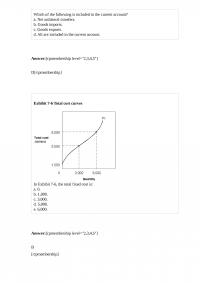
Which of the following is included in the current account? a. Net unilateral transfers. b. Goods imports. c. Goods exports. d. All are included in the current account. Exhibit 7-6 Total cost curves In Exhibit 7-6, the total fixed cost […]
BUS 465 Quiz 1
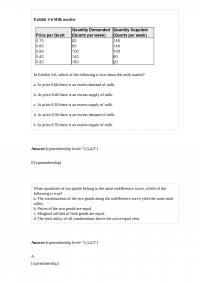
Exhibit 3-6 Milk market In Exhibit 3-6, which of the following is true about the milk market? a. At price 0.60 there is an excess demand of milk. b. At price 0.40 there is an excess supply of milk. c. […]
BUS 528 Final
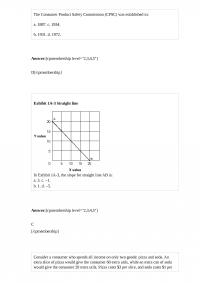
The Consumer Product Safety Commission (CPSC) was established in: a. 1887. c. 1934. b. 1931. d. 1972. Exhibit 1A-3 Straight line In Exhibit 1A-3, the slope for straight line AB is: a. 3. c. 1. b. 1. d. 5. Answer: […]
BUS 593 The horizontal summation
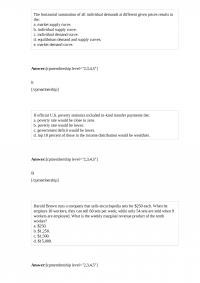
The horizontal summation of all individual demands at different given prices results in the: a. market supply curve. b. individual supply curve. c. individual demand curve. d. equilibrium demand and supply curves. e. market demand curve. If official U.S. poverty […]
BUS 627
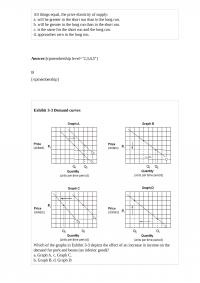
All things equal, the price elasticity of supply: a. will be greater in the short run than in the long run. b. will be greater in the long run than in the short run. c. is the same for the […]
BUS 628 Test 1
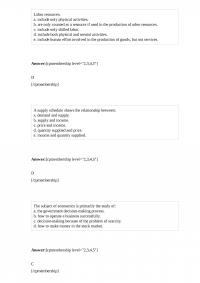
Labor resources: a. include only physical activities. b. are only counted as a resource if used in the production of other resources. c. include only skilled labor. d. include both physical and mental activities. e. include human effort involved in […]
BUS 632
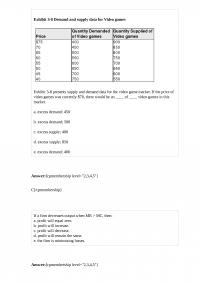
Exhibit 3-8 Demand and supply data for Video games Exhibit 3-8 presents supply and demand data for the video game market. If the price of video games was currently $70, there would be an ____ of ____ video games in […]
BUS 640 Final
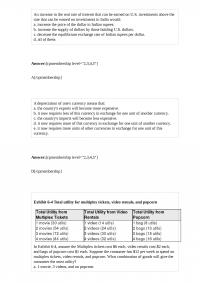
An increase in the real rate of interest that can be earned on U.S. investments above the rate that can be earned on investments in India would: a. increase the price of the dollar in Indian rupees. b. increase the […]
BUS 648 Midterm
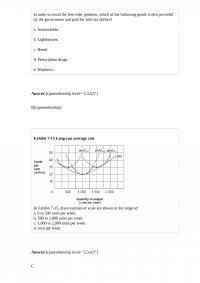
In order to avoid the free-rider problem, which of the following goods is best provided by the government and paid for with tax dollars? a. Automobiles. b. Lighthouses. c. Bread. d. Prescription drugs. e. Windows. Exhibit 7-15 Long-run average cost […]
BUS 689
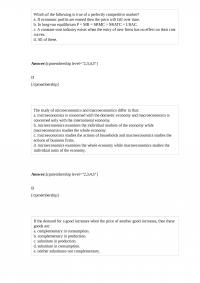
Which of the following is true of a perfectly competitive market? a. If economic profits are earned then the price will fall over time. b. In long-run equilibrium P = MR = SRMC = SRATC = LRAC. c. A constant-cost […]
BUS 707
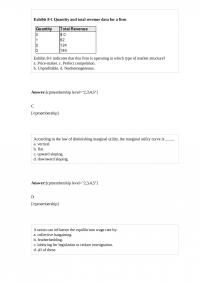
Exhibit 8-1 Quantity and total revenue data for a firm Exhibit 8-1 indicates that this firm is operating in which type of market structure? a. Price-maker. c. Perfect competition. b. Unprofitable. d. Nonhomogeneous. According to the law of diminishing marginal […]
BUS 737 Quiz The labor supply
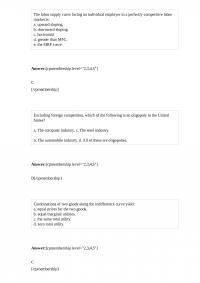
The labor supply curve facing an individual employer in a perfectly competitive labor market is: a. upward sloping. b. downward sloping. c. horizontal. d. greater than MFC. e. the MRP curve. Excluding foreign competition, which of the following is an […]
BUS 764 Quiz
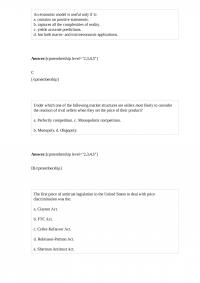
An economic model is useful only if it: a. contains no positive statements. b. captures all the complexities of reality. c. yields accurate predictions. d. has both macro- and microeconomic applications. Under which one of the following market structures are […]
BUS 775 Test 1
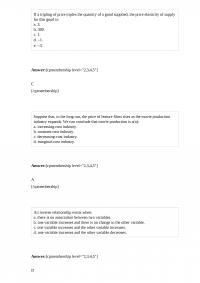
If a tripling of price triples the quantity of a good supplied, the price elasticity of supply for this good is: a. 3. b. 300. c. 1. d. 1. e. 3. Suppose that, in the long run, the price of […]
BUS 801 Midterm 2
A horizontal merger is one in which the merging firms: a. are about the same size. b. produce the same good in the same industry. c. will control greater than 50 percent of the market. d. have never directly competed […]
BUS 858 Quiz
An increase in the equilibrium price of Japanese yen per dollar could be caused by a(n): a. increase in the general level of prices in Japan. b. increase in the U.S. demand for domestically-built automobiles. c. decrease in the U.S. […]
ECB 100
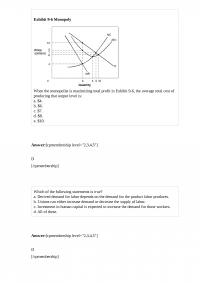
Exhibit 9-6 Monopoly When the monopolist is maximizing total profit in Exhibit 9-6, the average total cost of producing that output level is: a. $4. b. $6. c. $7. d. $8. e. $10. Which of the following statements is true? […]
ECB 210 Midterm 1
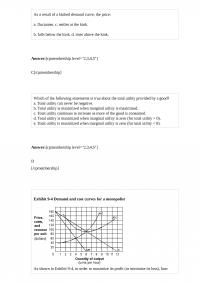
As a result of a kinked demand curve, the price: a. fluctuates. c. settles at the kink. b. falls below the kink. d. rises above the kink. Which of the following statements is true about the total utility provided by […]
ECB 277 Test
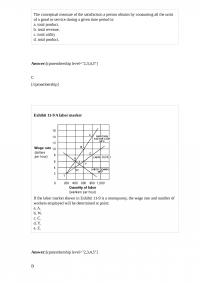
The conceptual measure of the satisfaction a person obtains by consuming all the units of a good or service during a given time period is: a. total product. b. total revenue. c. total utility d. total product. Exhibit 11-9 A […]
ECB 321 Quiz 3
Noise pollution is a serious problem. One major contributor is the recent development of very powerful amplification equipment for automobile radios. Many people complain that the windows in their home vibrate when some cars drive by. Others complain that loud […]
ECB 363 Homework
An example of price discrimination is the price charged for: a. troll dolls. b. college admission. c. textbooks. d. diamonds. Statistics on families below the poverty line may be overstated because: a. the poor are primarily children who soon will […]
ECB 370
When a perfectly competitive firm or a monopolistically competitive firm is making zero economic profit, a. no firms will want to enter or exit. b. some firms will want to leave. c. some firms will want to enter. d. market […]
ECB 406 Midterm
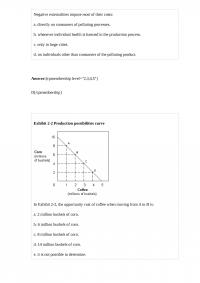
Negative externalities impose most of their costs: a. directly on consumers of polluting processes. b. whenever individual health is harmed in the production process. c. only in large cities. d. on individuals other than consumers of the polluting product. Exhibit […]
ECB 429
Marginal utility is best computed as the ratio of: a. total utility to change in quantity consumed. b. the change in total utility to total quantity consumed. c. total quantity consumed to total utility. d. the change in total utility […]
ECB 513 Test 1
If we observe a decrease in the price of a good and a decrease in the amount of the good bought and sold, this could be explained by a(an): a. increase in the supply of the good. c. decrease in […]
ECB 519 Midterm Exhibit 104
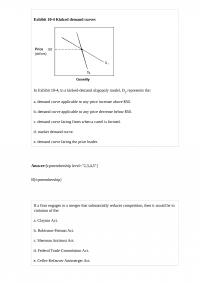
Exhibit 10-4 Kinked demand curves In Exhibit 10-4, in a kinked-demand oligopoly model, D2 represents the: a. demand curve applicable to any price increase above $50. b. demand curve applicable to any price decrease below $50. c. demand curve facing […]
ECB 547 Quiz 2
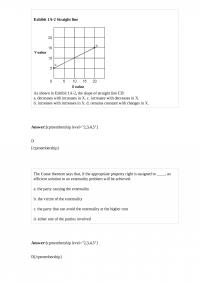
Exhibit 1A-2 Straight line As shown in Exhibit 1A-2, the slope of straight line CD: a. decreases with increases in X. c. increases with decreases in X. b. increases with increases in X. d. remains constant with changes in X. […]
ECB 549 Test
Suppose a monopolist and a perfectly competitive firm have the same cost curves. The monopolistic firm would: a. charge a lower price than the perfectly competitive firm. b. charge a higher price than the perfectly competitive firm. c. charge the […]
ECB 577 Test
For which of the following medical goods or services is the income elasticity of demand largest? a. Emergency services after a car accident. b. Measles shots. c. Physical examinations for life insurance applications. d. Medical tests to diagnose specific symptoms. […]
ECB 638 Midterm
If a good has a price elasticity of demand coefficient less than one, then: a. this good has an elastic demand. b. this good has an inelastic demand. c. a 10 percent increase in the price will result in a […]
ECB 668
If you were told that the exchange rate between the U.S. dollar and the Canadian dollar was 1.2, that would mean that Canadians would have to spend ____ to buy a $12 watch in New York City. a. c and […]
ECB 706 Midterm
The largest in-kind transfer program is: a. Transitory Assistance to Needy Families. b. Medicaid. c. Social Security. d. Food stamps. Exhibit 2-15 Production possibilities curve In Exhibit 2-15, the economy will experience the most future economic growth if it chooses […]
ECB 721
The cross price elasticities among substitute goods will be extremely high when: a. b and d. b. they are very similar to each other. c. people are consuming them frequently. d. people consume them in equal quantities. e. they are […]
ECB 734 Test 1
Suppose the president of a college argues that a 25 percent tuition increase will raise revenues for the college. It can be concluded that the president thinks that demand to attend this college is: a. elastic. c. unitary elastic. b. […]
ECB 800
When oligopolists take into account their competitors’ behavior, this situation is called: a. mutual interdependence. b. monopolistic competition. c. independent. d. price discrimination. e. loss minimization. A model (or theory): a. is a general statement about the causal relationship between […]
ECB 861 Midterm 1
The more elastic the supply of a product, the more the actual burden of a tax on the product will: a. fall on sellers. b. fall on buyers. c. fall equally on both buyers and sellers. d. create a smaller […]
ECB 870
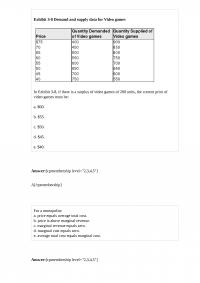
Exhibit 3-8 Demand and supply data for Video games In Exhibit 3-8, if there is a surplus of video games of 200 units, the current price of video games must be: a. $60. b. $55. c. $50. d. $45. e. […]
ECB 878 Test 1
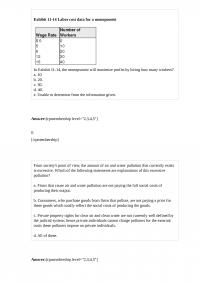
Exhibit 11-14 Labor cost data for a monopsonist In Exhibit 11-14, the monopsonist will maximize profits by hiring how many workers? a. 10. b. 20. c. 30. d. 40. e. Unable to determine from the information given. From society’s point […]
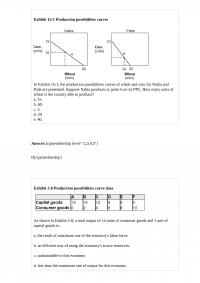
ECB 881 Exhibit 151 Production
Exhibit 15-1 Production possibilities curves In Exhibit 15-1, the production possibilities curves of wheat and corn for Nabia and Pada are presented. Suppose Nabia produces at point A on its PPC. How many units of wheat is the country able […]
ECB 885 Quiz
Some people believe that employees should be paid the same wages when their jobs, although different, require similar levels of education, training, experience, and responsibility. This principle is known as: a. the equal-pay-for-equal work doctrine. b. Lorenz equivalence. c. marginal […]
ECON 107 Midterm 1
A production possibility graph slopes down because of: a. the law of increasing costs. b. nonhomogeneous resources. c. inefficiency. d. improper output mix. e. unemployment. Bobby’s neighbor is growing a tree that is blocking Bobby’s ocean view. Bobby is considering […]
ECON 117 Quiz
If a 1 percent decrease in the price of product A brings about a 3 percent increase in the sales of product B, then: a. products A and B are complementary. b. the cross elasticity of demand between these two […]
ECON 133 Quiz 2
The number of cases of Coca-Cola bought increased by 50 percent when the price of pretzels declined by 10 percent. Assuming other factors are held constant, Coca-Cola and pretzels are classified as: a. complements. c. substitutes. b. unrelated goods. d. […]
ECON 221 Midterm
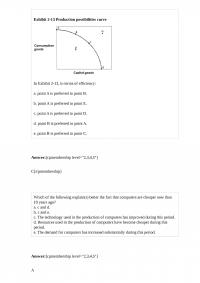
Exhibit 2-13 Production possibilities curve In Exhibit 2-13, in terms of efficiency: a. point A is preferred to point B. b. point A is preferred to point E. c. point A is preferred to point D. d. point B is […]
ECON 253 Quiz 3
Which of the following would be illegal under the Robinson-Patman Act? a. Ford and General Motors meet to fix the price of cars. b. Computer makers form a cartel. c. General Mills and Kelloggs decide to merge. d. Exxon sells […]
ECON 300 Quiz 3
A normal good is a good for which demand increases as: a. the income of consumers increases. b. its own price increases. c. the price of close substitutes decreases. d. the total number of consumers increases. e. a reflection of […]
ECON 336
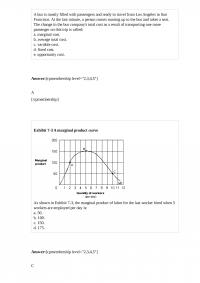
A bus is mostly filled with passengers and ready to travel from Los Angeles to San Francisco. At the last minute, a person comes running up to the bus and takes a seat. The change in the bus company’s total […]
ECON 504 Midterm
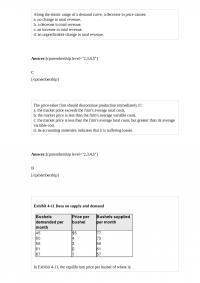
Along the elastic range of a demand curve, a decrease in price causes: a. no change in total revenue. b. a decrease in total revenue. c. an increase in total revenue. d. an unpredictable change in total revenue. The price-taker […]
ECON 521 Quiz 3
The Sherman Antitrust Act of 1890 is the federal antitrust law that prohibits: a. monopolization and conspiracies to restrain trade. b. mergers the substantially lessen competition. c. exclusive dealing, tying contracts, and interlocking directorates. d. unfair methods of competition in […]
ECON 523 Midterm 1
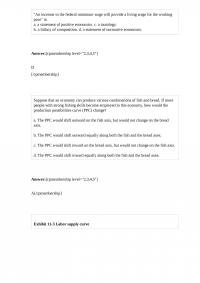
“An increase in the federal minimum wage will provide a living wage for the working poor” is: a. a statement of positive economics. c. a tautology. b. a fallacy of composition. d. a statement of normative economics. Suppose that an […]
ECON 536 Quiz 1
If the first four units of a good consumed have marginal utilities of 8, 4, 2, and 1, respectively, this trend is an indication of the: a. law of consumer equilibrium. b. law of diminishing marginal utility. c. law of […]
ECON 549 Test
Sam quits his job as an airline pilot and opens his own pilot training school. He was earning $40,000 as a pilot. He withdraws $10,000 from his savings where he was earning 6 percent interest and uses the money in […]
ECON 566 Quiz
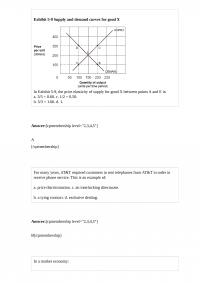
Exhibit 5-9 Supply and demand curves for good X In Exhibit 5-9, the price elasticity of supply for good X between points A and E is: a. 3/5 = 0.60. c. 1/2 = 0.50. b. 5/3 = 1.66. d. 1. […]
ECON 608 Midterm
Consumer surplus is the: a. amount by which the quantity supplied of a good exceeds the quantity demanded of a good. b. measure of consumes’ willingness to buy a good plus the price of the good. c. measure of how […]
ECON 617
Which of the following is most likely to help the residents of a nation produce more goods and services and achieve higher income levels? a. Higher tax rates. b. A higher rate of investment. c. A smaller trade sector. d. […]
ECON 652 Midterm 2
Absolute advantage is the ability of a country to produce a good with ________ than another country. a. a lower opportunity cost b. a higher opportunity cost c. fewer resources d. more resources A consumer buys only food and clothing. […]
ECON 672 Quiz 3
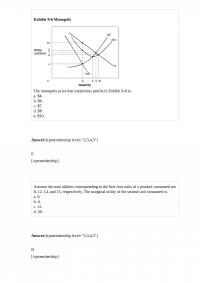
Exhibit 9-6 Monopoly The monopoly price that maximizes profits in Exhibit 9-6 is: a. $4. b. $6. c. $7. d. $8. e. $10. Assume the total utilities corresponding to the first four units of a product consumed are 8, 12, […]
ECON 684 Quiz 3
What country is our largest trading partner, as measured by exports and imports? a. Japan. d. Canada. b. The United Kingdom. e. Mexico. c. China. In Europe during the 14th century, the Black Plague killed 24 million people or close […]
ECON 729
A U.S. citizen’s gift for famine relief in Somalia would be considered a: a. capital inflow. c. current account transaction. b. capital outflow. d. service trade transaction. A monopoly is: a. a seller of a highly advertised and differentiated product […]
ECON A 117
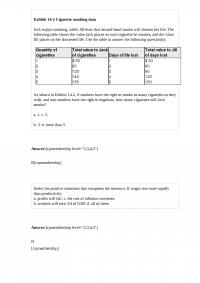
Exhibit 14-2 Cigarette smoking data Jack enjoys smoking, while Jill fears that second-hand smoke will shorten her life. The following table shows the value Jack places on each cigarette he smokes, and the value Jill places on her shortened life. […]
ECON A 147
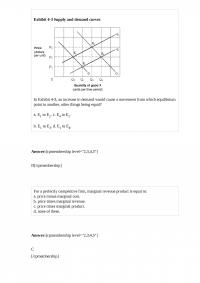
Exhibit 4-3 Supply and demand curves In Exhibit 4-3, an increase in demand would cause a movement from which equilibrium point to another, other things being equal? a. E1 to E2. c. E4 to E1. b. E1 to E3. d. […]
ECON A 166 Quiz
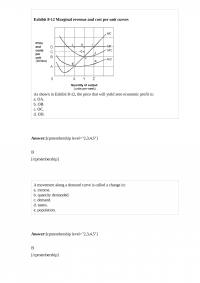
Exhibit 8-12 Marginal revenue and cost per unit curves As shown in Exhibit 8-12, the price that will yield zero economic profit is: a. OA. b. OB. c. OC. d. OD. A movement along a demand curve is called a […]
ECON A 175 Test 1
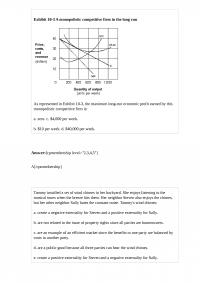
Exhibit 10-3 A monopolistic competitive firm in the long run As represented in Exhibit 10-3, the maximum long-run economic profit earned by this monopolistic competitive firm is: a. zero. c. $4,000 per week. b. $10 per week. d. $40,000 per […]
ECON A 257 Quiz 3
When economists say the quantity supplied of a product has decreased, they mean the: a. supply curve has shifted to the left. b. supply curve has shifted to the right. c. price of the product has risen, and consequently, suppliers […]
ECON A 271 Quiz 2
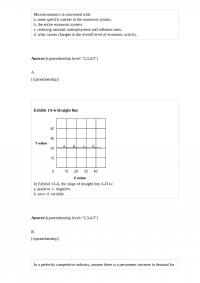
Microeconomics is concerned with: a. some specific market in the economic system. b. the entire economic system. c. reducing national unemployment and inflation rates. d. what causes changes in the overall level of economic activity. Exhibit 1A-6 Straight line In […]
ECON A 277 Midterm 1
Consumer equilibrium occurs at: a. any point of intersection between the budget line and an indifference curve. b. a point of tangency between the budget line and an indifference curve. c. the point where the slope of the indifference curve […]
ECON A 282 Test
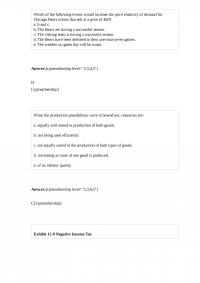
Which of the following events would increase the price elasticity of demand for Chicago Bears tickets that sell at a price of $20? a. b and c. b. The Bears are having a successful season. c. The visiting team is […]
ECON A 350 Midterm 1
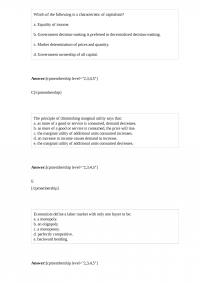
Which of the following is a characteristic of capitalism? a. Equality of income. b. Government decision-making is preferred to decentralized decision-making. c. Market determination of prices and quantity. d. Government ownership of all capital. The principle of diminishing marginal utility […]
ECON A 367 Test 1
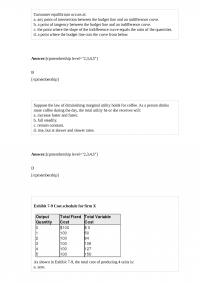
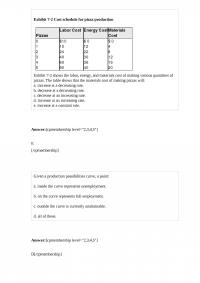
Exhibit 7-2 Cost schedule for pizza production Exhibit 7-2 shows the labor, energy, and materials cost of making various quantities of pizzas. The table shows that the materials cost of making pizzas will: a. increase at a decreasing rate. b. […]
ECON A 372 Final
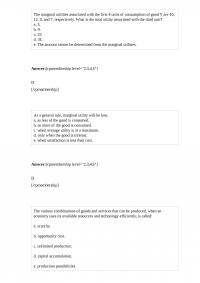
The marginal utilities associated with the first 4 units of consumption of good Y are 10, 12, 9, and 7, respectively. What is the total utility associated with the third unit? a. 3. b. 9. c. 25. d. 31. e. […]
ECON A 426 Homework
Which of the following is true about the production possibilities curve when a technological progress occurs? The curve: a. shifts inwards to the left. b. becomes flatter at one end and steeper at the other end. c. becomes steeper. d. […]
ECON A 431 Midterm
GDP per capita is a relatively good measurement of: a. the distribution of income. c. household production. b. purchasing power. d. the standard of living. Currently, union membership in the United States is about: a. 10 percent. b. 15 percent. […]
ECON A 475
Comparable worth is the principle that: a. goods and services priced the same have about the same worth. b. the wage rate equals the value of productivity. c. men and women should be paid comparably. d. employees who perform comparable […]
ECON A 564 Midterm 1
In the long run, price elasticities of demand are usually ____. a. less than they are in the short run because people can adjust b. the same as they are in the short run because tastes don’t change c. greater […]
ECON A 610 Test 2
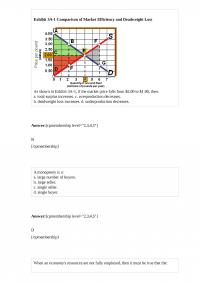
Exhibit 3A-1 Comparison of Market Efficiency and Deadweight Loss As shown in Exhibit 3A-1, if the market price falls from $2.00 to $1.00, then: a. total surplus increases. c. overproduction decreases. b. deadweight loss increases. d. underproduction decreases. A monopsony […]
ECON A 611 Midterm
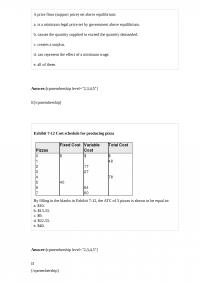
A price floor (support price) set above equilibrium: a. is a minimum legal price set by government above equilibrium. b. causes the quantity supplied to exceed the quantity demanded. c. creates a surplus. d. can represent the effect of a […]
ECON A 619 Quiz 2
Which of the following might increase the supply curve of labor? a. Elimination of discrimination against blacks. b. Elimination of discrimination against females. c. Easing licensing requirements. d. All of these. Which of the following is an explicit cost? a. […]
ECON A 667 Homework
The environmental approach found in the Clean Air Act of 1990 is: a. marketable pollution permits. c. command-and-control regulation. b. price caps. d. a thousand points of light. The costs of an economic activity borne by the producers are: a. […]
ECON A 749
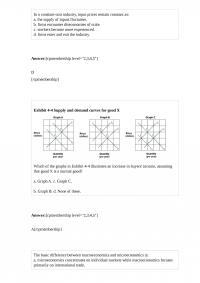
In a constant-cost industry, input prices remain constant as: a. the supply of inputs fluctuates. b. firms encounter diseconomies of scale. c. workers become more experienced. d. firms enter and exit the industry. Exhibit 4-4 Supply and demand curves for […]
ECON A 754 Final
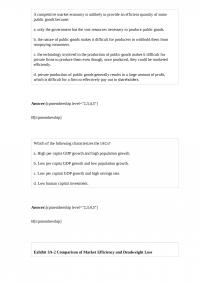
A competitive market economy is unlikely to provide an efficient quantity of some public goods because: a. only the government has the vast resources necessary to produce public goods. b. the nature of public goods makes it difficult for producers […]
ECON A 780 Midterm 2
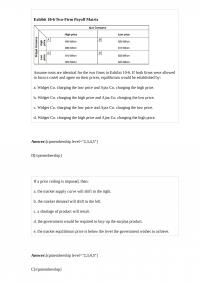
Exhibit 10-6 Two-Firm Payoff Matrix Assume costs are identical for the two firms in Exhibit 10-6. If both firms were allowed to form a cartel and agree on their prices, equilibrium would be established by: a. Widget Co. charging the […]
ECON A 806 Final
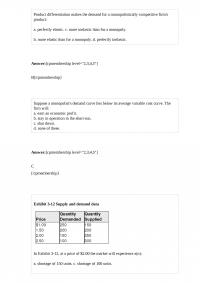
Product differentiation makes the demand for a monopolistically competitive firm’s product: a. perfectly elastic. c. more inelastic than for a monopoly. b. more elastic than for a monopoly. d. perfectly inelastic. Suppose a monopolist’s demand curve lies below its average […]
ECON A 841
According to the law of supply: a. more of a good is desired by consumers as the price falls. b. less of a good is desired by consumers as the price rises. c. more of a good will be offered […]
ECON A 880 Quiz 2
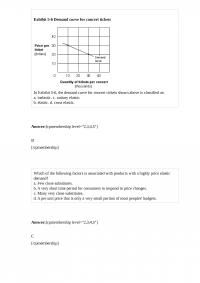
Exhibit 5-6 Demand curve for concert tickets In Exhibit 5-6, the demand curve for concert tickets shown above is classified as: a. inelastic. c. unitary elastic. b. elastic. d. cross elastic. Which of the following factors is associated with products […]
ECON E 218 Midterm 2
A monopolist will operate in the short run if which of the following is above average variable cost? a. Marginal cost. b. Marginal revenue. c. Price. d. All of these. There are apartments in Chicago whose rooftops overlook Wrigley Field. […]
ECON E 231 Midterm
If an economy’s population grows at 3 percent and real GDP grows at 3 percent, then: a. per capita real GDP is declining. b. the economy’s standard of living is increasing. c. per capita real GDP is negative. d. per […]
ECON E 262 Quiz 2
Eric is maximizing his total utility through his choices of two goods: clothes and food. His marginal utility of clothes is 60 and his marginal utility of food is 12. The price of clothes is $20. What must be the […]
ECON E 309 Homework
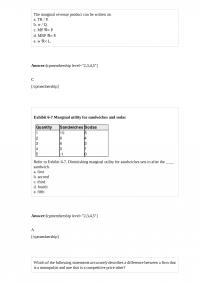
The marginal revenue product can be written as: a. TR / P. b. w / Q. c. MP P. d. MRP P. e. w L. Exhibit 6-7 Marginal utility for sandwiches and sodas Refer to Exhibit 6-7. […]
ECON E 318
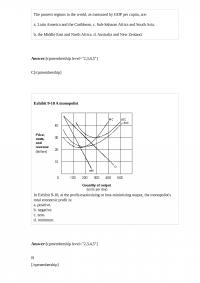
The poorest regions in the world, as measured by GDP per capita, are: a. Latin America and the Caribbean. c. Sub-Saharan Africa and South Asia. b. the Middle East and North Africa. d. Australia and New Zealand. Exhibit 9-10 A […]
ECON E 407 Quiz 2
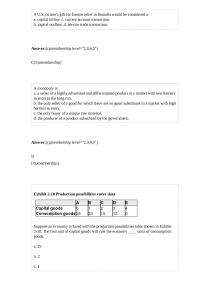
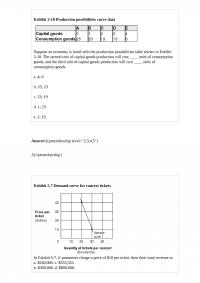
Exhibit 2-10 Production possibilities curve data Suppose an economy is faced with the production possibilities table shown in Exhibit 2-10. The second unit of capital goods production will cost ____ units of consumption goods, and the third unit of capital […]
ECON E 444 Quiz 2
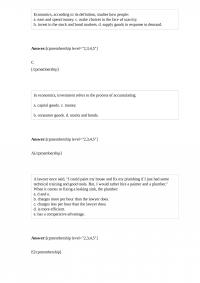
Economics, according to its definition, studies how people: a. earn and spend money. c. make choices in the face of scarcity. b. invest in the stock and bond markets. d. supply goods in response to demand. In economics, investment refers […]
ECON E 453 Quiz An economist at
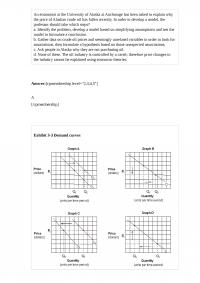
An economist at the University of Alaska at Anchorage has been asked to explain why the price of Alaskan crude oil has fallen recently. In order to develop a model, the professor should take which steps? a. Identify the problem, […]
ECON E 481 Quiz 2
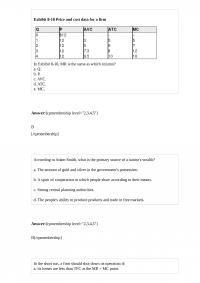
Exhibit 8-10 Price and cost data for a firm In Exhibit 8-10, MR is the same as which column? a. Q. b. P. c. AVC. d. ATC. e. MC. According to Adam Smith, what is the primary source of a […]
ECON E 634 Homework
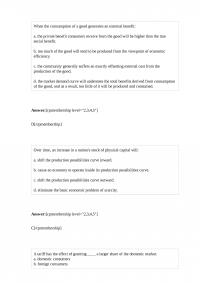
When the consumption of a good generates an external benefit: a. the private benefit consumers receive from the good will be higher than the true social benefit. b. too much of the good will tend to be produced from the […]
ECON E 680 Quiz 3
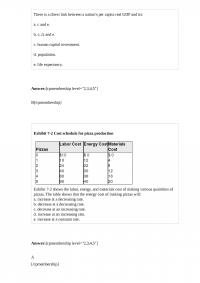
There is a direct link between a nation’s per capita real GDP and its: a. c and e. b. c, d, and e. c. human capital investment. d. population. e. life expectancy. Exhibit 7-2 Cost schedule for pizza production Exhibit […]
ECON E 687 Test
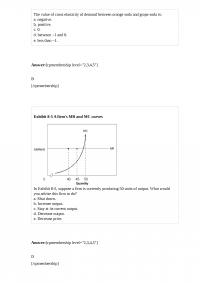
The value of cross elasticity of demand between orange soda and grape soda is: a. negative. b. positive. c. 0. d. between 1 and 0. e. less than 1. Exhibit 8-5 A firm’s MR and MC curves In Exhibit 8-5, […]
ECON E 726 Midterm 2
If the price of a textbook rises and then students purchase fewer textbooks, an economic model can show a cause-and-effect relationship only if which of the following conditions holds: a. students’ incomes fall. b. tuition decreases. c. the number of […]
ECON E 763 Quiz 1
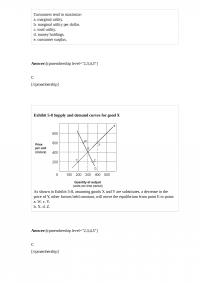
Consumers tend to maximize: a. marginal utility. b. marginal utility per dollar. c. total utility. d. money holdings. e. consumer surplus. Exhibit 5-8 Supply and demand curves for good X As shown in Exhibit 5-8, assuming goods X and Y […]
ECON E 804 Test 2
While waiting in line to buy a cheeseburger for $2 and a drink for 75 cents, Aaron notices that the restaurant has a value meal containing a cheeseburger, drink, and French fries for $3. For Aaron, the marginal cost of […]
ECON E 843 Test
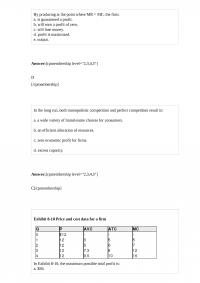
By producing at the point where MR = MC, the firm: a. is guaranteed a profit. b. will earn a profit of zero. c. will lose money. d. profit is maximized. e. output. In the long run, both monopolistic competition […]
Economics 112 Quiz 2
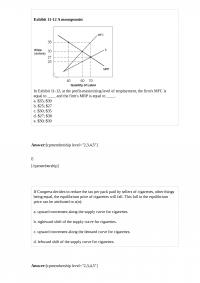
Exhibit 11-12 A monopsonist In Exhibit 11-12, at the profit-maximizing level of employment, the firm’s MFC is equal to ____ and the firm’s MRP is equal to ____. a. $35; $30 b. $25; $27 c. $30; $35 d. $27; $30 […]
Economics 137 Quiz
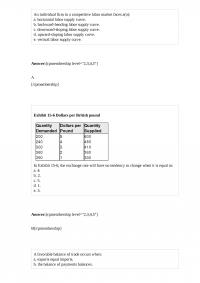
An individual firm in a competitive labor market faces a(n): a. horizontal labor supply curve. b. backward-bending labor supply curve. c. downward-sloping labor supply curve. d. upward-sloping labor supply curve. e. vertical labor supply curve. Exhibit 15-6 Dollars per British […]
Economics 161 Quiz 2
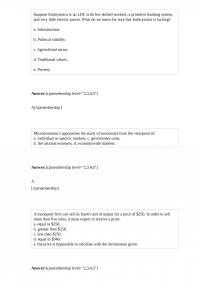
Suppose Embryonica is an LDC with few skilled workers, a primitive banking system, and very little electric power. What do we know for sure that Embryonica is lacking? a. Infrastructure. b. Political stability. c. Agricultural sector. d. Traditional values. e. […]
Economics 217 Midterm
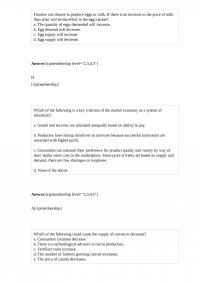
Farmers can choose to produce eggs or milk. If there is an increase in the price of milk then what will be the effect in the egg market? a. The quantity of eggs demanded will increase. b. Egg demand will […]
Economics 386 Quiz 2
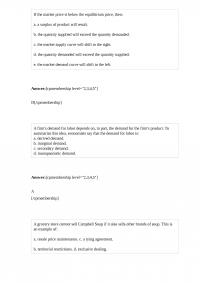
If the market price is below the equilibrium price, then: a. a surplus of product will result. b. the quantity supplied will exceed the quantity demanded. c. the market supply curve will shift to the right. d. the quantity demanded […]
Economics 411 Midterm 1
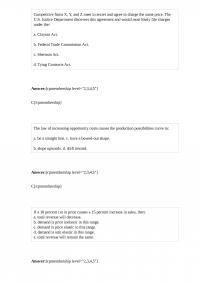
Competitive firms X, Y, and Z meet in secret and agree to charge the same price. The U.S. Justice Department discovers this agreement and would most likely file charges under the: a. Clayton Act. b. Federal Trade Commission Act. c. […]
Economics 421
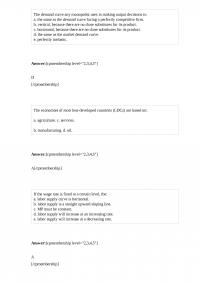
The demand curve any monopolist uses in making output decisions is: a. the same as the demand curve facing a perfectly competitive firm. b. vertical, because there are no close substitutes for its product. c. horizontal, because there are no […]
Economics 422 Midterm 1
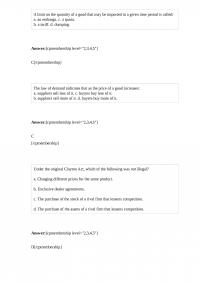
A limit on the quantity of a good that may be imported in a given time period is called: a. an embargo. c. a quota. b. a tariff. d. dumping. The law of demand indicates that as the price of […]
Economics 432 Midterm 1
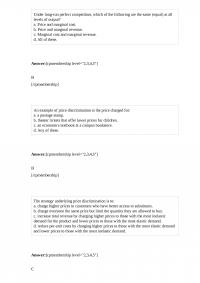
Under long-run perfect competition, which of the following are the same (equal) at all levels of output? a. Price and marginal cost. b. Price and marginal revenue. c. Marginal cost and marginal revenue. d. All of these. An example of […]
Economics 509 Quiz 2
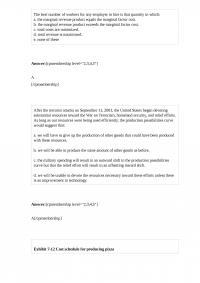
The best number of workers for any employer to hire is that quantity in which: a. the marginal revenue product equals the marginal factor cost. b. the marginal revenue product exceeds the marginal factor cost. c. total costs are minimized. […]
Economics 544
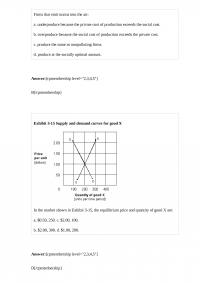
Firms that emit toxins into the air: a. underproduce because the private cost of production exceeds the social cost. b. overproduce because the social cost of production exceeds the private cost. c. produce the same as nonpolluting firms. d. produce […]
Economics 633
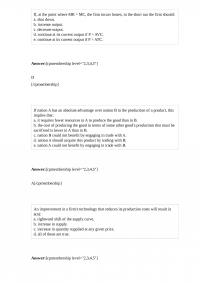
If, at the point where MR = MC, the firm incurs losses, in the short run the firm should: a. shut down. b. increase output. c. decrease output. d. continue at its current output if P > AVC. e. continue […]
Economics 683 Test
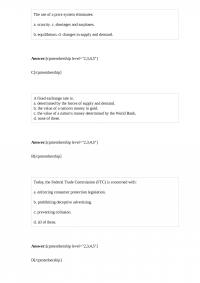
The use of a price system eliminates: a. scarcity. c. shortages and surpluses. b. equilibrium. d. changes in supply and demand. A fixed exchange rate is: a. determined by the forces of supply and demand. b. the value of a […]
Economics 717 Quiz 1
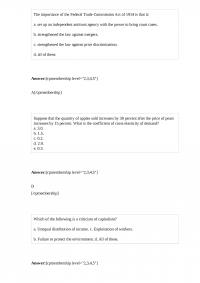
The importance of the Federal Trade Commission Act of 1914 is that it: a. set up an independent antitrust agency with the power to bring court cases. b. strengthened the law against mergers. c. strengthened the law against price discrimination. […]
Economics 750 Quiz 2
For a monopolist with a downward-sloping demand curve, a. the coefficient of price elasticity of demand is infinite. b. the coefficient of price elasticity of demand is zero. c. as price increases, marginal revenue decreases. d. as price decreases, marginal […]
Economics 760
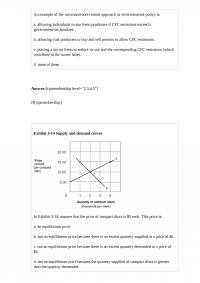
An example of the command-and-control approach to environmental policy is: a. allowing individuals to sue freon producers if CFC emissions exceed a government-set standard. b. allowing coal producers to buy and sell permits to allow CFC emissions. c. placing a […]
Economics 811 Test
Which of the following is not true about a production possibilities curve? The curve: a. indicates the combinations of goods and services that can be produced with given technology. b. indicates the efficient production points. c. indicates the non-efficient production […]
Economics 835 Quiz
Suppose there are two countries, X and Y. If the exchange rate, as measured in X’s currency, is currently 9, what do citizens of the nation of Y see when they read their newspapers? a. The exchange rate for X’s […]
MicroEconomic 115 Homework
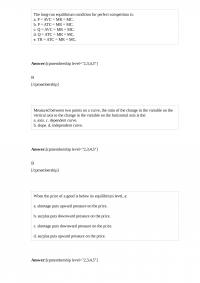
The long-run equilibrium condition for perfect competition is: a. P = AVC = MR = MC. b. P = ATC = MR = MC. c. Q = AVC = MR = MC. d. Q = ATC = MR = MC. […]
MicroEconomic 151 Test 1
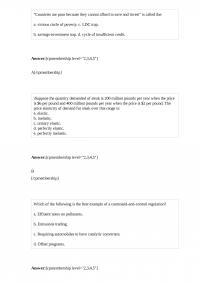
“Countries are poor because they cannot afford to save and invest” is called the: a. vicious circle of poverty. c. LDC trap. b. savings-investment trap. d. cycle of insufficient credit. \Suppose the quantity demanded of steak is 200 million pounds […]
MicroEconomic 155
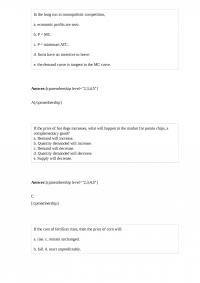
In the long run in monopolistic competition, a. economic profits are zero. b. P = MC. c. P = minimum ATC. d. firms have an incentive to leave. e. the demand curve is tangent to the MC curve. If the […]
MicroEconomic 204 Test 1
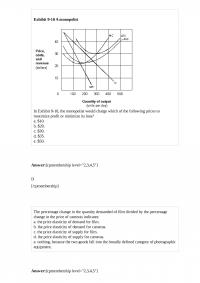
Exhibit 9-10 A monopolist In Exhibit 9-10, the monopolist would charge which of the following prices to maximize profit or minimize its loss? a. $10. b. $20. c. $30. d. $35. e. $50. The percentage change in the quantity demanded […]
MicroEconomic 210
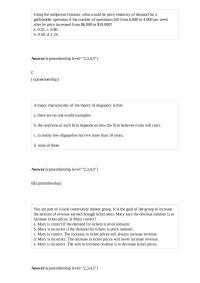
Using the midpoints formula, what would be price elasticity of demand for a gallbladder operation if the number of operations fell from 6,000 to 4,000 per week after its price increased from $6,000 to $10,000? a. 0.25. c. 0.80. b. […]
MicroEconomic 284 Midterm 2
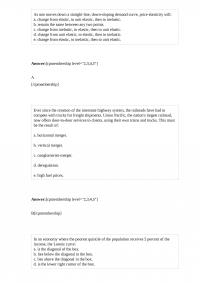
As one moves down a straight-line, down-sloping demand curve, price elasticity will: a. change from elastic, to unit elastic, then to inelastic. b. remain the same between any two points. c. change from inelastic, to elastic, then to unit elastic. […]
MicroEconomic 294 Economics is
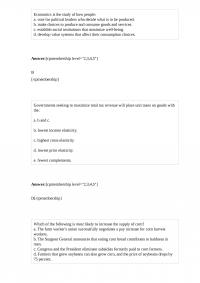
Economics is the study of how people: a. vote for political leaders who decide what is to be produced. b. make choices to produce and consume goods and services. c. establish social institutions that maximize well-being. d. develop value systems […]
MicroEconomic 372 Quiz
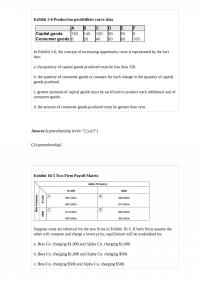
Exhibit 2-6 Production possibilities curve data In Exhibit 2-6, the concept of increasing opportunity costs is represented by the fact that: a. the quantity of capital goods produced must be less than 150. b. the quantity of consumer goods is […]
MicroEconomic 395 Quiz 1
Which of the following is often called the “Antimerger Act”? a. Clayton Act. b. Robinson-Patman Act. c. Sherman Antitrust Act. d. Federal Trade Commission Act. e. Celler-Kefauver Act. If we observe a decrease in the price of a good and […]
MicroEconomic 415 Test 1
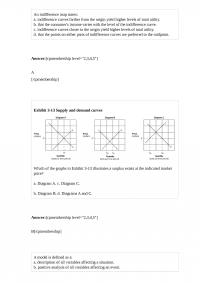
An indifference map states: a. indifference curves farther from the origin yield higher levels of total utility. b. that the consumer’s income varies with the level of the indifference curve. c. indifference curves closer to the origin yield higher levels […]
MicroEconomic 421 Quiz 2
Under both perfect competition and monopoly, a firm: a. is a price taker. b. maximizes profit by setting marginal cost equal to marginal revenue. c. will shut down in the short-run if price falls short of average total cost. d. […]
MicroEconomic 446 Midterm 1
In a two good, two-country world, a country has a comparative advantage in any good for which it has a: a. lower absolute cost than the other country. b. lower opportunity cost than the other country. c. higher absolute cost […]
MicroEconomic 473 Quiz 2
In long-run equilibrium, the typical perfectly competitive firm will: a. earn zero economic profit. b. change plant size in the long run. c. change output in the short run. d. do any of these. If the percentage change in the […]
MicroEconomic 575 Midterm 2
An example of a price ceiling would be: a. a ration coupon. b. a guarantee of a target price for farm products. c. parity pricing. d. rent control. e. the soil bank program. Externalities are unintended costs or benefits that […]
MicroEconomic 583 Quiz 2
Most of the world’s economies are mixed economies because _________. a. a cartel of powerful transnational firms demands it. b. the market system of allocation is always best. c. the command system of allocation is always best. d. government intervention […]
MicroEconomic 595 Test
The opportunity cost of an economic decision is: a. the best alternative that was sacrificed. b. the amount of money needed to implement the decision. c. any land, labor, and capital that are wasted. d. all options that were lost […]
MicroEconomic 625 Midterm 1
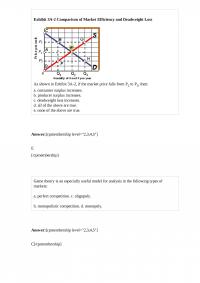
Exhibit 3A-2 Comparison of Market Efficiency and Deadweight Loss As shown in Exhibit 3A-2, if the market price falls from P2 to P3, then: a. consumer surplus increases. b. producer surplus increases. c. deadweight loss increases. d. all of the […]
MicroEconomic 637 Quiz 1
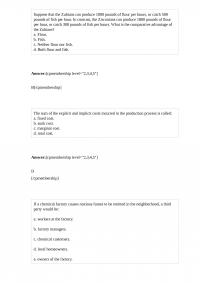
Suppose that the Zubians can produce 1000 pounds of flour per hours, or catch 500 pounds of fish per hour. In contrast, the Zirconians can produce 1800 pounds of flour per hour, or catch 300 pounds of fish per hours. […]
MicroEconomic 755 Homework
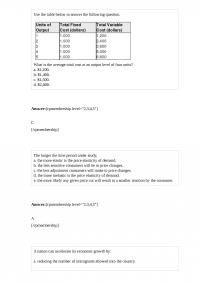
Use the table below to answer the following question. What is the average total cost at an output level of four units? a. $1,200. b. $1,400. c. $1,500. d. $2,000. The longer the time period under study, a. the more […]
MicroEconomic 800
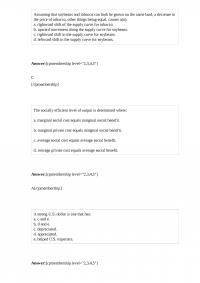
Assuming that soybeans and tobacco can both be grown on the same land, a decrease in the price of tobacco, other things being equal, causes a(n): a. rightward shift of the supply curve for tobacco. b. upward movement along the […]
MicroEconomic 867 Test
Alan Jones owns a company that sells life insurance. When he employs 10 salespersons his firm sells $200,000 worth of contracts per week, and when he employs 11 salespersons, total revenue is $210,000. The marginal revenue product of the 11th […]