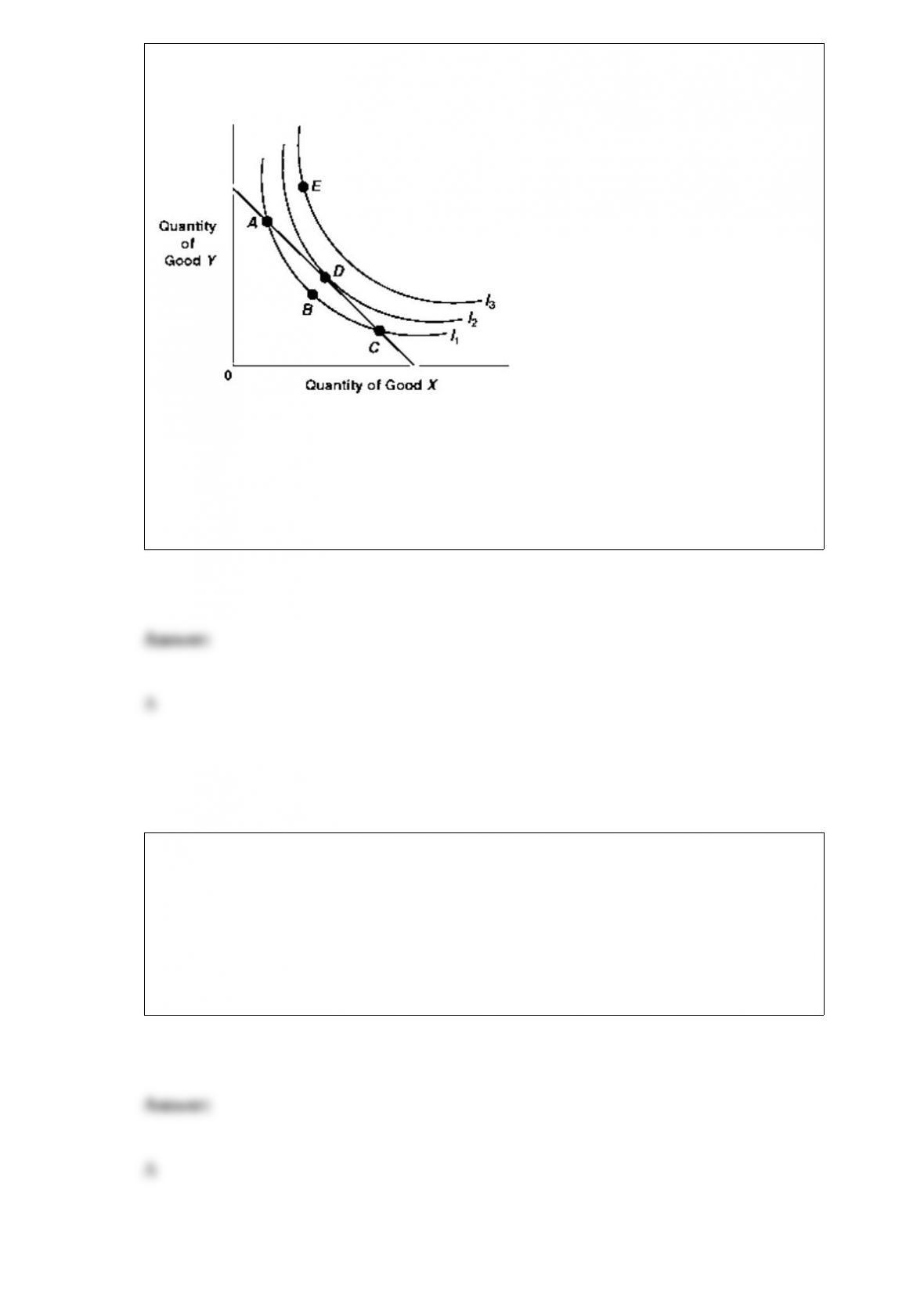
Exhibit 6A-3 Consumer equilibrium
Given the budget line and indifference curves shown in Exhibit 6A-3, assume the
consumer is initially at point A. To maximize total utility, the consumer should:
a. purchase more of good X and less of good Y.
b. remain at point C.
c. move to point B and then point C.
d. purchase more of good Y and less of good X.
If a 10 percent decrease in the price of product A brings about a 3 percent increase in
the sales of product B, then:
a. products A and B are complementary.
b. the cross elasticity of demand between these two products is positive.
c. products A and B are substitutes.
d. the demand for these products is inelastic.
e. the total revenue earned from product A will decrease.

Which of the following government programs provides recipients with unrestricted cash
payments?
a. Temporary Assistance to Needy Families (TANF).
b. Medicaid.
c. The food stamp program.
d. Housing assistance programs.
John paints the exterior of his house and, as a result, his neighbor Christine is able to
sell her home for $5,000 more than she could have before. John’s house painting:
a. creates a negative externality for Christine.
b. shows John is a free rider.
c. results in an efficient market outcome for both.
d. creates a positive externality for Christine.
e. was poorly done.
Which of the following can bring about a change in the quantity demanded?
a. Change in supply.
b. Change in quality.
c. Change in income.
d. Change in product price.
e. Change in taste.

A state of consumer equilibrium for two goods consumed exists when the:
a. marginal utility of all goods is the same for the last dollar spent on each good.
b. marginal utility per dollar’s worth of two goods is the same for the last dollar spent
on each good.
c. price of two goods is the same for the last dollar spent on each good.
d. marginal cost per dollar spent on two goods is the same.
Command-and-control legislation, as compared to incentive-based regulation:
a. encourages the use of comparative advantage in the short run, and the development
of new technology in the long run.
b. encourages the use of comparative advantage in the short run, but discourages the
development of new technology in the long run.
c. discourages the use of comparative advantage in the short run, but encourages the
development of new technology in the long run.
d. discourages the use of comparative advantage in the short run, and discourages the
development of new technology in the long run.

Demand price elasticity is measured by the:
a. percentage change in income / percentage change in price.
b. percentage change in quantity demanded / percentage change in income.
c. percentage change in price / percentage change in quantity demanded.
d. percentage change in quantity demanded / percent change in price.
e. percentage change in total revenue / percentage change in price.
The pig farm industry is perfectly competitive. Which of the following is true?
a. Since the industry is perfectly competitive, price and quantity are at the socially
efficient levels.
b. The competitive price is higher and quantity lower than the socially efficient point.
c. The competitive price is higher and quantity higher than the socially efficient point.
d. The competitive price is lower and quantity higher than the socially efficient point.
When economists look at the percentage change in quantity demanded generated by a
change in income, they are looking at:
a. price elasticity of demand.
b. income elasticity of demand.
c. price elasticity of supply.
d. cross elasticity of demand.
e. cross elasticity of supply.

A perfectly competitive firm’s short-run supply curve is the part of its marginal cost
curve that is:
a. upward sloping.
b. above the minimum level of average variable cost.
c. above average fixed cost.
d. both a and b.
An increase in demand for a nation’s currency in the foreign exchange market will:
a. cause the nation’s currency to appreciate.
b. make it more expensive for the nation to import goods.
c. cause the nation’s balance on current account to shift toward a surplus.
d. make it less expensive for foreigners to buy the nation’s goods.
Market structure is defined as the:
a. number of firms in each industry.
b. similarity of the product sold.
c. ease of entry into and exit from the market.

d. all of these.
An economic system is the organizations and methods used to determine:
a. what goods and services are produced.
b. how goods and services are produced.
c. for whom goods and services are produced.
d. all of these.
A good or service that is forgone by choosing one alternative over another is called
a(n):
a. explicit cost. c. historical cost.
b. opportunity cost. d. accounting cost.

Suppose a firm has total revenue of $200 million, explicit costs of $190 million, and
implicit costs of $20 million. This firm’s accounting profit is:
a. $80 million.
b. $70 million.
c. $10 million.
d. $10 million.
If the quantity demanded of milk is 55,000 and the quantity supplied of milk is 80,000,
then:
a. there is an excess supply of 25,000 units of milk.
b. the price of milk will tend to rise to clear the market.
c. consumers get the milk they want so market equilibrium exists.
d. there is an excess demand of 25,000 units of milk.
e. this is the intersection of market supply and demand curves.
The slope of a line parallel to the vertical axis is:
a. 1.
b. 0.
c. infinite.
d. undefined.
The statement “A tax cut would be the fairest way to stimulate the economy” is an
example of positive economic analysis.
What are the characteristics of monopolistic competition?
The law of diminishing marginal utility implies that the marginal utility of my tenth
pistachio nut is less than the marginal utility of my third pistachio nut, other things
constant.
Diseconomies of scale cause the short-run marginal cost curve to slope upwards.

Overconsumption of a product can be caused by imperfect information.
“Mere size is no offense” is an antitrust ruling based on the rule of reason.