The conceptual measure of the satisfaction a person obtains by consuming all the units
of a good or service during a given time period is:
a. total product.
b. total revenue.
c. total utility
d. total product.
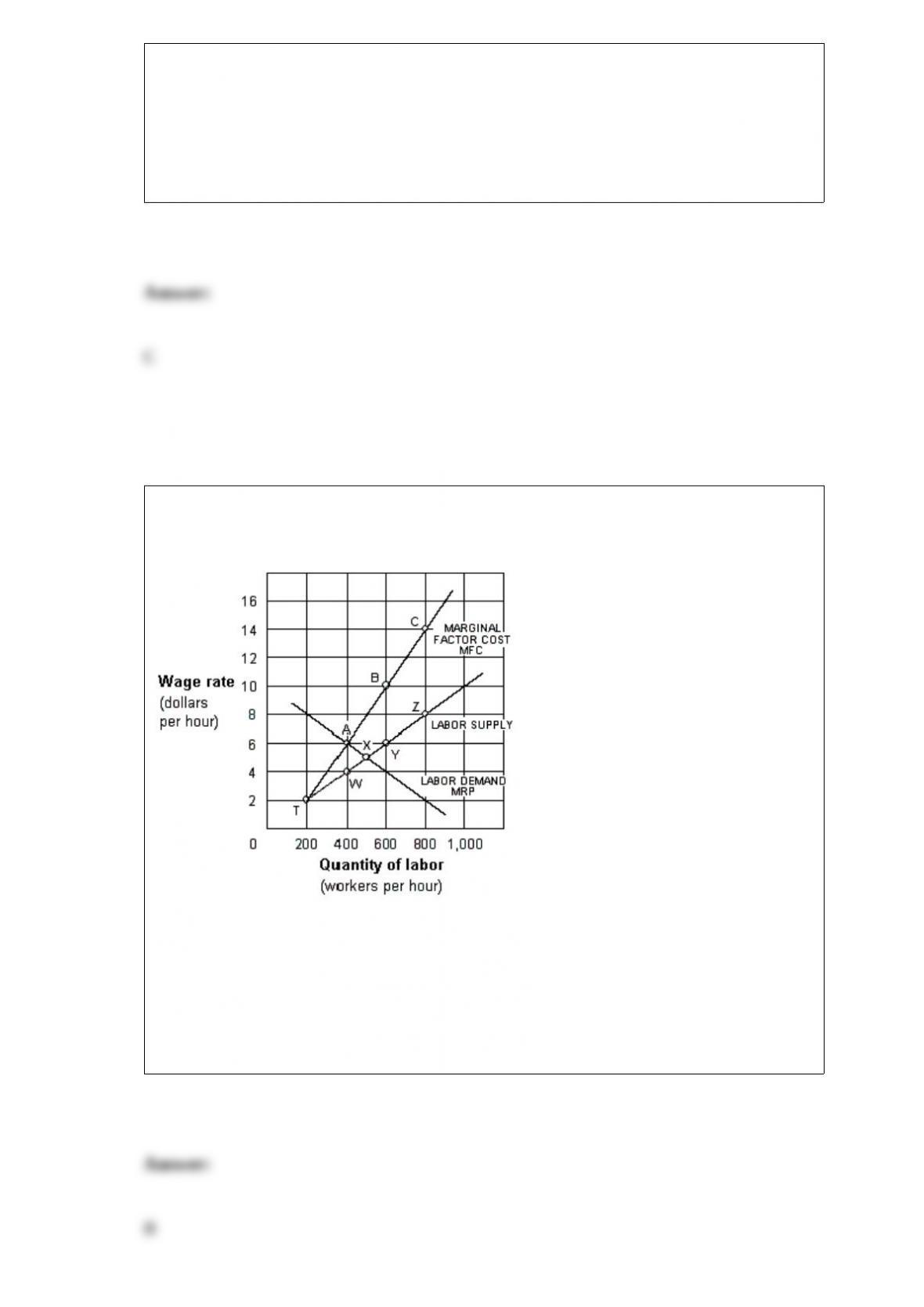
Exhibit 11-9 A labor market
If the labor market shown in Exhibit 11-9 is a monopsony, the wage rate and number of
workers employed will be determined at point:
a. A.
b. W.
c. C.
d. Y.
e. Z.

If a decrease in the price of movie tickets increases the total revenue of movie theaters,
this is evidence that demand is:
a. price elastic. c. unit elastic with respect to price.
b. price inelastic. d. perfectly inelastic.
When a 2 percent increase in price generates a greater than 2 percent decrease in
quantity demanded, then:
a. demand is price inelastic.
b. total revenue increases.
c. demand is positively sloped.
d. demand is unit elastic.
e. total revenue decreases.
Exhibit 1A-7 Straight line relationship
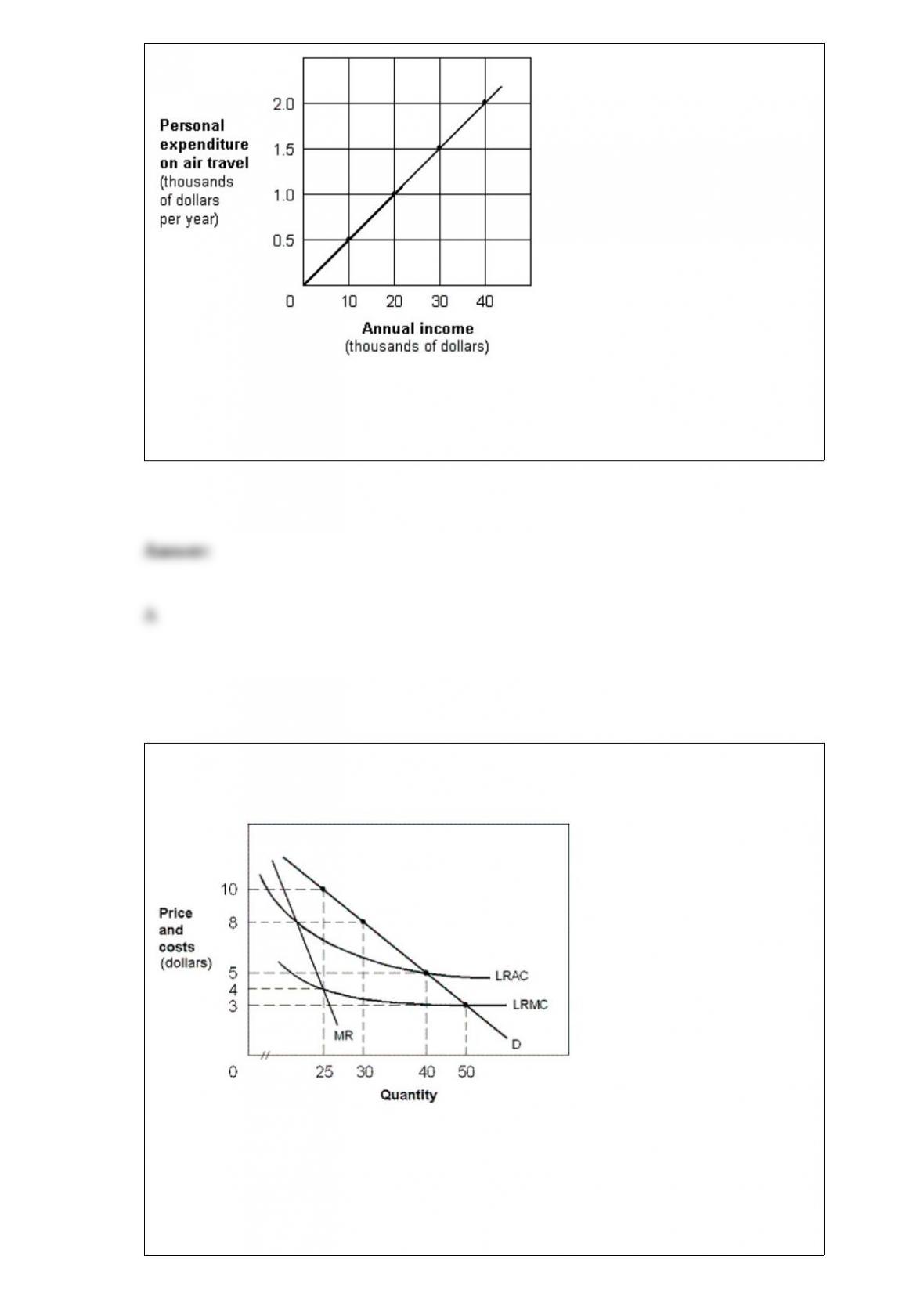
According to Exhibit 1A-7, the relationship between annual income and air-travel
expenditures is:
a. direct. c. complex.
b. inverse. d. independent.
Exhibit 13-3 A monopolist
In Exhibit 13-3, if this is an unregulated monopoly firm, the price and output which
would maximize profits are:
a. price = $8; output = 25.

b. price = $8; output = 30.
c. price = $5; output = 40.
d. price = $4; output = 25.
e. price = $10; output = 25.
Absolute advantage occurs when one nation can produce a good ____ its trading
partners.
a. in larger quantities than
b. faster than
c. that is desired by
d. more efficiently than
e. only consumed by
Which of the following distinguishes industrially advanced countries from
less-developed countries?
a. GDP per capita.
b. Educational attainment of the workforce.
c. Extent to which capital is technologically advanced.
d. All of the above.

Price ceilings set below the equilibrium create:
a. externalities. c. shortages.
b. unemployment. d. surpluses.
Which of the following factors of production is not variable in the long run?
a. the size of the firm’s plant.
b. property taxes on the assets of the firm.
c. highly trained labor.
d. All factors of production are variable in the long run.
Economic profit equals accounting profit minus:
a. explicit costs.
b. implicit costs.
c. fixed costs.
d. variable costs.
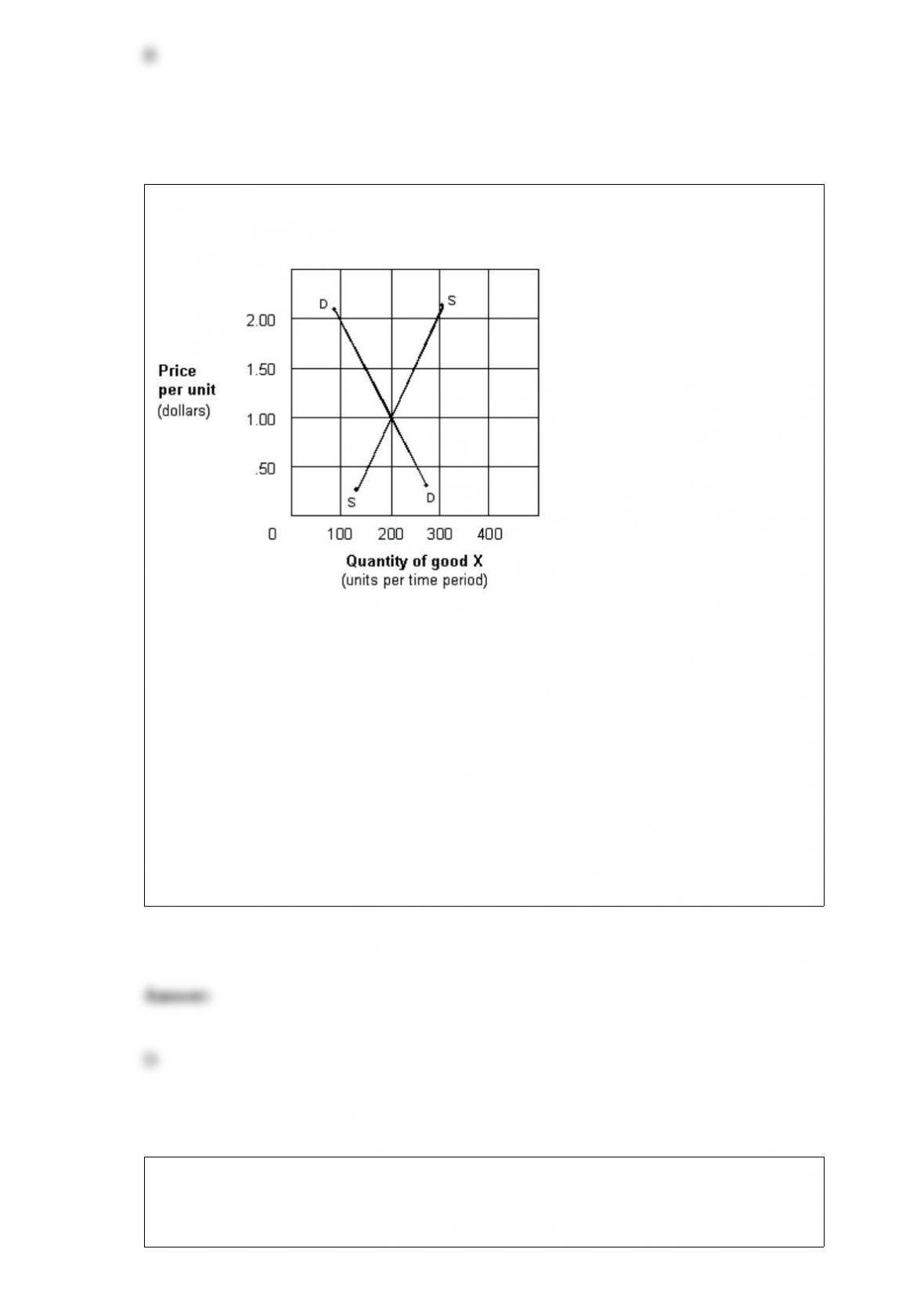
Exhibit 3-15 Supply and demand curves for good X
In Exhibit 3-15, if the market price of good X is initially $.50, a movement toward
equilibrium requires:
a. no change, because an equilibrium already exists.
b. the price to fall below $.50 and both the quantity supplied and the quantity demanded
to rise.
c. the price to remain the same, but the supply curve to shift to the left.
d. the price to rise above $.50, the quantity supplied to rise, and the quantity demanded
to fall.
When Brazil can generate a product using fewer labor hours and resources than the
United States, an economist would say that Brazil had:
a. a comparative advantage in production of the product.

b. an absolute advantage in production of the product.
c. a higher opportunity cost of producing the product.
d. no incentive to import the product, regardless of the cost-price conditions for other
products.
The perpetual state of insufficiency of resources to satisfy people’s unlimited wants is:
a. apparent only in poor countries.
b. completely unrealistic.
c. present in modern economies, but not in the past.
d. the definition of scarcity.
In international trade, an infant industry is one:
a. that protects firms that produce products for infants.
b. with a large number of very small firms.
c. in which the firms are experiencing very small profits.
d. in the early stages of its development.
If Japan gives up ten bushels of rice to produce one bicycle, while the United States

gives up five bushels of rice to produce one bicycle, then:
a. the opportunity cost of producing bicycles in the United States is higher than in
Japan.
b. Japan has a comparative advantage in the production of bicycles.
c. the United States has an absolute advantage in the production of rice.
d. total output will be highest if the United States specializes in rice and Japan
specializes in bicycles.
e. total output will be highest if Japan specializes in rice and the United States
specializes in bicycles.
On the production possibilities curve, a movement between points that yields a loss of
one good in order to raise the output of another good will maintain efficient production.
In the United States, families headed by single women have higher poverty rates than
families headed by single men or by married couples.
It’s difficult for a private firm to provide a public good because of free riders.

If economic profit is zero, then a normal profit is earned.
If a country finds that its Lorenz curve is moving further away from the diagonal, this
means its income is becoming more unevenly distributed over time.