
“An increase in the federal minimum wage will provide a living wage for the working
poor” is:
a. a statement of positive economics. c. a tautology.
b. a fallacy of composition. d. a statement of normative economics.
Suppose that an economy can produce various combinations of fish and bread. If more
people with strong fishing skills became employed in this economy, how would the
production possibilities curve (PPC) change?
a. The PPC would shift outward on the fish axis, but would not change on the bread
axis.
b. The PPC would shift outward equally along both the fish and the bread axes.
c. The PPC would shift inward on the bread axis, but would not change on the fish axis.
d. The PPC would shift inward equally along both the fish and the bread axes.
Exhibit 11-3 Labor supply curve
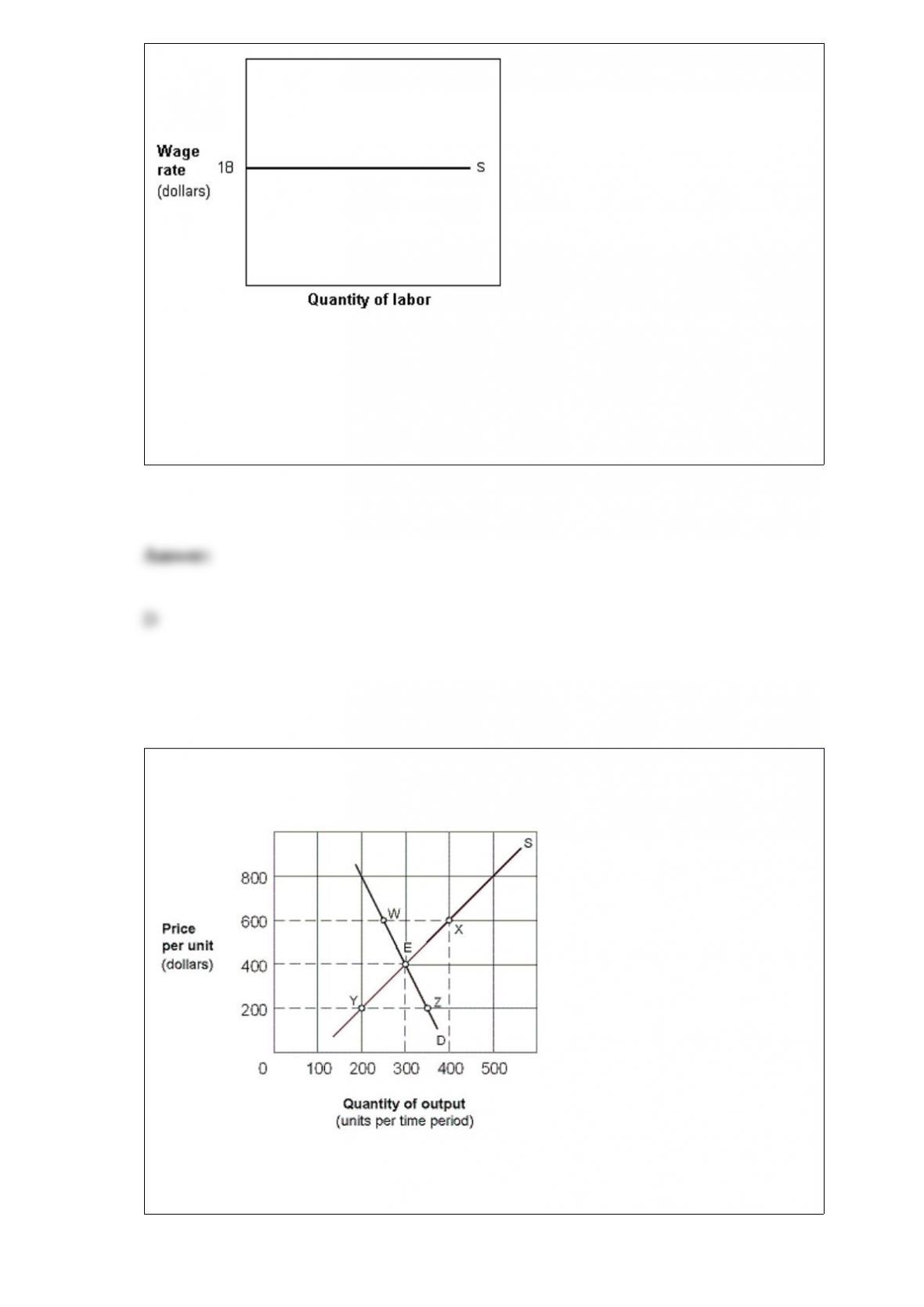
In Exhibit 11-3, the total wage cost of hiring 6 employees is:
a. $18 per hour.
b. $36 per hour.
c. $3 per hour.
d. $108 per hour.
e. $648 per hour.
Exhibit 5-8 Supply and demand curves for good X
In Exhibit 5-8, the price elasticity of supply for good X between points Y and E is:
a. 1/5 = 0.20. c. 3/5 = 0.60.
b. 5/3 = 1.66. d. 1.

Exhibit 8-19 Long-run perfectly competitive industry
As shown in Exhibit 8-19, assume that a perfectly competitive industry is in long-run
equilibrium at point A and the demand curve shifts from D1 to D2. Which of the
following is a part of the industry adjustment process?
a. The price will temporarily rise at point B.
b. New firms will enter the industry.
c. Firms will temporarily make positive economic profits.
d. All of these.
Profit is maximized when which of the following conditions occurs?
a. Total revenue equals total cost.
b. Average revenue equals average cost.
c. Marginal revenue equals marginal cost.
d. Both b. and c. above are correct.

Which of the following is most likely to be a fixed cost for a business?
a. expenditures on low-skill labor.
b. shipping charges for the delivery of products.
c. managerial salaries.
d. property taxes on the firm’s buildings.
In an oligopoly industry, price:
a. will be lower than the competitive price, due to cost savings.
b. will exceed the monopoly price, due to the destructiveness of competitive forces.
c. cannot be predicted exactly, because it is likely to lie between the competitive and
monopoly prices.
d. none of these.

Suppose a change in technology increases the marginal product of labor. The result is
a(n):
a. downward movement along the demand for labor curve.
b. rightward shift in the demand for labor curve.
c. leftward shift in the demand for labor curve.
d. upward movement along the demand for labor curve.
In the long run in a monopolistic competitive industry,
a. economic profits will be positive.
b. price will be driven to zero.
c. the firm will not operate where MR = MC.
d. economic profit will be zero.
e. price will exceed average cost.
In a perfectly competitive industry, assume the short-run average total cost increases as
the output of the industry expands. In the long run, the industry supply curve will:
a. first have a positive slope and then a negative slope.
b. have a negative slope.
c. be perfectly horizontal.
d. be perfectly vertical.
e. have a positive slope.

Suppose an oil company wants to make its total revenue as large as possible. It should
charge a price at which the demand for oil is:
a. elastic. c. inelastic.
b. unitary elastic. d. perfectly inelastic.
A change in a third variable not on either axis of a graph is illustrated with a:
a. horizontal or vertical line. c. shift of a curve.
b. movement along a curve. d. point of intersection.
The official U.S. poverty line for a family is calculated by taking 3 times the annual
cost of:
a. public housing.
b. basic medical care.
c. utilities and transportation.
d. a minimal diet.

If a good is produced up to the point where marginal social benefit equals marginal
social cost, then:
a. social welfare is maximized.
b. the good is overproduced and the market is inefficient.
c. firms are earning zero profits.
d. all externalities have been eliminated.