There is a direct link between a nation’s per capita real GDP and its:
a. c and e.
b. c, d, and e.
c. human capital investment.
d. population.
e. life expectancy.
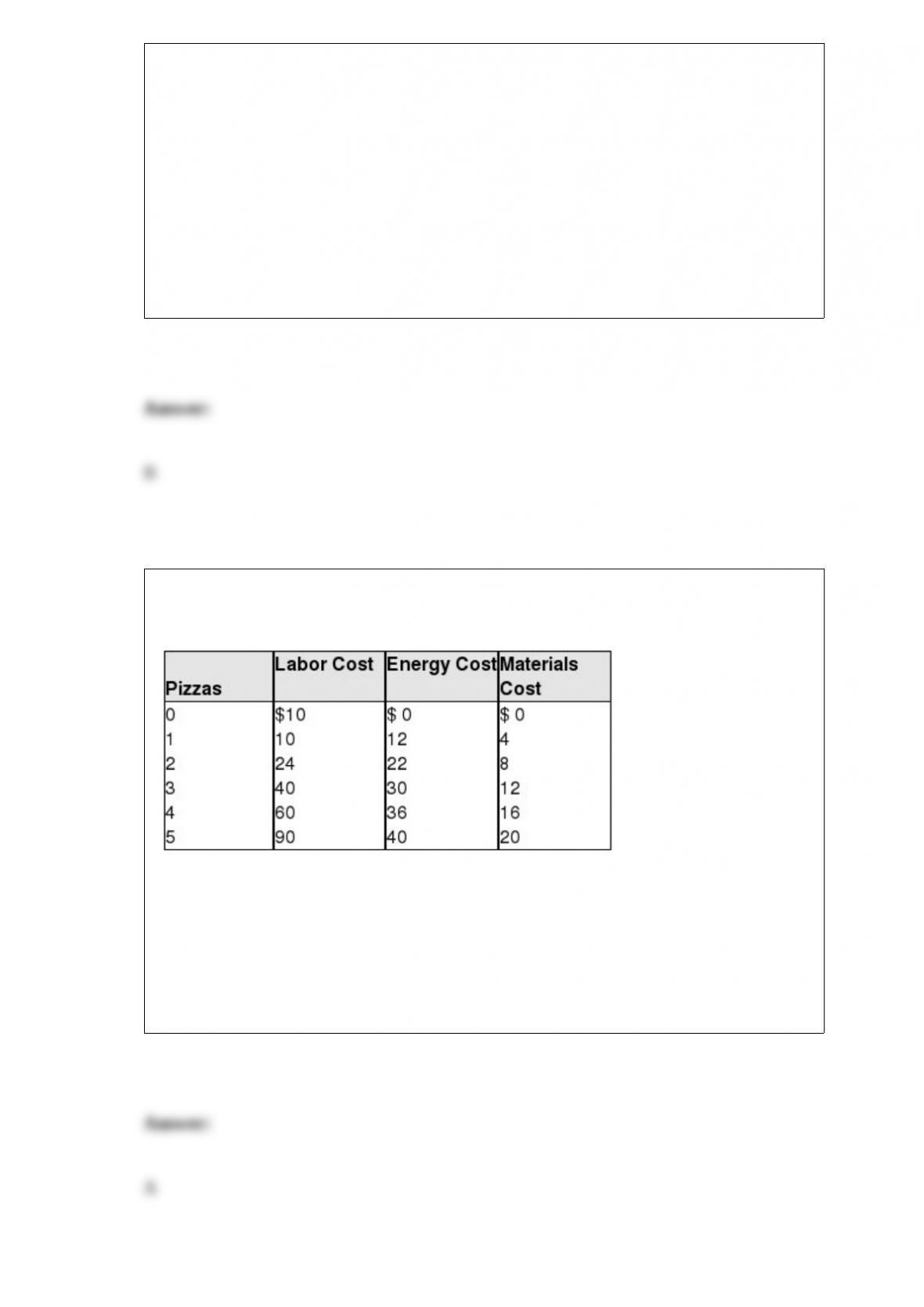
Exhibit 7-2 Cost schedule for pizza production
Exhibit 7-2 shows the labor, energy, and materials cost of making various quantities of
pizzas. The table shows that the energy cost of making pizzas will:
a. increase at a decreasing rate.
b. decrease at a decreasing rate.
c. decrease at an increasing rate.
d. increase at an increasing rate.
e. increase at a constant rate.

If this economy’s distribution of income becomes more equal, then the Lorenz curve
shown in Exhibit 12-3 will:
a. move closer to the 45 line.
b. become more bowed outward.
c. lie above the 45 line.
d. shift down and to the right.
If a firm has total revenue of $200 million, explicit costs of $190 million, and implicit
costs of $30 million, its economic profit is:
a. $200 million.
b. $70 million.
c. $10 million.
d. $10 million.
e. $20 million.
If the government imposes a price ceiling below the market equilibrium price, then:
a. c and d.
b. there will be excess supply.
c. there will be excess demand.
d. the intent is to benefit consumers.

e. the intent is to benefit producers.
A car leasing company that expands its size by buying its competitors may run the risk
of increasing production cost per unit due to:
a. diseconomies of scale.
b. economies of scale.
c. diminishing returns.
d. greater use of large-volume purchases.
Substitute goods are goods that are:
a. jointly consumed.
b. competing for consumer spending.
c. used late in the game.
d. inferior.
e. normal.
A positive economic statement is:
a. an opinion of an action that should be taken.
b. an action that will have a positive effect on the economy.
c. a statement testable by facts.
d. a claim that the speaker is positive will occur.
e. always a microeconomic position.
A normative economic statement:
a. is a model used to collect data.
b. is a statement of fact.
c. is a statement of what ought to be, not what is.
d. indicates what will occur if certain assumptions are true.
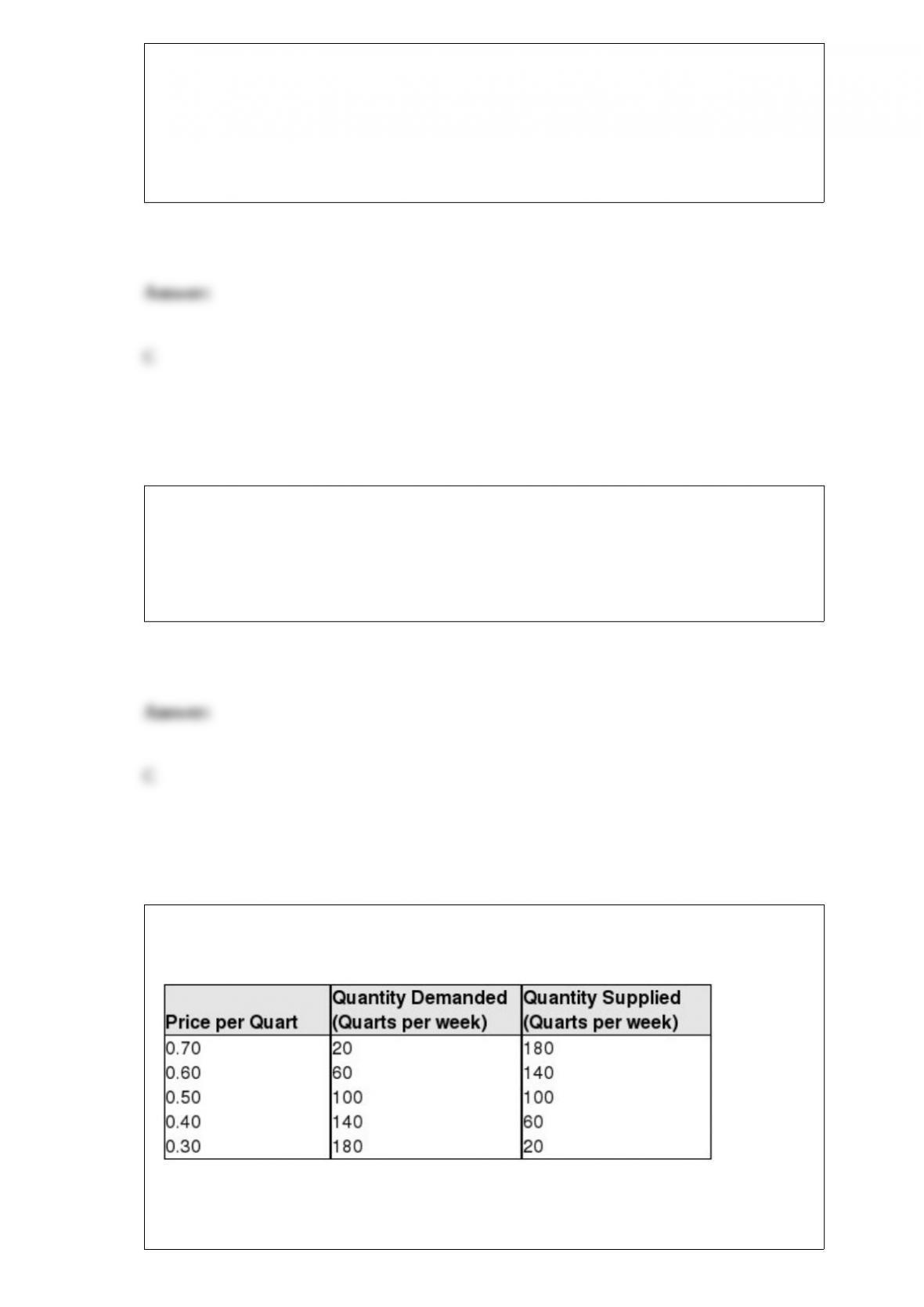
Exhibit 3-6 Milk market
In Exhibit 3-6, which of the following are the equilibrium price and equilibrium
quantity in the milk market?

a. $0.70 per quart and 200 quarts of milk.
b. $0.60 per quart and 100 quarts of milk.
c. $0.50 per quart and 100 quarts of milk.
d. $0.40 per quart and 60 quarts of milk.
e. $0.30 per quart and 20 quarts of milk.
Which of the following is always associated with monopolistic competition?
a. Identical products
b. Economic profits in the short run
c. MR lies above the demand curve
d. Demand curves become more inelastic as new entry occurs
e. Product differentiation
A firm operating in a perfectly competitive market is a price taker because:
a. no firm has a significant market share.
b. no firm’s product is perceived as different.
c. setting a price higher than the going price results in zero sales.
d. all of these.

If John’s marginal benefit derived from the consumption of another candy bar is greater
than the price of the candy bar:
a. John will not purchase any more candy bars.
b. John will increase his total satisfaction by purchasing the candy bar.
c. the opportunity cost of the candy bar is lower than the price.
d. John will decrease his total utility if he purchases the candy bar.
Monopolists are criticized because they are inefficient. What is meant by this
statement?
a. Monopolists charge too high a price.
b. Monopolists don’t innovate enough to control pollution.
c. Monopolists produce a large quantity of waste.
d. Monopolists usually don’t produce at the minimum of the ATC.
e. Monopolists could use their resources better elsewhere.
The conclusion arrived at from a kinked-demand oligopoly model is that:
a. oligopoly firms cannot maximize their profits.

b. oligopoly firms should keep prices at their current level.
c. all oligopoly firms should raise prices.
d. all oligopoly firms should lower prices.
e. oligopoly market structure will lead to lower prices than more competitive industries.
Which of the following is evidence of an ineffective cartel?
a. Output changes are dictated by changes in demand.
b. Price changes are dictated by changes in demand.
c. Members do not agree on output quotas.
d. All of these.
The total fixed cost curve:
a. varies with the quantity of inputs used.
b. decreases with output.
c. increases with output.
d. remains constant regardless of output.
An increase in the consumption of a good resulting from a reduction in price that makes
the good cheaper in relation to other goods is called the:
a. substitution effect.
b. income effect.
c. real balance effect.
d. inelasticity effect.
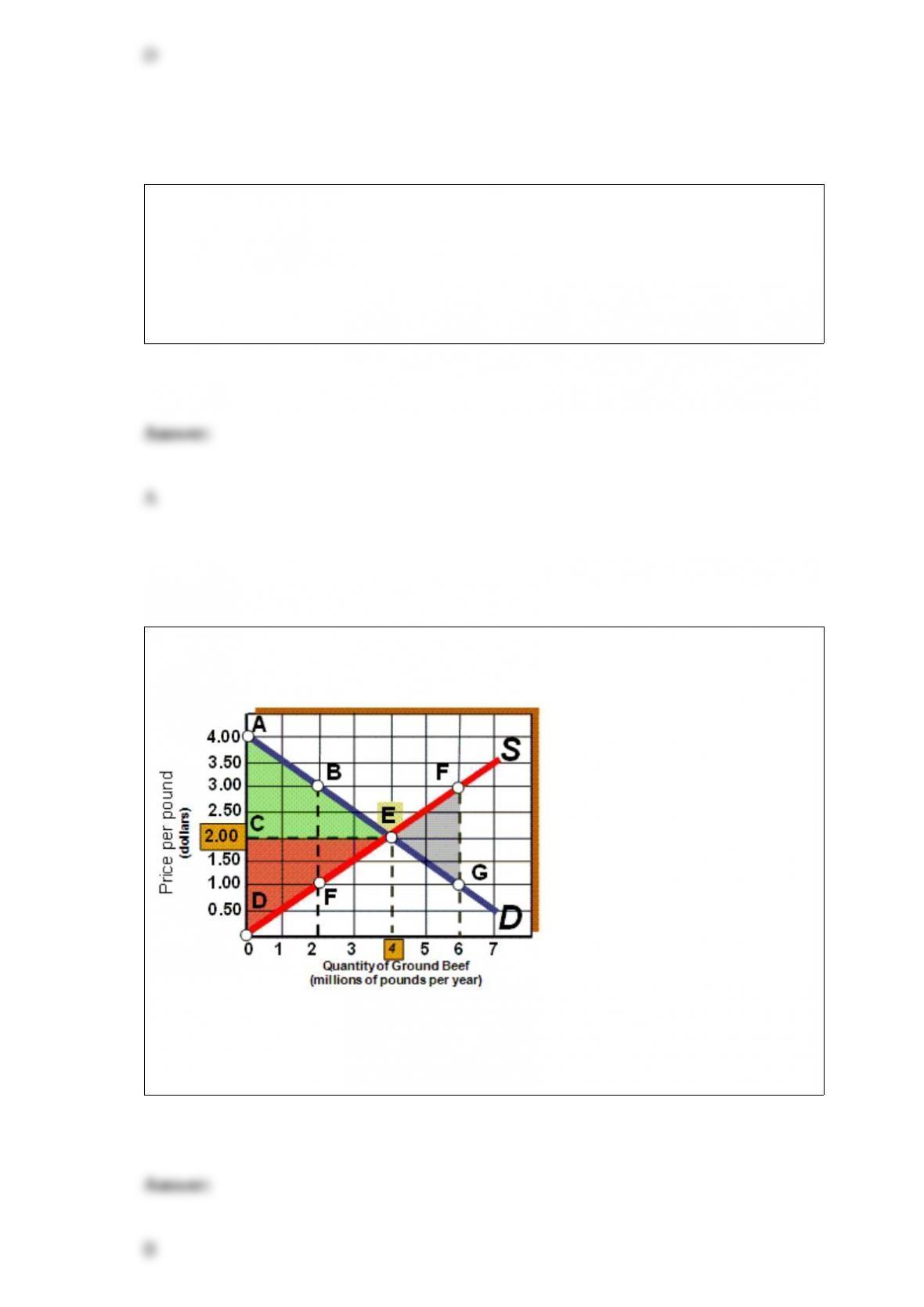
Exhibit 3A-1 Comparison of Market Efficiency and Deadweight Loss
As shown in Exhibit 3A-1, if the market is in equilibrium, then ____ represents
producer surplus.
a. ADFB c. EGH
b. CEFD d. BEF
What is the shape of the average fixed cost curve for a firm in the short run?
a. U-shaped.
b. A curve that constantly increases as output expands and eventually approaches
infinity at high rates of output.
c. A vertical line.
d. A curve that declines as output expands and approaches the horizontal-axis when
output is large.