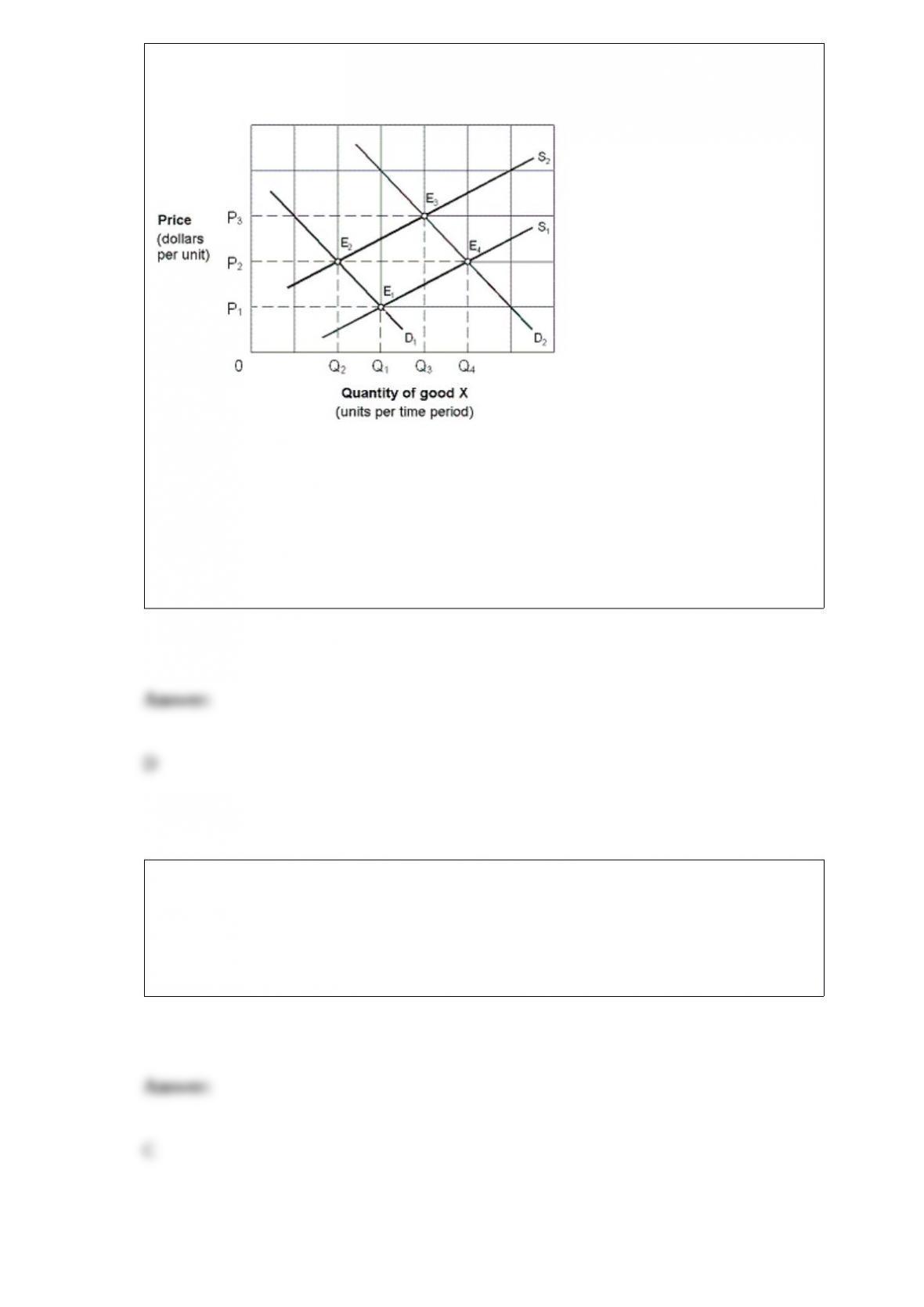
Exhibit 4-3 Supply and demand curves
In Exhibit 4-3, an increase in demand would cause a movement from which equilibrium
point to another, other things being equal?
a. E1 to E2. c. E4 to E1.
b. E1 to E3. d. E1 to E4.
For a perfectly competitive firm, marginal revenue product is equal to:
a. price minus marginal cost.
b. price times marginal revenue.
c. price times marginal product.
d. none of these.
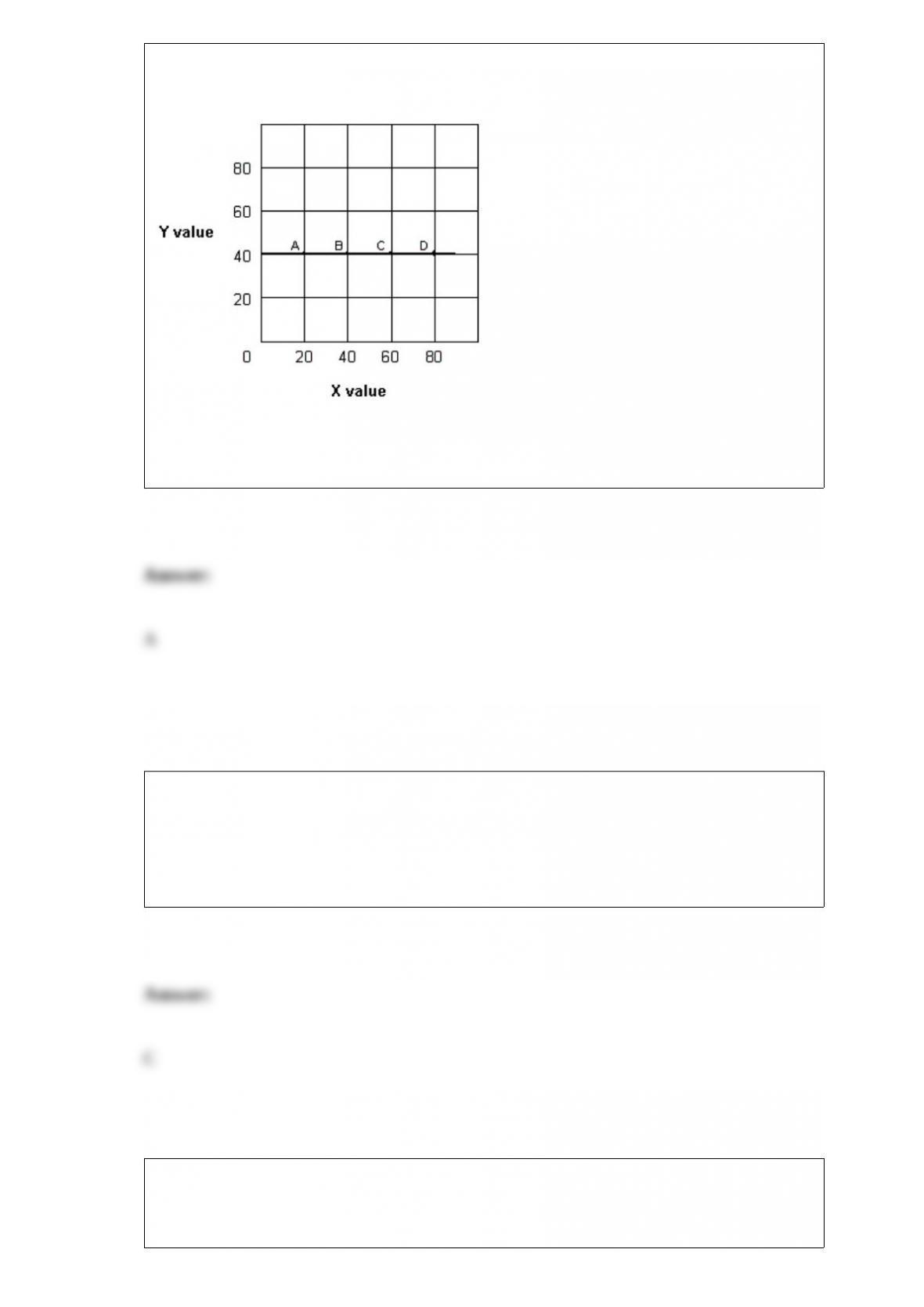
Exhibit 1A-4 Straight line
In Exhibit 1A-4, the slope of the straight line A-D is:
a. 0. c. 1/2.
b. 1. d. 1.
The Utah Pie case was brought under which of the following laws?
a. The Sherman Antitrust Act. c. The Robinson-Patman Act.
b. The Federal Trade Commission Act. d. The Celler-Kefauver Act.
If you were a government official and wanted to raise the price of wheat, which of the
following actions would you take?

a. Take wheat from government storage and sell it.
b. Encourage farmers to use more fertilizer.
c. Lower the price of rye.
d. Subsidize purchases of farm equipment.
e. Encourage farmers to grow less wheat.
The ability of a good to satisfy a want refers to its:
a. usefulness.
b. utility.
c. worthiness.
d. necessity.
The “Four Tigers” of East Asia are the newly industrialized countries of Taiwan, South
Korea, Hong Kong, and:
a. Japan. c. the Philippines.
b. Singapore. d. Vietnam.

An externality is an unintended ____ imposed on ____ as a result of the ____.
a. c or d
b. cost; sellers; negligence of others
c. cost; third parties; economic activity of others
d. benefit; third parties; economic activity of others
e. benefit; sellers; beneficence of others
Suppose rice can be produced in country X at a lower cost than in country Y, while tuna
can be produced in country Y at a lower cost than in country X. International
competition will:
a. destroy the rice market in both countries.
b. drive X to specialize in rice and Y to specialize in tuna.
c. drive Y to specialize in rice and X to specialize in tuna.
d. cause both X and Y to reject international specialization.
e. result in lower total output of rice and tuna.
In Exhibit 11-6, how many thousands of workers are firms willing to hire?
a. 20.
b. 10.
c. 15.
d. All 25 workers.
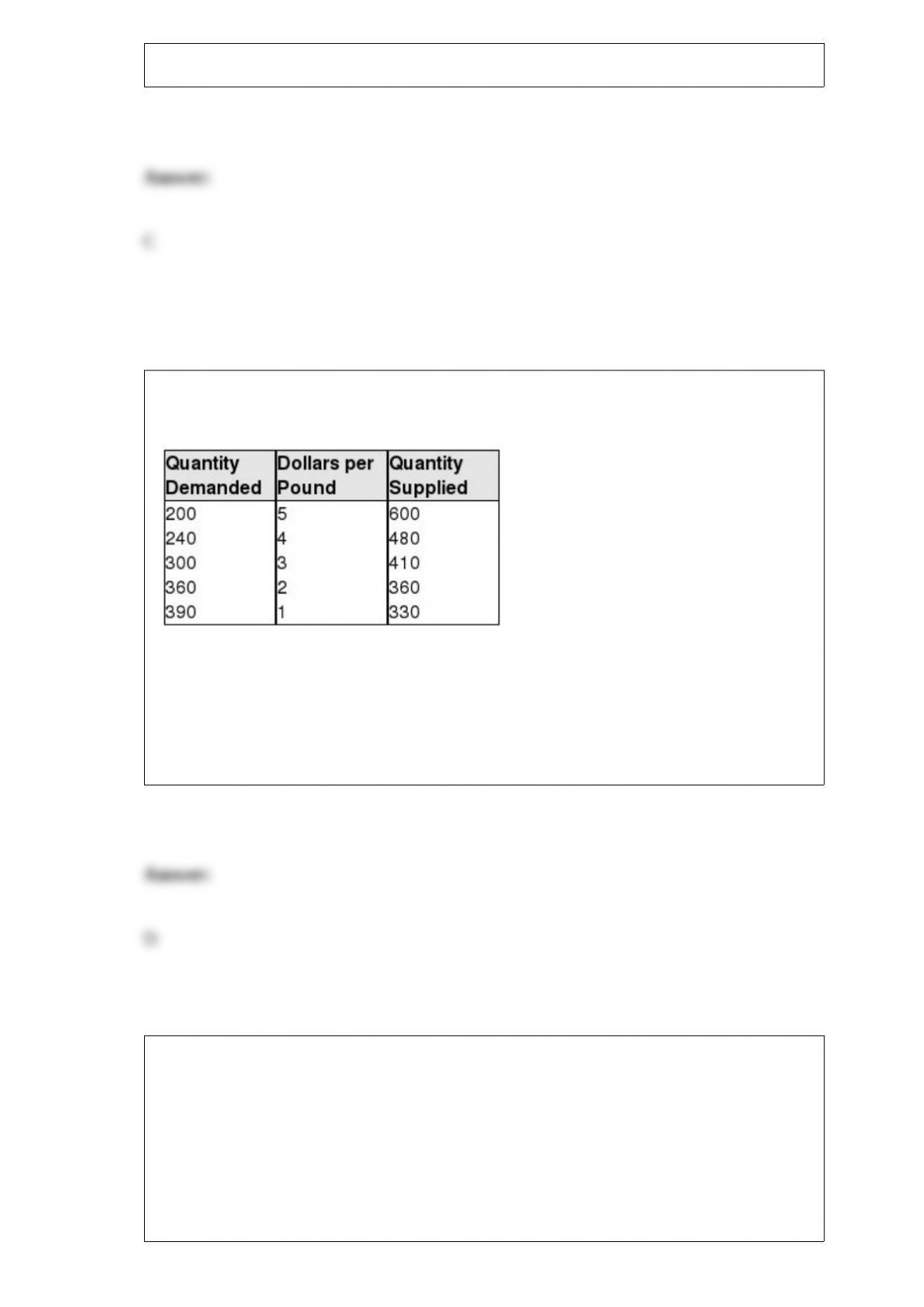
Exhibit 15-6 Dollars per British pound
In Exhibit 15-6, the equilibrium exchange rate is:
a. 5.
b. 4.
c. 3.
d. 2.
e. 1.
A pollution tax is:
a. a positive externality used to offset a negative one
b. a price per unit of discharge of pollution
c. a tax on pollution control equipment

d. itself a form of negative externality
The production possibilities curve for the nation of Economania shifts to the right. This
could have been caused by:
a. a decrease in Economania’s capital stock.
b. a decrease in the Economania’s labor supply.
c. high unemployment in Economania the previous time period.
d. Economania producing all consumer goods in the previous period.
e. technological innovation in the production of Economania goods.
If Coke and Pepsi are close substitutes, then if:
a. Coke raises its price, so will Pepsi.
b. Coke raises its price, it will not lose customers to Pepsi.
c. Pepsi lowers its price, it will not hurt Coke.
d. Pepsi lowers its price, so will Coke.
e. Coke raises its price, some customers will switch to Pepsi.
In long-run equilibrium, output is expanded to the minimum long-run average total cost
by:
a. perfectly competitive firms but not by monopolistically competitive firms.
b. monopolistically competitive firms but not by perfectly competitive firms.
c. both monopolistically competitive firms and perfectly competitive firms.
d. neither perfectly competitive firms nor monopolistically competitive firms.
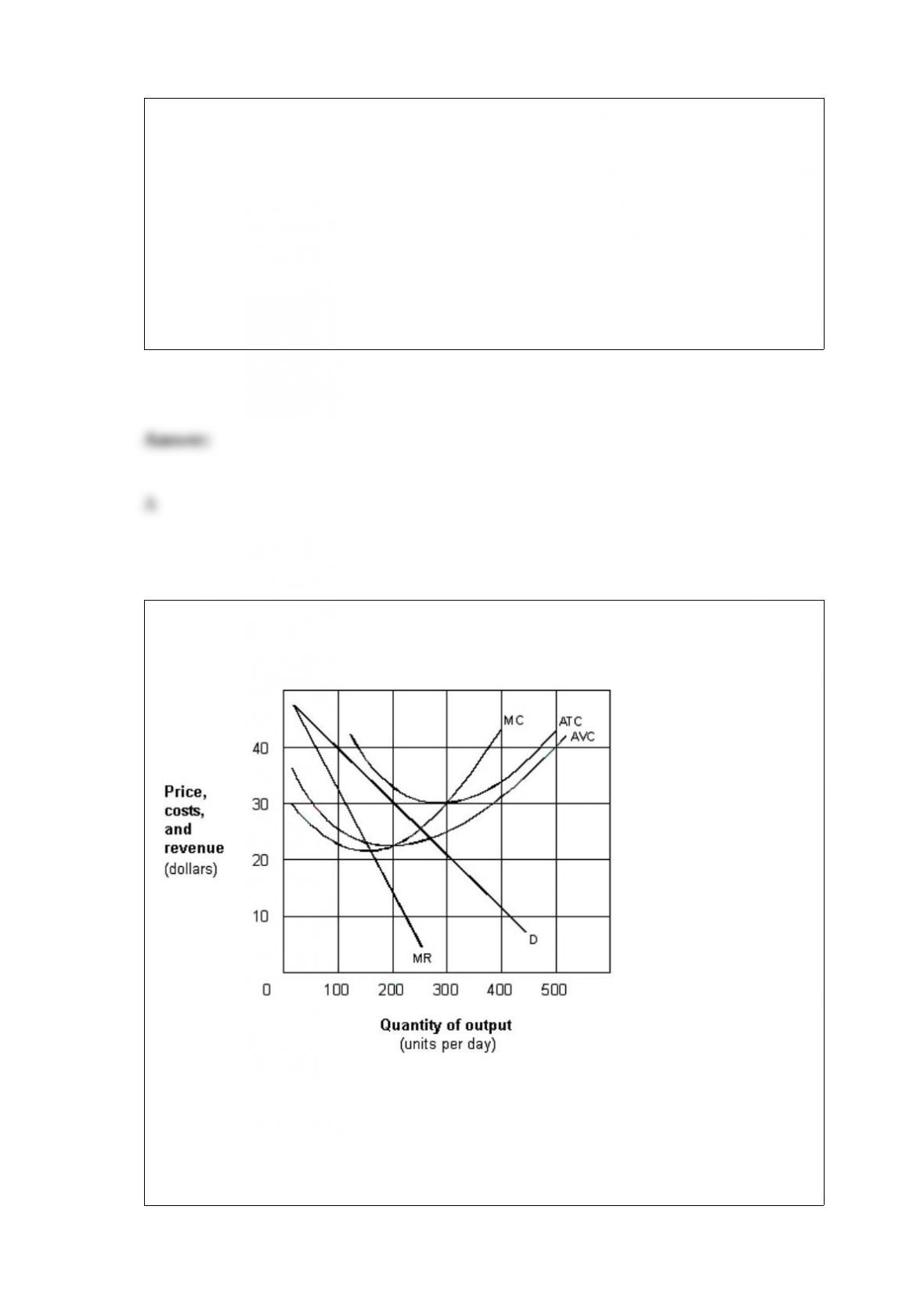
Exhibit 9-10 A monopolist
In Exhibit 9-10, the profit-maximizing or loss-minimizing output for the monopolist is:
a. 100 units per day.
b. 150 units per day.
c. 200 units per day.
d. 250 units per day.
e. 300 units per day.

Private costs are:
a. the full resource costs of an economic activity.
b. always less than social costs.
c. the costs of an economic activity borne by the producer.
d. all of these.
Which of the following would an economist classify as capital?
a. 100 shares of Microsoft stock. c. credit card.
b. $50 bill. d. lawyer’s personal computer.