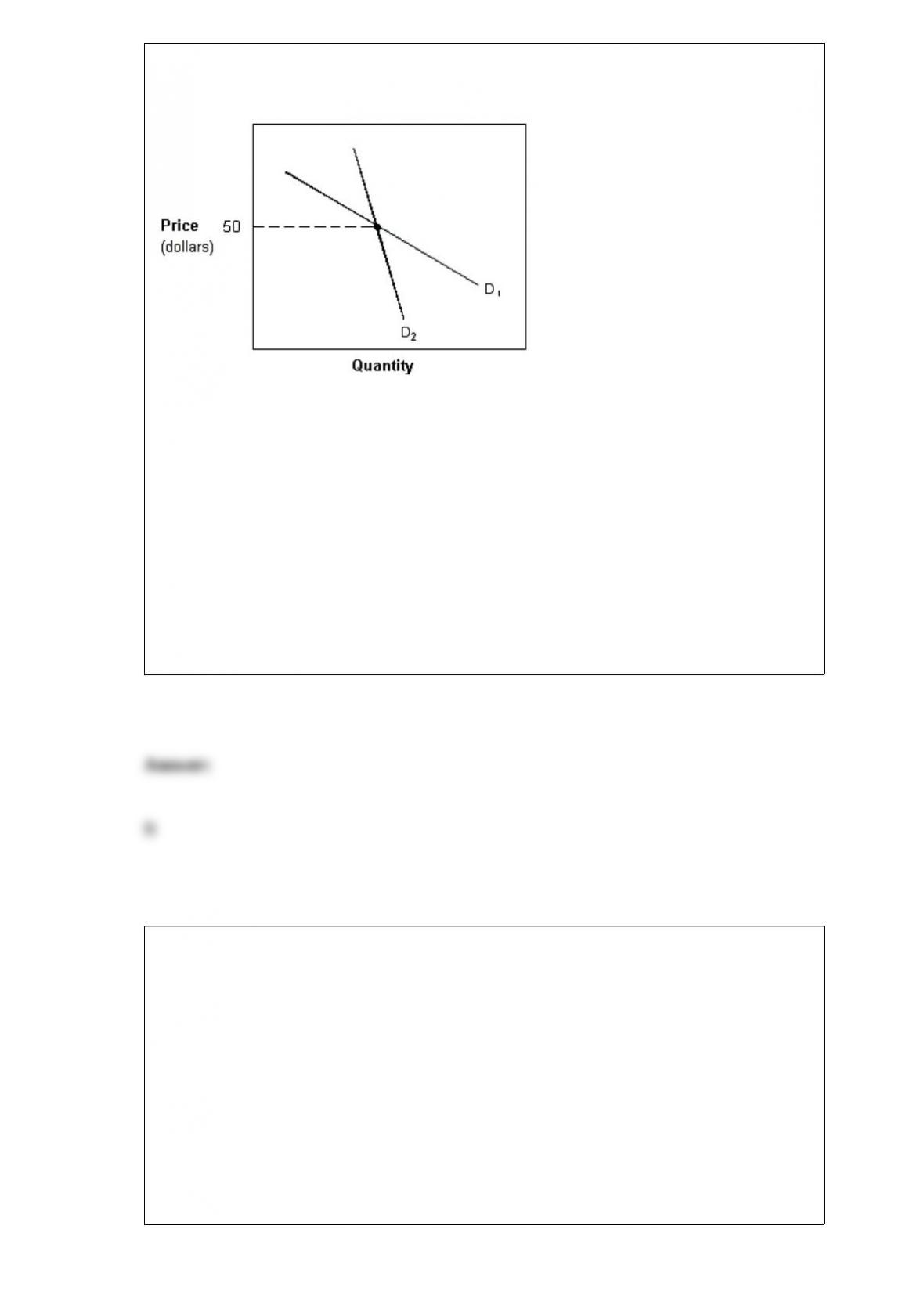
Exhibit 10-4 Kinked demand curves
In Exhibit 10-4, in a kinked-demand oligopoly model, D2 represents the:
a. demand curve applicable to any price increase above $50.
b. demand curve applicable to any price decrease below $50.
c. demand curve facing firms when a cartel is formed.
d. market demand curve.
e. demand curve facing the price leader.
If a firm engages in a merger that substantially reduces competition, then it would be in
violation of the:
a. Clayton Act.
b. Robinson-Patman Act.
c. Sherman Antitrust Act.
d. Federal Trade Commission Act.
e. Celler-Kefauver Antimerger Act.

Albert, Betty, Christine and David are all very good students. When they hold their
study sessions, they often discuss very difficult concepts in great detail. Christine’s
roommate, Elizabeth, who takes completely different classes, still learns from the
discussions of the others. This is the case of a(n) ____, which ____ a ____.
a. public good; benefits; third party
b. externality; imposes a cost on; free rider
c. market failure; results from; third party
d. free rider; benefits from; third party
e. Externalities; benefits; third party
A decrease in quantity demanded is given by a(n):
a. downward shift of the demand curve.
b. upward shift of the demand curve.
c. downward movement to the right along the demand curve.
d. upward movement to the left along the demand curve.
e. downward shift of both demand and supply curves.
An increase in the demand for a product means that the:
a. demand curve shifts to the left.
b. demand curve shifts to the right.
c. supply curve shifts to the right.
d. supply curve shifts to the left.
e. quantity supplied has increased.
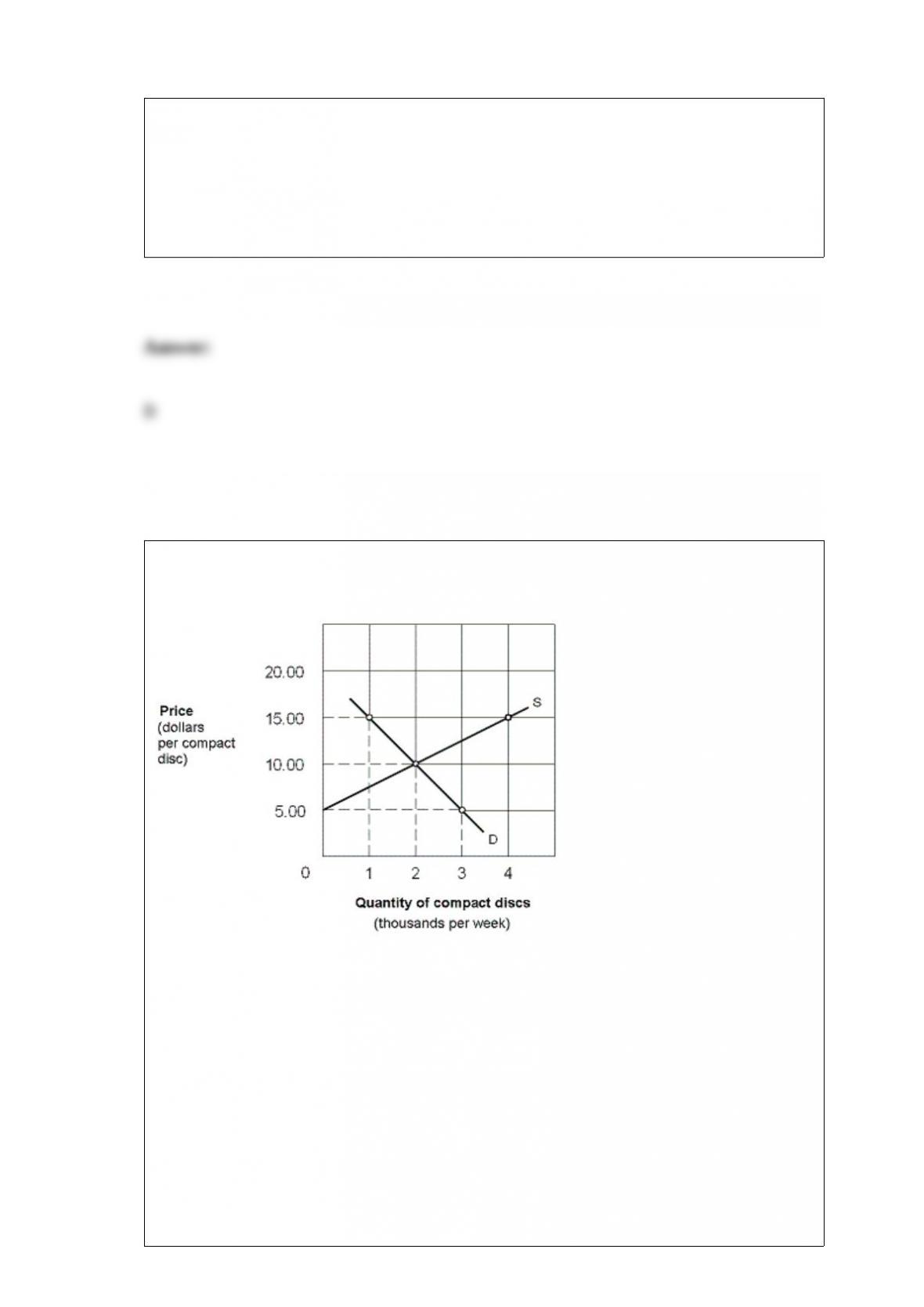
Exhibit 3-14 Supply and demand curves
In Exhibit 3-14, assume that the market price of compact discs is $15 each. This price
is:
a. an equilibrium price.
b. not an equilibrium price because there is an excess quantity demanded at a price of
$15.
c. an equilibrium price because suppliers can store inventories in their warehouses.
d. not an equilibrium price because the quantity supplied of compact discs is greater
than the quantity demanded.

The North American Free Trade Agreement affects trade between:
a. the United States, Cuba, and Brazil.
b. the United States, Canada, and Mexico.
c. the United States, Puerto Rico, and Cuba.
d. Brazil, Bolivia, Peru, and Columbia.
e. China and the United States.
Which of the following changes in the exchange rate represents an appreciation of the
dollar?
a. 100 yen = $1 to 90 yen = $1 c. 1 peso = $10 to 1 peso = $11
b. 1 yen = $.10 to 1 yen = $.08 d. 200 francs = $10 to 190 francs = $10
In the long run, a firm might experience rising per-unit cost due to:
a. economies of scale.
b. diseconomies of scale.
c. the law of supply.
d. the law of diminishing marginal returns.

Travel by bus and pawn-shop services would be expected to be examples of:
a. normal goods. c. substitute goods.
b. inferior goods. d. complementary goods.
Which of the following is not a characteristic of most less-developed countries?
a. Inadequate human capital.
b. Inadequate capital goods.
c. High population growth rate.
d. Inadequate water supplies.
e. High productivity.
If the quantity of concert tickets sold decreases by 10 percent when the price increases
by 5 percent, the price elasticity of demand over this range of the demand curve is:
a. price elastic. c. perfectly inelastic.
b. price inelastic. d. unitary elastic.
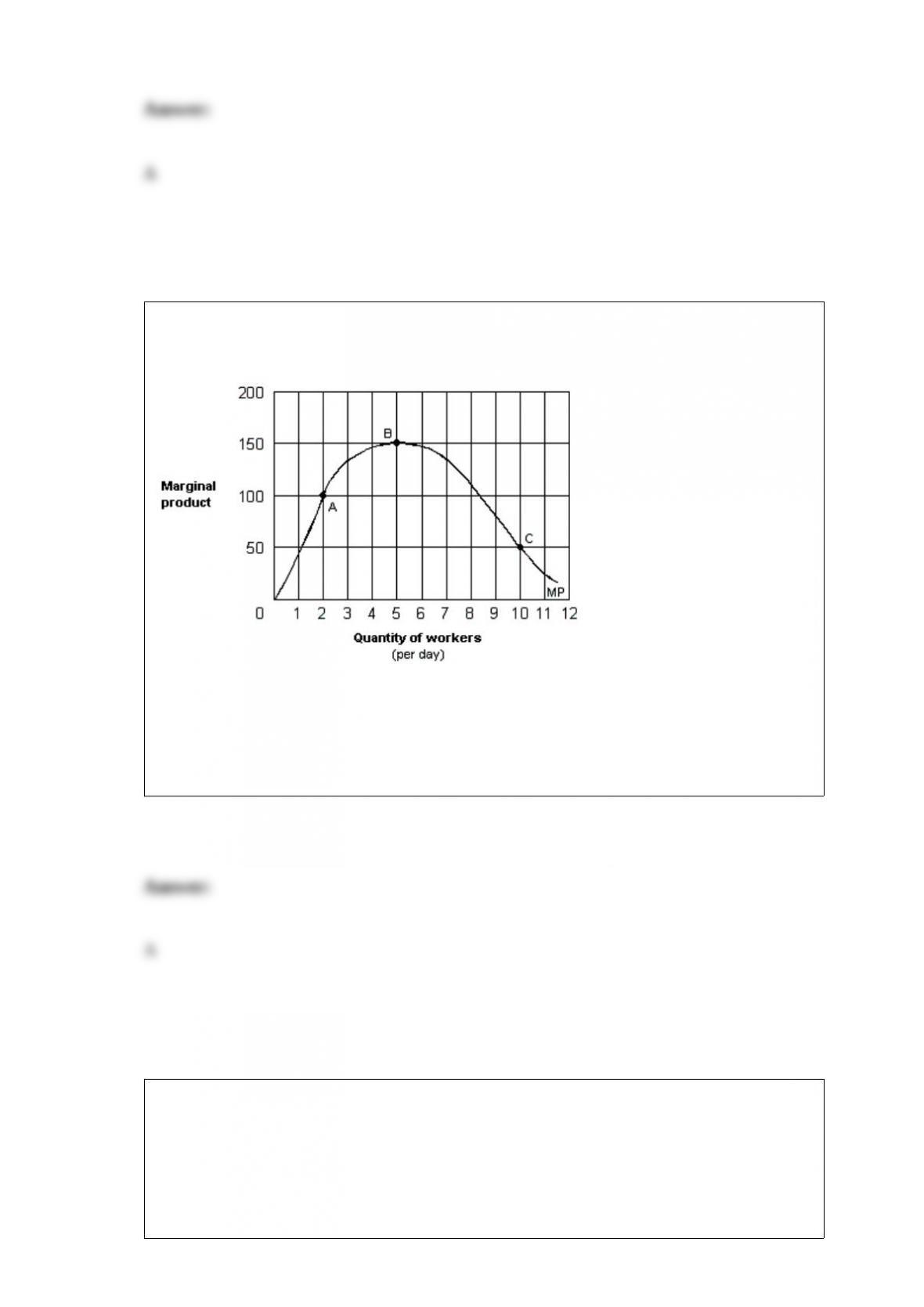
Exhibit 7-3 A marginal product curve
As shown in Exhibit 7-3, the law of diminishing returns applies where there are:
a. more than 5 workers per day.
b. more than 4 workers per day.
c. more than 3 workers per day.
d. between 0 and 5 workers per day.
Which of the following can be a barrier to an LDC’s economic growth and
development?
a. Low population growth. c. Faster capital accumulation.
b. A low level of human capital. d. More infrastructure.
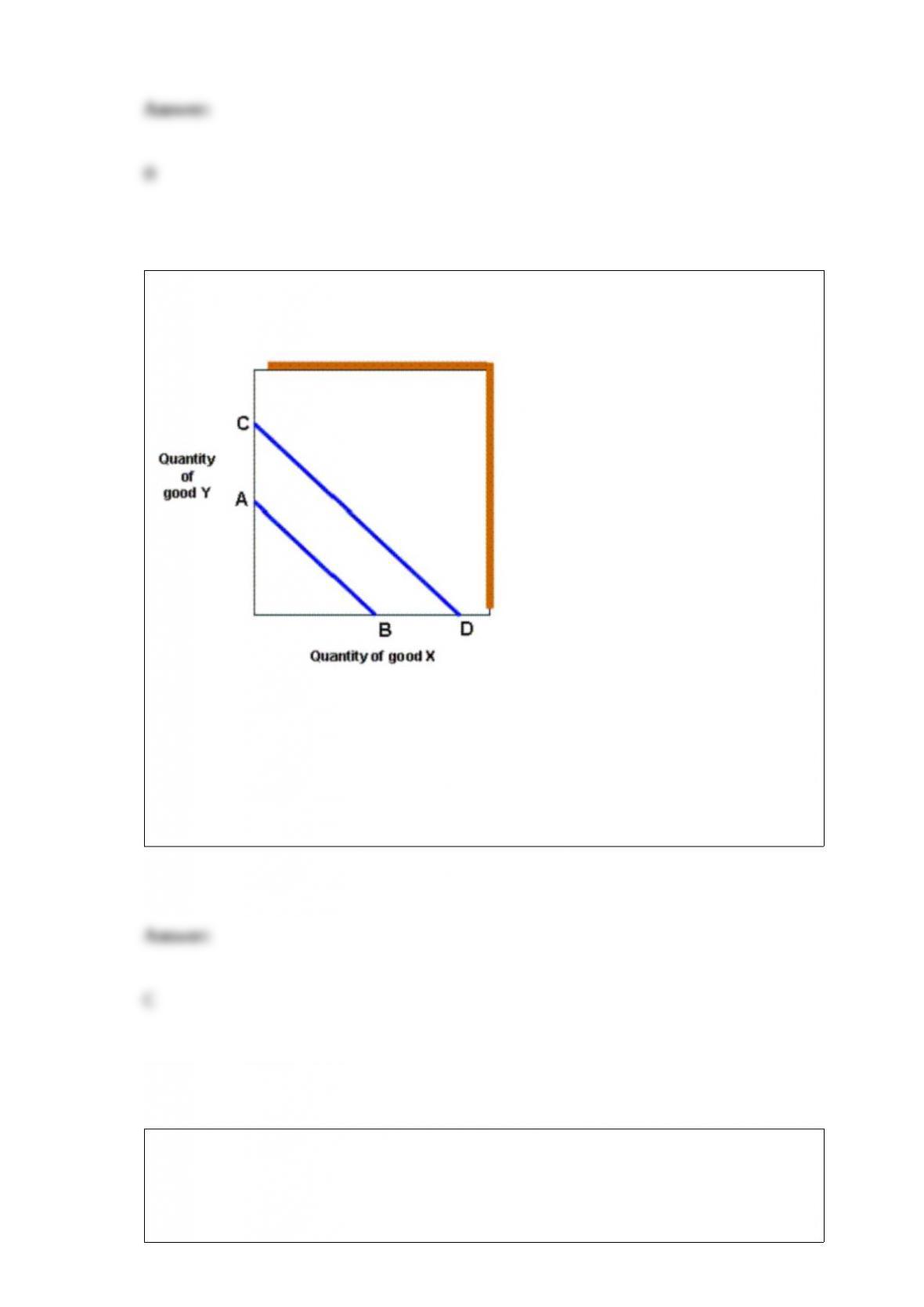
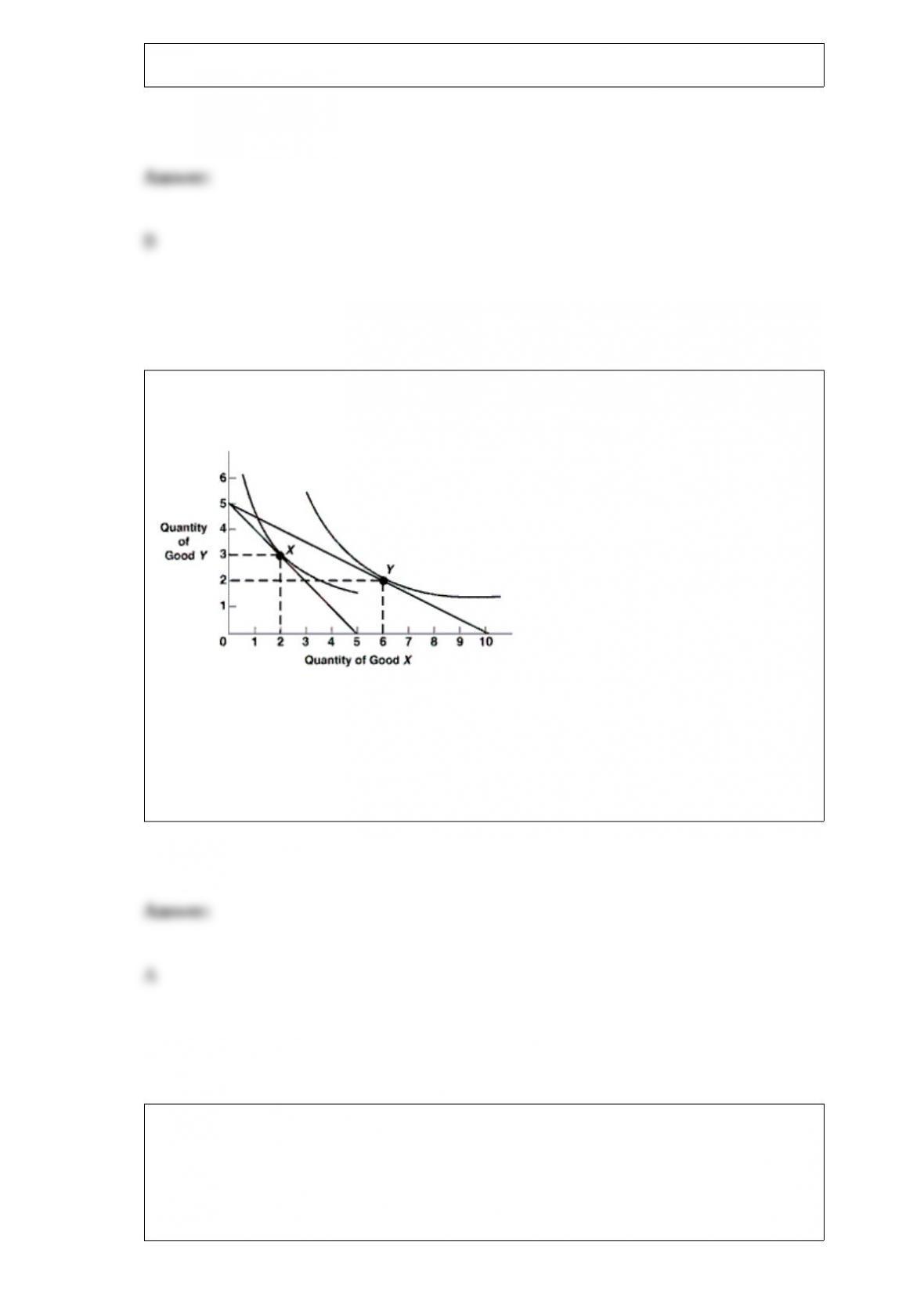
Exhibit 6A-1 Budget line
Assume the price of good Y with its quantity measured on the vertical axis is $20 and
the price of good X with its quantity measured on the horizontal axis is $5. If the
consumer’s budget is $100, then the absolute value of the slope of the budget line is:
a. 100.
b. 20.
c. 1/4.
d. 4.
In short-run perfectly competitive equilibrium, which of the following is always true?
a. Profit equals zero.
b. Profit can be negative, zero, or positive.
c. Profit can be zero or positive, but not negative.
d. Profit is positive, otherwise firms would not produce.
Exhibit 6A-6 Consumer equilibrium
As shown in Exhibit 6A-6, the total utility a consumer receives at point B is ____ the
total utility at point A.
a. greater than
b. equal to
c. less than
d. equal to the marginal rate of substitution (MRS) plus
At the point where marginal cost equals average variable cost,
a. b and c.
b. marginal cost is rising.
c. average total cost is at its minimum.
d. average variable cost is falling.

e. there is no total cost.
Which of the following is a problem when comparing GDPs per capita between
nations?
a. GDP per capita fails to measure income distribution.
b. Fluctuations in exchange rates affect differences in GDP per capita.
c. GDP per capita is subject to greater measurement errors for LDCs compared to IACs.
d. All of these.
When Harlan County, Kentucky, has a monopsony coal mining firm,
a. d and e.
b. workers will work for the firm that pays the higher wage.
c. coal buyers will continue to buy coal from other counties.
d. coal miners will only have one employer.
e. wages will be determined only by the demand for labor.

A community in a Southeastern state passed a beautification ordinance (law) prohibiting
the placement of indoor furniture outside of homes (i.e., no couches on the porch). The
law represents a conflict between ____ and ____.
a. the rich; the poor
b. third parties; market participants
c. victims; criminals
d. public goods; private goods
e. residents; visitors