
Which of the following is most likely to help the residents of a nation produce more
goods and services and achieve higher income levels?
a. Higher tax rates.
b. A higher rate of investment.
c. A smaller trade sector.
d. Greater use of taxation to transfer income from the rich to the poor.
When the price of a good falls, consumers may increase the quantity consumed because
they have greater total purchasing power. This statement describes the:
a. substitution effect.
b. income effect.
c. consumer equilibrium effect.
d. price effect.
Exhibit 1A-1 Straight line

In Exhibit 1A-1, as X increases along the horizontal axis, corresponding to points A-B
on the line, the Y values increase. The relationship between the X and Y variables is:
a. direct. c. independent.
b. inverse. d. variable.
A monopsonist’s marginal factor cost (MFC) curve lies above its supply curve because
the firm must:
a. lower the product price to sell more.
b. increase the price of its product to sell more.
c. decrease the factor price to hire more.
d. lower the factor price to hire more.
e. none of these.
Which of the following statements is true?

a. An opportunity cost is what must be given up in order to get something else.
b. The three fundamental economic questions refer to What to produce? How to
produce? and When to produce?
c. The term “investment” refers to the purchase of stocks and bonds and other financial
securities.
d. The law of increasing opportunity cost implies that as production of one type of good
is expanded then fewer and fewer of other goods must be given up.
The short run is a time period such that:
a. the existing firms in the market do not have sufficient time to change the amounts of
any of the inputs that they employ.
b. the existing firms in the market do not have sufficient time to either increase or
decrease their current rate of output.
c. the existing firms in the market do not have sufficient time to increase the size of
their existing plant or build a new factory.
d. new firms may build plants and enter the industry.
Deadweight loss is the result of:
a. disequilibrium. c. overproduction.
b. underproduction. d. all of these are correct.

As shown in Exhibit 9-3, in order to maximize its profit, what price should GeneTech
charge for its vaccine?
a. $20 per dose.
b. $25 per dose.
c. $35 per dose
d. $50 per dose.
Assume the United States can use a given amount of its resources to produce either 20
airplanes or 8 automobiles and Japan can employ the same amount of its resources to
produce either 20 airplanes or 10 automobiles. The U.S. should specialize in:
a. airplanes. c. both goods.
b. automobiles. d. neither good.
If an economy’s population grows at 3 percent and real GDP grows at 2 percent, then:
a. per capita real GDP is declining.
b. the economy’s standard of living is increasing.
c. per capita real GDP is negative.
d. per capita real GDP is growing.
e. the economy is experiencing unemployment.
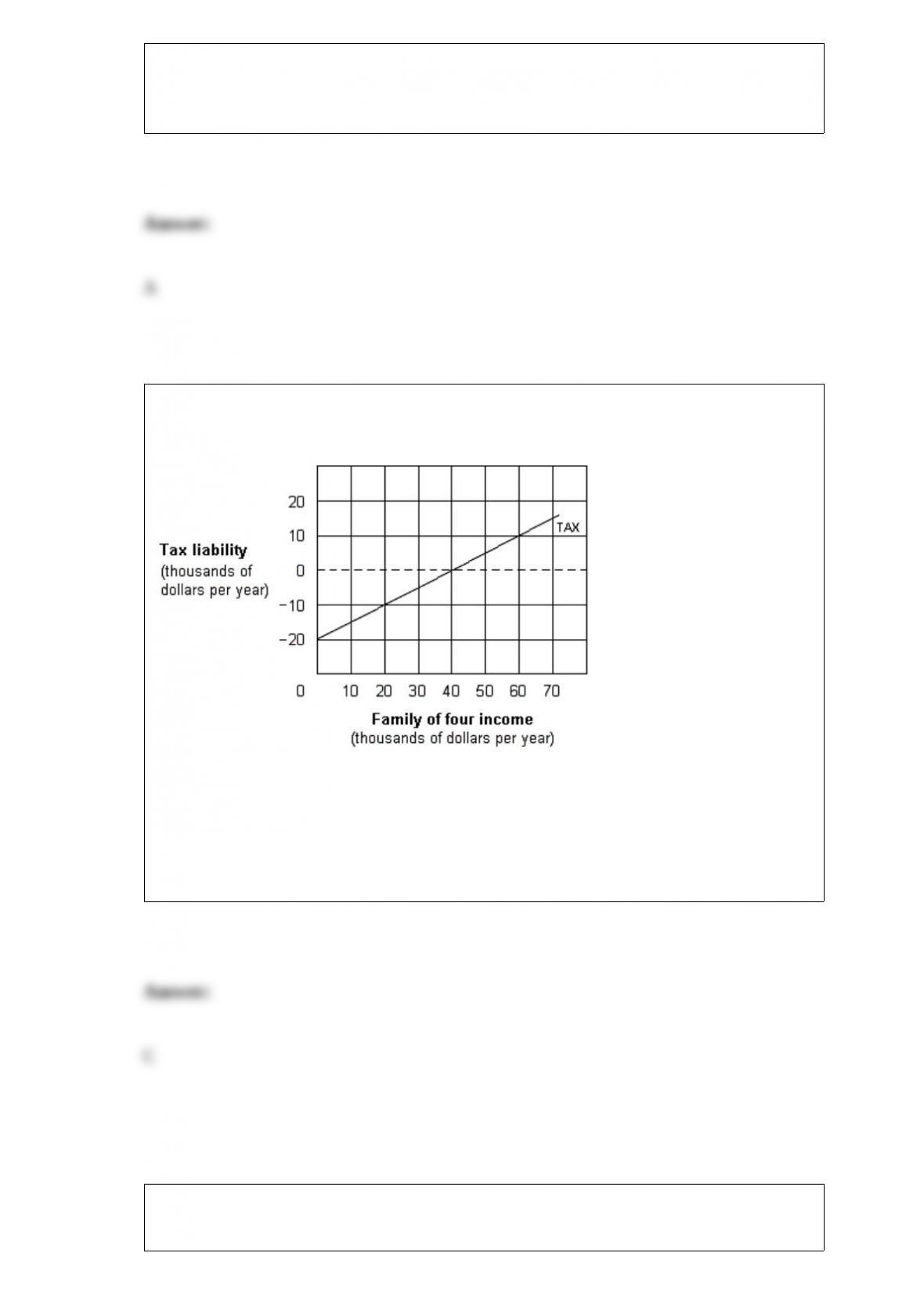
Exhibit 12-7 Negative income tax
As shown in Exhibit 12-7, a family of four with no earned income receives ____ from
the government.
a. zero payment.
b. the break-even income of $40,000.
c. a $20,000 payment.
d. a $20,000 tax deferment.
There is a technological advance in the production of digital watches. This will cause:
a. demand to increase.

b. supply to increase.
c. demand to decrease.
d. supply to decrease.
e. the price to increase.
Typically, a country’s population is divided into how many income groups to find a
Lorenz Curve?
a. 1 or 2.
b. 5 or 10.
c. 10 or 20.
d. 25 or 50.
e. 100.
Any change in price along a perfectly inelastic demand curve produces:
a. greater change in the quantity demanded.
b. less change in the quantity demanded.
c. no change in the quantity demanded.
d. infinite change in the quantity demanded.

In the short run, if a perfectly competitive firm is producing at a price below average
total cost, its economic profit is:
a. positive.
b. zero.
c. negative.
d. normal.
If butter is a substitute for margarine, then an increase in the price of butter would be
most likely to cause:
a. a rightward shift of demand for margarine.
b. a leftward shift of demand for margarine.
c. the quantity demanded for margarine to increase.
d. the quantity demanded for margarine to decline.
e. a decline in the price of margarine.
The rules of the WTO:
a. apply only to domestic trade within a nation.
b. apply to both domestic trade within a nation and international trade with other
nations.
c. apply only to trade among nations.
d. include a prohibition of tariffs.
e. encourage high tariffs.
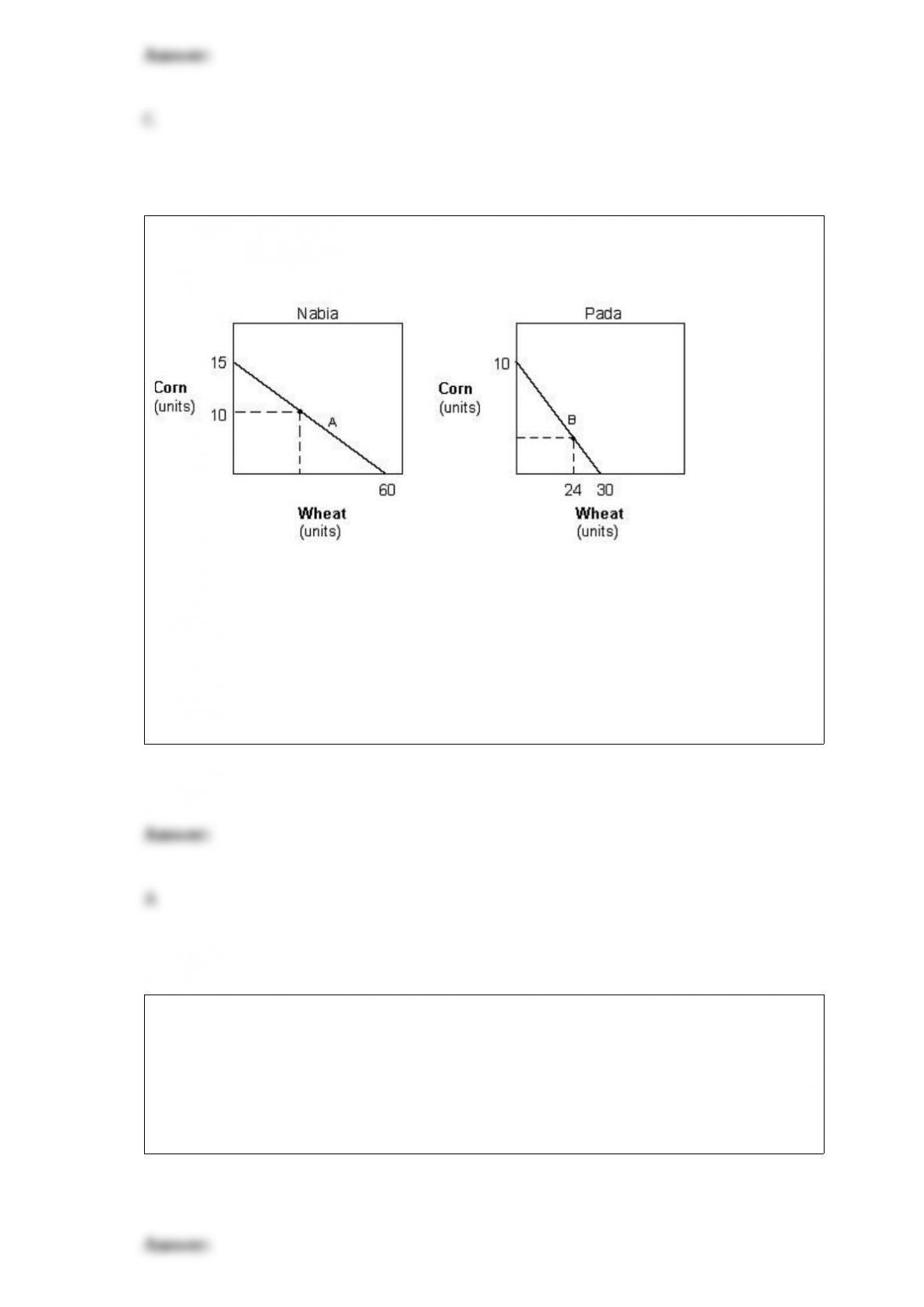
Exhibit 15-1 Production possibilities curves
In Exhibit 15-1, the production possibilities curves of wheat and corn for Nabia and
Pada are presented. Suppose Pada produces at point B on its PPC. How much corn is
the country able to produce?
a. 2.
b. 15.
c. 10.
d. 6.
e. 13.
Which of the following is not counted as income when the official poverty rate is
calculated?
a. Medicaid benefits.
b. dividends derived from the ownership of stock.
c. earnings derived from a part-time job.
d. money income derived from transfer payments.

If the short-run price elasticity of demand for hospital care is .27, then the long-run
price elasticity is expected to be:
a. greater than .27.
b. greater than 1.
c. less than .27.
d. equal to .27.
e. less than 0.
A normative economic statement is:
a. a statement of fact.
b. a statement of opinion which advocates a particular position.
c. not acceptable in the economics profession.
d. the only acceptable manner to present economic information.
e. a statement based upon government-supplied information.
Two goods are complementary if:
a. they are part of the basic food group.
b. each performs the same basic task.
c. the cross elasticity of demand is positive.
d. they are used together.

e. the income elasticity of demand is negative.
When economists say the quantity supplied of a product has increased, they mean the:
a. supply curve has shifted to the left.
b. supply curve has shifted to the right.
c. price of the product has risen, and consequently, suppliers are producing more of it.
d. price of the product has fallen, and consequently, suppliers are producing less of it.