
Suppose a monopolist and a perfectly competitive firm have the same cost curves. The
monopolistic firm would:
a. charge a lower price than the perfectly competitive firm.
b. charge a higher price than the perfectly competitive firm.
c. charge the same price as the perfectly competitive firm.
d. refuse to operate in the short run unless an economic profit could be made.
e. refuse to operate in the short run if an economic loss was present.
The law of demand states that, ceteris paribus, price and quantity demanded are:
a. directly related. c. uniformly related.
b. inversely related. d. horizontally related.
Sally recently got a 15 percent raise. She now purchases 7.5 percent more steak dinners.
Sally’s income elasticity for steak dinners is:
a. 0.5. c. 1.5.
b. 0.75. d. 2.0.

A curve that depicts the relationship between price and quantity demanded is the:
a. supply curve. c. demand curve.
b. supply schedule. d. equilibrium price.
Which of the following is the best example of a public good?
a. Apples. c. Education.
b. Cars. d. National defense.
A side effect of a price floor set above the equilibrium price is:
a. the new price is below equilibrium price.
b. an excess supply of the good is created.
c. an excess demand for the good is created.
d. the supply of the good decreases.
e. the demand for the good increases.

Which of the following most directly reflects the law of diminishing marginal utility?
a. After watching two football games, Terry decides to watch a third game.
b. A sports fan enjoys watching Monday night football rather than going to the theater.
c. After listening to three compact discs, Kim decides to go bowling rather than listen to
a fourth disc.
d. A musician receives the biggest ovation of the evening after playing the final number
of a recital.
If the demand for a product increases in an increasing cost industry, as the market
adjusts in the long run:
a. price will rise.
b. the firm’s per-unit cost will increase.
c. the firm’s per-unit cost will fall.
d. the market price will return to its initial position.
While waiting in line to buy two tacos at 80 cents each and a medium drink for 90
cents, Jordan notices that the restaurant has a value meal containing three tacos and a
medium drink all for $3. For Jordan, the marginal cost of the third taco would be:
a. zero. c. 80 cents.
b. 50 cents. d. $1.
If two goods were to become even stronger substitutes than before, an economist would
expect the cross elasticity to become:
a. positive.
b. one.
c. zero.
d. smaller.
e. larger.
Which of the following is not a common characteristic of IACs?
a. Market-based economies.
b. Large stocks of technologically advanced capital.
c. Well-educated labor.
d. Low per capita energy consumption.
Opening trade between two nations would:
a. shift their production possibilities curves outward.
b. shift their production possibilities curves inward.
c. leave the production possibilities unchanged and increase their consumption
possibilities.
d. leave the production possibilities unchanged and decreased their consumption
possibilities.
A profit-maximizing firm will continue to expand output:
a. as long as the revenues from the production and sale of an additional unit exceeds the
average cost of the unit.
b. until the average cost of producing the good or service is at a minimum.
c. as long as the revenues from the production and sale of an additional unit exceeds the
marginal cost of the unit.
d. until the marginal cost of producing a good or service is at a minimum.
According to the classification in the text, which of the following is not an industrially
advanced country (IAC)?
a. Singapore. c. United Arab Emirates.
b. Hong Kong. d. Ireland.

Long-run economies of scale exist when the long-run average cost curve:
a. rises.
b. remains constant.
c. falls.
d. does not exist.
In the short run, why would a firm in a perfectly competitive market shut down
production if the prevailing market price falls below the lowest possible average
variable cost?
a. At that point (economic) profit is zero.
b. Below that point average revenue becomes less than marginal revenue.
c. Below that point marginal revenue becomes insufficient to pay for avoidable average
variable cost.
d. Below that point other firms with similar cost will find it profitable to enter the
market and take away demand from the existing firms.
The rule of reason was applied in the:
a. Standard Oil case. c. American Tobacco Trust case.
b. U.S. Steel case. d. All of these.
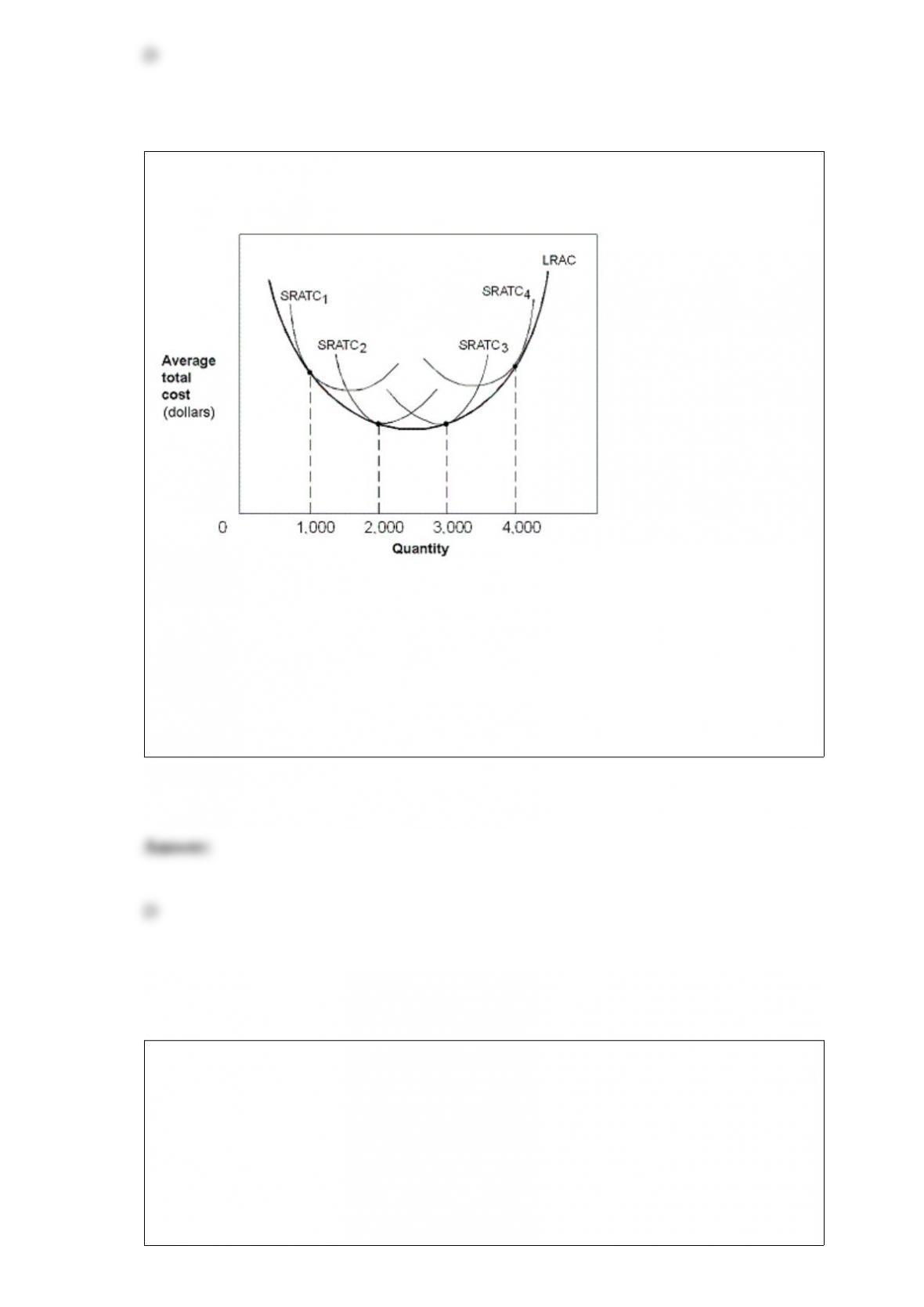
Exhibit 7-14 Cost curves
In Exhibit 7-14, a firm finds that it is experiencing numerous managerial and
information problems. The position of its short- and long-run average total cost curves
suggest that it is operating at a production level:
a. between 0 and 1,000.
b. between 1,000 and 2,000.
c. between 2,000 and 3,000.
d. between 3,000 and 4,000.
e. where it should shut down immediately.
The federal agency established in 1934 to regulate telephones and broadcasting
industries is the:
a. Interstate Commerce Commission (ICC).
b. Federal Trade Commission (FTC).
c. Securities and Exchange Commission (SEC).
d. Equal Employment Opportunity Commission (EEOC).
e. Federal Communications Commission (FCC).
If the price of a product rises, consumers buy less of the good because the:
a. MU/P of the good falls below the MU/P of other goods.
b. MU/P of the good rises above the MU/P of other goods.
c. marginal utility of the good diminishes.
d. total utility of the good diminishes.
e. marginal utility of the good rises.
Suppose the Good Food supermarket increases the price of a pound of bananas from
$.75 to $1.25 and finds that the quantity of bananas it sells per month drops from 1,500
to 1,000. The price elasticity of demand coefficient for bananas in this price range is:
a. 0.80. c. 2.00.
b. 3.00. d. 0.50.
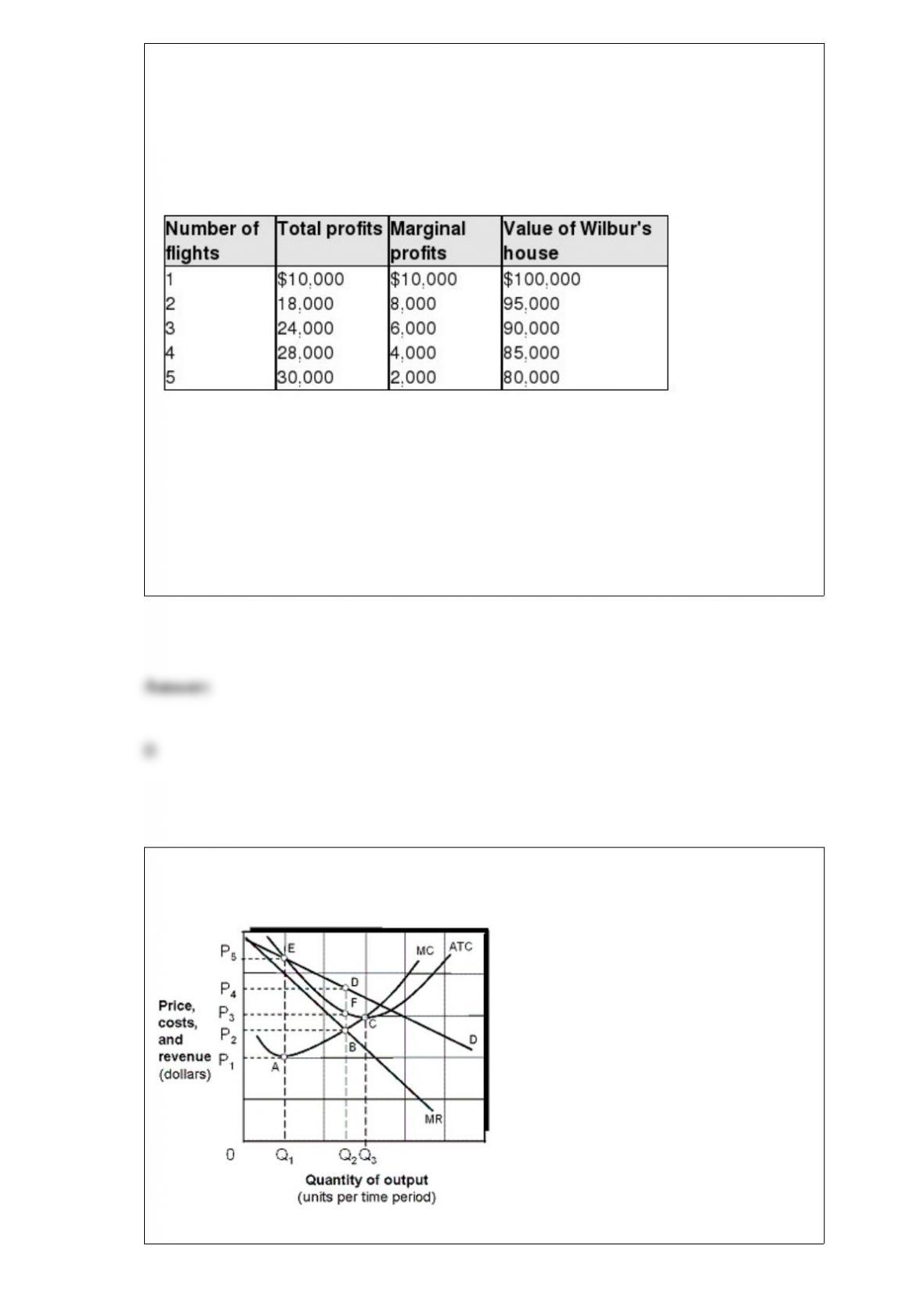
Exhibit 14-3 Impact of flights on house value
Each time Orville flies over Wilber’s house, the noise reduces the value of Wilbur’s
house. The table shows the profits to Orville of each flight, and the value of Wilbur’s
house.
As shown in Exhibit 14-3, if Wilbur has the property right to have no planes flying over
his house, but Orville is allowed to negotiate with Wilber, what will be the number of
flights?
a. 2. c. 4.
b. 3. d. 5.
Exhibit 9-8 Profit maximizing for a monopolist
As shown in Exhibit 9-8, if the monopolist produces the profit-maximizing output, total

revenue is the rectangular area:
a. OQAP1.
b. OQ2BP2.
c. OQ3CP3.
d. OQ2DP4.