
Eric is maximizing his total utility through his choices of two goods: clothes and food.
His marginal utility of clothes is 60 and his marginal utility of food is 12. The price of
clothes is $20. What must be the price of food?
a. 12.
b. 6.
c. 4.
d. 1.
e. 0.
Looking at the relationship between elasticity and total revenue, we can see that ____.
a. b and c
b. when demand is unit elastic, small price changes don’t change total revenue
c. when a good is price inelastic, revenue increases when prices increase
d. when a good is price elastic, revenue increases when prices increase
e. total revenue is maximized when the elasticity has stopped changing
In the very short-run period,
a. the price elasticity of supply is very elastic.
b. the price elasticity of demand is very elastic.
c. the cross elasticity of demand is very inelastic.
d. income elasticity is very elastic.
e. the price elasticity of supply is very inelastic.
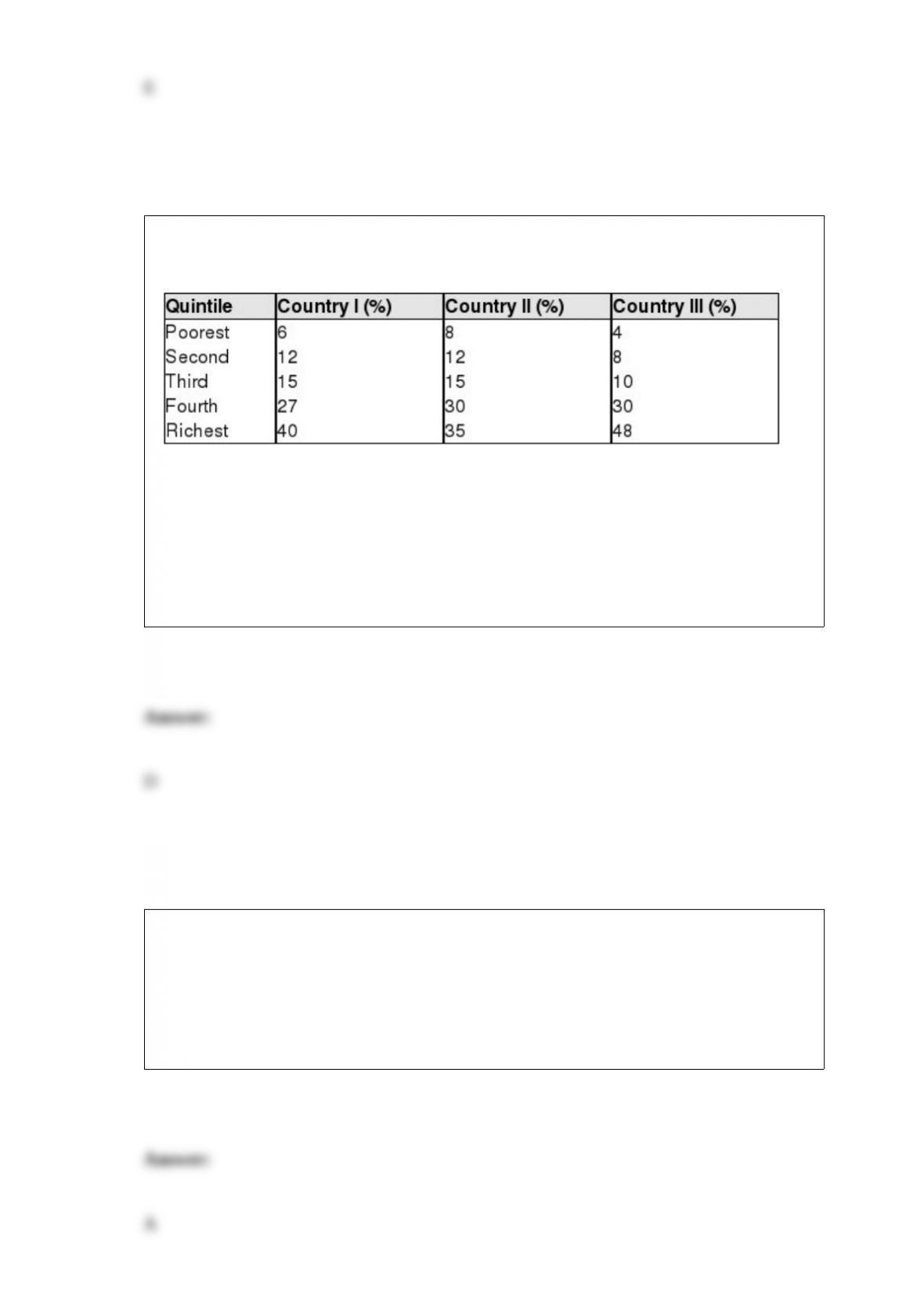
Exhibit 12-1 Income distribution for three countries
Exhibit 12-1 shows the percentage of income received by each population quintile.
From this chart we can conclude:
a. Country I has the most unequal income distribution.
b. Country III has the most equal income distribution.
c. Country II has the most unequal income distribution.
d. Country II has the most equal income distribution.
e. Country III has a more equal income distribution than Country II.
The change in total utility due to a 1-unit change in the quantity consumed is:
a. marginal utility.
b. average utility.
c. per capita utility.
d. total utility.
e. the principle of diminishing marginal utility.

Which of the following best describes average variable cost?
a. The change in total cost when one additional unit of output is produced.
b. Total cost divided by the quantity of output produced.
c. Total variable cost divided by the quantity of output produced.
d. Total fixed cost divided by the quantity of output produced.
e. Costs that do not vary as output varies.
The government would use production taxes to remedy the problem of substantial:
a. internal benefits of production.
b. external benefits of production.
c. external costs of production.
d. external benefits of consumption
e. external costs of consumption.
The current account in the BOP records:
a. all money flowing between countries.
b. a nation’s yearly exports and imports of goods and services.
c. only the transactions involving capital goods in international trade.
d. only the transactions involving consumer goods in international trade.
e. only those goods and services purchased on credit in international transactions.
Ralph wants to buy some milk and a box of cereal. If Ralph buys 2 quarts of milk at $1
per quart, the box of cereal costs 75 cents. If he buys 3 quarts of milk at $1 per quart,
the box of cereal is free. For Ralph, the marginal cost of the third quart of milk is:
a. zero. c. 75 cents.
b. 25 cents. d. $1.
A downward-sloping portion of a long-run average total cost curve is the result of:
a. economies of scale.
b. diseconomies of scale.
c. diminishing returns.
d. the existence of fixed resources.
The supply curve reflects the:
a. inverse relationship between price and quantity offered.

b. positive relationship between demand and supply.
c. negative relationship between price and quantity bought.
d. positive relationship between price and quantity bought.
e. positive relationship between price and quantity offered.
Transactions costs are defined to be the costs of:
a. negotiating and enforcing contracts.
b. complying with environmental regulations.
c. eliminating market and government failures.
d. finding and obtaining offsets.
Which of the following does not illustrate opportunity cost?
a. If I study, I must give up going to the football game.
b. If I buy a computer, I must do without a 35″ television.
c. If I spend more on clothes, I must spend less on food.
d. All of these illustrate opportunity cost.

Suppose a German bank purchases a U.S. Treasury bond. This transaction would be
recorded in the:
a. capital account. c. goods trade balance.
b. current account. d. unilateral transfers.
The per se rule was an antitrust law guideline that emphasized ____ over ____.
a. price; quantity
b. quantity; price
c. law; the economy
d. size; behavior
e. behavior; size
Which of the following is concerned primarily with mergers?
a. The Sherman Antitrust Act. c. The Robinson-Patman Act.
b. The Clayton Act. d. The Celler-Kefauver Act.
Other things being equal, the effect of a decrease in the price of DVDs on the market
for DVD players is a(n):
a. leftward shift in the demand curve for DVD players.
b. upward movement along the demand curve for DVD players.
c. rightward shift in the demand curve for DVD players.
d. downward movement along the demand curve for DVD players.
Marginal revenue product is defined as the extra:
a. output a firm would receive after hiring one more unit of resource.
b. cost of hiring one more unit of resource
c. revenue earned by selling one more unit of product.
d. revenue earned by hiring one more unit of resource
e. output received by spending one more dollar on resources
The president of Tucker Motors says, “Lowering the price won’t sell a single additional
Tucker car.” The president believes that the price elasticity of demand is:
a. perfectly elastic.
b. perfectly inelastic.
c. unitary elastic.
d. elastic.
e. inelastic.
The positive externality associated with education is:
a. producers can get higher prices for their goods and services.
b. less crowding in the classrooms.
c. increases in societal well-being and economic growth.
d. technological progress slows as basic research increases.
e. the market excludes noncontributors to education from benefits.
The per se rule was introduced in the:
a. Standard Oil case. c. American Tobacco Trust case.
b. U.S. Steel case. d. Alcoa case.
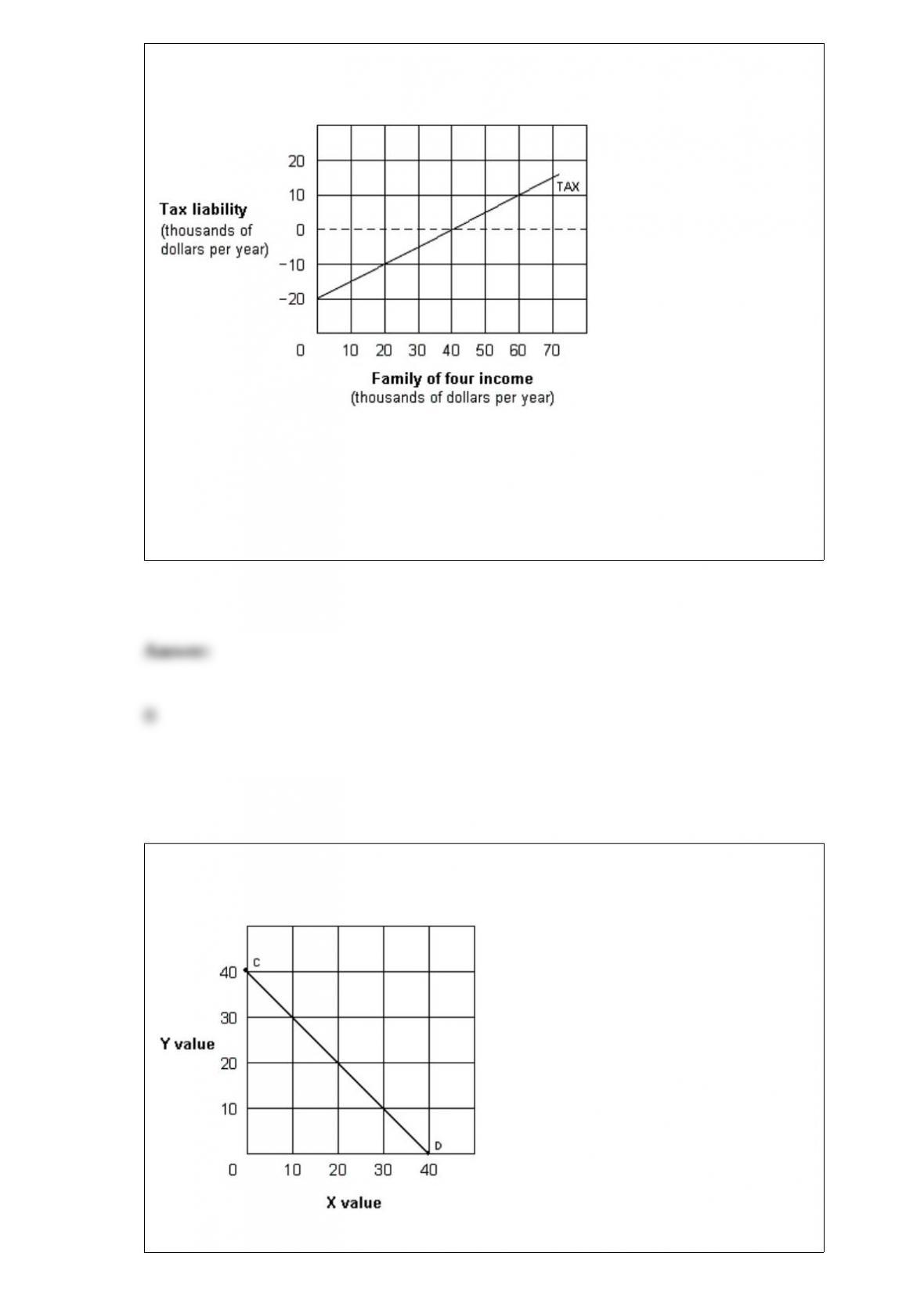
Exhibit 12-7 Negative income tax
Under the negative income tax scheme in Exhibit 12-7, families earning between
$10,000 and $40,000 would:
a. receive the maximum negative income tax payment of $20,000.
b. receive payments under the negative income tax.
c. pay no income taxes, but receive no payments.
d. None of these is true.
Exhibit 1A-5 Straight line
Straight line CD in Exhibit 1A-5 shows that:

a. increasing values for X increases the value of Y.
b. decreasing values for X decreases the value of Y.
c. there is an inverse relationship between X and Y.
d. all of these.
Negative income tax plans have the disadvantage of decreasing work incentives in
comparison to existing welfare programs without work incentives.
A monopsony hires labor up to the point where the marginal revenue product of labor
equals the wage rate.
A monopolist maximizes total revenue.

If renting videos is an inferior good, demand for this service will rise when consumer
income falls.
Food stamps and Medicaid are in-kind transfer programs.
If the price elasticity of demand for a good is elastic, then consumers are relatively
unresponsive with respect to the quantity purchased when the price changes.
Marginal utility tends to fall as a person increases his or her consumption.

A downward-sloping line has a negative slope.