
Which of the following might increase the supply curve of labor?
a. Elimination of discrimination against blacks.
b. Elimination of discrimination against females.
c. Easing licensing requirements.
d. All of these.
Which of the following is an explicit cost?
a. The opportunity cost of an owner/entrepreneur’s time invested in the firm.
b. The opportunity cost of the money the business owner/entrepreneur has invested in
the firm.
c. The wages paid to workers.
d. None of the above.
If the price elasticity of demand for a product measures .45,
a. this good has many available substitutes.
b. this good must be a nonessential good.
c. this good is a high-priced good.
d. a decrease in price will increase total revenue.
e. this good is demand price inelastic.

If a revenue-maximizing firm is told that the price elasticity of demand is equal to one,
it should:
a. raise prices 1 percent.
b. lower prices 1 percent.
c. raise prices until the elasticity becomes very high.
d. keep the price where it is.
e. lower prices until the elasticity becomes very high.
Which of the following statements best describes firms under monopolistic
competition?
a. There is little price or quality competition.
b. The firms compete, using quality, location, advertising, and price.
c. Firms do not compete using advertising.
d. There is little competition between firms.
The economic system that answers the What, How and For Whom questions by central
authority is a:
a. market economy. c. traditional economy.
b. command economy d. any of these
‘Good’ trusts were exempt from antitrust prosecution under the:
a. per se rule.
b. Sherman Act.
c. Clayton Act.
d. rule of reason.
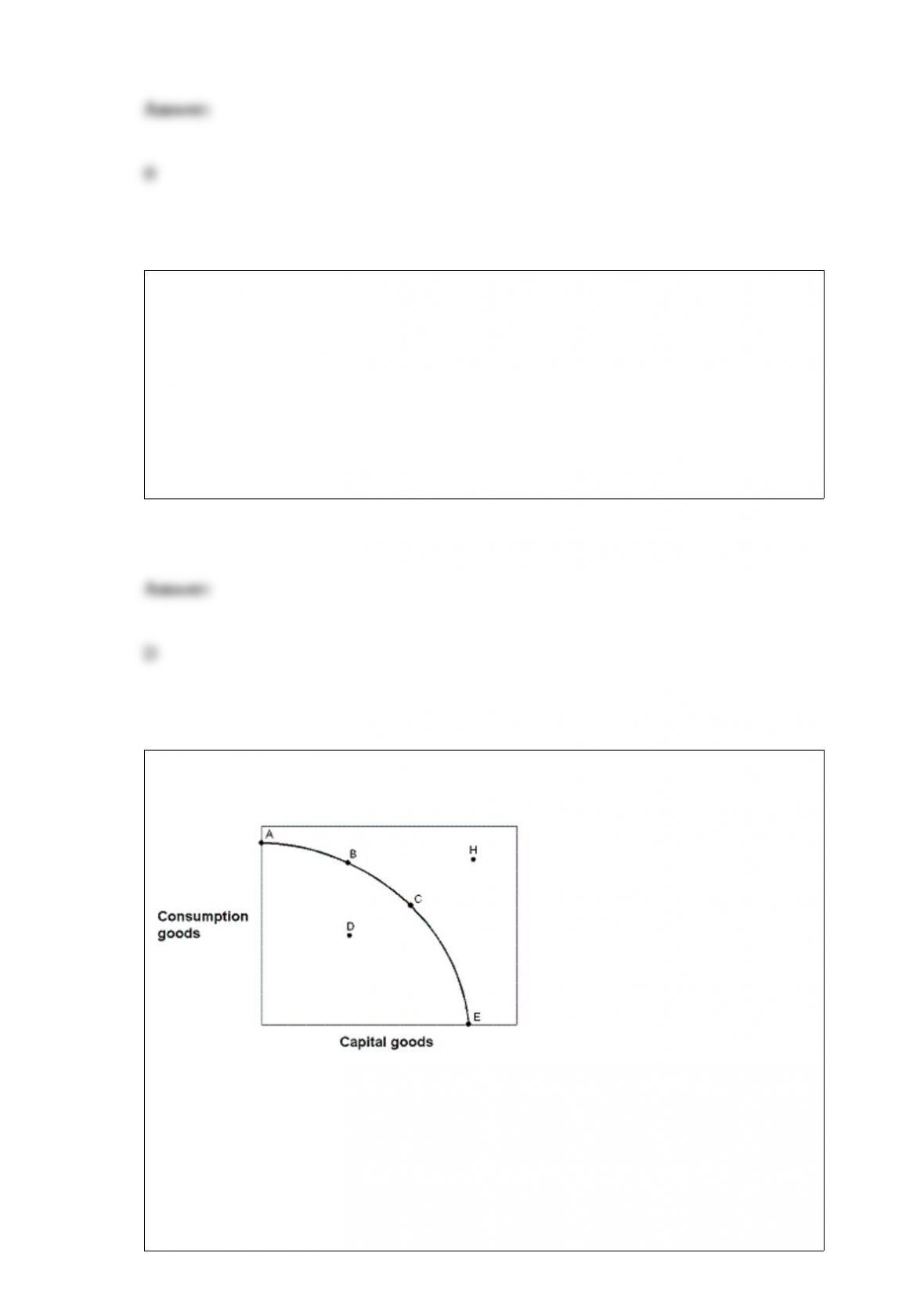
Exhibit 2-13 Production possibilities curve
In Exhibit 2-13, point H is:
a. achievable with today’s resource base.
b. not achievable today because the economy has not achieved full employment.
c. not achievable today because the economy is not at its maximum point of efficiency.

d. not achievable today because of waste.
e. not achievable today because of inadequate production capacity.
A monopolistic competitive firm is inefficient because the firm:
a. earns positive economic profit in the long run.
b. is producing at an output corresponding to the condition that marginal cost equals
price.
c. is not maximizing its profit.
d. produces an output where average total cost is not minimum.
Which fundamental economic question requires society to choose the technological and
resource mix used to produce goods?
a. The What to Produce question. c. The How to Produce question.
b. The Why to Produce question. d. The For Whom to Produce question.

An increase in demand for French fries will cause equilibrium wage rates:
a. and quantities of potato workers hired to rise.
b. and quantities of potato workers hired to fall.
c. to rise and quantities of potato workers hired to fall.
d. to fall and quantities of potato workers hired to rise.
e. and quantities of potato workers hired to stay the same.
Compare two economies A and B that start out with identical production possibilities
curves. Economy A chooses an efficient point with 6 consumption goods and 3 capital
goods, while economy B also chooses an efficient point, but with 4 consumption goods
and 5 capital goods. In the future we can predict:
a. economy A will operate inefficiently.
b. economy B will operate inefficiently.
c. economy A and economy B will grow equally fast.
d. economy A will grow faster than economy B.
e. economy B will grow faster than economy A.
According to the economic theory of labor markets, if unions are successful in raising
wages, with no accompanying increase in labor productivity, then which of the
following is true?
a. The quantity of labor demanded by profit-maximizing firms will decline.

b. The quantity of labor demanded by profit-maximizing firms will increase.
c. The quantity of labor supplied by workers will decline.
d. There will be a shortage of labor in the unionized labor market.
The price elasticity of demand between milk and soda is likely to be:
a. negative, because the goods are complements.
b. positive, because the goods are complements.
c. negative, because the goods are substitutes.
d. positive, because the goods are substitutes.
e. 0, because the goods are not usually consumed by the same person at one time.
Select the normative statement that completes the following sentence: If the minimum
wage is raised:
a. cost per unit of output will rise.
b. workers will gain their rightful share of total income.
c. the rate of inflation will increase.
d. profits will fall.
A kink in the demand curve facing an oligopolist is caused by:
a. rapidly rising marginal revenues.
b. excessive advertising.
c. the belief that competitors will follow price increases but not match price decreases.
d. the tendency of competitors to follow price reductions but not price increases.
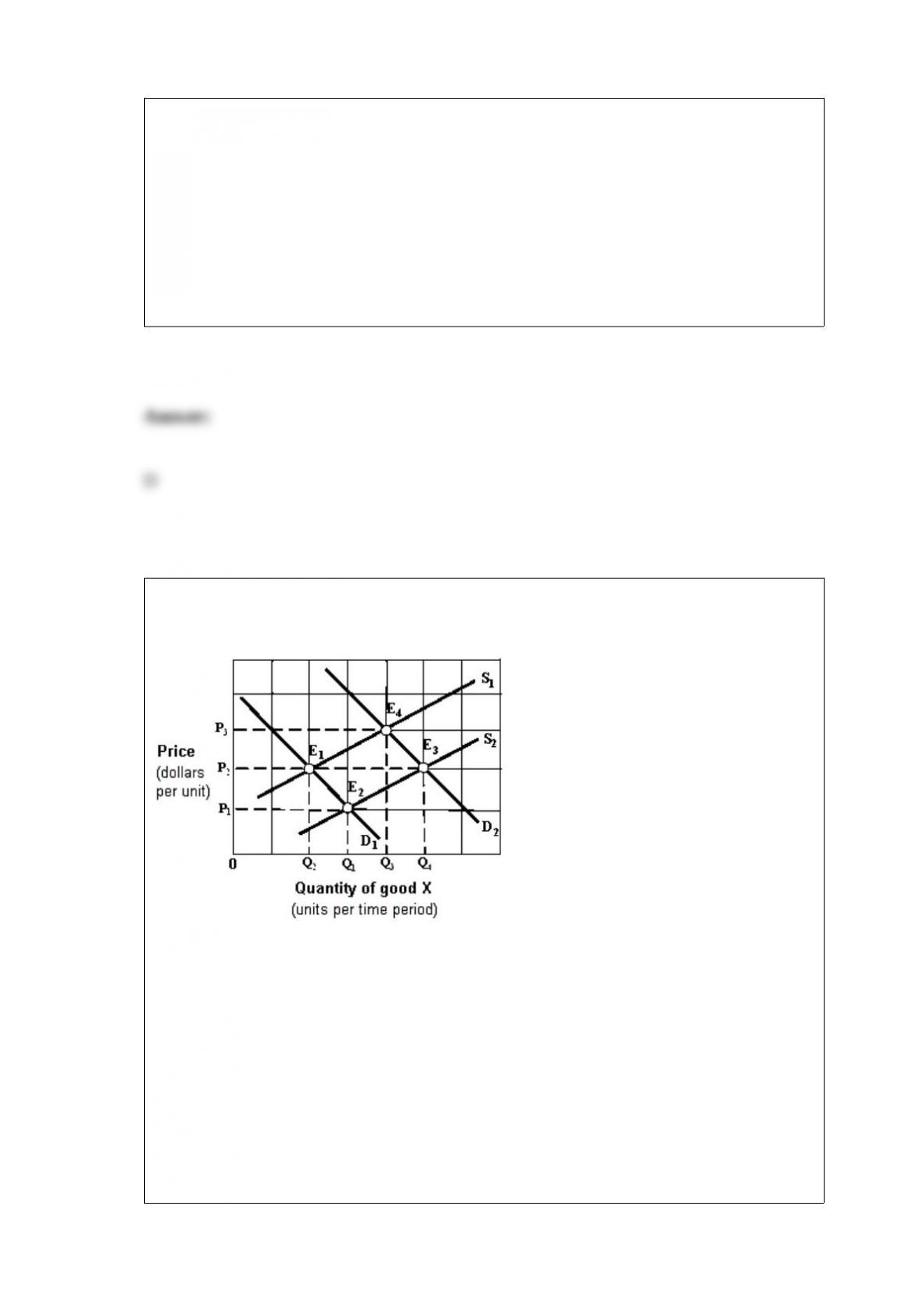
Exhibit 4-2 Supply and demand curves
The market shown in Exhibit 4-2 is initially in equilibrium at E1. Changes in market
conditions result in a new equilibrium at E2. This change is stated as a(n):
a. increase in supply and an increase in quantity demanded.
b. increase in supply and a decrease in demand.
c. decrease in supply and a decrease in quantity demanded.
d. increase in demand and an increase in supply.

Consumers buy less of a good as its price increases because:
a. production costs have risen.
b. substitute goods are now relatively cheaper.
c. the income of consumers has effectively risen.
d. the higher price will make the good more valuable to each consumer.
Incentive-based regulations:
a. set an environmental goal, but are flexible on how to achieve the goal.
b. obtain more efficiency gains is obtainable from CAC regulations.
c. effluent taxes are an example of incentive-based regulations.
d. all of the above are true.
e. none of the above are true.
A point inside a production possibilities curve reflects:
a. the law of increasing costs.

b. technological innovation.
c. less than full use of resources and technology.
d. economic efficiency.
e. a way to increase future economic growth.