
If an economy’s population grows at 3 percent and real GDP grows at 3 percent, then:
a. per capita real GDP is declining.
b. the economy’s standard of living is increasing.
c. per capita real GDP is negative.
d. per capita real GDP is constant.
e. the economy is experiencing unemployment.
During the short run, a firm has enough time to adjust:
a. its technology.
b. its fixed inputs.
c. its variable inputs.
d. all of its inputsboth fixed and variable.
The demand curve is downward-sloping because of the law of ____.
a. diminishing marginal utility
b. diminishing consumer equilibrium
c. consumer equilibrium
d. diminishing utility maximization
Suppose a previously competitive labor market turns into a monopsony. The labor
supply curve faced by the new monopsonist is:
a. above the labor supply curve under perfect competition.
b. the market supply curve of labor.
c. below the labor supply curve under perfect competition.
d. changed because workers are now more willing to supply labor.
e. perfectly horizontal.
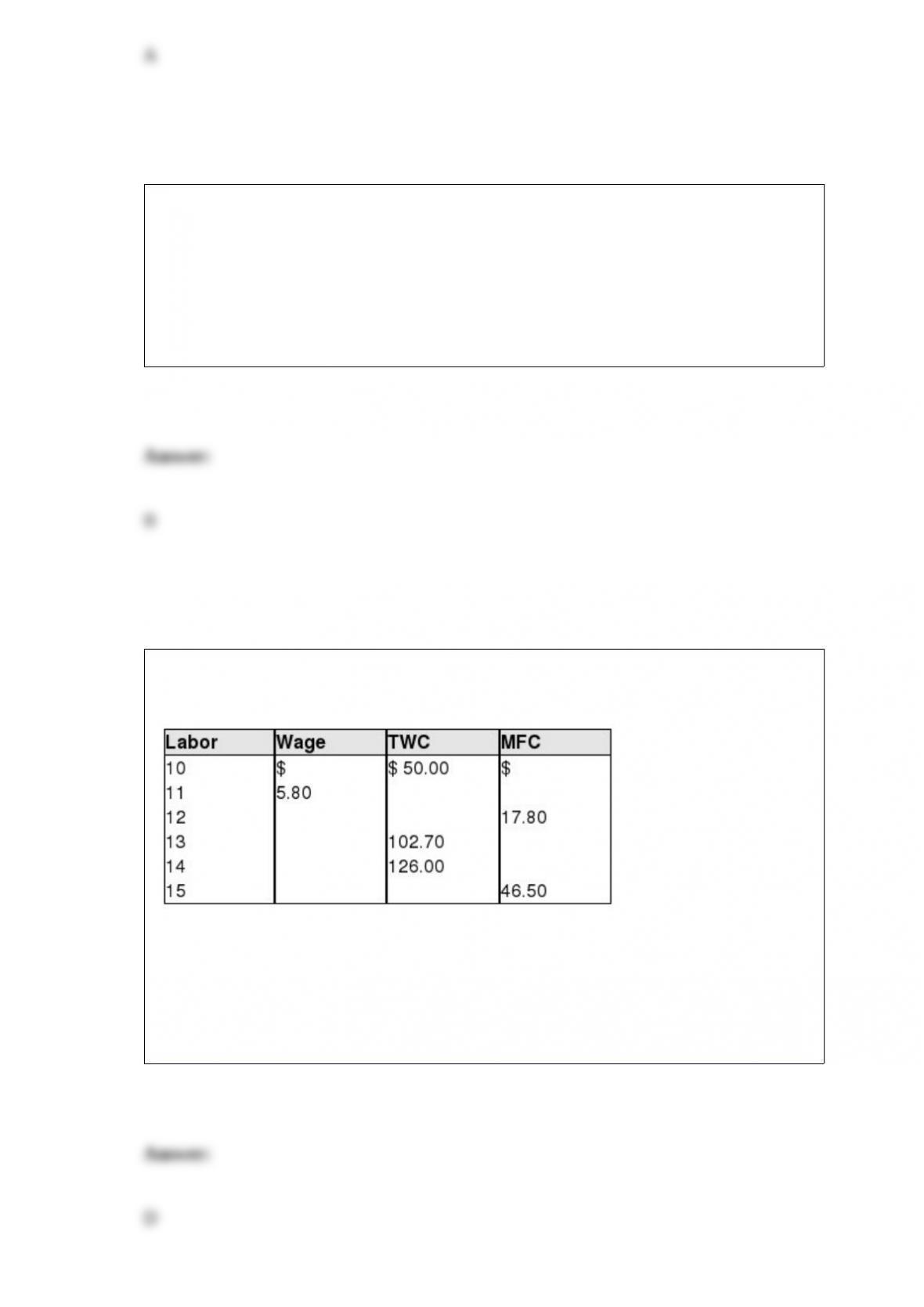
Exhibit 11-11 Labor wage and cost data
In Exhibit 11-11, the wage required to hire 14 employees is equal to:
a. $5.50.
b. $8.10.
c. $8.80.
d. $9.00.
e. $9.50.

The budget line is a(n):
a. convex curve.
b. vertical line.
c. concave curve.
d. downward-sloping straight line.
e. upward-sloping straight line.
Three of the four events described below might reasonably be expected to shift the
demand curve for Tacos to a new position. One would not shift the demand curve. The
single exception is:
a. a change in people’s tastes with respect to Tacos.
b. an increase in the money income of beef consumers.
c. a widespread advertising campaign undertaken by the producers of a product
competitive with Tacos.
d. a fall in the price of Tacos.
The purchase of U.S. assets by foreigners is a:
a. capital inflow. c. current account deficit.
b. capital outflow. d. unilateral transfer.

The amount of a good that is given up to produce another good is:
a. its dollar cost.
b. its opportunity cost.
c. its relative cost.
d. its absolute cost.
e. all of these.
The responsiveness of suppliers to changing prices is called the:
a. cross elasticity.
b. supply elasticity.
c. supply period.
d. long-run.
e. market-day.
Cartel pricing refers to the output and price choice of a cartel. This choice most closely
resembles that of a:
a. b or d

b. godfather oligopoly.
c. duopoly.
d. monopoly.
e. more competitive industry.
If a 5 percent decrease in the price of a good produces a 5 percent increase in the
quantity demanded, the price elasticity of demand is:
a. perfectly elastic.
b. perfectly inelastic.
c. elastic.
d. inelastic.
e. unitary elastic.
A third party is a person, or persons, who:
a. consume goods produced from at least two intermediate inputs.
b. avoids the transactions of the two principal parties.
c. takes risks to avoid externalities.
d. internalizes the costs of market failure.
e. is imposed upon by the activity of others.
When the opportunity cost of producing carrots increases as more carrots are produced,
then:
a. no more carrots will be produced.
b. resources are equally suited to the production of carrots and to other goods.
c. the production possibilities curve is a straight line.
d. the production possibilities curve becomes positively sloped.
e. the law of increasing costs is present.
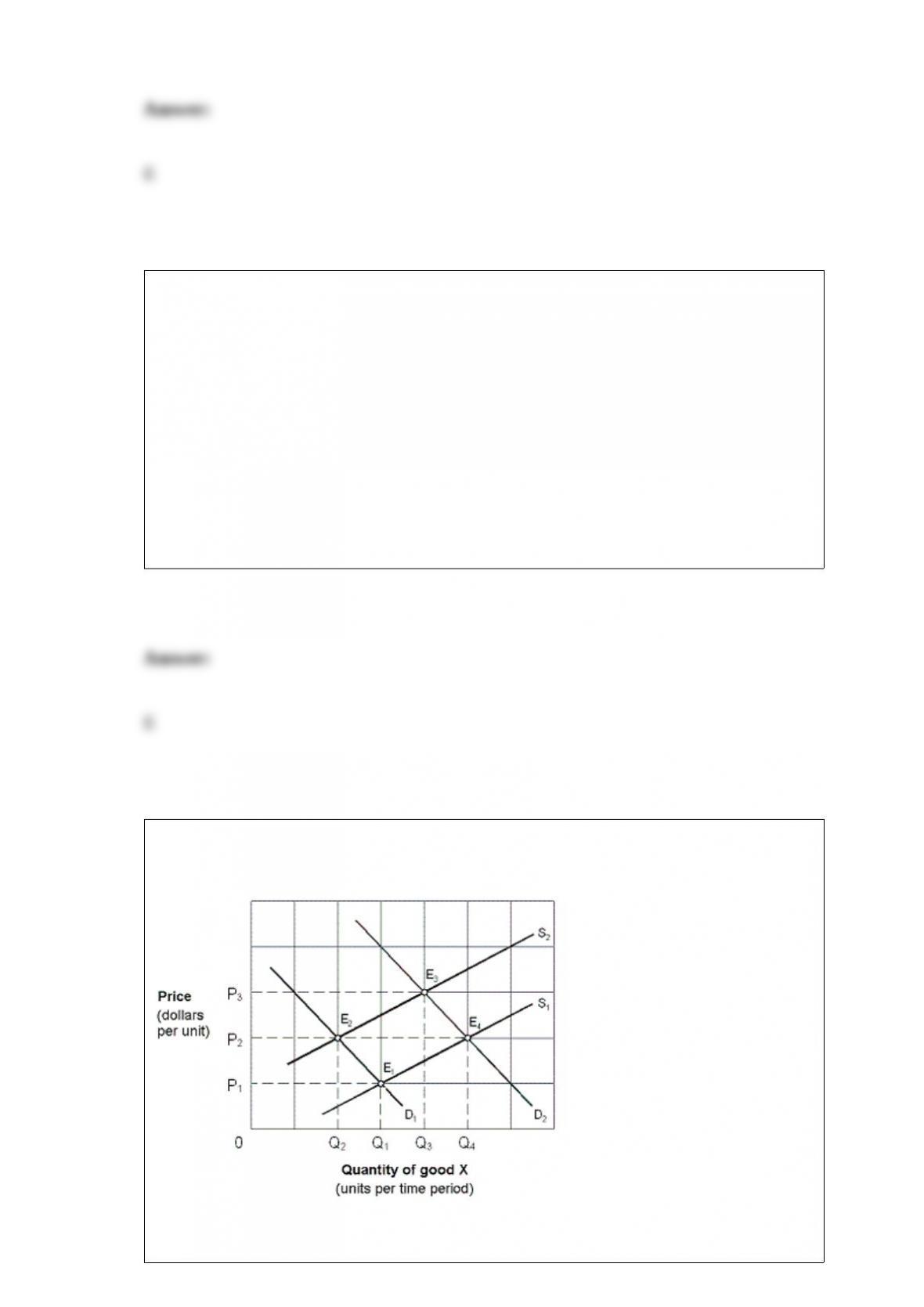
Exhibit 4-3 Supply and demand curves
The market shown in Exhibit 4-3 is initially in equilibrium at E4. Changes in market

conditions result in a new equilibrium at E3. This change is stated as a(n):
a. increase in supply and an increase in quantity demanded.
b. increase in supply and a decrease in demand.
c. decrease in supply and a decrease in quantity demanded.
d. increase in demand an increase in supply.
An economic model is:
a. a plastic scaled version of the economy.
b. a complete depiction of reality.
c. an abstraction from reality.
d. applicable to consumer behavior but not to producer behavior.
e. not an accepted tool of the economics profession.
An organization of sellers designed to coordinate their supply decisions to maximize
joint profits is called a:
a. consumer cooperative. c. regulatory agency.
b. marketing association. d. cartel.

Elasticity is a measure of:
a. the slope of a linear demand curve.
b. the slope of a supply curve.
c. relative responsiveness.
d. economic welfare.
e. consumer tastes.