
The marginal utilities associated with the first 4 units of consumption of good Y are 10,
12, 9, and 7, respectively. What is the total utility associated with the third unit?
a. 3.
b. 9.
c. 25.
d. 31.
e. The amount cannot be determined from the marginal utilities.
As a general rule, marginal utility will be less:
a. as less of the good is consumed.
b. as more of the good is consumed.
c. when average utility is at a maximum.
d. only when the good is inferior.
e. when satisfaction is less than cost.
The various combinations of goods and services that can be produced, when an
economy uses its available resources and technology efficiently, is called:
a. scarcity.
b. opportunity cost.
c. unlimited production.
d. capital accumulation.
e. production possibilities.

Two goods, X and Y, are complementary goods if the demand for X:
a. increases when the price of Y increases.
b. increases when income increases.
c. decreases when the price of Y increases.
d. increases as the price of its substitute good increases.
e. decreases as the price of its substitute good decreases.
In the U.S. balance of payments, purchases of foreign assets by U.S. residents are
tabulated as a:
a. unilateral transfer. c. current account outflow.
b. capital outflow. d. capital inflow.
Ceteris paribus, a change in the price of a good always results in a change in:
a. income.
b. tastes.
c. quantity demanded.
d. both income and tastes.
e. the price of other goods.

Economic growth may be represented by a(n):
a. leftward shift of a production possibilities curve.
b. outward shift of a production possibilities curve.
c. movement along a production possibilities curve.
d. production possibilities curve that remains fixed.
The labor supply curve facing a monopsonist is:
a. downward sloping.
b. upward sloping.
c. a horizontal line.
d. backward bending.
e. a vertical line.

Exhibit 7-1 Production of pizza data
Exhibit 7-1 shows the change in the production of pizzas as more workers are hired.
The marginal product of the labor input begins to fall with the employment of the ____
worker.
a. first
b. second
c. third
d. fourth
e. fifth
If a perfectly competitive firm sells 10 units of output at a market price of $5 per unit,
its marginal revenue per unit is:
a. $5.
b. $50.
c. more than $5 but less than $50.
d. less than $5.
The price elastic portion of the linear demand curve lies:
a. b and c.
b. above the point of unit elasticity.
c. anywhere to the left of current market prices.
d. below the point where total revenue is maximized.
e. at the intersection with the supply curve.
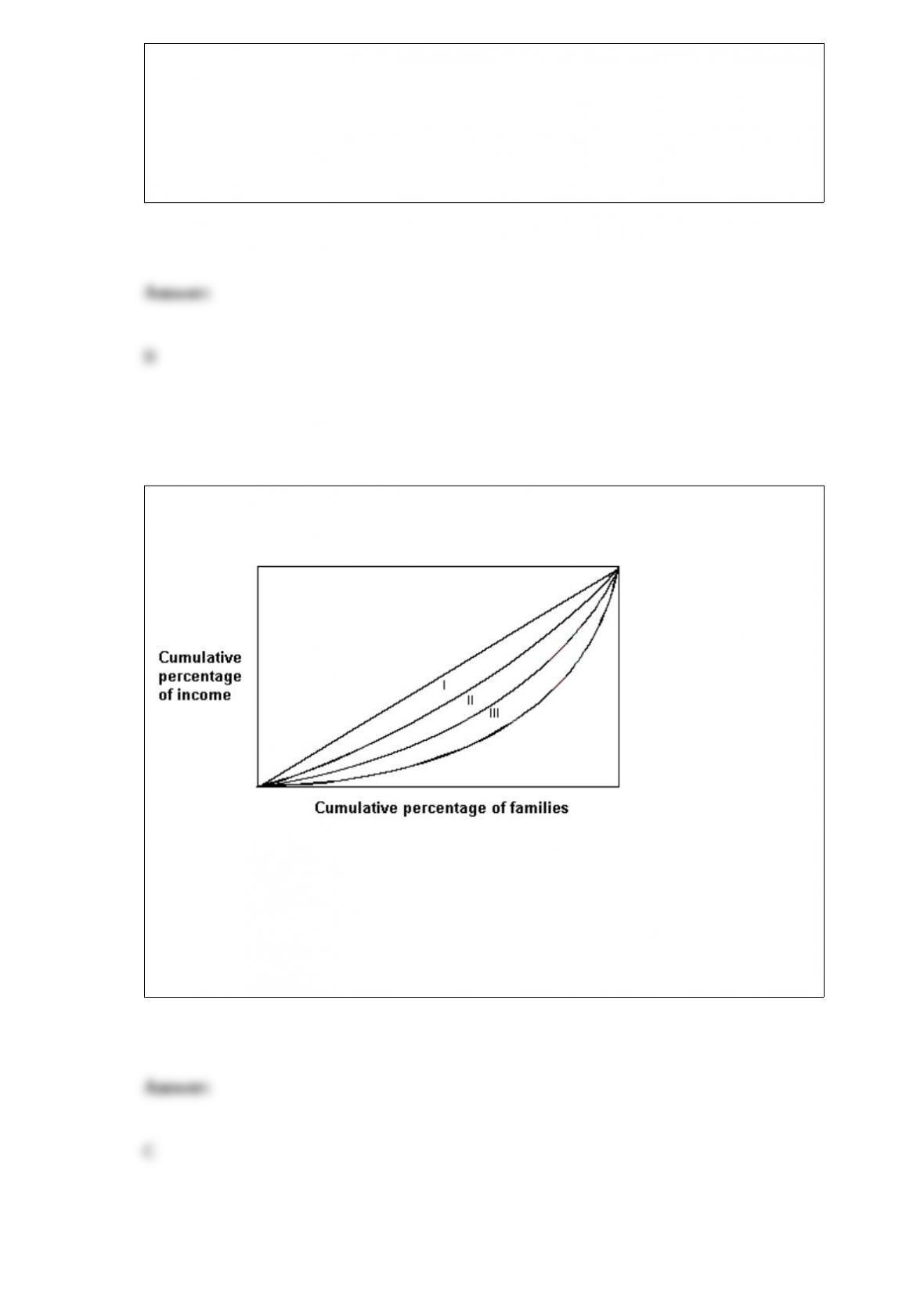
Exhibit 12-6 Lorenz curves
Exhibit 12-6 shows the Lorenz Curve for three countries, I, II, and III. Which of the
following statements is true?
a. Country I has the most unequal income distribution.
b. Country II has the most unequal income distribution.
c. Country I has the most equal income distribution.
d. Country III has the most equal income distribution.
e. Country II has a more equal income distribution than Country I.

Which of the following is true under natural monopoly?
a. The marginal cost curve will be above the average cost curve.
b. The monopolist will set price equal to marginal cost and will earn economic profits.
c. Economies of scale exist.
d. Output is produced under conditions of constant cost.
If a firm in a competitive industry is making zero economic profit but still producing, it
must be the case that:
a. MC = MR > ATC.
b. MC = MR < ATC.
c. MC = ATC > MR.
d. MC = MR = ATC.
e. this situation is not possible.
If some firms internalize their external costs by being a cleaner and more
‘environmentally friendly’ producers than other firms that do not, then which of the
following offers the best and most complete description of this situation?
a. The environmentally friendly firm will be operating at a higher marginal and average
cost than those firms that shift some costs to society in the form of external costs.
b. In a long-run competitive equilibrium in which consumers do not distinguish
between environmentally friendly and standard producers, the environmentally
producers will receive negative economic profits and be forced to change or exit.
c. Without regulations requiring firms to internalize their external costs, producers can
only afford to be environmentally friendly if consumers reward them with a price
premium.
d. None of the above is correct.
If marginal utility is positive, then total utility is:
a. constant.
b. negative.
c. increasing.
d. decreasing.
e. zero.
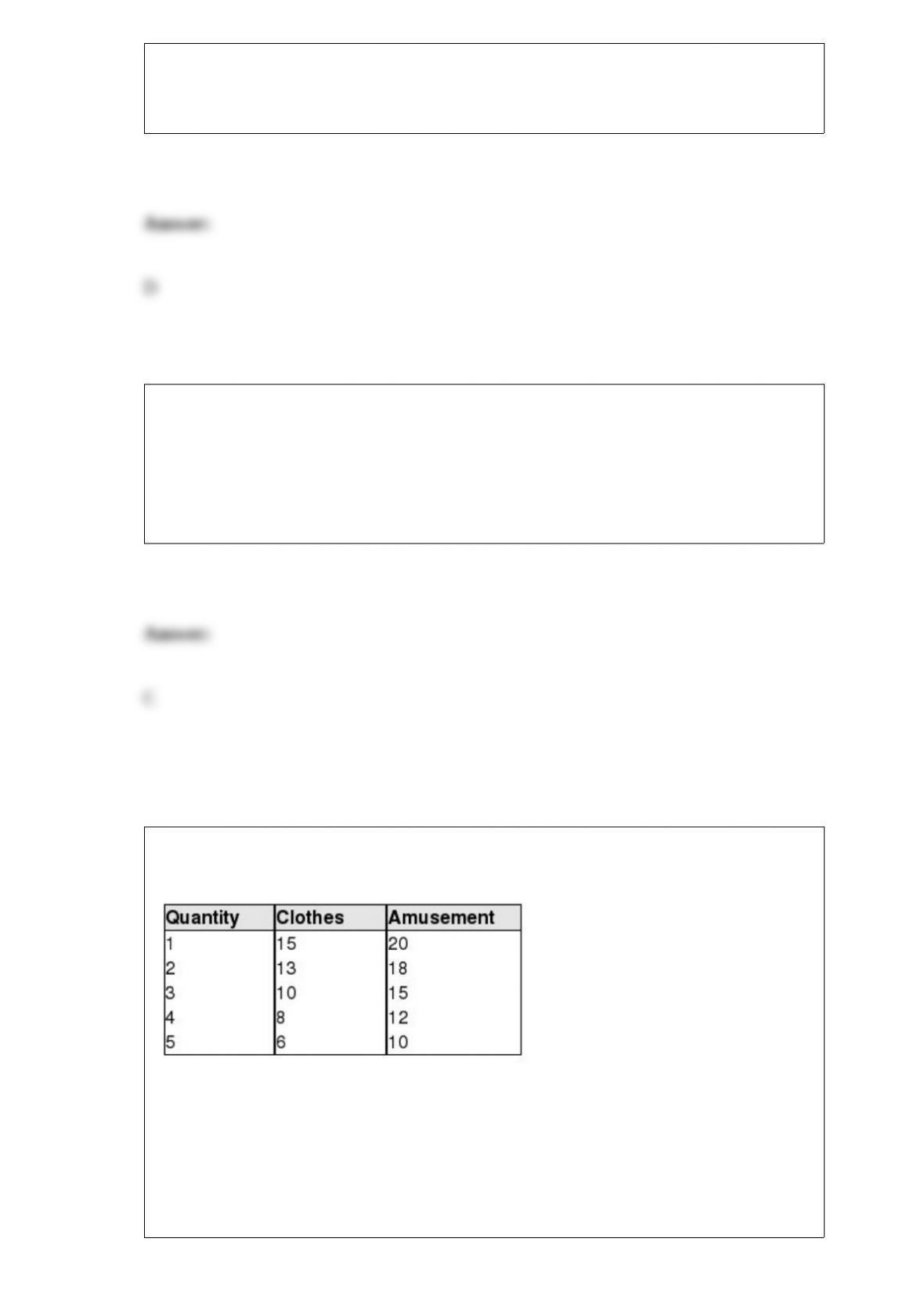
Exhibit 6-6 Marginal utility for data for clothes and amusement
Refer to Exhibit 6-6. Clothes and amusements are priced at $10 each. The marginal
utility per dollar for the first unit of amusement is:
a. 0.5.
b. 1.5.
c. 2.0.
d. 5.0.
e. 20.0.

Applying a price of labor to the law of diminishing returns generates:
a. the law of increasing costs.
b. less output as more labor is hired.
c. differences in the quality of labor.
d. a negatively-sloped labor supply curve.
e. specialization and the division of labor.
Which of the following best explains the determination of the equilibrium price of a
product?
a. Production costs. c. The interaction of supply and demand.
b. The supply of a good. d. The decisions of government.
A line that represents combinations of two goods that a consumer can purchase with a
fixed income and given price for each good is called the:
a. indifference curve.

b. demand curve.
c. budget line.
d. money line.
If a consumer’s purchases of a product increases as income increases, this good is
classified as a(n):
a. superior good.
b. inferior good.
c. substitute good.
d. complementary good.
e. normal good.
The term ‘capitalism’ refers to which of the following?
a. A religion based on amassing capital.
b. An economic system characterized by private ownership of resources, and
decentralized market allocation.
c. An economic system characterized by government ownership of resources and
centralized allocation.
d. None of the above answers are correct.
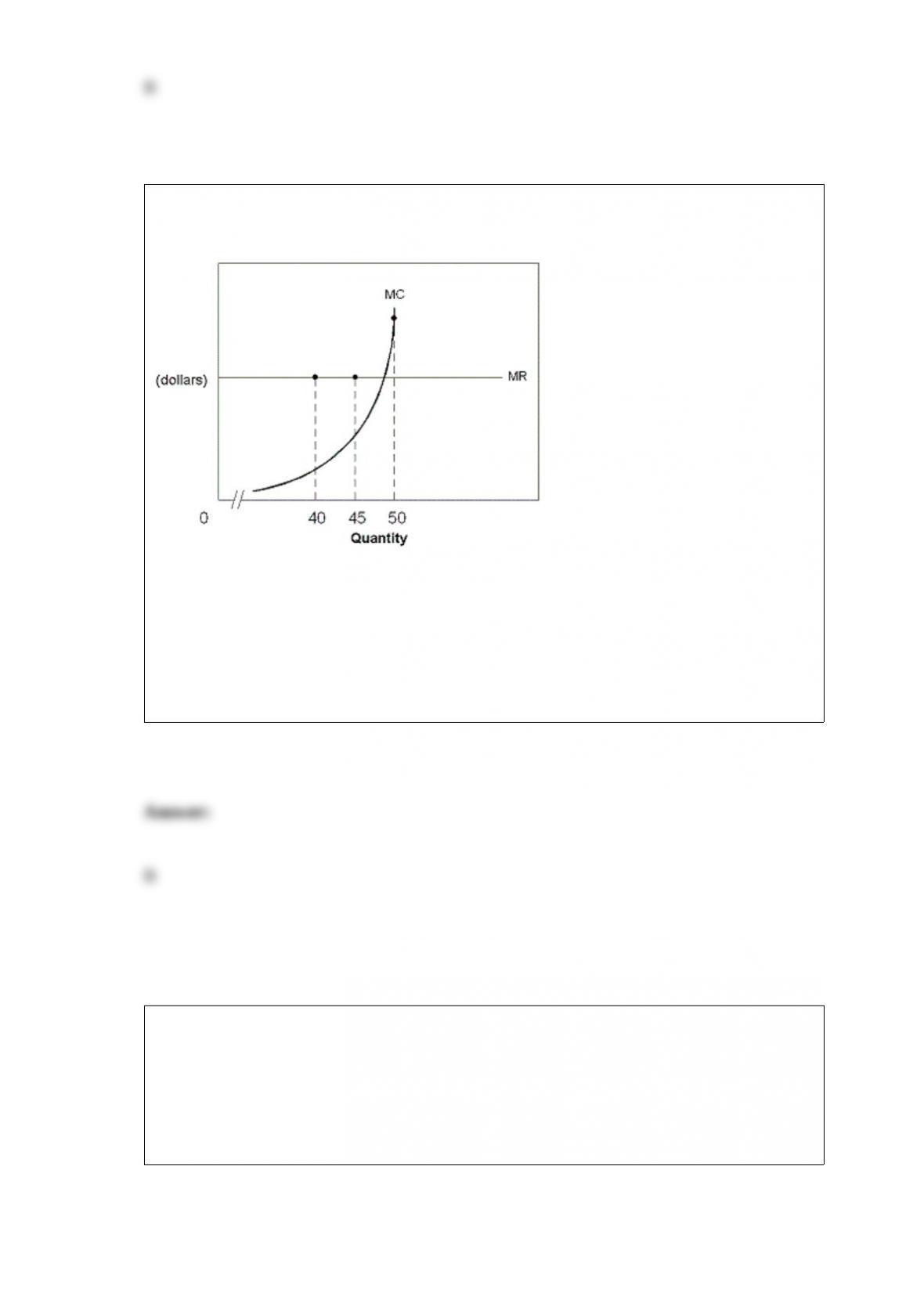
Exhibit 8-5 A firm’s MR and MC curves
In Exhibit 8-5, suppose a firm is currently producing 45 units of output. What would
you advise this firm to do?
a. Shut down.
b. Increase output.
c. Stay at its current output
d. Decrease output
e. Decrease price.
If a firm decreases output when MR < MC, then:
a. profit will equal zero.
b. profit will increase.
c. profit will decrease.
d. profit will remain the same.
e. the firm is minimizing losses.