Microeconomics is concerned with:
a. some specific market in the economic system.
b. the entire economic system.
c. reducing national unemployment and inflation rates.
d. what causes changes in the overall level of economic activity.
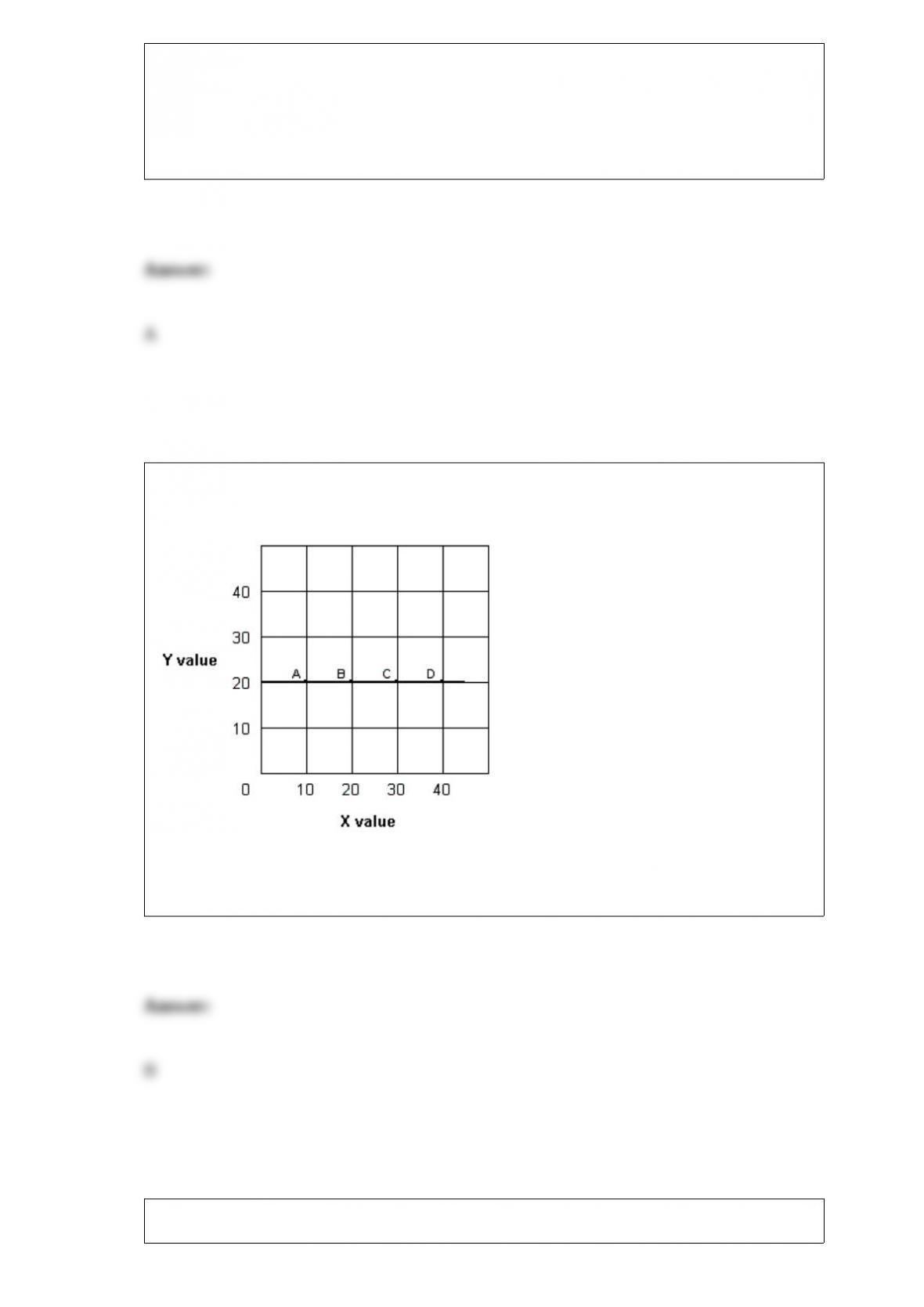
Exhibit 1A-6 Straight line
In Exhibit 1A-6, the slope of straight line A-D is:
a. positive. c. negative.
b. zero. d. variable.
In a perfectly competitive industry, assume there is a permanent increase in demand for

a product. The process of transition to a new long-run equilibrium will include:
a. the exit of firms.
b. temporarily lower production costs.
c. both a and b.
d. neither a nor b.
Cash payments to a steel mill for steel used in production would be an example of:
a. sunk costs.
b. fixed costs.
c. explicit costs.
d. implicit costs.
e. entrepreneurial costs.
Between 1929 and 2005 in the United States, the Lorenz curve became:
a. less bowed outward.
b. more bowed outward.
c. a straight line.
d. a downward-sloping curve.

Complete the following analogy: A criminal is to a police artist’s sketch as the economy
is to:
a. money.
b. an economic model.
c. a resource.
d. Ceteris paribus.
e. scarcity.
In order for the law of diminishing returns to be present, we must have:
a. at least one factor of production to be fixed.
b. output decreasing as more laborers are hired.
c. the price of labor increasing as more workers are hired.
d. simultaneous changes in labor and capital.
e. double the output when labor input is doubled.
Exhibit 3-11 Demand and supply curves
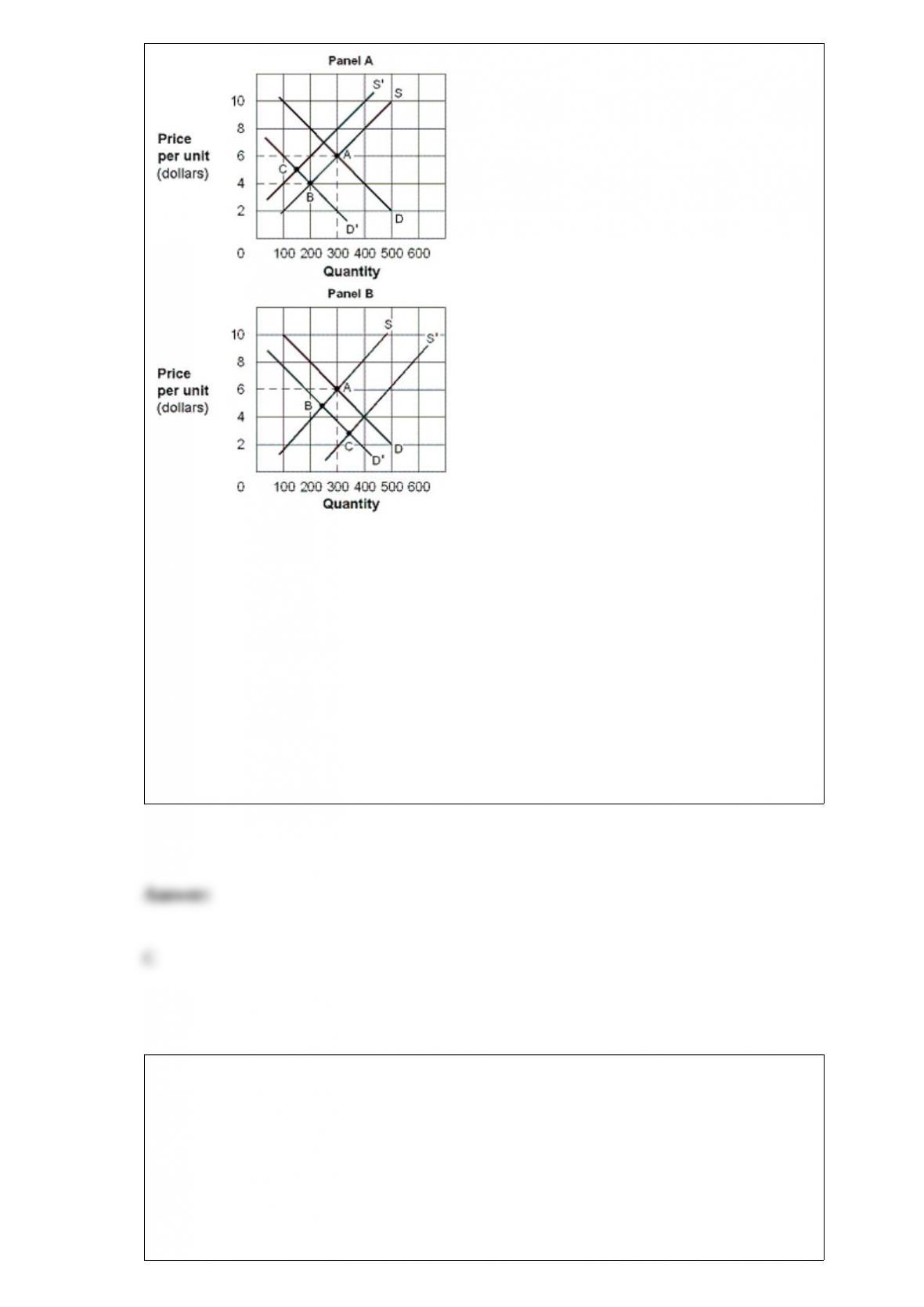
In Exhibit 3-11, in Panel A the movement from A to B describes a(n):
a. increase in demand and an increase in the quantity supplied.
b. increase in the quantity demanded and an increase in supply.
c. decrease in demand and a decrease in the quantity supplied.
d. decrease in the quantity demanded and a decrease in supply.
e. decrease in the quantity demanded and an increase in supply.
Interlocking directorates are illegal under the ____ whether or not the effect may be to
substantially lessen competition.
a. Clayton Act
b. Robinson-Patman Act
c. Sherman Antitrust Act

d. Federal Trade Commission Act
e. Interstate Commerce Act
The law of increasing costs holds that the opportunity cost:
a. of a good decreases as the quantity of the good produced increases.
b. of a good is proportional to the resources used in its production.
c. of a good increases as more of the good is produced.
d. of a good does not change with the resources used its production.
e. changes as more of the good is produced.
If Mr. Smith thinks the last dollar spent on shirts yields less satisfaction than the last
dollar spent on cola, and Smith is a utility-maximizing consumer, he should:
a. decrease his spending on cola.
b. decrease his spending on cola and increase his spending on shirts.
c. increase his spending on shirts.
d. increase his spending on cola and decrease his spending on shirts.

The MFC curve increases for a monopsonist because:
a. hiring more workers raises total labor costs.
b. output price rises as a firm’s market power increases.
c. hiring more workers does not affect wages.
d. the later workers hired are less productive.
e. as more workers are hired, all workers receive higher wages.
Coffee and tea are:
a. complements.
b. substitutes.
c. inferior goods.
d. unrelated goods.
e. nonmarket goods.
Exhibit 7-9 Cost schedule for firm X
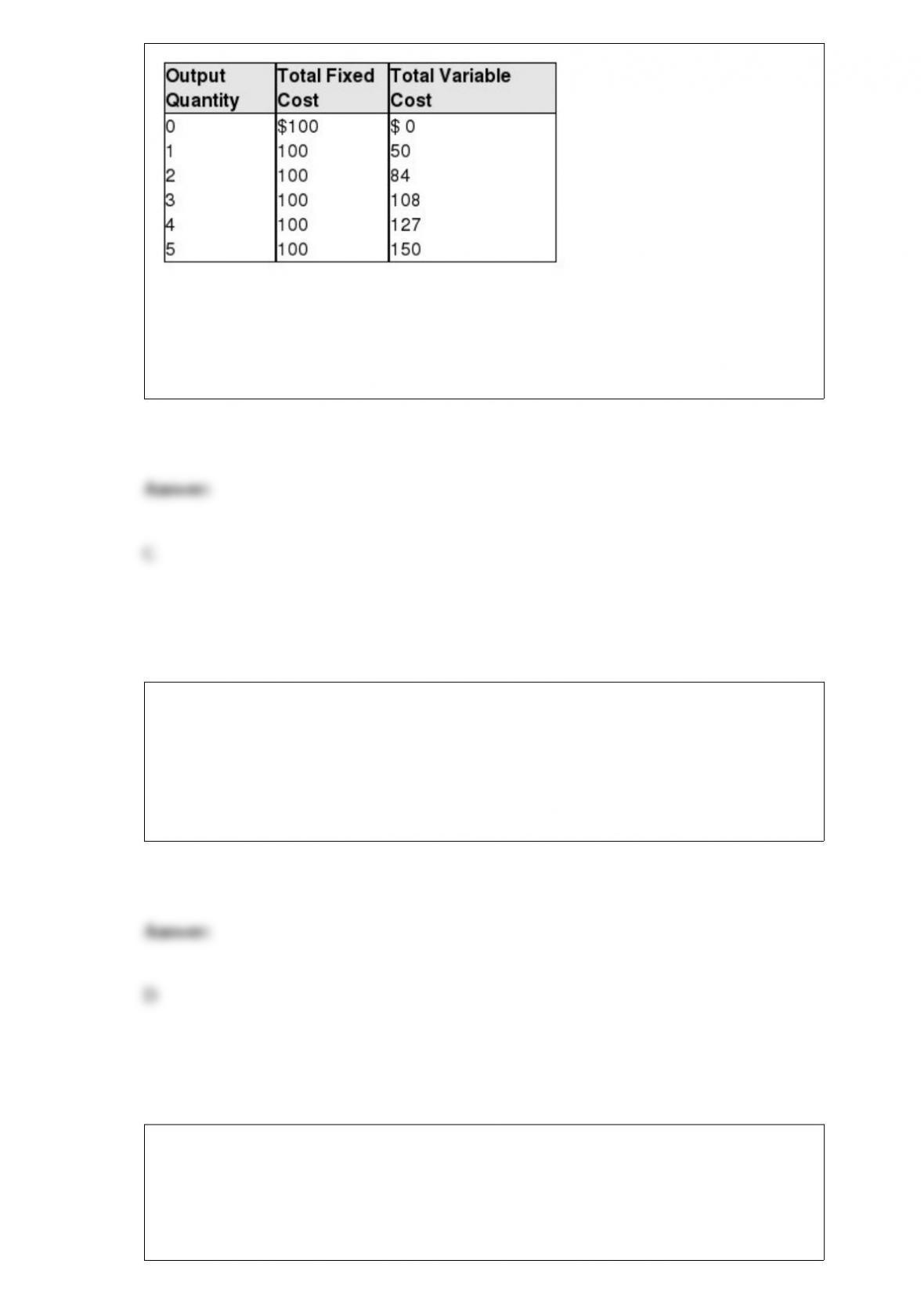
As shown in Exhibit 7-9, the marginal cost of producing the third unit is:
a. $50.
b. $16.
c. $24.
d. $23.
Compared to higher-income families, low-income families would demand
proportionately more of which of the following kinds of goods?
a. Luxury goods.
b. Substitute goods.
c. Normal goods.
d. Inferior goods.
A graph that shows the percentage of the families on one axis and the percentage of
income on the other is called the:
a. Budget-distribution curve.
b. Income-consumption curve.
c. Lorenz curve.
d. Marx curve.
The average fixed cost of a firm equal:
a. implicit costs divided by output.
b. explicit costs divided by output.
c. total cost minus variable cost.
d. total cost minus total variable cost divided by output.
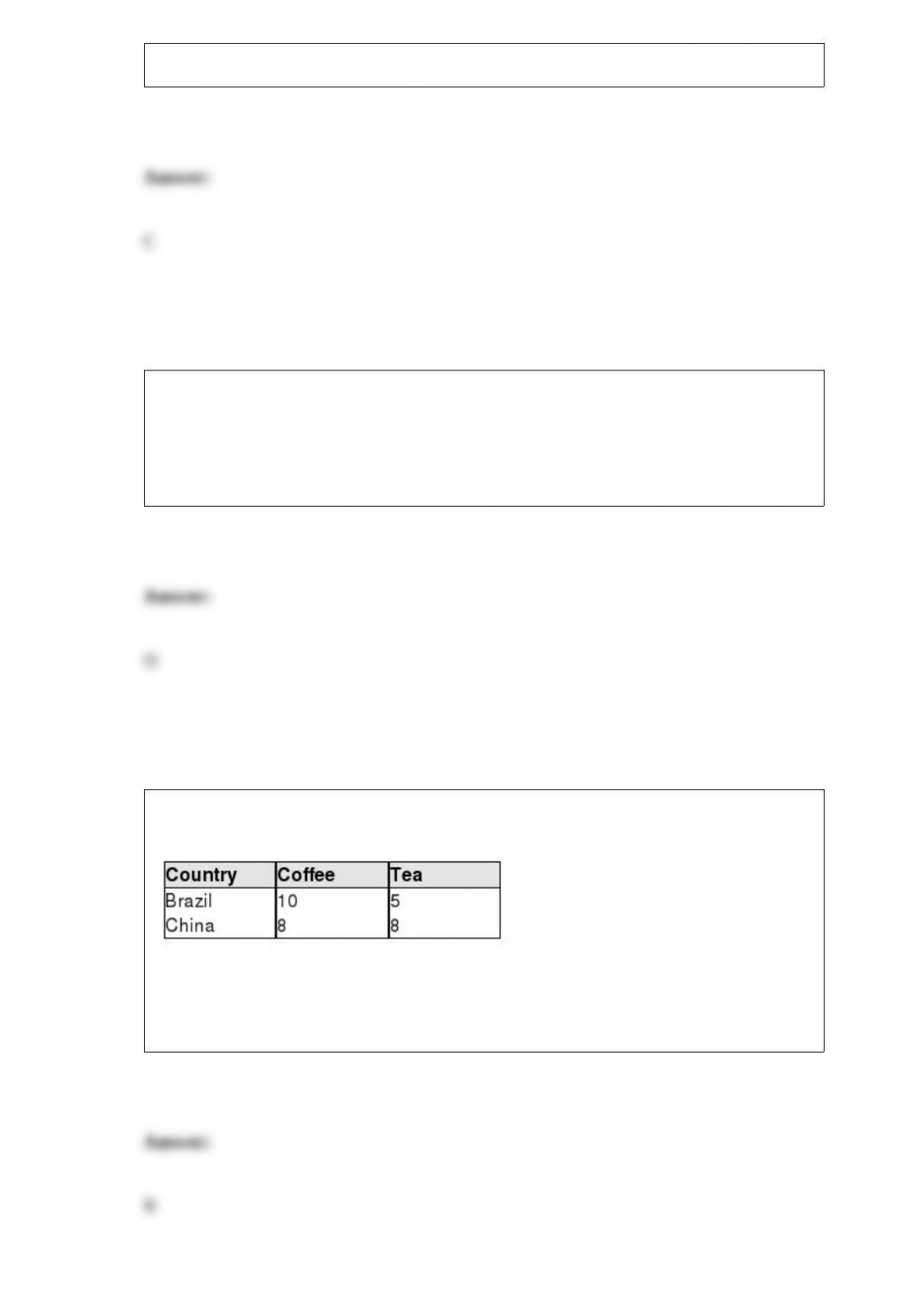
Exhibit 15-4 Coffee and tea output (pounds per hour)
As shown in Exhibit 15-4, compared to Brazil, China has a comparative advantage in
the production of:
a. coffee. c. both coffee and tea.
b. tea. d. neither coffee nor tea.

Suppose Tucker Inc. is willing to sell one gizmo for $10, a second gizmo for $15, a
third for $20, and the market price is $25. What is Tucker Inc.’s producer surplus?
a. $10 c. $30
b. $15 d. $50
Which of the following correctly lists the three fundamental economic questions?
a. If to produce? Why to produce? When to produce?
b. If to produce? What to produce? How to produce?
c. Why to produce? What to produce? How to produce?
d. What to produce? How to produce? For whom to produce?
Exhibit 6A-3 Consumer equilibrium
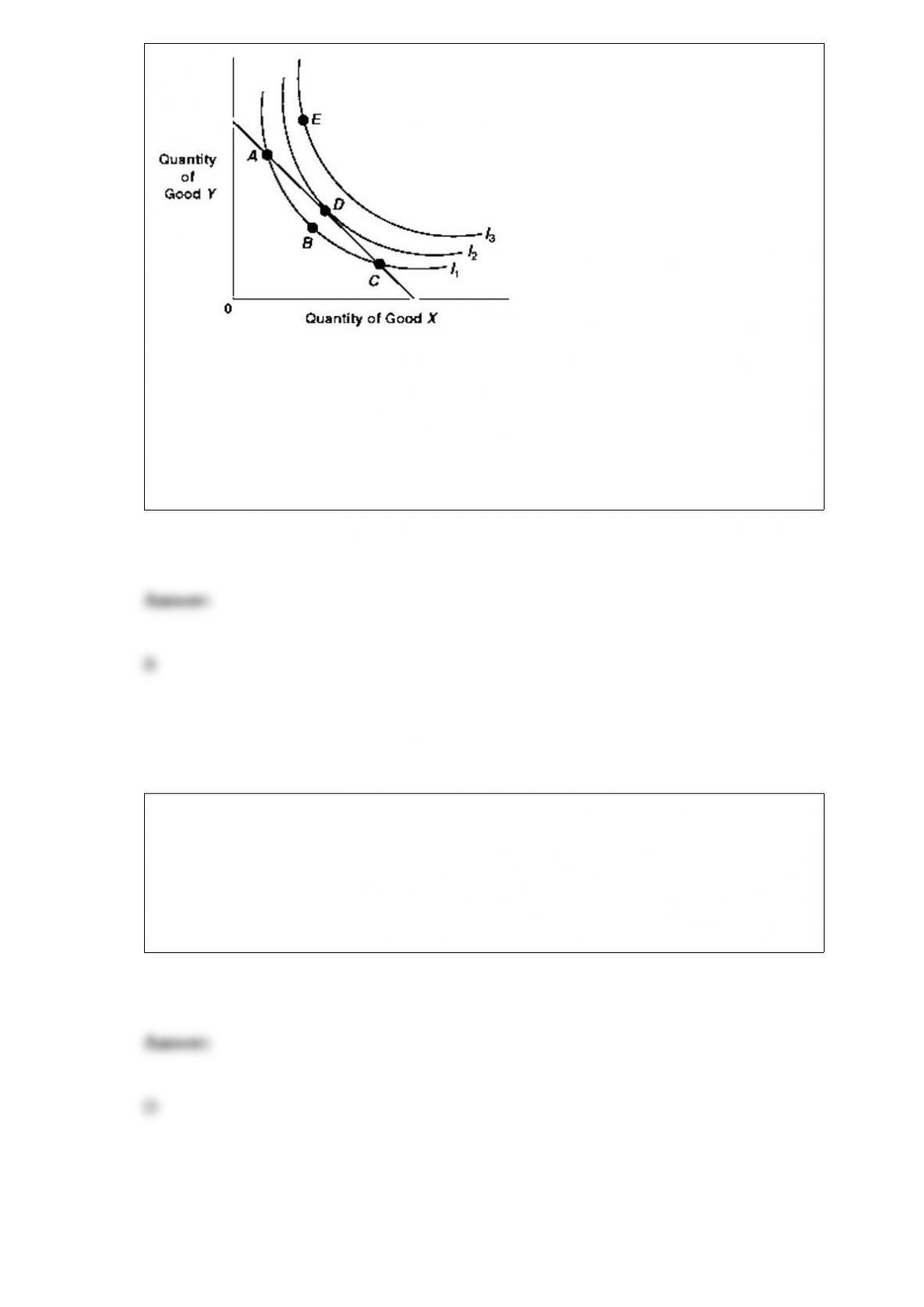
Given the budge line and indifference curves shown in Exhibit 6A-3, consumer
equilibrium occurs at a tangency to which of the following indifference curves?
a. I1.
b. I2.
c. I3.
d. I1 or I2.
Normative economics is:
a. usually incorrect.
b. a statement of fact.
c. the analysis of what is.
d. the study of what ought to be.
e. free of value judgments.