
What type of economic analysis is limited to testable, verifiable statements?
a. Macroeconomics. c. Positive economics.
b. Entrepreneurial economics. d. Normative economics.
Starting in 1964, the U.S. government has defined the poverty line as income at or
below ________ the amount of money needed to buy a minimum diet for all family
members.
a. two times
b. three times
c. four times
d. five times
Exhibit 2-2 Production possibilities curve
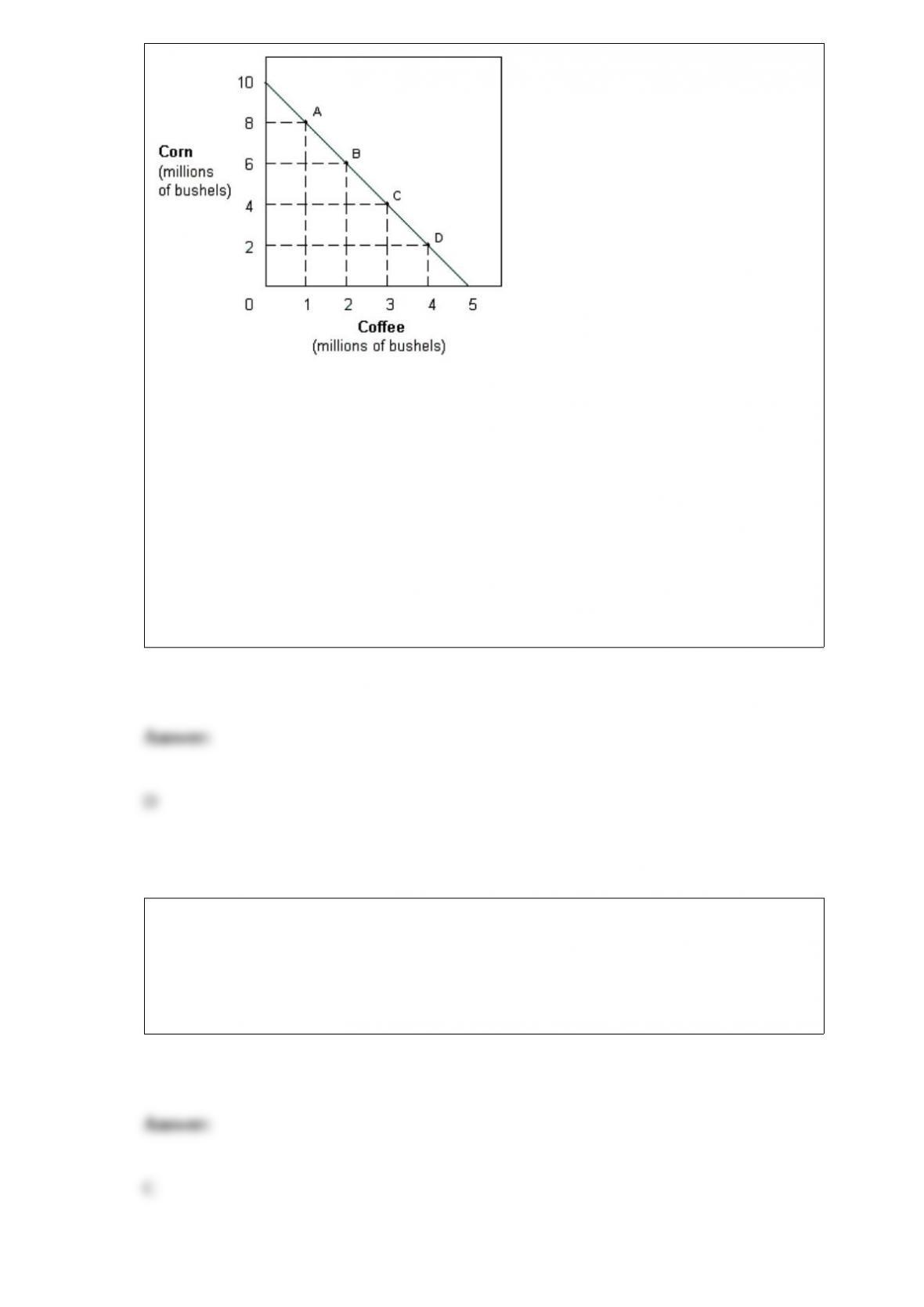
The production possibilities in Exhibit 2-2 indicates that the opportunity cost of corn is:
a. increasing.
b. decreasing.
c. zero.
d. constant.
e. indeterminate.
The change in total cost that results from the production of one additional unit is called:
a. marginal revenue.
b. average variable cost.
c. marginal cost.
d. average total cost.

If the economy is in recession and the number of used baby clothing stores increases,
then:
a. used baby clothes are a necessity.
b. used baby clothes are an inferior good.
c. used baby clothes are a normal good.
d. new baby clothes are a luxury.
e. used baby clothes have price-elastic demand.
In Exhibit 9-3, what is the maximum hourly profit that GeneTech can earn from its
vaccine?
a. $1,500.
b. $3,000.
c. $4,500.
d. $10,500.
The slope of an indifference curve is equal to the ratio of the ____ of the good on the
horizontal axis to the ____ of the good on the vertical axis.
a. marginal product (MP); total value (TV)
b. marginal utility (MU); marginal utility (MU)
c. price (P); price (P)
d. total utility (TU); price (P)
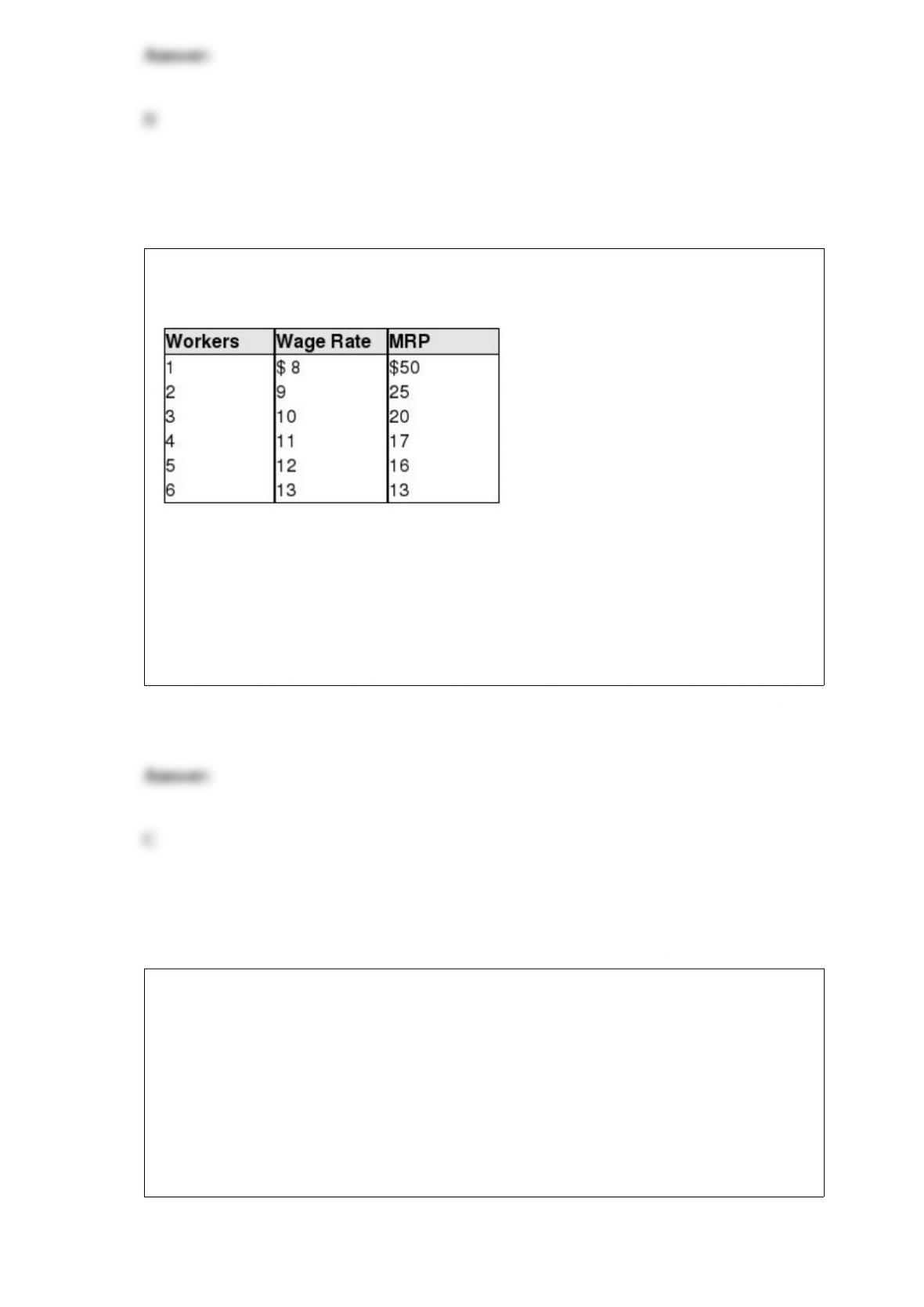
Exhibit 11-13 A monopsonist’s supply and marginal revenue product data
In Exhibit 11-13, what is the marginal factor cost when the monopsonist hires 4
workers?
a. $11.
b. $16.
c. $14.
d. $17.
e. $12.
Mutual interdependence among firms in an oligopoly means that:
a. firms never practice price leadership.
b. firms never form a cartel.
c. it is difficult to know how firms will react to decisions of rivals.
d. no formal agreement is possible among firms.
Assume Qs represents the quantity supplied at a given price and Qd represents quantity
demanded at the same given price. Which of the following market conditions produces
an upward movement of the price?
a. Qs = 1,000, Qd = 750. c. Qs = 750, Qd = 1,000.
b. Qs = 750, Qd = 750. d. Qs = 1,000, Qd = 1,000.
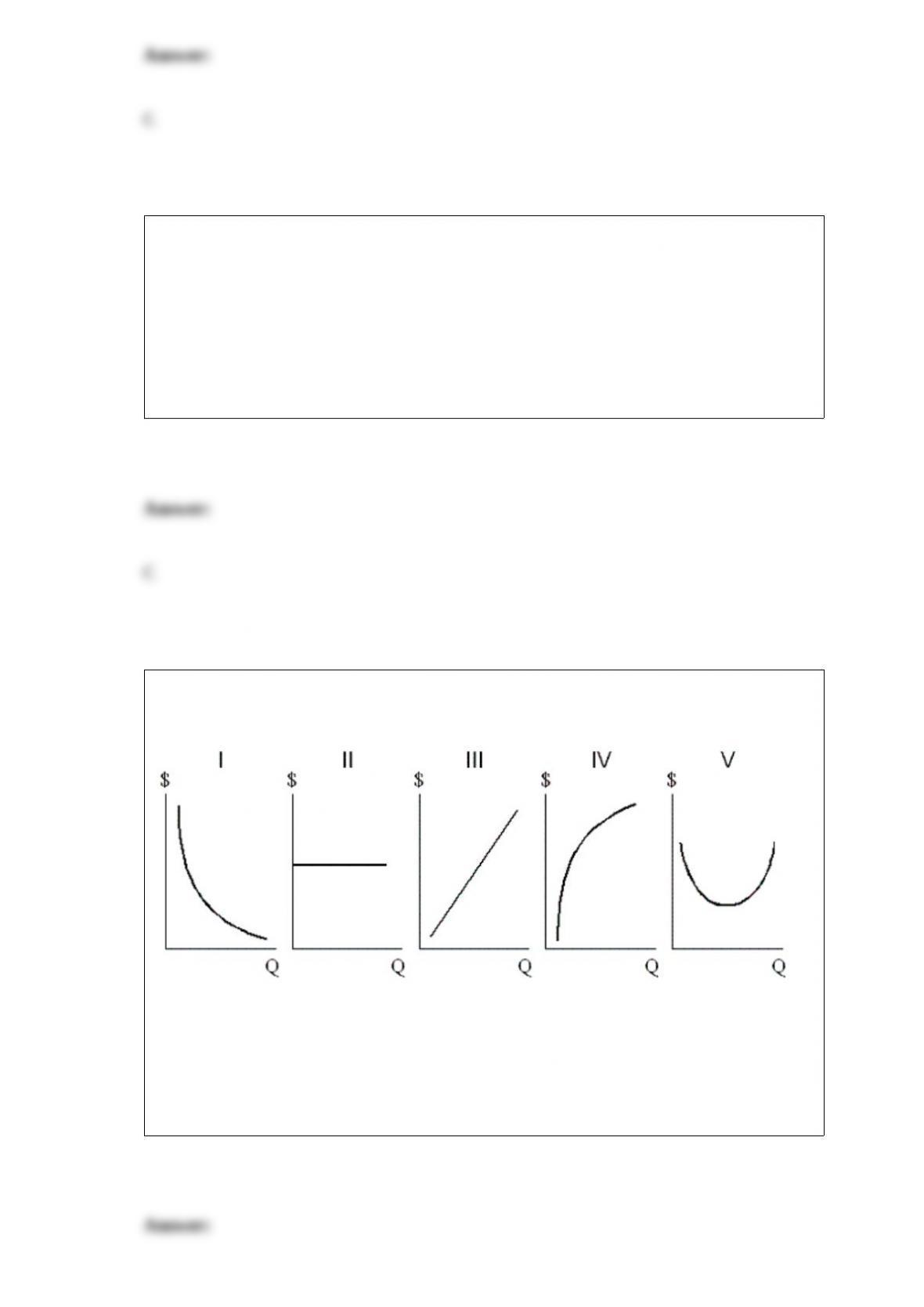
Exhibit 7-13 Cost curves
In Exhibit 7-13, AFC is shown by the graph labeled:
a. I.
b. II.
c. III.
d. IV.
e. V.

A perfectly competitive firm’s short-run supply curve is the:
a. average total cost curve.
b. demand curve above the marginal revenue curve.
c. same as the market supply curve.
d. marginal cost curve above the average variable cost curve.
The minimum point on the marginal cost curve corresponds to the:
a. maximum point on the total cost curve.
b. minimum point on the total cost curve.
c. inflection point on the total variable cost curve.
d. midpoint of the total cost curve.
Assume that peanut butter and jelly are complementary goods. A decrease in the
number of peanut butter suppliers will cause the:
a. demand for peanut butter to increase.
b. supply of peanut butter to increase.
c. demand for jelly to increase.
d. demand for jelly to decrease.
e. supply of jelly to decrease.

An increase in the demand for peanut butter, a normal good, can be caused by a(n):
a. decrease in consumer income.
b. increase in the price of jams, jellies, and preserves.
c. decrease in the price of bread.
d. drought in Georgia that destroyed 30 percent of the peanut crop.
e. decrease in the price of bologna.
Assuming that professional and college football are substitutes, an increase in the ticket
price for professional football, other things being equal, will:
a. increase the demand for college football tickets.
b. decrease the demand for college football tickets.
c. not change the demand for college football tickets.
d. decrease the demand for professional football games.
In the short run, a perfectly competitive firm’s most profitable level of output is where:
a. total revenue minus total cost is at a maximum.

b. marginal cost equals marginal revenue.
c. Both of the above.
d. Neither of the above.
Under a per se approach to the antitrust laws,
a. the government must prove some anticompetitive outcome from the act.
b. large size alone can be an antitrust violation.
c. the action will pass antitrust scrutiny if it is shown to be reasonable.
d. the only real question is whether the prices charged are reasonable.
e. the courts have ruled antitrust laws unconstitutional
Assume a competitive market has firms earning large economic profits. What is
expected to happen over time in this competitive market and to firm’s profits?

A perfectly competitive firm is a price taker, but a monopoly is a price maker.
The Coase Theorem states that the public sector can achieve environmental efficiency,
as long as property rights are clearly assigned.
A black market may arise when government imposes a price ceiling.
In recent years, the poorest 20 percent of the U.S. population received approximately 15
percent of the total income.

Combating the “greenhouse effect” has classic free-rider problems.