
Suppose that the Zubians can produce 1000 pounds of flour per hours, or catch 500
pounds of fish per hour. In contrast, the Zirconians can produce 1800 pounds of flour
per hour, or catch 300 pounds of fish per hours. What is the comparative advantage of
the Zubians?
a. Flour.
b. Fish.
c. Neither flour nor fish.
d. Both flour and fish.
The sum of the explicit and implicit costs incurred in the production process is called:
a. fixed cost.
b. sunk cost.
c. marginal cost.
d. total cost.
If a chemical factory causes noxious fumes to be emitted in the neighborhood, a third
party would be:
a. workers at the factory.
b. factory managers.
c. chemical customers.
d. local homeowners.
e. owners of the factory.

Assume that an oligopolist has a kinked demand curve. Suppose that the marginal cost
curve passes through the gap in the marginal revenue curve. This means price and
output will be shown by a point:
a. above the curve.
b. below the curve.
c. at the kink
d. on the upper part of the curve.
e. on the lower part of the curve.
The price elasticity of demand coefficient for a good will be greater:
a. if close substitutes exist.
b. if minor complements exist.
c. in the short-run.
d. if a small portion of the budget will be spent on it.
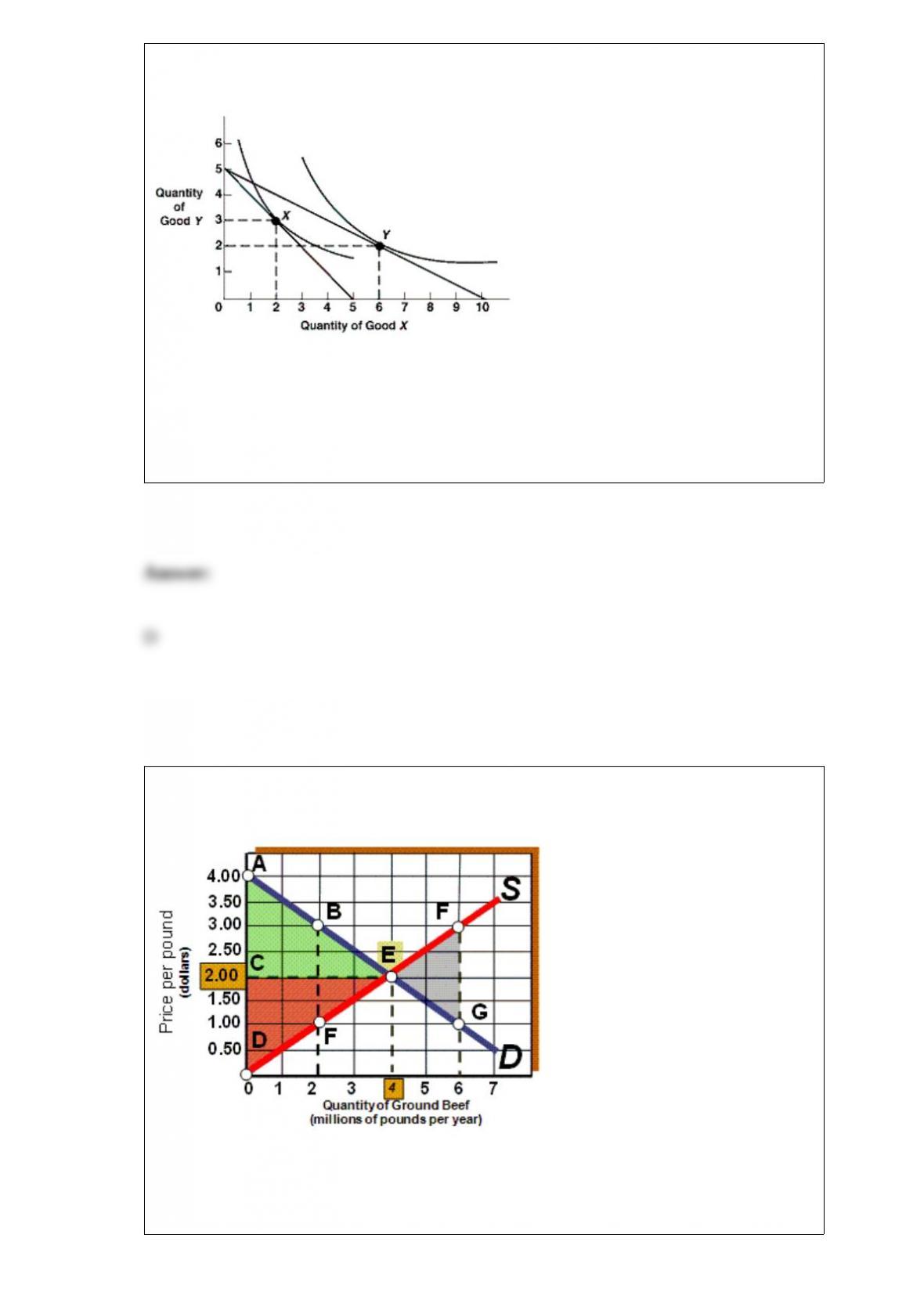
Exhibit 6A-5 Consumer equilibrium
As shown in Exhibit 6A-5, the marginal rate of substitution (MRS) at point X is equal
to:
a. 0.75.
b. 2.0.
c. 0.5.
d. 1.0.
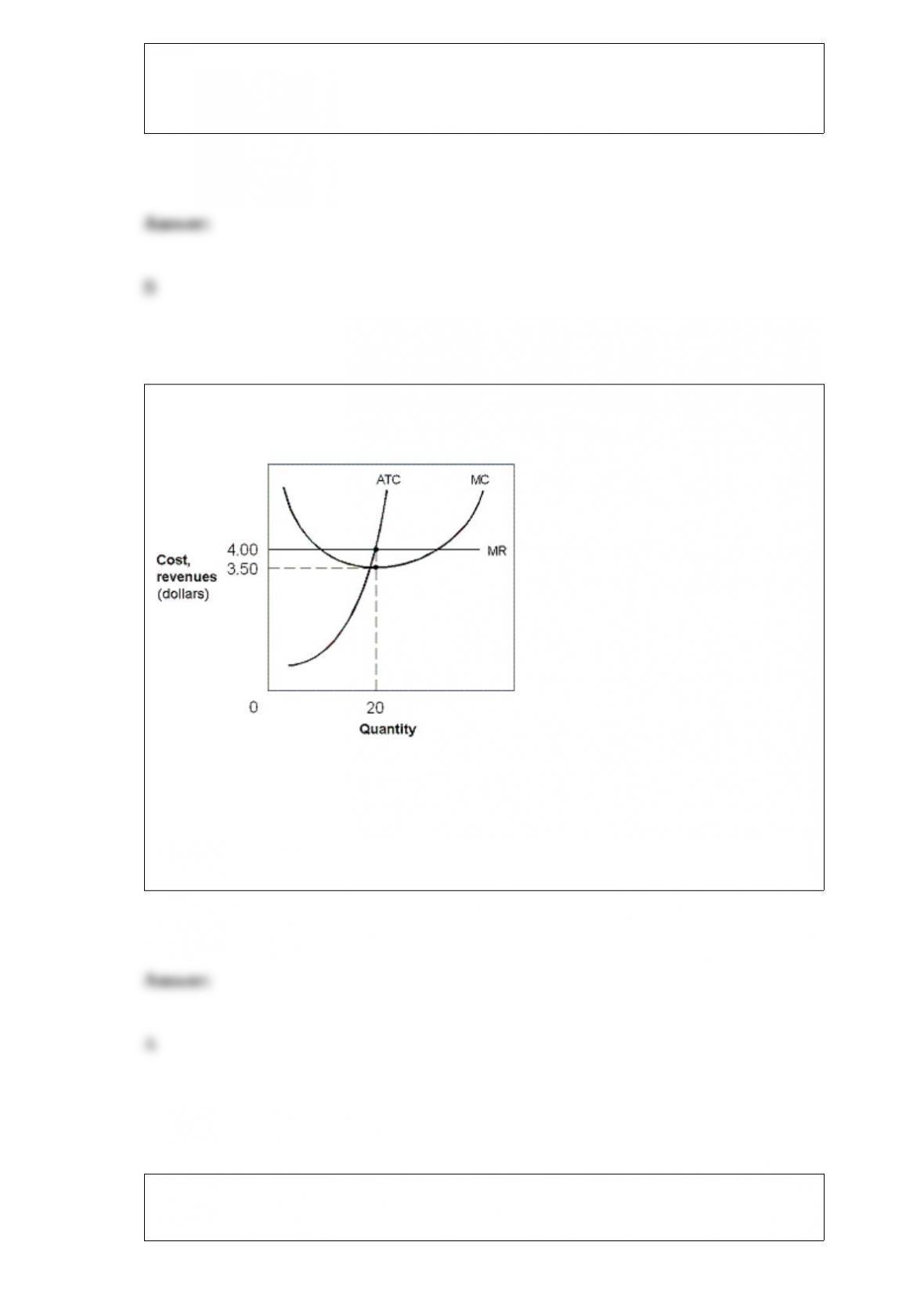
Exhibit 3A-1 Comparison of Market Efficiency and Deadweight Loss
As shown in Exhibit 3A-1, if the market is in equilibrium, then ____ represents
consumer surplus.
a. ABEC c. EGH
b. AED d. BEF

The law of demand says that the lower the price charged for a good, ceteris paribus,
the:
a. greater the quantity demanded per period of time.
b. greater the demand for the good per period of time.
c. smaller the demand for the good per period of time.
d. smaller the quantity demanded per period of time.
e. larger the supply of the good per period of time.
If there is bilateral currency trade between Japan and the U.S., then as the supply of
U.S. dollars on the world foreign exchange market ________, the price of a dollar in
terms of Japanese yen will ________.
a. increases, fall
b. decreases, fall
c. increases, increases
d. decreases, stays the same
Which of the following would be a private cost to a cigarette smoker?

a. Cost to the employer of the higher health insurance premiums due to the hiring of a
smoker.
b. Cost to the employer of the extra effort lost due to the increased missed days of work
as a result of smoking.
c. Cost to the city of extra park cleanup due to the presence of cigarette butts.
d. Price of the pack of cigarettes.
e. Cost to the government to pay the hospital expenses of indigent smokers.
Tara buys four music cassettes when the price is $10 and two cassettes when the price is
$14. Her price elasticity of demand is:
a. 0.
b. 1.
c. 2.
d. 3.
e. 4.
There is a significant positive relationship between ________ and __________.
a. natural resource commodity exports, high levels of per capita GDP
b. investment in capital, high levels of per capita GDP
c. high levels of illiteracy, high levels of per capita GDP
d. limited government recognition of land tenure and property ownership, high levels of
per capita GDP
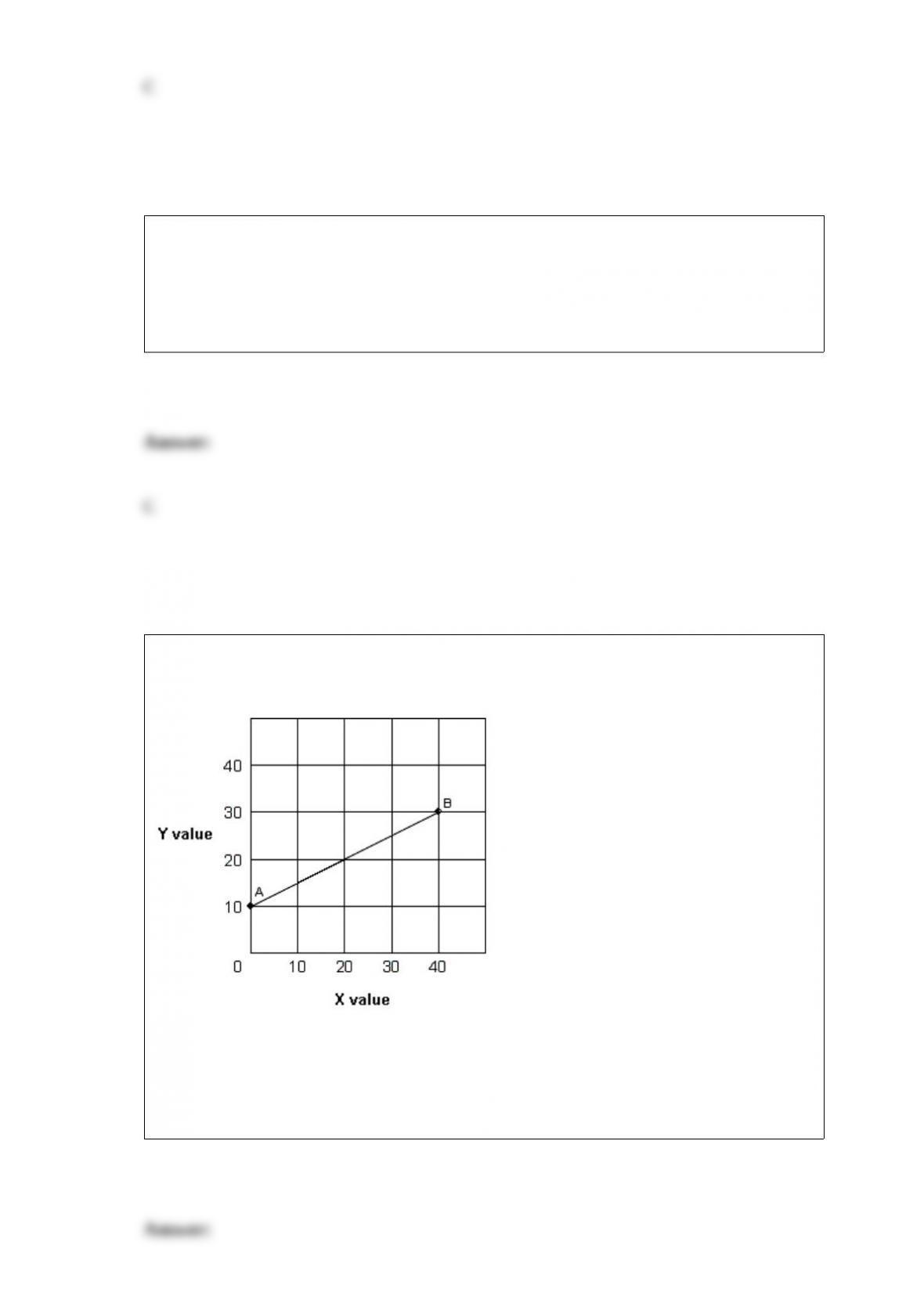
Exhibit 8-6 A firm’s cost and MC curves
In Exhibit 8-6, if this firm is currently producing 20 units of output, this firm:
a. is at its profit-maximizing point.
b. could increase profits by increasing output.
c. could increase profits by decreasing output.
d. should shut down.
e. should decrease price.
The marginal cost is the:
a. b and c.

b. change in total cost as the quantity changes by one unit.
c. change in total variable cost as the quantity changes by one unit.
d. change in total fixed cost as the quantity changes by one unit.
e. same as the fixed cost when average fixed cost is at a minimum.
If two goods are complementary, a(n):
a. decrease in the price of one product will cause a decrease in the demand for the other
product.
b. decrease in the price of one product will cause an increase in the demand for the
other product.
c. increase in the price of one product will cause an increase in the supply of the other
product.
d. increase in the price of one product will cause a decrease in the supply of the other
product.
e. increase in the price of one product will cause an increase in the demand for the other
product.
When economists use the term Ceteris paribus, they are indicating that:
a. the relationship between two economic variables cannot be determined.
b. the analysis is true for the individual but not for the economy as a whole.
c. all other variables except the ones specified are assumed to be constant.
d. their conclusions are based on normative economics rather than positive economic
analysis.
Which of the following is a firm’s supply curve in a perfectly competitive market?
a. Total cost.
b. Marginal revenue.
c. Marginal cost.
d. Average variable cost.
Exhibit 1A-1 Straight line
Straight line AB in Exhibit 1A-1 shows that:
a. increasing values for X will decrease the values of Y.
b. decreasing values for X will increase the values of Y.
c. there is a direct relationship between X and Y.
d. all of these.

If a consumer is indifferent between 5 units of A and 8 units of B, then the consumer
would:
a. also be indifferent between 4 units of A and 9 units of B.
b. also be indifferent between 8 units of A and 5 units of B.
c. prefer 6 units of A and 8 units of B.
d. give up 1 unit of A if he/she could acquire 2 units of B.
e. not trade product A in exchange for any units of product B.
Which of the following will reduce the supply of motorcycles?
a. An increase in the population age 16 to 35, the primary consumers of motorcycles.
b. An increase in taxes imposed on motorcycle producers.
c. A technological improvement reducing the production costs of motorcycles.
d. A government study that reveals motorcycle riders, on average, live 10 years longer
than those who don’t ride motorcycles.