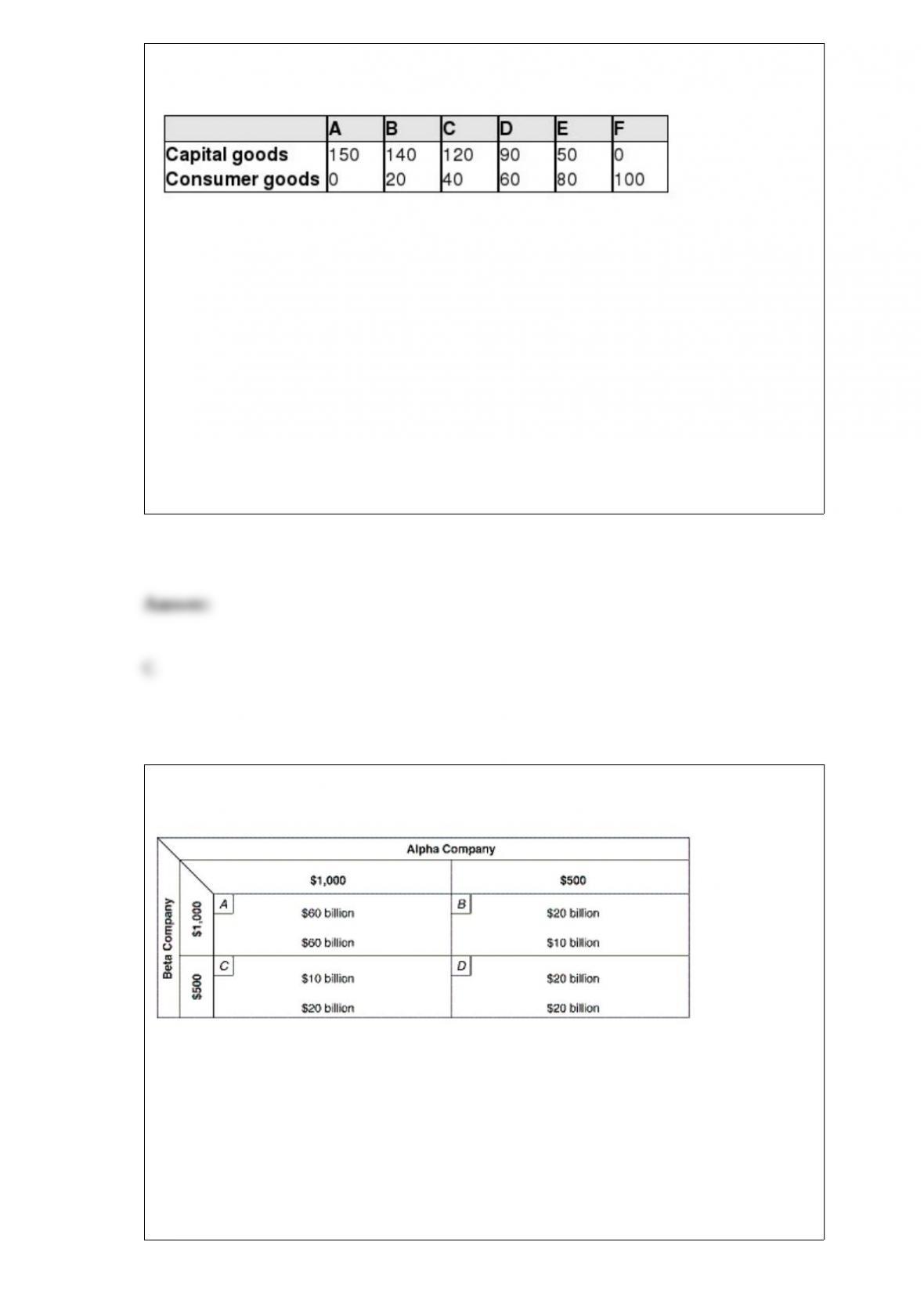
Exhibit 2-6 Production possibilities curve data
In Exhibit 2-6, the concept of increasing opportunity costs is represented by the fact
that:
a. the quantity of capital goods produced must be less than 150.
b. the quantity of consumer goods is constant for each change in the quantity of capital
goods produced.
c. greater amounts of capital goods must be sacrificed to produce each additional unit of
consumer goods.
d. the amount of consumer goods produced must be greater than zero.
Exhibit 10-5 Two-Firm Payoff Matrix
Suppose costs are identical for the two firms in Exhibit 10-5. If both firms assume the
other will compete and charge a lower price, equilibrium will be established by:
a. Beta Co. charging $1,000 and Alpha Co. charging $1,000.
b. Beta Co. charging $1,000 and Alpha Co. charging $500.
c. Beta Co. charging $500 and Alpha Co. charging $500.

d. Beta Co. charging $500 and Alpha Co. charging $1,000.
If the units of variable input in a production process are 1, 2, 3, 4, and 5, and the
corresponding total outputs are 30, 34, 37, 39, and 40, respectively. The marginal
product of the fourth unit is:
a. 2.
b. 1.
c. 37.
d. 39.
An economist estimates that .67 is the price elasticity of demand for disposable diapers.
This suggests that disposable diaper producers could:
a. advertise more to raise the price elasticity of demand.
b. encourage more parents to use cloth diapers.
c. lower the price of disposable diapers to raise more revenue.
d. raise the price of disposable diapers to raise more revenue.
e. maximize revenues by staying at the current price.
Which of the following statements is true?
a. Competitive markets result in the socially efficient price and quantity when
externalities exist.
b. Command-and-control regulations set an environmental goal and dictate how the
goal will be achieved.
c. Economists prefer command-and-control regulations to incentive-based pollution
programs.
d. An effluent tax is a tax imposed on rich people.
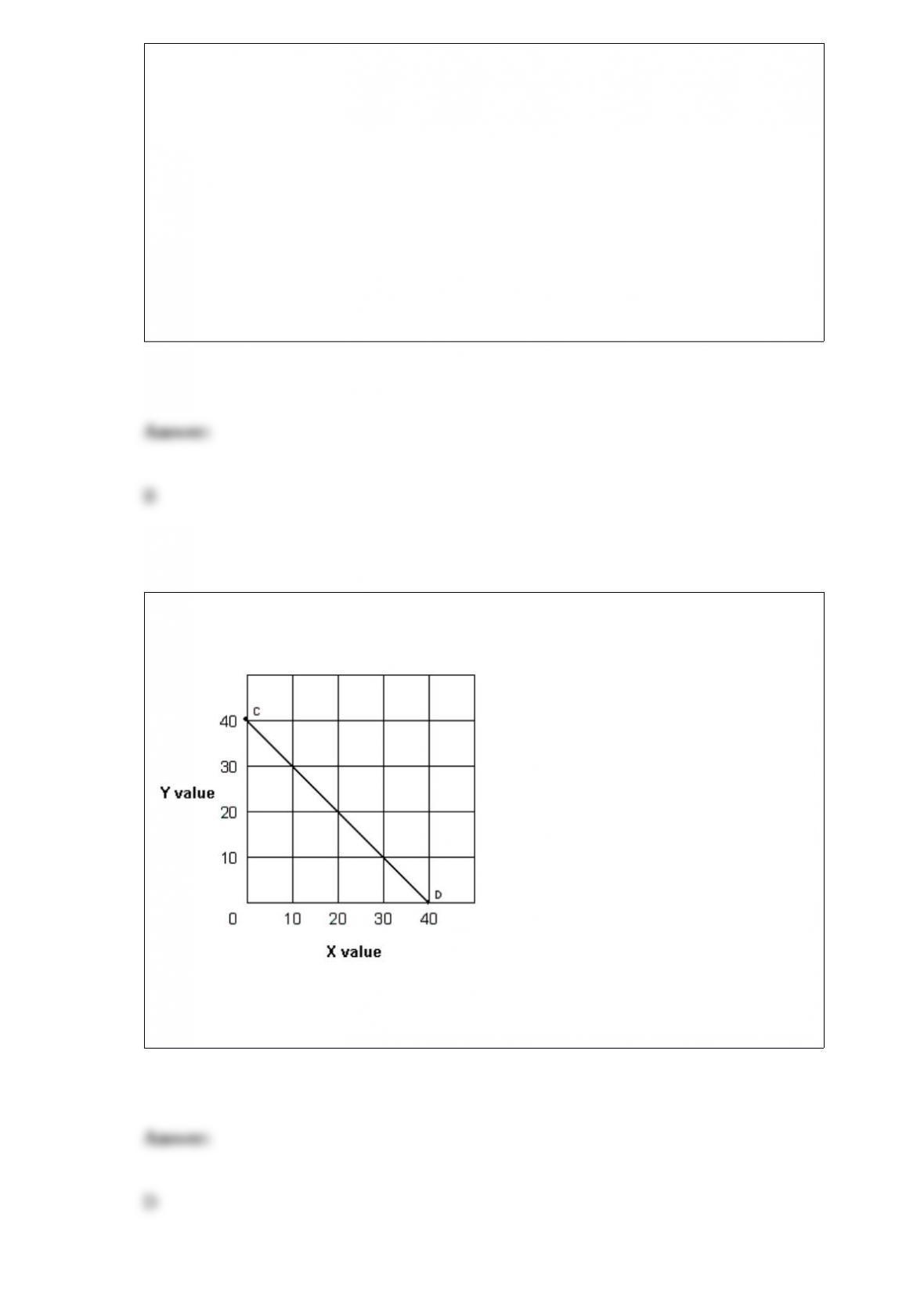
Exhibit 1A-5 Straight line
As shown in Exhibit 1A-5, the slope of straight line CD:
a. decreases with increases in X. c. increases with decreases in X.
b. increases with increases in X. d. remains constant with changes in X.

A minimum wage that is set below the equilibrium wage will:
a. cause increased unemployment.
b. have no effect on employment.
c. cause the overall wage to increase.
d. cause the overall wage to decrease.
e. create more jobs.
A perfectly competitive firm’s short-run supply curve is the:
a. segment of the marginal cost curve above average fixed cost.
b. segment of the marginal cost curve above the minimum level of average variable
cost.
c. upward-sloping segment of the marginal cost curve.
d. both a and b.
In a socialistic system, most economic decisions are made by:
a. firms. c. stockholders.
b. consumers. d. government planners.

Paul’s Plumbing is a small business that employs 12 people. Which of the following is
the best example of an implicit cost incurred by this firm?
a. The tax payments on property owned by the firm.
b. The wages paid to the 12 employees.
c. The half of the payroll taxes on the wages of the 12 employees paid by the
employers, but not the half paid by the employees.
d. The accounting services provided free of charge to the firm by Paul’s wife, who is an
accountant.
A technological advance that increases labor productivity will:
a. lower wages.
b. decrease the demand for labor as fewer workers are needed.
c. decrease the supply of labor as fewer workers are needed.
d. increase the demand for labor as MP rises.
e. decrease the demand for labor as MP falls.
Which of the following statements is true?
a. The doctrine of laissez-faire advocates an economic system with extensive
government intervention and little individual decision-making.

b. In capitalism income is distributed on the basis of need.
c. Adam Smith was the father of socialism.
d. Most real-world economies are mixed economic systems.
e. The “invisible hand” refers to government economic control.
A change in supply cannot be caused by a change in:
a. resource prices.
b. technology.
c. prices of other goods.
d. the price of the good itself.
e. the number of suppliers.
A monopoly will price its product:
a. where total revenue is maximized.
b. where total costs are minimized.
c. at that point on the market demand curve corresponding to an output level in which
marginal revenue equals marginal cost.
d. at that point on the market demand curve which intersects the marginal cost curve.

When deciding whether to buy a second car, marginal analysis indicates that the
purchaser should compare the:
a. benefits expected from two cars with the cost of both.
b. additional benefits expected from a second car with the cost of the two cars.
c. dollar cost of the two cars with the potential income that the cars will generate.
d. additional benefits of the second car with the additional cost of the second car.
Which of the following is a public good?
a. Air traffic control. c. Clean air.
b. National defense. d. All of these.
As market price increases in the short run, a profit-maximizing firm in a perfectly
competitive market will expand output along its:
a. marginal cost curve.
b. average total cost curve.
c. average variable cost curve.
d. market demand curve.

Under perfect competition, no matter how much output is produced, the total revenue
curve is:
a. a positively-sloped line.
b. a negatively-sloped line.
c. a horizontal straight line.
d. a U-shaped curve.
e. a hill-shaped curve.
The most important weakness of the Sherman Antitrust Act was that:
a. the Supreme Court refused to enforce it.
b. it wasn’t specific about the types of acts which would violate the law.
c. it didn’t outlaw restraints of trade.
d. it was too complicated.
e. it was too specific.

The opportunity cost of a purchase is:
a. the selling price of the good or service.
b. zero if the good or service satisfies a need.
c. greater for persons who are rich.
d. the good or service given up for the good or service purchased.
If the expansion of output in an industry leads to unchanged resource prices, the
industry is most likely to be a(n):
a. decreasing cost industry.
b. increasing cost industry.
c. constant cost industry.
d. industry characterized by economies of scale.
Under an exclusive buying arrangement, a retailer agrees to sell a good at the
manufacturer’s suggested retail price.

A monopoly can successfully price discriminate as long as there are no close substitutes
for its product.
It is possible for a nation to have an absolute advantage in the production of a product,
but not a comparative advantage in the production of the same product.
If input prices increase, the supply curve for cheese will shift to the right.
If a 10 percent price increase causes the quantity demanded for a good to decrease by
20 percent, demand is elastic.