
In a two good, two-country world, a country has a comparative advantage in any good
for which it has a:
a. lower absolute cost than the other country.
b. lower opportunity cost than the other country.
c. higher absolute cost than the other country.
d. higher opportunity cost than the other country.
Any point on the production possibilities curve illustrates:
a. minimum production combinations.
b. maximum production combinations.
c. economic growth.
d. a nonfeasible production combination.
A sandwich shop owner has the following information: P = MR = $4, ATC = $2, AVC =
$1, MC = 4, and Q = 500. From this, she can determine:
a. her profits are not being maximized.
b. she has earned zero economic profits.
c. she has earned economic profits of $1,000.
d. she has earned economic profits of $1,500.
e. she should sell fewer sandwiches.

An unfavorable balance of trade occurs when:
a. exports equal imports.
b. the balance of payments balances.
c. the current and capital account in the BOP are equal.
d. the value of the exports of goods exceeds the value of the imports of goods.
e. the value of the exports of goods is less than the value of the imports of goods .
In the country of Bora Bora, consumers buy large quantities of alcohol, tobacco, and
coffee. Last year, the prices of these goods each increased by 10 percent. The quantities
demanded for these goods fell by 10, 3, and 8 percent, respectively. If the government is
thinking about imposing a unit tax on one of these goods, which good should they
choose to tax to raise the most tax revenue, and why?
a. Alcohol; because the price elasticity is highest.
b. Tobacco; because the price elasticity is lowest.
c. Coffee; because it will have the lowest tax elasticity.
d. Tobacco; because it will have the highest tax elasticity.
e. Alcohol; because the burden of taxation would be more even.
Exhibit 3-8 Demand and supply data for Video games
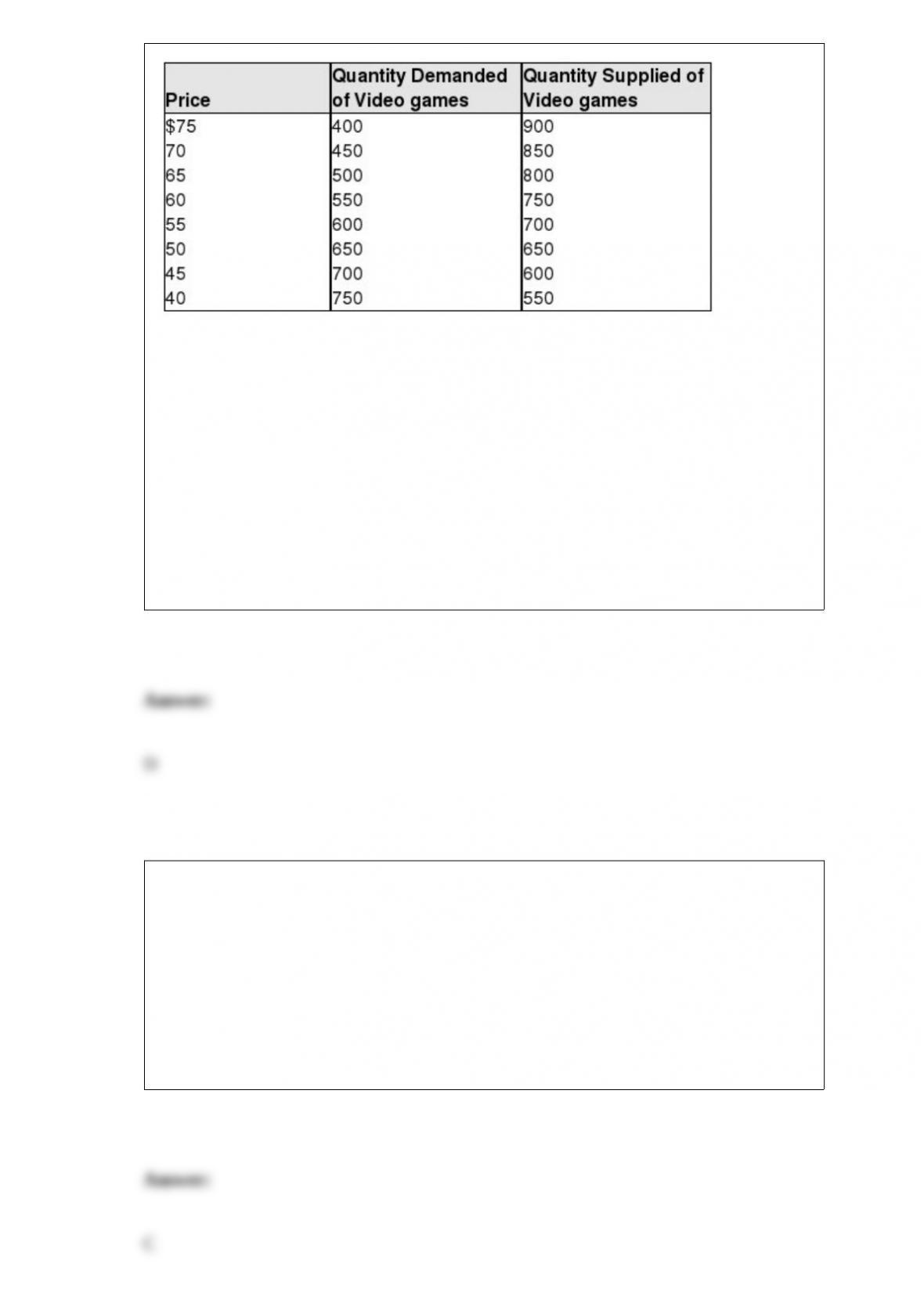
In Exhibit 3-8, the equilibrium market price in this video game market would be:
a. $65
b. $60
c. $55
d. $50
e. $45
__________ generally results in increases in per-capita GDP.
a. Civil war
b. High levels of inequality in the distribution of land ownership
c. Investment in human capital
d. A stock of natural resources
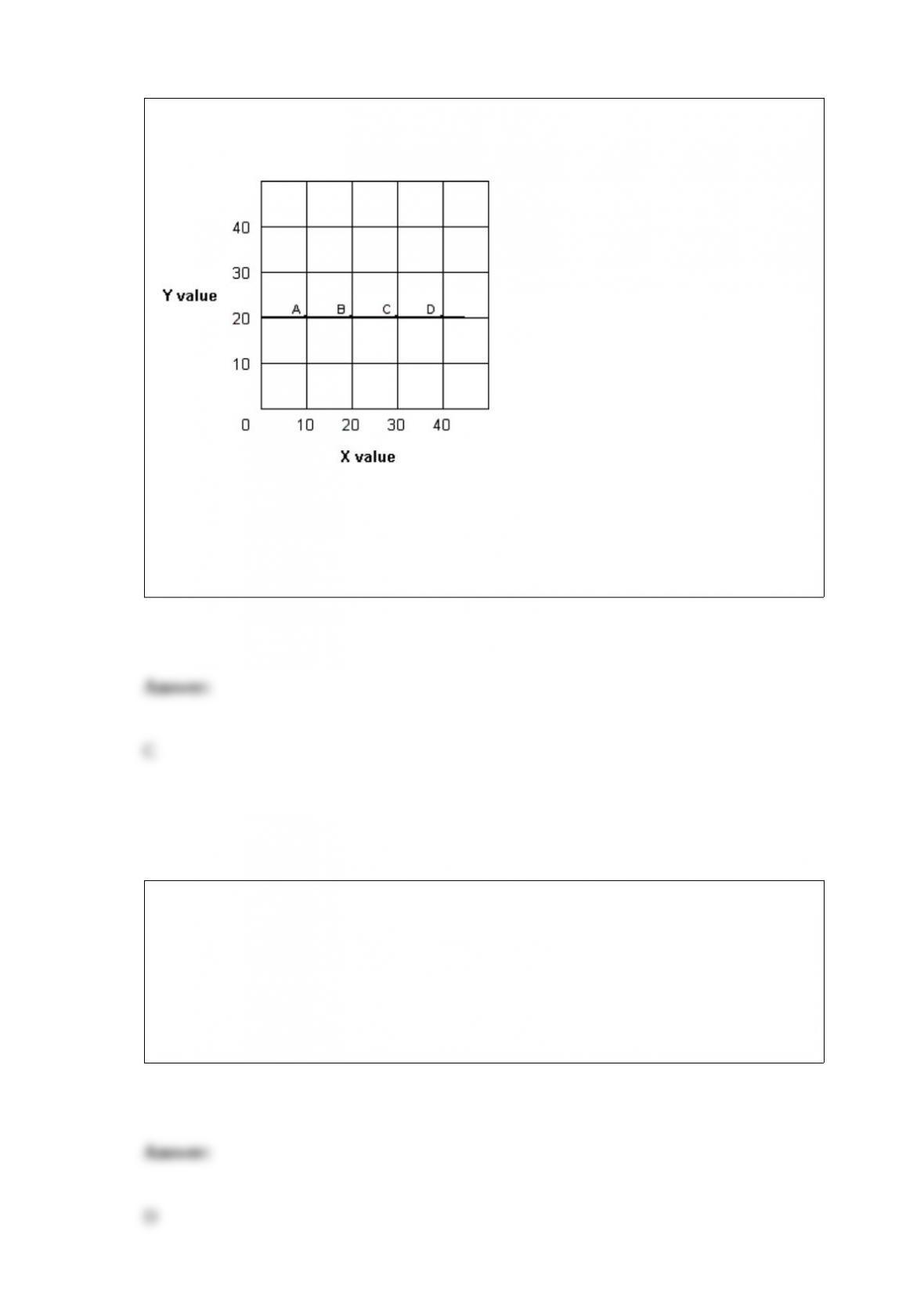
Exhibit 1A-6 Straight line
Straight line A-D in Exhibit 1A-6 shows that:
a. increasing value for X will increase the value of Y.
b. increasing value for X will decrease the value of Y.
c. increasing values for X does not affect the value of Y.
d. all of these.
Supply curves slope upward because:
a. the quality is assumed to vary with price.
b. technology improves over time, increasing the ability of firms to produce more at
each possible price.
c. increases in the price of a good lead to rightward shifts of the supply curve.
d. rising prides provide producers with the incentives needed to increase the quantity
supplied.

What is the economic criterion most often used to compare living standards across
countries?
a. Real GDP growth.
b. Unemployment rate.
c. Incidence of AIDS.
d. Rate of population growth.
e. Real per capita GDP.
The production possibilities curve for the nation of Economagic shifts to the left. This
could have been caused by:
a. an increase in Economagic’s labor supply.
b. innovation in the production of goods in Economagic.
c. a war that destroyed some of Economagic’s resource base.
d. unemployment among Economagic’s workers.
e. Economagic’s choice of more consumption and less capital last period.
The Sherman Antitrust Act:

a. prohibited restraint of trade.
b. created the Federal Trade Commission.
c. prohibited fraudulent advertising.
d. regulated the railroads.
Two goods that are substitutes are:
a. bacon and eggs.
b. camera and film.
c. tennis racket and tennis balls.
d. movie theater tickets and video rentals.
e. coffee and cream.
A firm in a price-taker market:
a. must take the price that is determined in the market.
b. must reduce its price if it wants to sell a larger quantity.
c. must be large relative to the total market.
d. can exert a major influence on the market price.
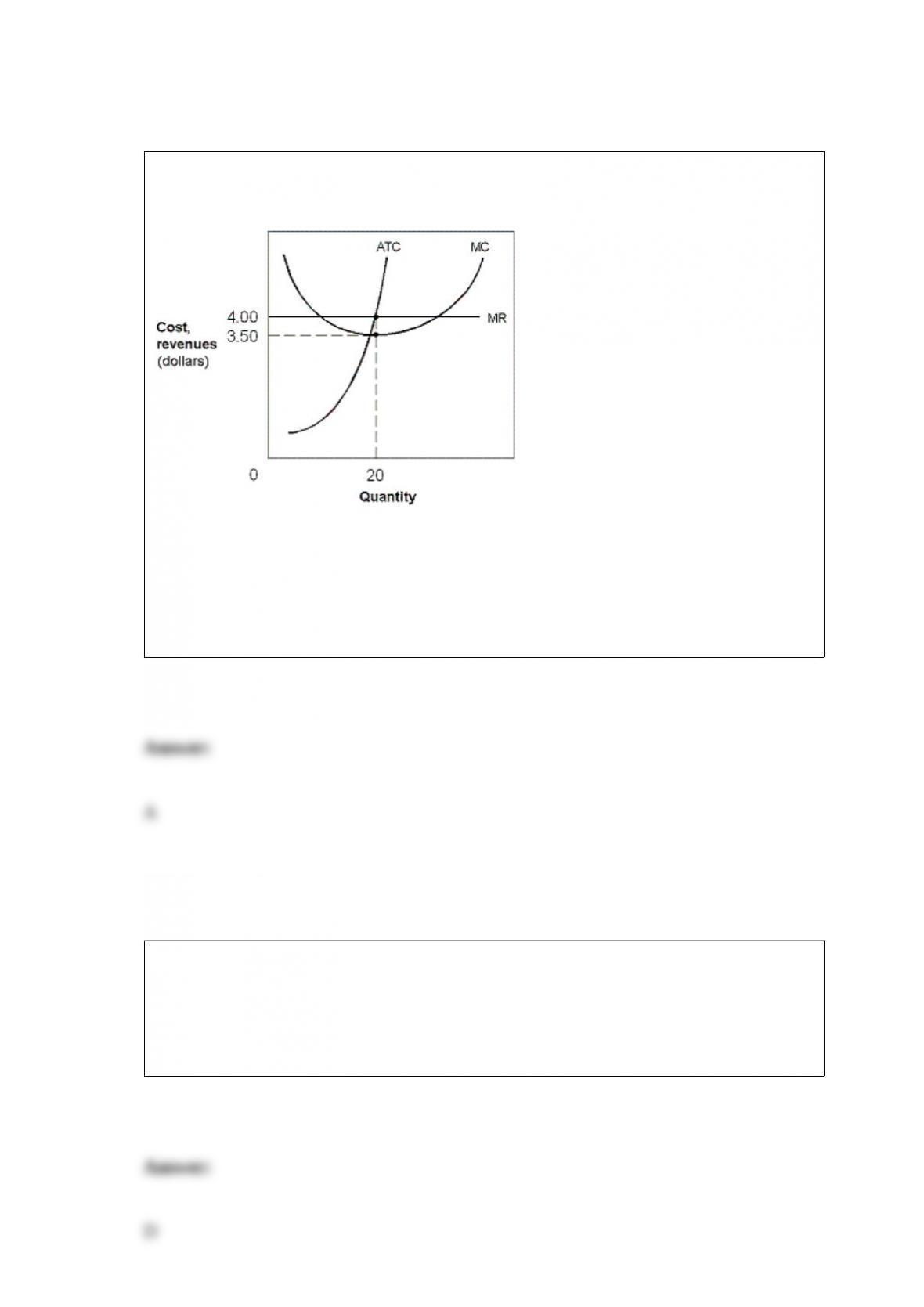
Exhibit 8-6 A firm’s cost and MC curves
In Exhibit 8-6, if this firm is currently producing 20 units of output, this firm:
a. is earning a profit of $10.
b. is earning a profit of $.50.
c. is losing $10.
d. should shut down.
e. is losing $.50
Which one of the following is the most accurate definition of economics?
a. Economics is the study of stocks and bonds.
b. Economics is the study of how people allocate unlimited resources.
c. Economics is the study of how consumers choose to spend their income.
d. Economics is the study of how society chooses to allocate scarce resources.
A monopolistically competitive firm will:
a. maximize profits by producing where MR = MC.
b. not likely earn an economic profit in the long run.
c. shut down if price is less than average variable cost.
d. all of these.
An excise tax levied on a product will impose a smaller relative burden on consumers
(and a larger relative burden on sellers) when:
a. the supply of the product is relatively inelastic.
b. the supply of the product is relatively elastic.
c. the demand for the product is relatively elastic.
d. either a or c is true.
A firm has $200 million in total revenue and explicit costs of $190 million. If its owners
have invested $100 million in the company at an opportunity cost of 10 percent interest
per year, the firm’s accounting profit is:
a. $400 million.
b. $100 million.
c. $80 million.
d. $10 million.
e. zero.
The Interstate Commerce Commission (ICC) was established in 1887 to regulate:
a. banking.
b. railroads and all surface transportation.
c. nationwide advertising.
d. interstate sales of food and drugs.
Describe the factors that could cause an increase in the wage rate of workers.
In long-run equilibrium, a perfectly competitive firm will produce an output level at
which its long-run average cost curve is upward sloping.
What is scarcity and why does it exist? How is scarcity related to the study of
economics?
A market system does not operate based on self-interest.
Consumer surplus measures the value between the price consumers are willing to pay
for a product and the preference price.

The price elasticity of demand measures consumer responsiveness to a price change.
The per se rule would have not found a well-behaved, but gigantic, firm to be in
violation of the antitrust laws.
Karl Marx viewed socialism only as a transition to the ideal state of communism.
What is the difference between positive and normative economics? How can knowledge
of positive economics be useful in normative economics?
For a public good, only one user can consume the good.