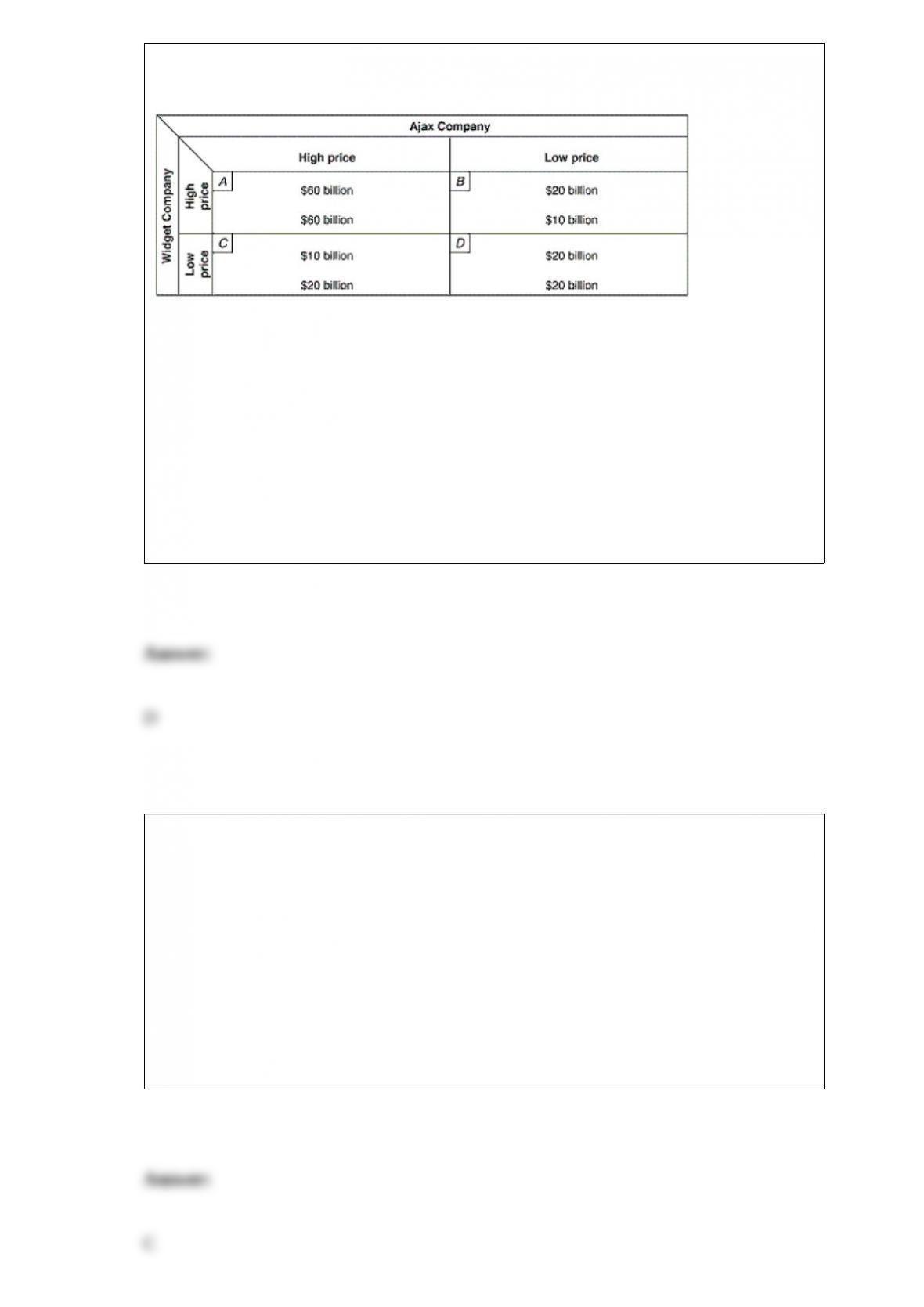
Exhibit 10-6 Two-Firm Payoff Matrix
Assume costs are identical for the two firms in Exhibit 10-6. If both firms were allowed
to form a cartel and agree on their prices, equilibrium would be established by:
a. Widget Co. charging the low price and Ajax Co. charging the high price.
b. Widget Co. charging the high price and Ajax Co. charging the low price.
c. Widget Co. charging the low price and Ajax Co. charging the low price.
d. Widget Co. charging the high price and Ajax Co. charging the high price.
If a price ceiling is imposed, then:
a. the market supply curve will shift to the right.
b. the market demand will shift to the left.
c. a shortage of product will result.
d. the government would be required to buy-up the surplus product.
e. the market equilibrium price is below the level the government wishes to achieve.
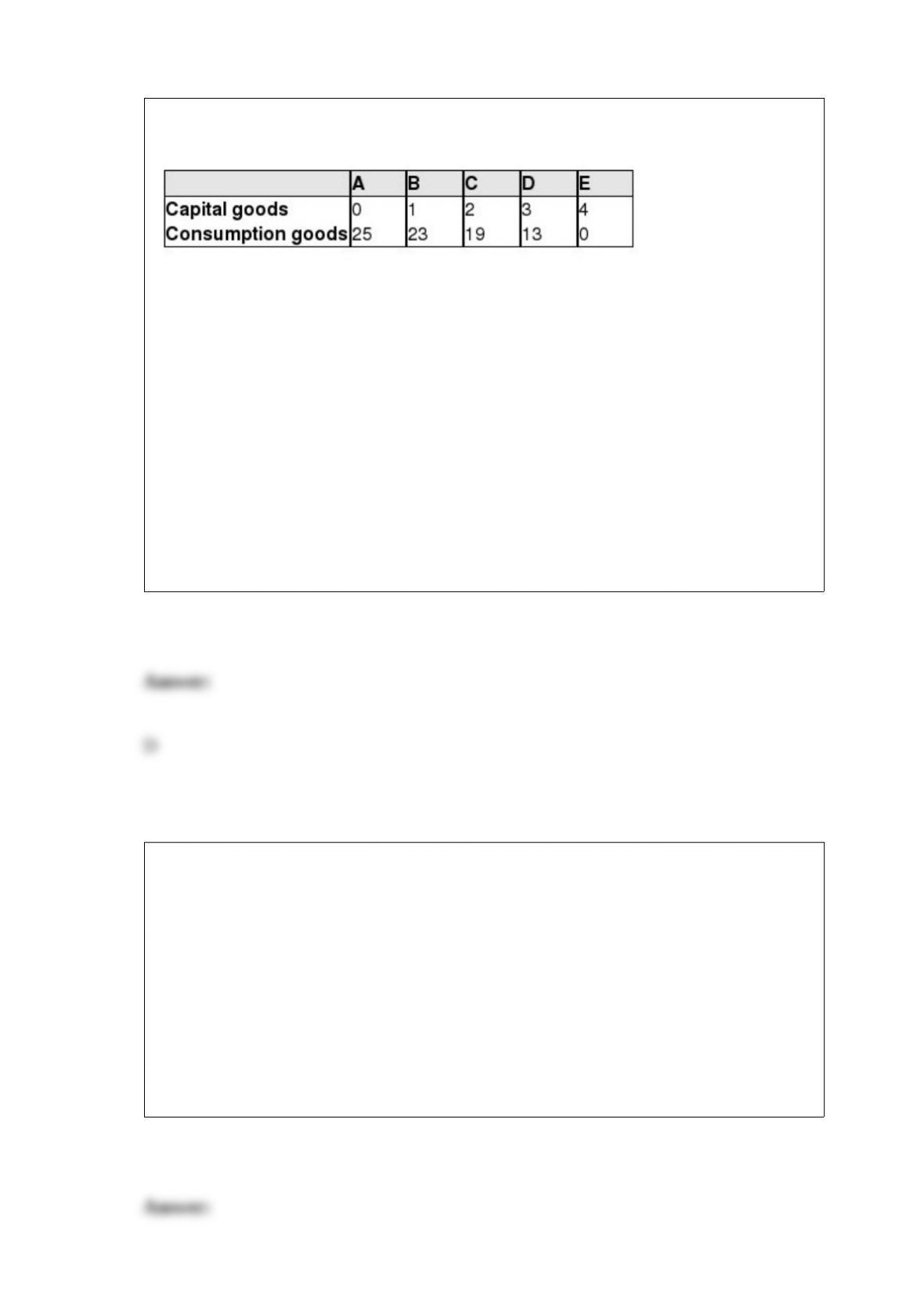
Exhibit 2-10 Production possibilities curve data
Suppose an economy is faced with the production possibilities table shown in Exhibit
2-10. As additional units of capital goods are being produced, the number of
consumption goods produced must ____, because ____.
a. increase; the production possibility table shows only the maximum efficiency points
b. increase; of the law of increasing costs
c. decrease; of the law of increasing costs
d. decrease; of the finite nature of the resource base
e. increase; capital goods will assist in the production of consumer goods
A free rider is a person who:
a. is harmed by another’s actions.
b. is subject to a negative externality.
c. receives benefits from someone else’s action but does not pay for them.
d. pays less than the full value for a product.
e. won the state lottery.

Marginal utility is defined as:
a. the extra satisfaction the consumer receives from an extra $1 of income.
b. the total level of satisfaction a consumer receives upon the consumption of a certain
number of goods.
c. the number of hours a consumer would be willing to work to receive a certain
product.
d. the extra satisfaction a person derives from consuming an additional unit of a good.
e. a comparison of the utility a good provides with the price of that good.
The price elasticity of demand for a vertical demand curve is:
a. perfectly elastic.
b. perfectly inelastic.
c. unitary elastic.
d. elastic.
e. inelastic.
Which of the following would not be classified as a capital resource?
a. The Empire State Building.
b. A Caterpillar bulldozer.
c. A Macintosh computer.
d. 100 shares of stock in General Motors.
In the long run, total fixed cost will:
a. remain constant.
b. increase.
c. decrease.
d. not exist by definition.
A monopoly will be maximizing profits if it is operating at the point where:
a. price is at a maximum.
b. average cost is at a minimum.
c. average cost is at a maximum.
d. marginal cost is at a minimum.
e. marginal revenue = marginal cost.
Total utility is maximized in the consumption of two goods by equating the:
a. prices of both goods for the last dollar spent on each good.
b. marginal utilities of both goods for the last dollar spent on each good.
c. ratios of marginal utility to the price of both goods for the last dollar spent on each
good.
d. marginal utility of one good to the price of the other.
If the equilibrium price of good X is $5 and a price ceiling is imposed at $4, the result
will be a(n):
a. accumulation of inventories of unsold gas.
b. shortage.
c. surplus.
d. all of these.
If a 1 percent change in income generates a greater than 1 percent change in quantity
demanded of boating expenditures, then boating is an:
a. example of Engel’s law.
b. inferior good.
c. income inelastic good.
d. income elastic good.
e. example of a substitute good.
Which of the following statements is true?
a. Economic profit equals accounting profit minus implicit costs.
b. The short run is any period of time in which there is at least one fixed input.
c. A fixed input is any resource for which the quantity cannot change during the period
under consideration.
d. In the long run there are no fixed costs.
e. All of these.
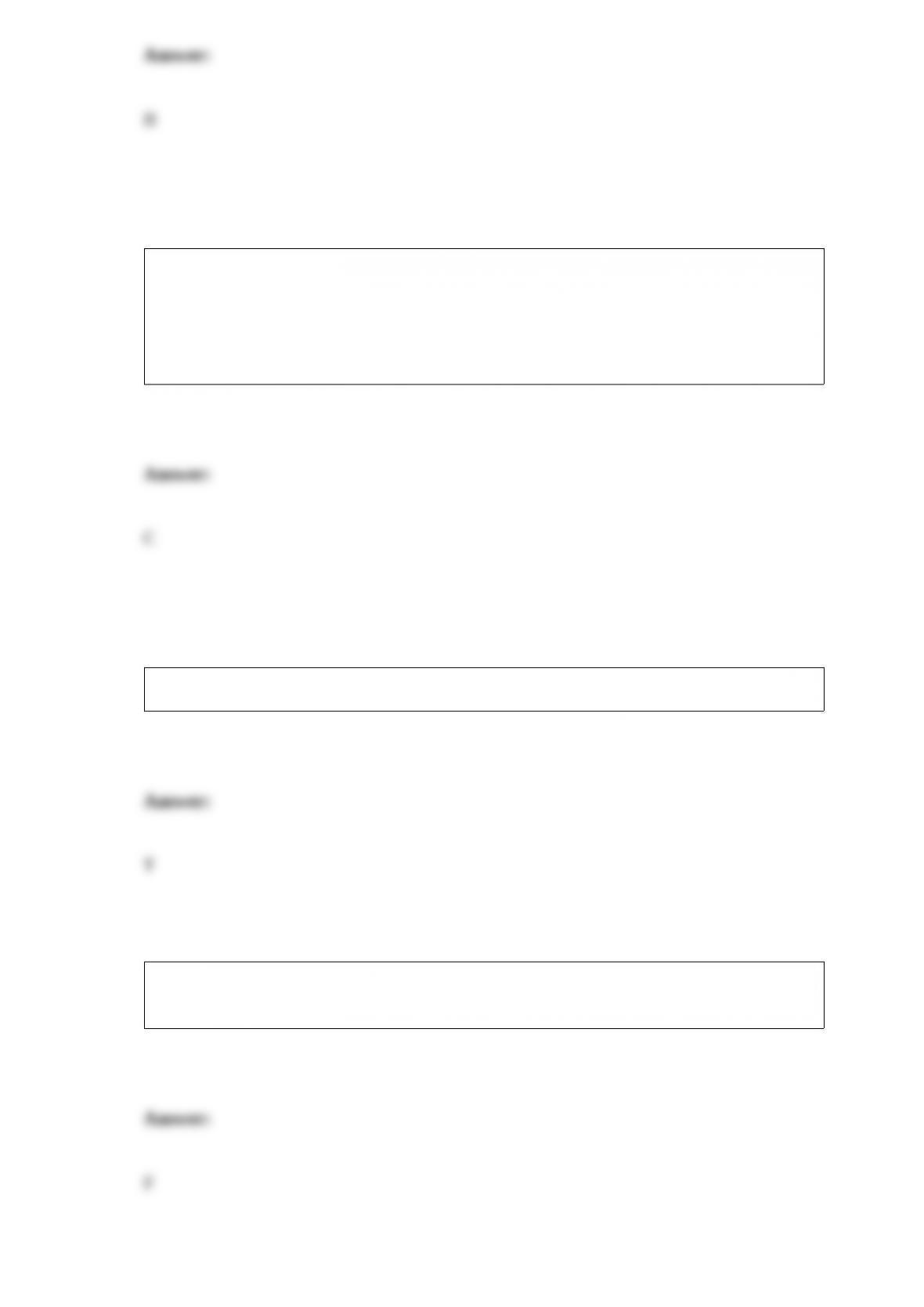
Exhibit 8-14 Total cost and total revenue curves
If the firm in Exhibit 8-14 minimizes its loss at 200 units of output, marginal cost is:
a. $75 per unit.
b. equal to marginal revenue.
c. $100 per unit.
d. $175 per unit.
A lower price elasticity of demand coefficient occurs when:
a. many substitutes exist.
b. the quantity demanded is more responsive.
c. few substitutes exist.
d. the market is broadly defined.
Every economic choice has an opportunity cost.
An increase in demand is reflected as a rightward (outward) shift of the demand curve
and is caused by an increase in price.

The total utility of a good is equal to the marginal utility of the last unit consumed.
A merger of firms that compete in the same market is classified as a conglomerate
merger.
Economic efficiency and economic freedom are commonly cited as two major benefits
of socialism.
Easy entry and exit cause oligopoly profits to be zero in the long run.
Economic profit equals accounting profit minus implicit costs.
The command system relies on prices set by firms on the basis of consumer demands.
If movies are an inferior good, movie attendance will rise when consumer incomes fall.