
While waiting in line to buy a cheeseburger for $2 and a drink for 75 cents, Aaron
notices that the restaurant has a value meal containing a cheeseburger, drink, and
French fries for $3. For Aaron, the marginal cost of purchasing the French fries:
a. would be zero.
b. would be 25 cents.
c. would be 50 cents.
d. cannot be determined because the information about the price of the French fries is
not provided.
The Celler-Kefauver Act strengthened the nation’s antitrust approach to merger
enforcement by:
a. making all mergers illegal.
b. making all conglomerate mergers illegal.
c. creating the Federal Trade Commission.
d. providing HHI guidelines the government could use to clarify antitrust enforcement.
e. amending the Clayton Act to include the purchase of assets with cash of another
company as a potential antitrust violation.

If two workers can produce 22 units of output, and the addition of a third worker
increases output to 30 units, the marginal product of the third worker is:
a. 8 units.
b. 10 units.
c. 22 units.
d. 30 units.
If an increase in the price of a product from $1 to $2 per unit leads to a decrease in the
quantity demanded from 100 to 80 units, then demand is:
a. elastic.
b. inelastic.
c. of unitary elasticity.
d. 0.
e. inferior.
How much of the U.S. federal budget is spent on foreign aid?
a. About 1 percent. c. About 25 percent.
b. About 5 percent. d. About 50 percent.

The creative ability of persons to combine and direct resources to produce new products
is known as:
a. economizing. c. value judgment.
b. entrepreneurship. d. product sensitivity.
How is a tariff different from a quota?
a. A tariff sets a limit on the quantity of a good that may be imported, while a quota is a
tax on an import.
b. A tariff and a quota are different words for the same thing.
c. A tariff is a tax on an import, while a quota set a limit on the quantity of a good that
may be imported.
d. None of the above are correct.
Jerome, the florist, sold 500 bridesmaid’s bouquets in June. He estimates his costs that
month were ATC = $10, AVC = $6, and MC = $9. If he sold each bouquet at the
constant market price of $9, Jerome:
a. made an economic profit of $500.
b. made a loss of $500.
c. made an economic profit of $1,500.
d. made a loss of $1,500.
e. should have shut down in June.

An economic system that answers the What, How, and For Whom questions using
prices determined by the interaction of the forces of supply and demand is a:
a. market economy. c. traditional economy.
b. command economy. d. none of these.
Since the demand for labor depends on the demand for the product labor produces, the
demand for labor is called:
a. primary demand.
b. secondary demand.
c. dependent demand.
d. derived demand.
If Stimpson University increases tuition in order to increase its revenue, it will:
a. not be successful if the demand curve slopes downward.
b. be successful if demand is elastic.
c. be successful if demand is inelastic.
d. be successful if supply is elastic.
e. be successful if supply is inelastic.

Real GDP per capita and other alternative measures of the quality of life are:
a. independent. c. poorly correlated.
b. directly correlated. d. inversely related.
Compared to the perfectly competitive outcome, monopolistically competitive markets
will result in:
a. a wider variety of products and higher prices.
b. less product variety and higher prices.
c. a wider variety of products and lower prices.
d. less product variety and lower prices.
An upward-sloping line or curve is used to illustrate:
a. a direct relationship. c. two unrelated variables.

b. an inverse relationship. d. the ceteris paribus assumption.
Which of the following would be an external cost associated with the manufacture of
cigarettes?
a. Price of a pack of cigarettes.
b. Price of leaf tobacco.
c. Cost to the government of the hospital expenses of indigent smokers.
d. Cost to the employer of the higher health insurance premiums due to the hiring of a
smoker.
e. Cost to the employer of the extra effort lost due to the increased missed days of work
as a result of smoking.
If a decrease in price of good X causes the demand curve for good Y to increase, then
these two goods are:
a. normal goods.
b. complementary goods.
c. substitute goods.
d. equilibrium goods.
e. market-day goods.

If people expect the price of packaged coffee to rise next week, coffee demand will:
a. decrease now.
b. increase now.
c. stay the same now and increase next week.
d. stay the same now and decrease next week.
e. stay the same now and next week.
A negative income tax program is:
a. b, c, d, and e.
b. basically an income tax in reverse.
c. based on government cash payments to the poor that are linked to their income levels.
d. designed to provide a minimum level of income to the poor.
e. based on cash payments that decline as income level increases.
A major technological advance would be represented on a production possibilities curve
by a(n):
a. movement off the production possibilities curve toward a point outside the curve.
b. movement toward the curve from a point inside the curve.

c. outward shift of the entire curve.
d. movement to the left along the curve to a higher point.
The law of diminishing marginal returns implies that, in the short run:
a. output must fall beyond a certain point.
b. price must fall beyond a certain point.
c. the marginal product of the variable input must eventually decrease.
d. wages of workers must eventually increase.
e. total cost must fall beyond a certain point.
The cross elasticity of demand for complementary products must:
a. be greater than one.
b. be less than one.
c. be zero.
d. exceed zero.
e. be negative.
With an upward-sloping supply curve, which of the following is true?
a. An increase in price results in a decrease in quantity supplied.
b. An increase in price results in an increase in supply.
c. A decrease in price results in a decrease in quantity supplied.
d. A decrease in price results in an increase in supply.
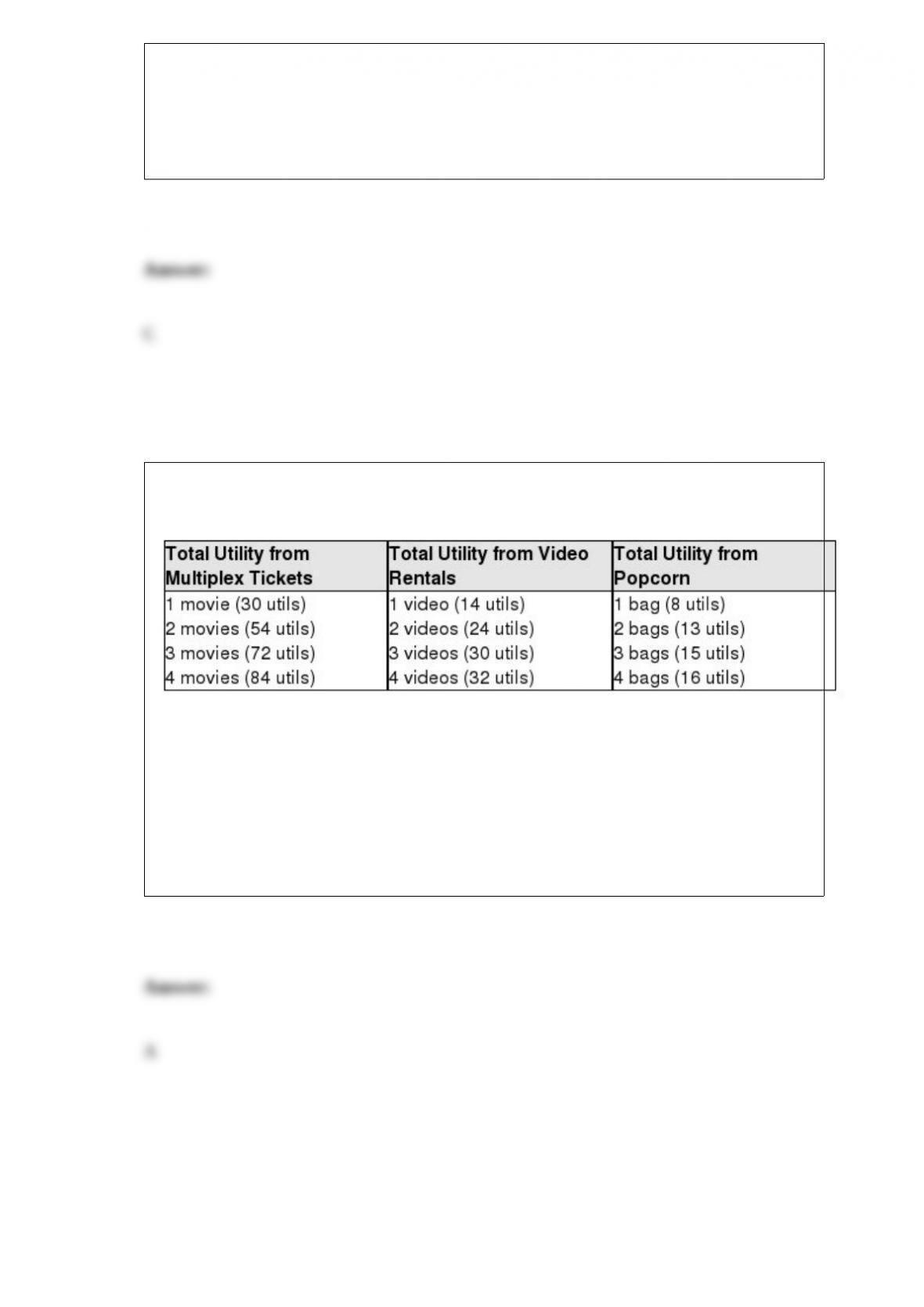
Exhibit 6-4 Total utility for multiplex tickets, video rentals, and popcorn
In Exhibit 6-4, assume the Multiplex tickets cost $6 each, video rentals cost $2 each,
and bags of popcorn cost $1 each. Suppose the consumer has $12 per week to spend on
multiplex tickets, video rentals, and popcorn. In the consumer equilibrium, what is the
marginal utility per dollar for each of the three goods?
a. 5 utils per dollar.
b. 9 utils per dollar.
c. 13 utils per dollar.
d. 22 utils per dollar.