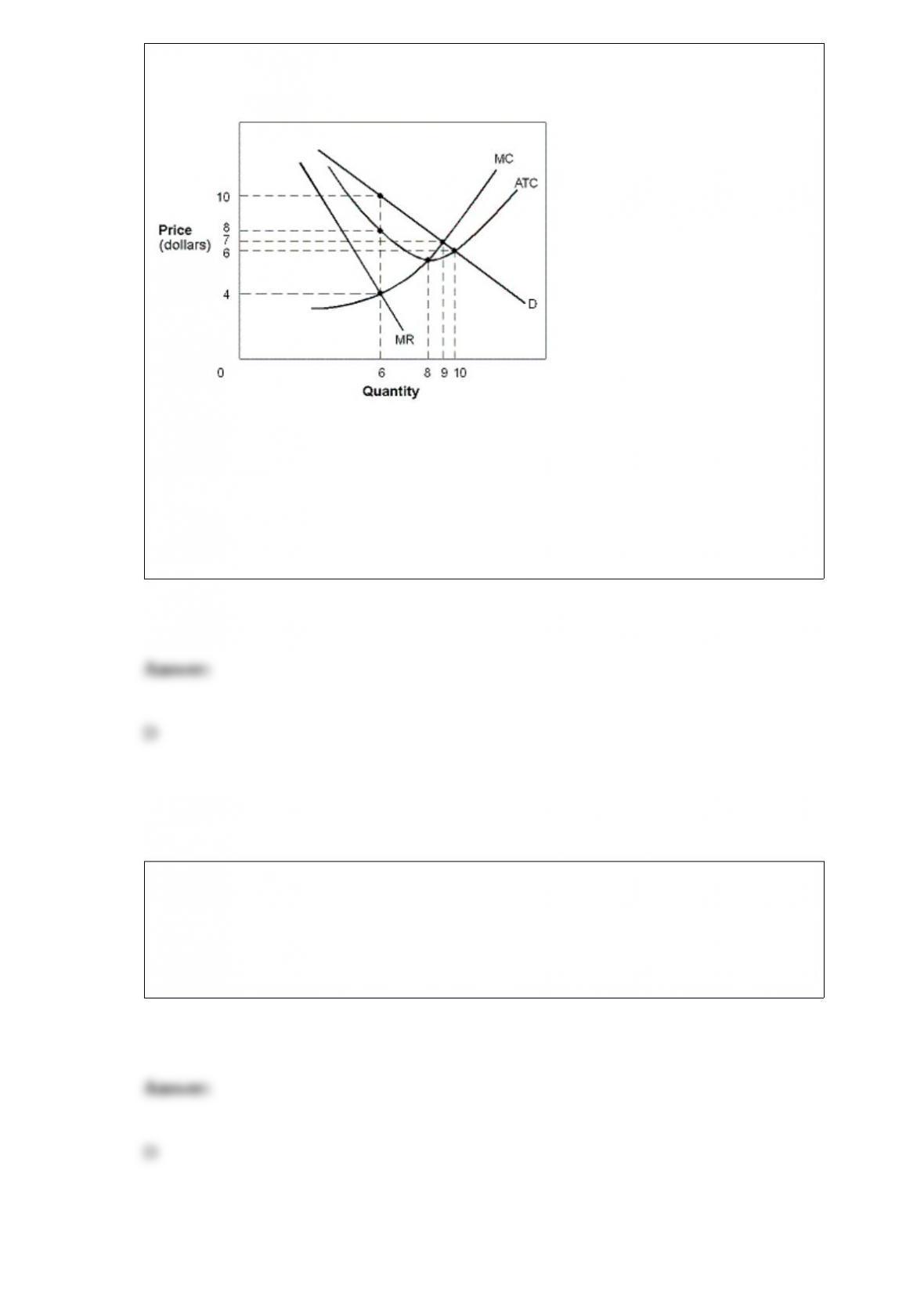
Exhibit 9-6 Monopoly
When the monopolist is maximizing total profit in Exhibit 9-6, the average total cost of
producing that output level is:
a. $4.
b. $6.
c. $7.
d. $8.
e. $10.
Which of the following statements is true?
a. Derived demand for labor depends on the demand for the product labor produces.
b. Unions can either increase demand or decrease the supply of labor.
c. Investment in human capital is expected to increase the demand for those workers.
d. All of these.
If the free market is called upon to provide public goods, then:
a. there will more goods provided than is optimal.
b. there will be fewer goods provided than is optimal.
c. the market will provide the optimal number of goods.
d. the market price will be correct, but the optimal amount of output will not be
produced.
e. the firms will earn excess profit.
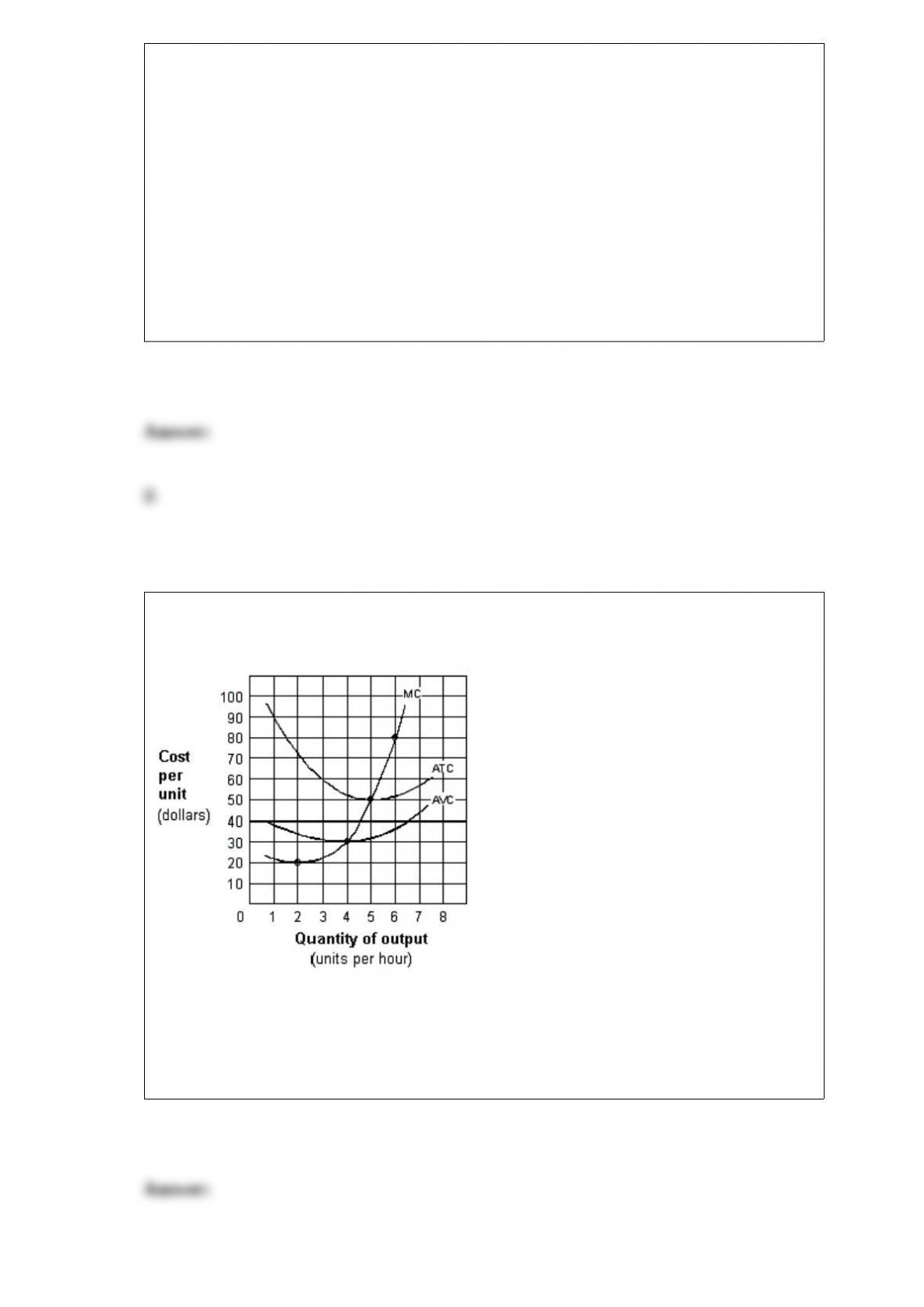
Exhibit 8-16 Short-run cost curves for a competitive firm
In Exhibit 8-16, if the market price of its product is $50 per unit, then the firm will:
a. break even.
b. shut down.
c. exit the industry.
d. earn a positive economic profit.

If the government wants to raise tax revenue and shift most of the tax burden to the
sellers, it would impose a tax on a good with a:
a. steep (inelastic) demand curve and steep (inelastic) demand curve.
b. steep (inelastic) demand curve and a flat (elastic) supply curve.
c. flat (elastic) demand curve and a steep (inelastic) supply curve.
d. flat (elastic) demand curve and a flat (elastic) supply curve.
Which of the following is an example of a positive economic statement?
a. The economy’s real output increased at about 3 percent last year and the
unemployment rate decreased.
b. A central bank should not print too much money because inflation could result.
c. Congress should stabilize the social security system by raising taxes now.
d. The government farm products surplus should be distributed to the needy.
In Marx’s ideal communist society, the state:
a. actively promotes income incentives. c. owns resources and conducts planning.
b. follows the doctrine of laissez faire. d. does not exist.

The slope of the budget line is equal to the ratio of:
a. marginal utilities.
b. money income to the price of the good on the horizontal axis.
c. money income to the price of the good on the vertical axis.
d. price of the good on the horizontal axis to the price of the good on the vertical axis.
Adam Smith was an advocate of:
a. mercantilism. c. unrestricted or free trade.
b. a nation maximizing its stock of gold. d. the visible hand of public interest.
At any point where a monopolist’s marginal revenue is positive, the downward-sloping
straight-line demand curve is:
a. perfectly elastic.
b. elastic, but not perfectly elastic.
c. unit elastic.
d. inelastic.

If a monopolistically competitive firm can earn a profit, it will increase production
until:
a. MR > AVC.
b. MR = ATC.
c. MC > MR.
d. MR = AR.
e. MR = MC.
Which of the following is not one of the three fundamental economic questions?
a. What happens when you add to or subtract from a current situation?
b. For whom to produce?
c. How to produce?
d. What to produce?
Perfect competition is defined as market structure in which:
a. there are many small sellers.
b. the product is homogeneous.
c. it is very easy for firms to enter or exit the market.
d. all of these.
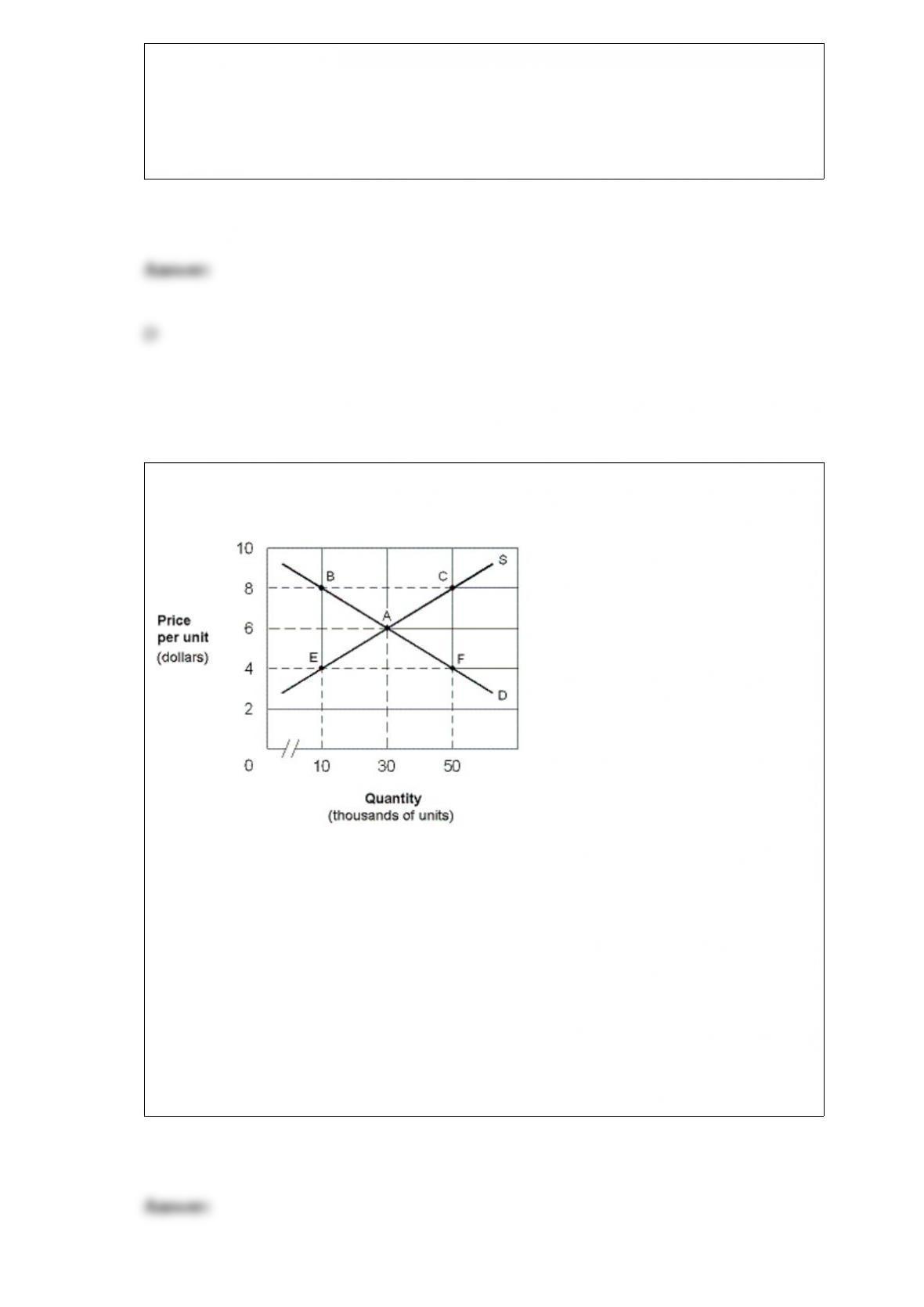
Exhibit 3-10 Demand and supply curves
In Exhibit 3-10, which of the following points represents an excess quantity supplied?
a. Point E.
b. Point B.
c. Point C.
d. Point F.
e. Point A.
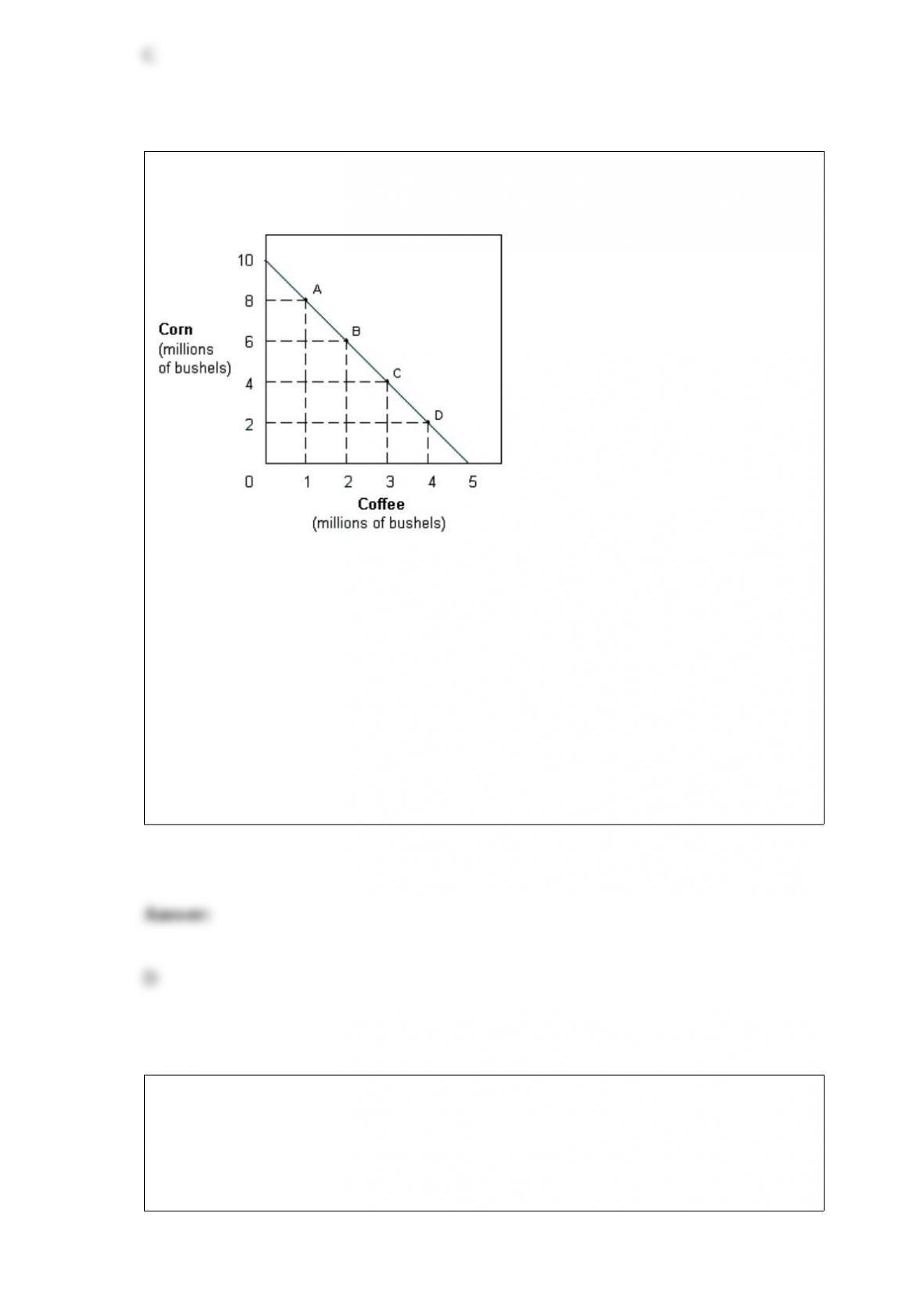
Exhibit 2-2 Production possibilities curve
In Exhibit 2-2, the opportunity cost of coffee when moving from A to B is:
a. the same as moving from A to C.
b. the same as moving from A to D.
c. the same as moving from B to D.
d. the same as moving from B to C.
e. it is not possible to determine.
The U.S. supply curve of dollars is upward-sloping because a:
a. higher number of yen per dollar means Japanese goods are cheaper in Japan.
b. higher number of yen per dollar means Japanese goods are cheaper in the U.S.
c. lower number of yen per dollar means Japanese goods are cheaper in the U.S.
d. none of these.

If a perfectly competitive firm sells 50 units of output at a market price of $10 per unit,
its marginal revenue is:
a. more than $10.
b. less than $10.
c. $10.
d. $5300.
In general, supply curves slope upward because:
a. increases in the price of a good result in lower opportunity costs.
b. rising prices provide producers with a greater profit incentive.
c. consumers buy a greater quantity.
d. technology improves the ability of firms to produce more at each possible price.
A perfectly elastic demand curve has an elasticity coefficient of:
a. 0. c. less than 1.
b. 1. d. infinity.

A chain saw is an example of which of the following factors of production?
a. Land. c. Capital.
b. Labor. d. None of these.
The economic system characterized by private ownership of resources and market is:
a. capitalism. c. fascism.
b. communism. d. socialism.
The more inelastic the demand for a product, the more the actual burden of a tax on the
product will:
a. fall on sellers.
b. fall on buyers.
c. fall equally on both buyers and sellers.
d. create a larger deadweight loss (or excess burden).
A health club sells 50 memberships when the monthly price is $60 and 70 memberships
when the monthly price is $40. The price elasticity of demand for memberships at this
health club is (using the average values method):
a. 0.25.
b. 0.6.
c. 1.0.
d. 1.1.
e. 0.83
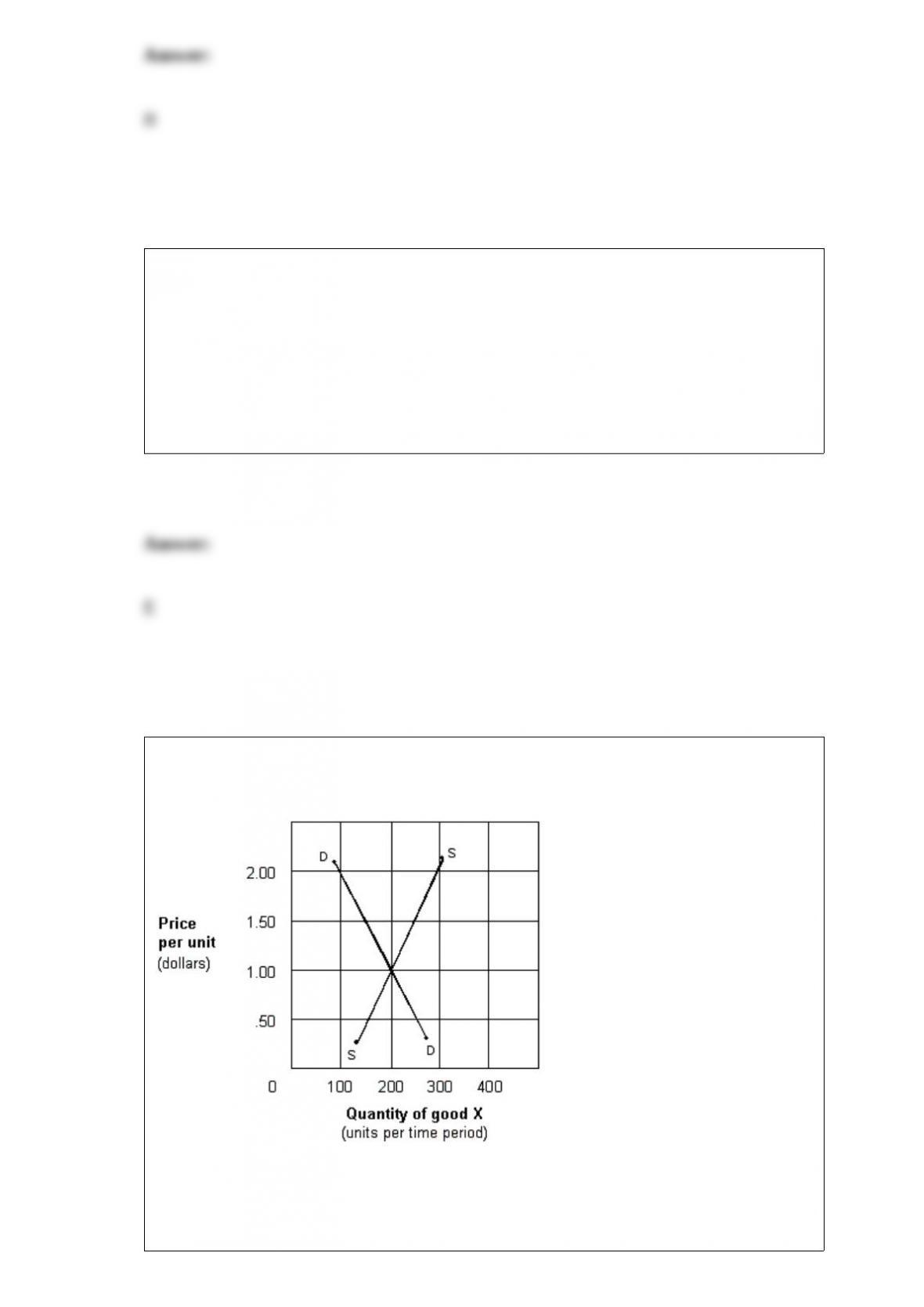
Exhibit 3-15 Supply and demand curves for good X
In Exhibit 3-15, if the price moves from $2.00 to $1.00, unsold inventories will:
a. fall, putting upward pressure on price.

b. fall, putting less pressure on price.
c. rise, putting less pressure on price.
d. rise, putting upward pressure on price.
When the marginal cost of a price-taker firm is more than the market price of its
product, the firm should:
a. expand output.
b. reduce output.
c. maintain output.
d. charge more than the market price.