
Which of the following is often called the “Antimerger Act”?
a. Clayton Act.
b. Robinson-Patman Act.
c. Sherman Antitrust Act.
d. Federal Trade Commission Act.
e. Celler-Kefauver Act.
If we observe a decrease in the price of a good and an increase in the amount of the
good bought and sold, this could be explained by a(n):
a. increase in the supply of the good. c. decrease in the demand for the good.
b. increase in the demand for the good. d. decrease in the supply of the good.
Given the same marginal revenue product (MRP) and supply curves, the equilibrium
quantity of labor employed in a monopsonistic labor market will be:
a. equal to that in a competitive labor market.
b. less than that in a competitive labor market.
c. greater than that in a competitive labor market.
d. there is insufficient information for a conclusion.
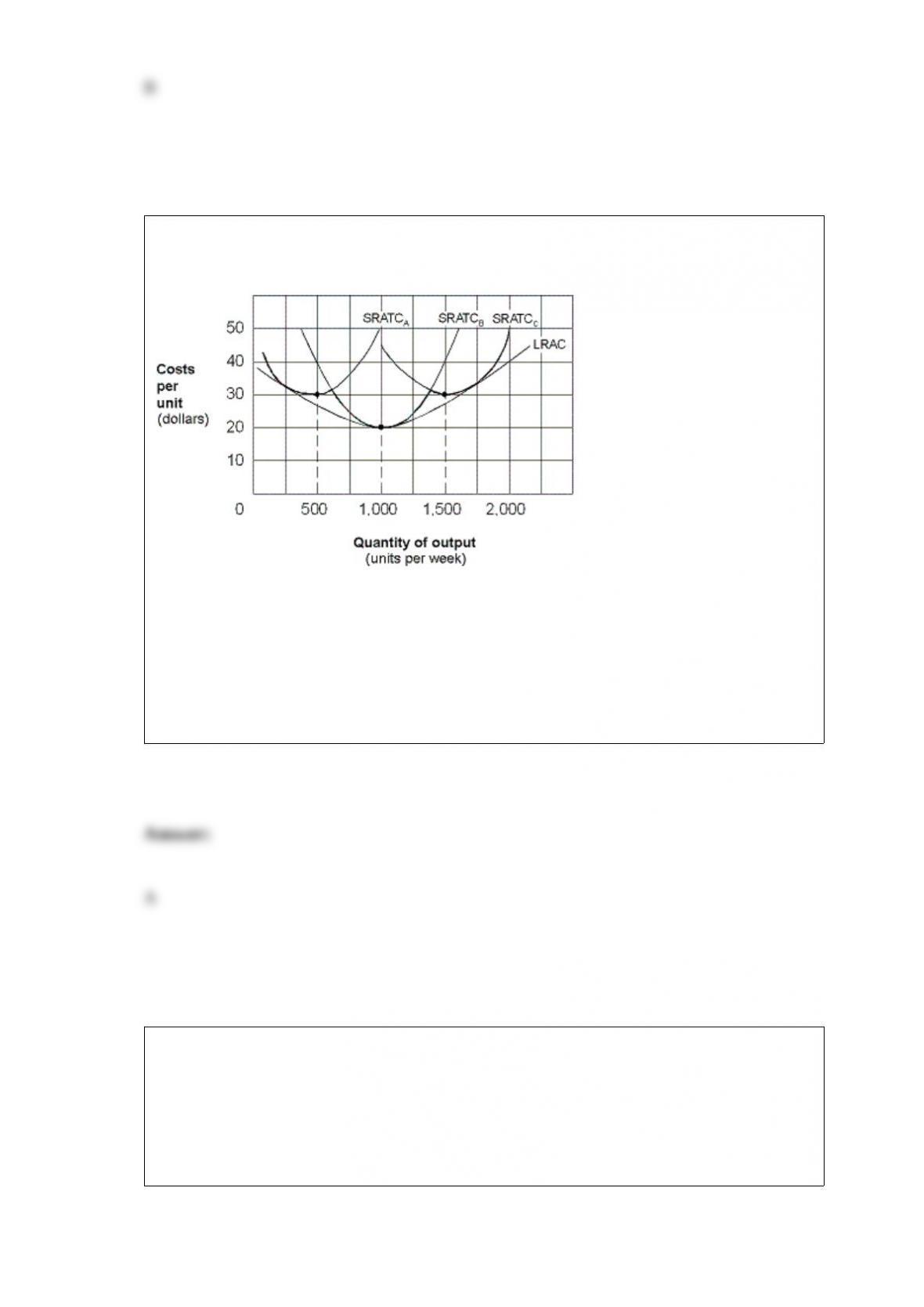
Exhibit 7-15 Long-run average cost
If the firm represented in Exhibit 7-15 is operating with a plant whose size corresponds
to short-run average total cost curve A, the level of output that would minimize its
short-run average total cost is:
a. 500 units per week.
b. 1,000 units per week.
c. 1,500 units per week.
d. 2,000 units per week.
Assuming that clothing is a normal good, an increase in consumer income, other things
being equal, would:
a. increase the demand for clothing.
b. decrease the demand for clothing.
c. increase the quantity of clothing demanded.
d. decrease the quantity of clothing demanded
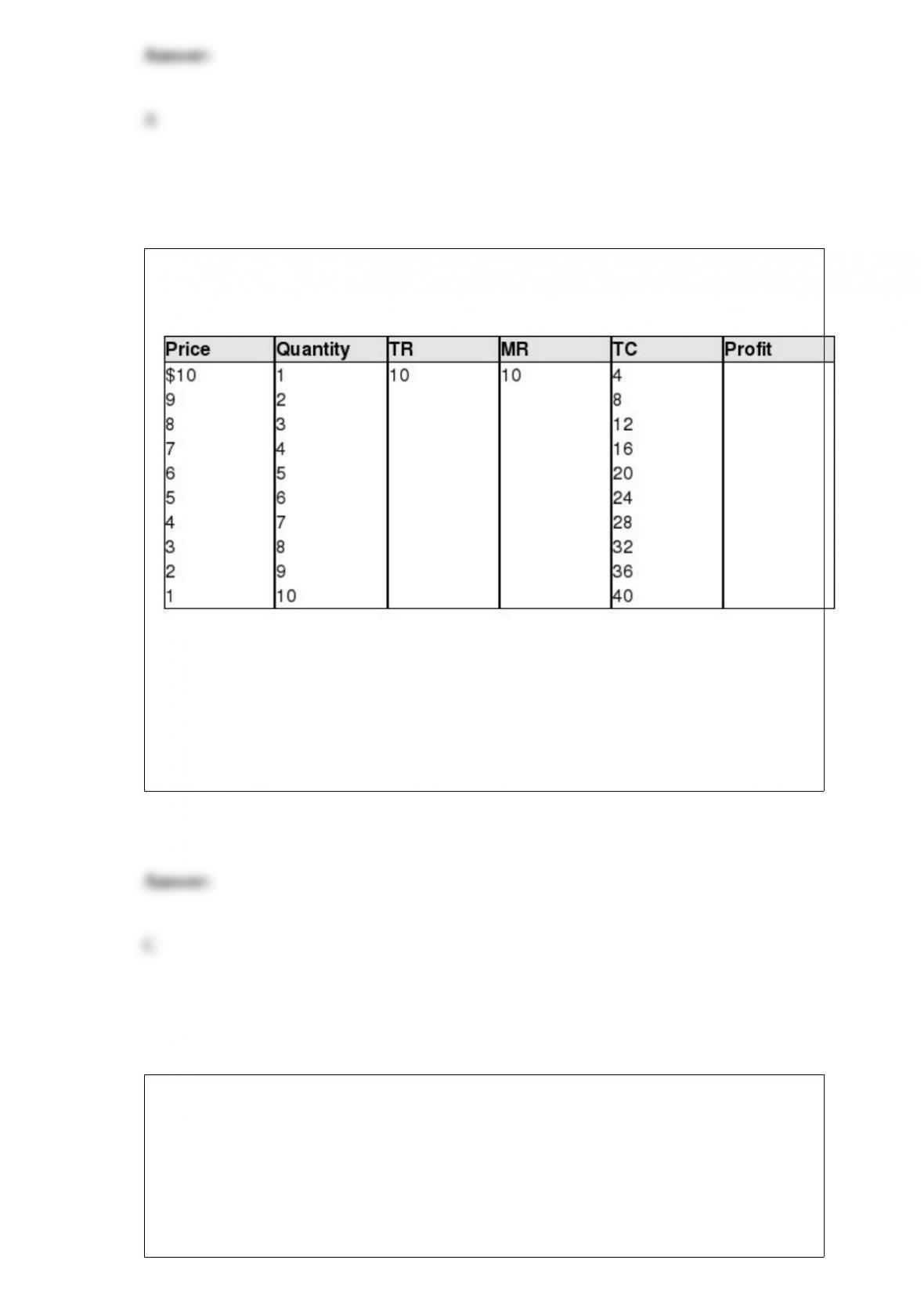
Exhibit 9-5 Demand and cost data for a monopolist
Refer to Exhibit 9-5. The demand schedule and cost schedule for a monopolist are
provided. Which output level maximizes profit?
a. 2.
b. 6.
c. 4.
d. 5.
e. 7.
Which of the following is a partially valid economic argument for restricting free trade?
a. Restrictions on foreign trade will increase employment and permanently reduce
unemployment.
b. Removal of restrictions that have existed for years will initially cause inflation.
c. Infant industries need permanent protection to develop and gain productive
efficiency.
d. A nation needs to protect industries that are vital to national defense in case of future

international conflict.
Minimum wage legislation:
a. sets a price ceiling above the market-clearing price.
b. has no impact if the minimum wage is above the market-clearing price.
c. has the same impact in all labor markets.
d. creates unemployment when the minimum wage is above the equilibrium wage.
e. is opposed by organized labor.
Which of the following makes long-term low-interest loans to LDCs?
a. Agency for International Development (AID).
b. World Bank.
c. International Monetary Fund (IMF).
d. New International Economic Order (NIEO).

Which of the following most clearly illustrates the concept of derived demand?
a. An increase in the price of steak causes the demand for poultry to increase.
b. An increase in the demand for new houses leads to an increase in the demand for
construction workers.
c. An increase in consumer income leads to an increase in the demand for services
provided by the government.
d. An increase in the demand for new cars causes the demand for used automobiles to
rise.
What shape is the production possibilities curve usually expected to exhibit?
a. Upward-sloping.
b. Bowed out.
c. Bowed in.
d. Straight line.
e. U-shaped.
Assume the short-run average total cost for a perfectly competitive industry decreases
as the output of the industry expands. In the long run, the industry supply curve will:
a. have a positive slope.
b. have a negative slope.
c. be perfectly horizontal.
d. be perfectly vertical.
If one dollar exchanges for 20 Thailand baht, then:
a. a baht is worth $20.
b. $20 will exchange for one baht.
c. a baht is worth $2.
d. the United States and Thailand would not engage in trade.
e. a baht is worth a nickel.
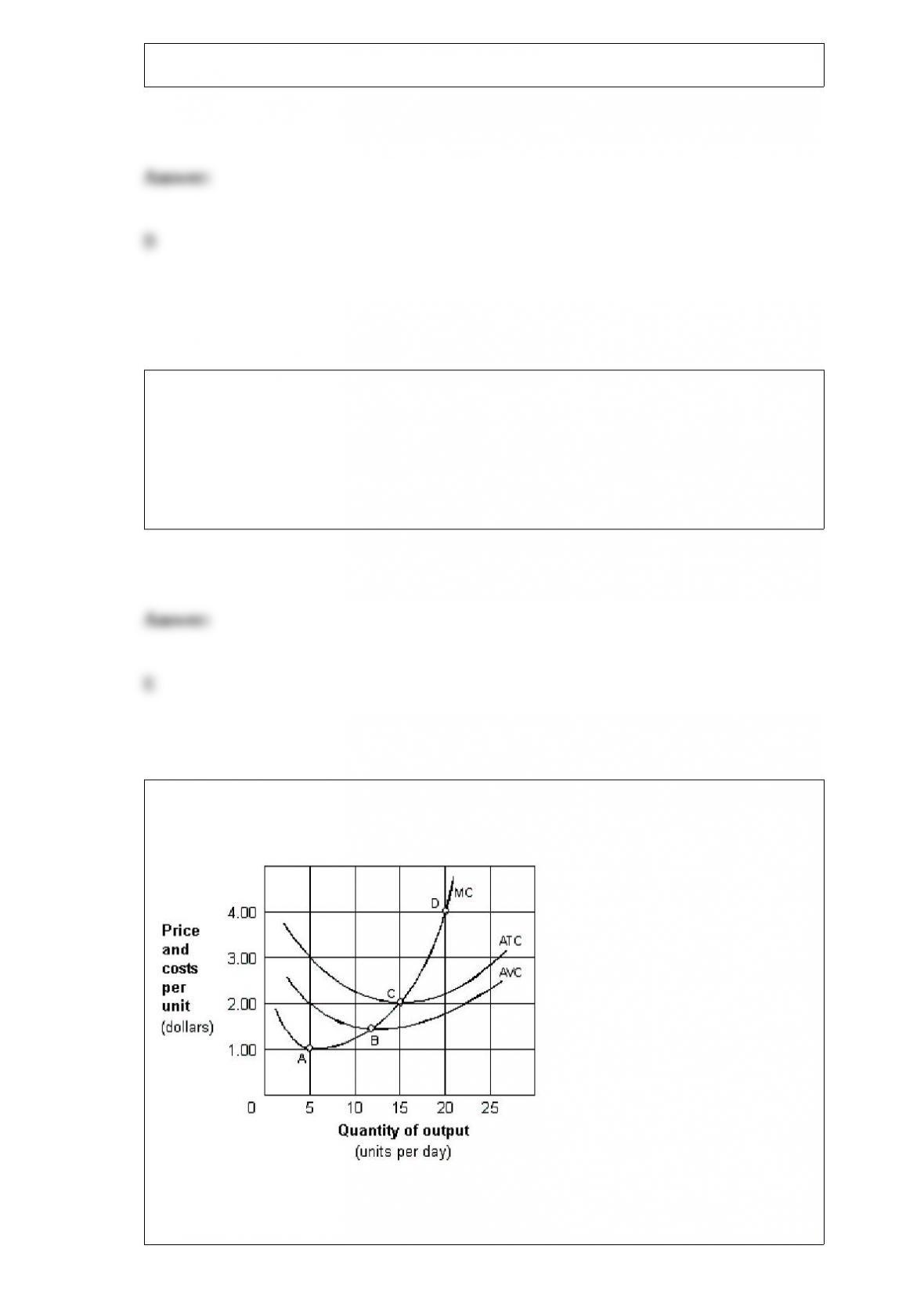
Exhibit 8-3 Cost per unit curves
In Exhibit 8-3, if the price of the firm’s product is $2.00 per unit, the firm will produce:
a. 5 units per day.
b. 10 units per day.

c. 15 units per day.
d. 20 units per day.
If a firm offers quantity discounts or special promotional allowances only to favored
distributors and the effect is to substantially lessen competition, then it is in violation of
the:
a. Clayton Act.
b. Robinson-Patman Act.
c. Sherman Antitrust Act.
d. Federal Trade Commission Act.
e. Celler-Kefauver Act.
The development of new technology typically:
a. shifts the supply curve to the right.
b. reduces profits.
c. results in a downward movement along a supply curve.
d. increases costs of production.
e. shifts the demand curve to the right.

A basic problem with the infant-industry argument is that:
a. most industries need protection when they are mature, not when they are first
established.
b. the amount of the tariff is unlikely to have much impact on the success of an infant
industry.
c. political pressure will likely prevent the withdrawal of the tariff when the industry
matures.
d. domestic consumers will continue to buy the foreign products anyway, regardless of
the tariff.
The purpose of a cartel is to:
a. promote product innovation.
b. increase market competition.
c. act like a monopoly.
d. diversify operations.
e. decrease market concentration.
Other things being equal, the effect of an increase in the price of Coca-Cola would
cause a(n):

a. upward movement along the demand curve for Coca-Cola.
b. leftward shift in the demand curve for Coca-Cola.
c. downward movement along the demand curve for Coca-Cola.
d. rightward shift in the demand curve for Coca-Cola.
If a supply curve has a constant slope throughout its length, it must have a constant
price elasticity throughout its length.
The primary cause of diseconomies of scale is scarcity of machinery and capital.
A surplus means that the quantity supplied is greater than the quantity demanded at the
prevailing price.

Supply-demand analysis shows that a tax collected from sellers is always fully shifted
to buyers.
Macroeconomics studies economywide issues like inflation and unemployment.
According to the text, Singapore and Hong Kong are classified as industrially advanced
countries (IACs).
For most firms, the costs of energy and raw materials will be total fixed costs.

If marginal product is at a maximum, then marginal cost is at a minimum.
In the short run, the monopolistic competitive firm will charge a price equal to marginal
cost.