
Karl Marx published:
a. Das Kapital. c. The Wealth of Nations.
b. General Theory of Communism. d. Capitalist Manifesto.
If a box of Swiss chocolate priced at 100 francs can be purchased for $50, the exchange
rate is:
a. 0.50 francs per dollar. c. 0.50 dollars per franc.
b. 4.00 francs per dollar. d. none of these.
The “ceteris paribus” clause in the law of demand does not allow which of the
following factors to change?
a. Consumer tastes and preferences. c. Expectations.
b. The prices of other goods. d. All of these.
Along a production possibilities curve showing capital and consumption goods
production, which of the following pairs are being held fixed?

a. Unemployment and capital goods production.
b. Number of resources and consumption goods production.
c. Composition of the economy’s output and number of resources.
d. Capital and consumption goods production.
e. Technology and number of resources.
Which of the following explains the vicious circle of poverty?
a. By investing in education and infrastructure at the same time, the country can
overcome the problems of poverty.
b. Poverty arises out of the lack of investment, but they cannot invest because they are
poor.
c. A nation can shift its production possibilities curve inward by shifting more resources
into the production of capital goods.
d. A nation can shift its production possibilities curve outward by shifting more
resources into the production of consumer goods.
e. There are dual economies in the world: Some are meant to be rich and others are
meant to be poor.
In monopolistic competition if there is profit, there is:

a. a signal for new firms to enter.
b. a motive for existing firms to increase prices.
c. proof that advertising works.
d. a motive for existing firms to decrease prices.
e. product differentiation.
Which of the following is the best example of an action that imposes an external cost?
a. Wear and tear on your car as the result of frequent use.
b. Deterioration in the average quality of a house you own as the result of poor
maintenance.
c. Water pollution from an upstream factory that increases the cost of providing clean
water to downstream residents.
d. A rose garden on your property from which your neighbor gets much enjoyment.
Economists use ____ economic analysis to understand an individual market. They then
use ____ economic analysis to guide future national economic policy.
a. b and d c. positive; normative
b. macro; micro d. normative; positive

A firm’s opportunity cost of using resources provided by the firm’s owners is called:
a. sunk costs.
b. fixed costs.
c. explicit costs.
d. implicit costs.
e. entrepreneurial costs.
A characteristic of an oligopoly is:
a. mutual interdependence in pricing decisions.
b. independent pricing decisions.
c. lack of control over prices.
d. none of these.
Exhibit 3-15 Supply and demand curves for good X
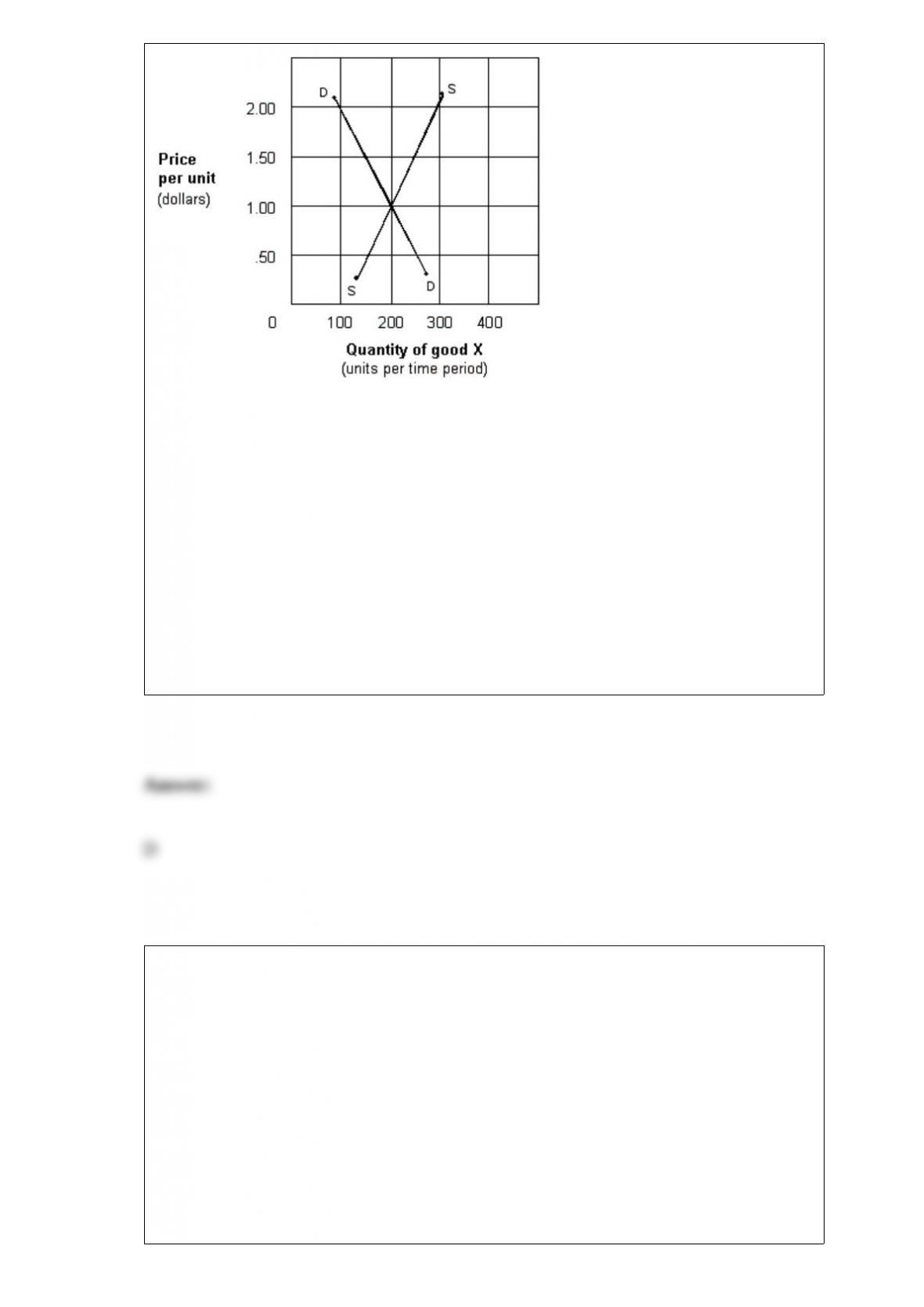
In Exhibit 3-15, if the market price of good X is initially $1.50, a movement toward
equilibrium requires:
a. no change, because an equilibrium already exists.
b. the price to fall below $1.50 and both the quantity supplied and the quantity
demanded to fall.
c. the price to remain the same, but the supply curve to shift to the left.
d. the price to fall below $1.50, the quantity supplied to fall, and the quantity demanded
to rise.
If consumers switch away from eating margarine at the same time that the number of
margarine suppliers increases, then:
a. these two effects cancel each other out and there is no change in the margarine
market equilibrium.
b. the demand curve shifts left and the supply curve shifts right.
c. there is a margarine price increase.
d. there is an excess demand for margarine.

e. the equilibrium quantity of margarine must increase.
Reductions in available resources will cause the production possibilities curve to:
a. expand. c. become vertical.
b. disappear. d. shift inward.
The economic system that is generally considered to be the most efficient at answering
the What to produce and the How to produce questions is the:
a. market economy. c. soviet economy.
b. command economy d. traditional economy.
The supply curve that monopsonists face is different from the supply curves that firms
in competitive labor markets face because with a monopsony,
a. d and e.
b. the supply curve of labor is relatively flat.
c. offering a wage lower than the market wage means having no workers.
d. the employer faces the market supply curve.
e. the firm does not take the wage as given.
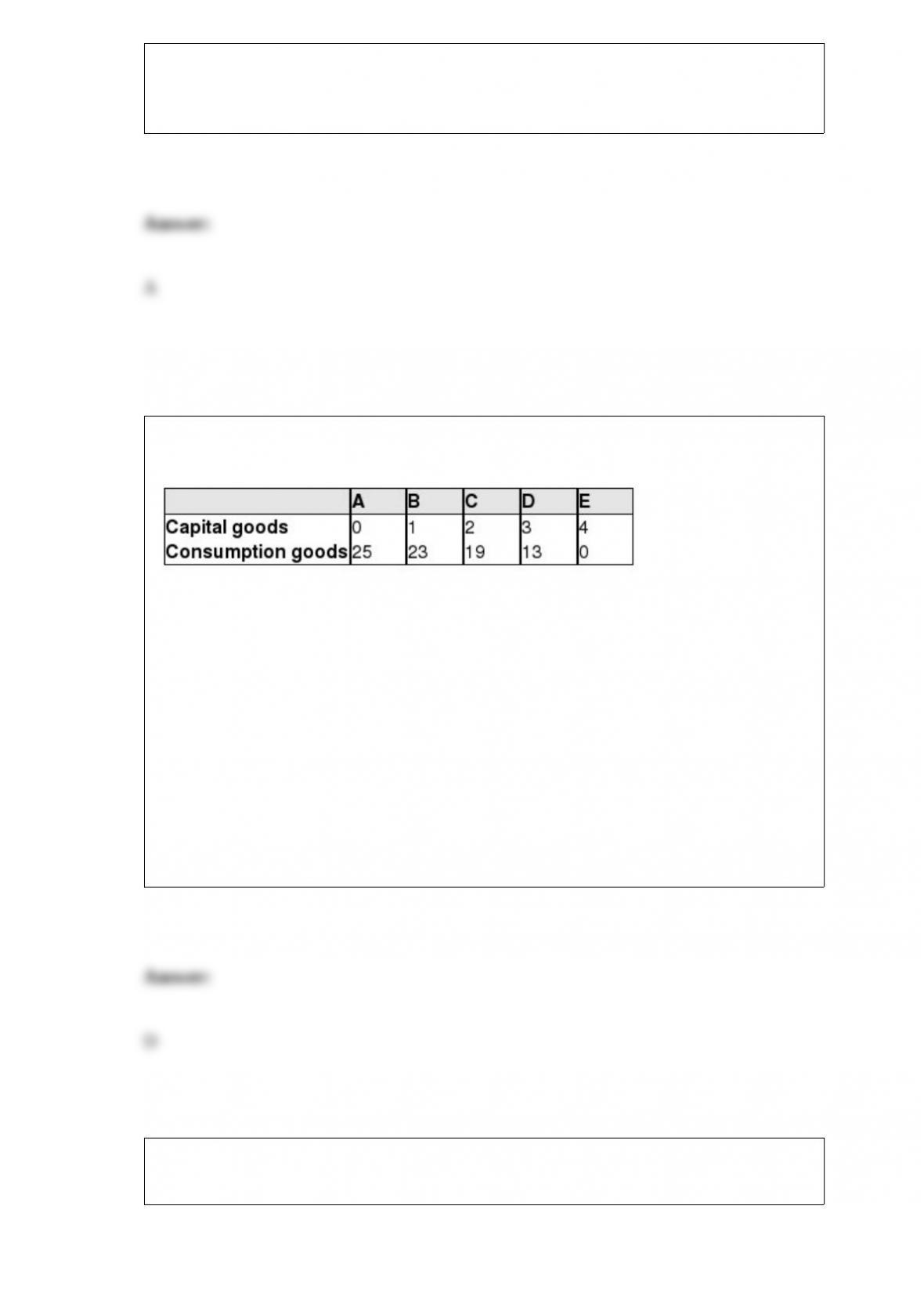
Exhibit 2-10 Production possibilities curve data
Suppose an economy is faced with the production possibilities table shown in Exhibit
2-10. If this economy chooses the combination of goods at point A,
a. only capital goods are being produced.
b. every resource in the economy is utilized in the production of capital goods.
c. no capital goods are being used as factors of production.
d. every resource in the economy is being used in the production of consumption goods.
e. no consumption goods are being produced.
Exhibit 11-8 A labor market
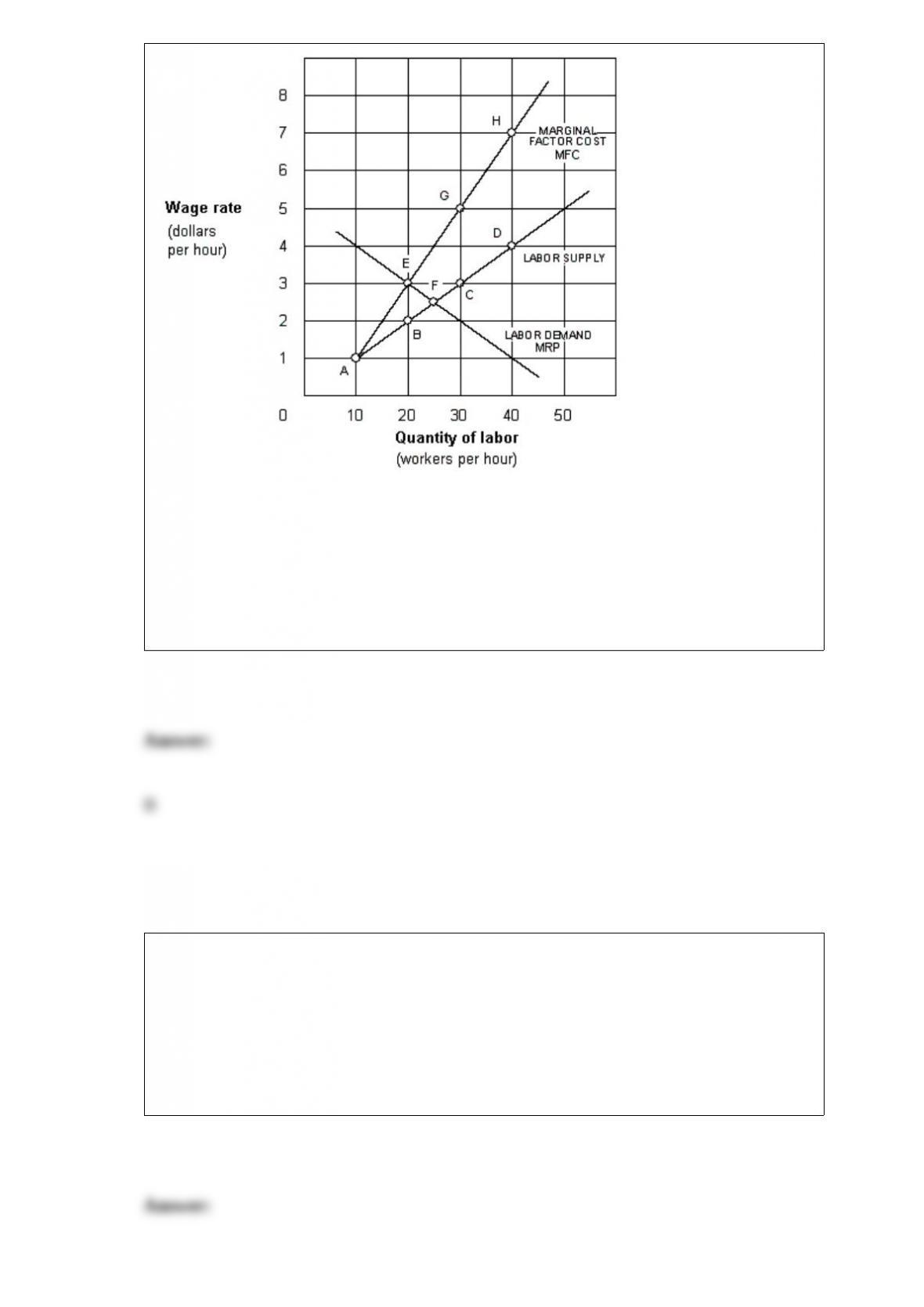
If the labor market shown in Exhibit 11-8 is a monopsony, the wage rate and number of
workers employed will be determined at point:
a. A.
b. B.
c. C.
d. D.
e. F.
Which of the following program(s) is (are) in-kind assistance to fight poverty in the
United States?
a. b and e.
b. Medicaid.
c. Unemployment benefits.
d. Temporary Assistance to Needy Families (TANF).
e. Food stamps.
The balance of payments ____.
a. b and e
b. is always zero
c. with some nations is different than it is with others
d. is negative when the nation runs a trade deficit
e. can only be expanded when the government has foreign exchange reserves
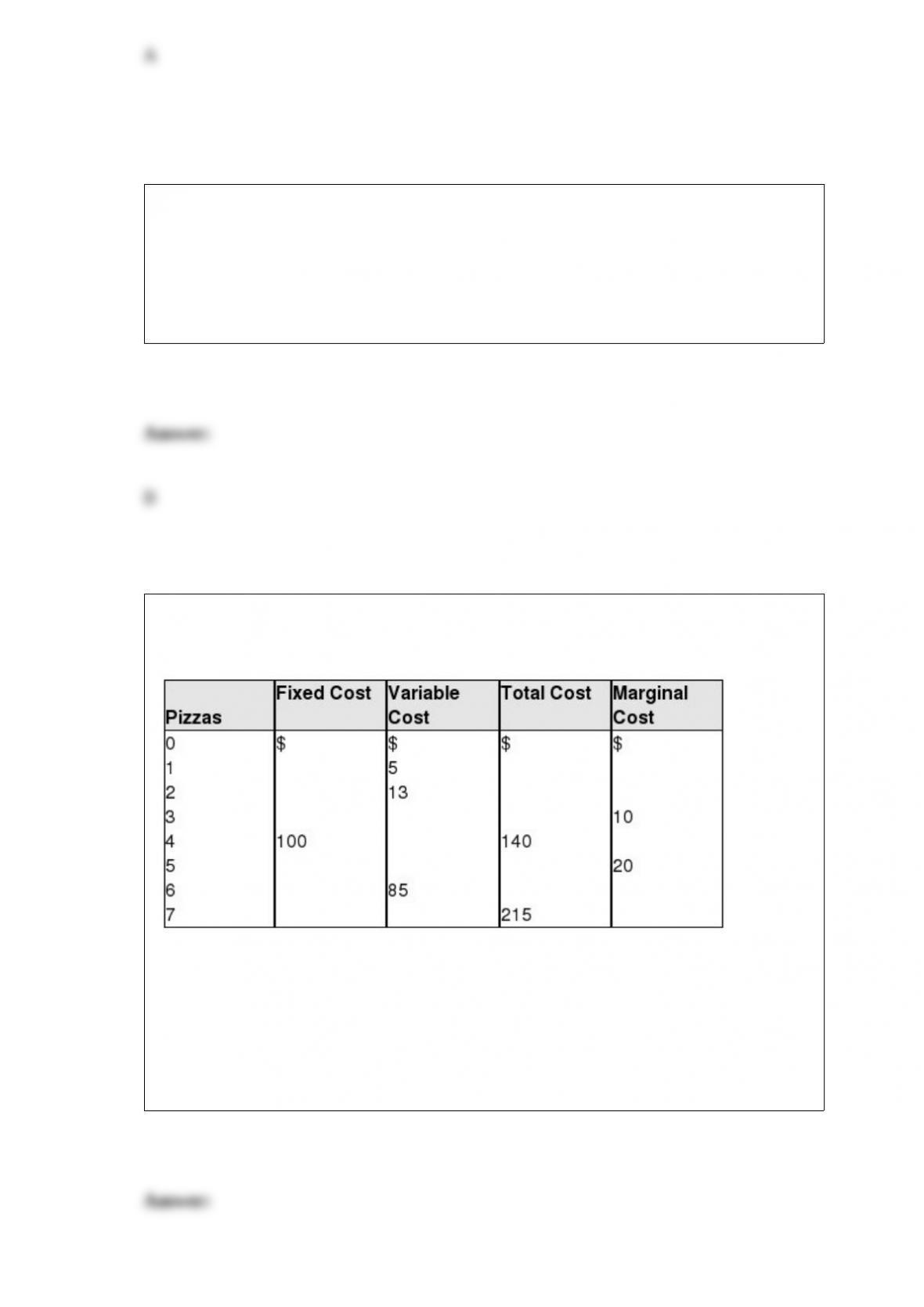
Exhibit 7-8 Costs schedules for producing pizza
By filling in the blanks in Exhibit 7-8, the variable cost of producing 4 pizzas is shown
to be equal to:
a. $100.
b. $40.
c. $60.
d. $85.
e. $185.

Which of the following is in charge of U.S. aid to foreign countries?
a. Agency for International Development (AID).
b. World Bank.
c. International Monetary Fund (IMF).
d. New International Economic Order (NIEO).
If the price of a good falls, the marginal utility per dollar spent on that good:
a. also falls.
b. stays the same.
c. rises.
d. will rise or fall, depending on the consumer.
e. remains unchanged, provided the consumer buys no more of the good.
Exhibit 3-7 Demand and supply curves
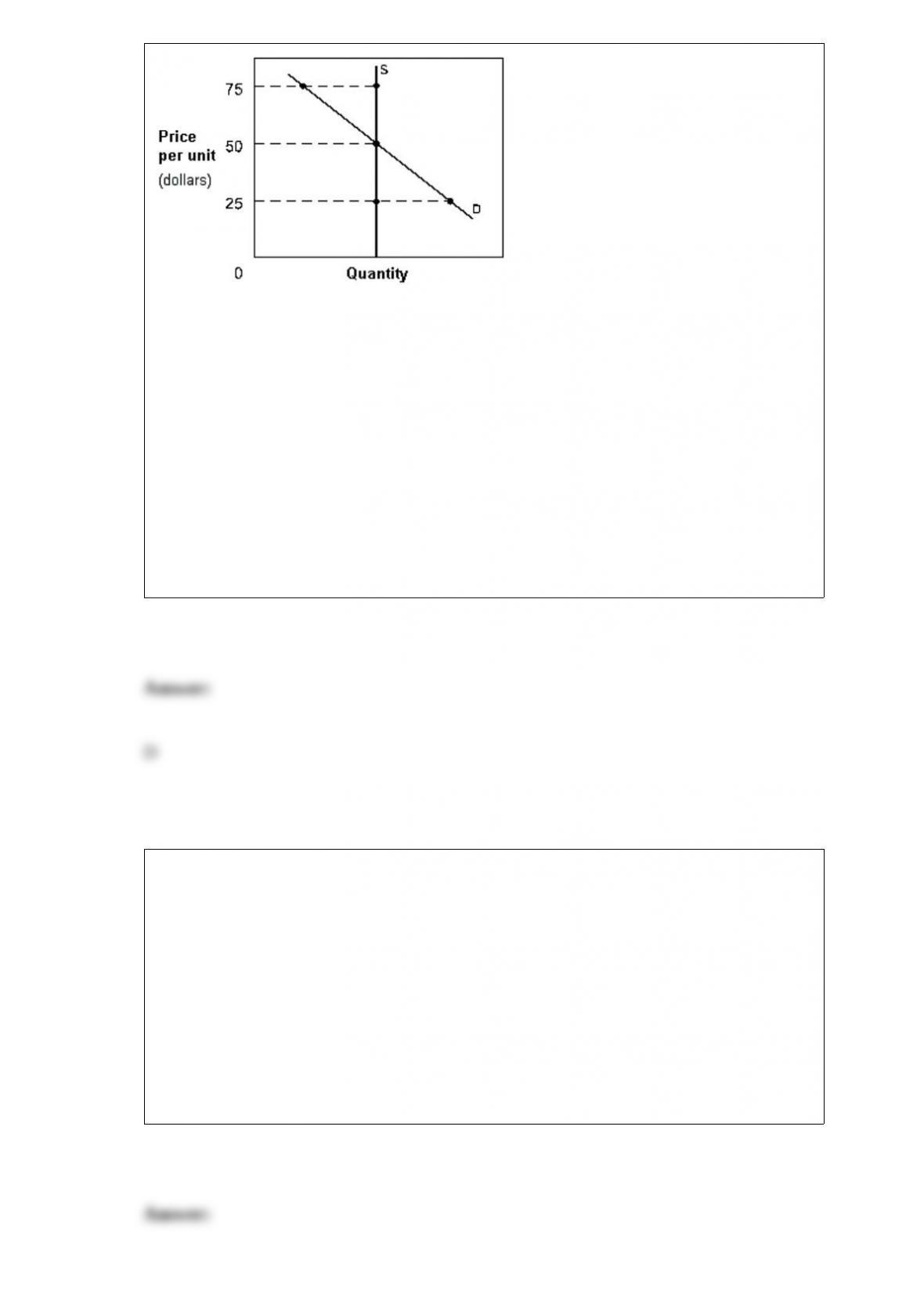
In Exhibit 3-7, if price happened to currently be $75 in this market, a ____ would result,
causing a(n) ____ in price.
a. shortage; increase
b. shortage; decrease
c. surplus; increase
d. surplus; decrease
e. market clearing; change
Imperfect knowledge about a product can cause:
a. excessive resources devoted to producing a product.
b. consumers paying too high a price for a product.
c. overconsumption of a product.
d. all of the above answers are true.
e. none of the above answers a.-c. are true.

An oligopolist operating with a kinked demand curve would expect rivals to match its
price:
a. increases. c. both a and b.
b. decreases. d. neither a nor b.
A natural monopoly exists whenever economies of scale are very extensive.
Suppose A and B are complementary goods. Other things being equal, the demand
curve for A will shift to the right when the price of B goes up.
If a firm is producing an output level at which marginal revenue exceeds marginal cost

in the short run, the firm will increase profits by reducing its output level.
At the equilibrium price, deadweight loss is minimized.
The purchase of Michelin Tire Company by General Motors is an example of a
horizontal merger.
Regardless of the demand for its product, a monopolist will be able to earn positive
economic profits.
Emission permits allow producers to pollute an unspecified amount.
In the long run, marginal cost must equal marginal revenue for a monopolistic
competitive firm, but not at the minimum point of the long-run average cost curve.
If marginal revenue exceeds marginal cost in the short run, total revenue for the
perfectly competitive firm is greater than total cost.