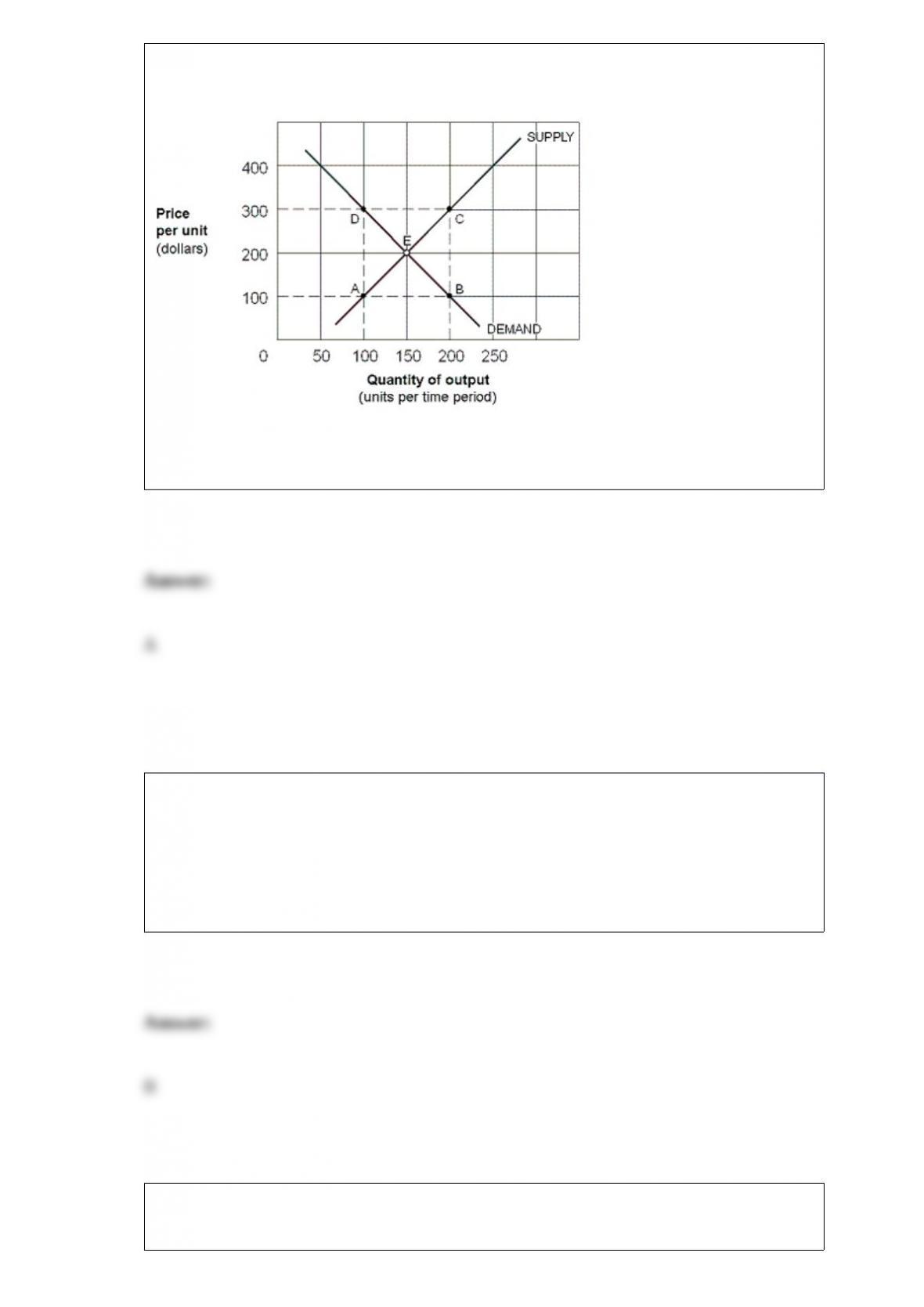
Exhibit 5-9 Supply and demand curves for good X
In Exhibit 5-9, the price elasticity of supply for good X between points A and E is:
a. 3/5 = 0.60. c. 1/2 = 0.50.
b. 5/3 = 1.66. d. 1.
For many years, AT&T required customers to rent telephones from AT&T in order to
receive phone service. This is an example of:
a. price discrimination. c. an interlocking directorate.
b. a tying contract. d. exclusive dealing.
In a market economy:

a. collective decision-making is more important than individual decision-making.
b. goods and services are distributed as if by an “invisible hand” to those who can not
afford them.
c. profit provides an incentive to be productive.
d. the distribution of wealth is equitably distributed.
Price elasticity of demand is defined as the ratio of the:
a. percentage increase in price to an increase in quantity demanded.
b. unit change in quantity demanded to the dollar change in price.
c. maximum amount that consumers will pay to increase quantity.
d. percentage change in quantity demanded to the percentage change in price, other
things being equal.
If the government imposes a price ceiling below the market equilibrium price, which of
the following will result?
a. There will be a surplus of the good.
b. The quantity demanded will exceed the quantity supplied.
c. The quantity supplied will exceed the quantity demanded.
d. The demand curve will shift to the left.

The law of demand shows that:
a. there is an inverse relationship between price and quantity demanded.
b. the demand curve is positively sloped.
c. when the price of a good increases, the quantity demanded increases.
d. the supply curve is vertical.
e. individual demand is the same as market demand.
The most important characteristic of the equilibrium price is that it:
a. guarantees that producers earn profit. c. increases the quantity demanded.
b. clears the market. d. decreases the quantity demanded.
Suppose that price is below the minimum average total cost (ATC) but above the
minimum average variable cost (AVC), and the market price is expected to rise at least
to ATC in the near future. In the short run, a firm that is a price taker would:
a. immediately shut down and get out of the industry.
b. continue to produce a quantity such that marginal revenue equals marginal cost.
c. shut down temporarily, in hopes of restarting in the near future.
d. cut price and expand output in hopes of achieving economies of scale

A production possibilities curve shows the various:
a. prices that can be charged for capital and consumption goods.
b. combinations of prices and outputs that can be produced.
c. combinations of goods the economy has the capacity to produce.
d. combinations of resources and prices that the economy can produce.
Consumer equilibrium occurs where the budget line is tangent to the:
a. lowest possible indifference curve.
b. highest possible indifference curve.
c. utility maximizing indifference curve.
d. utility equalization indifference curve.
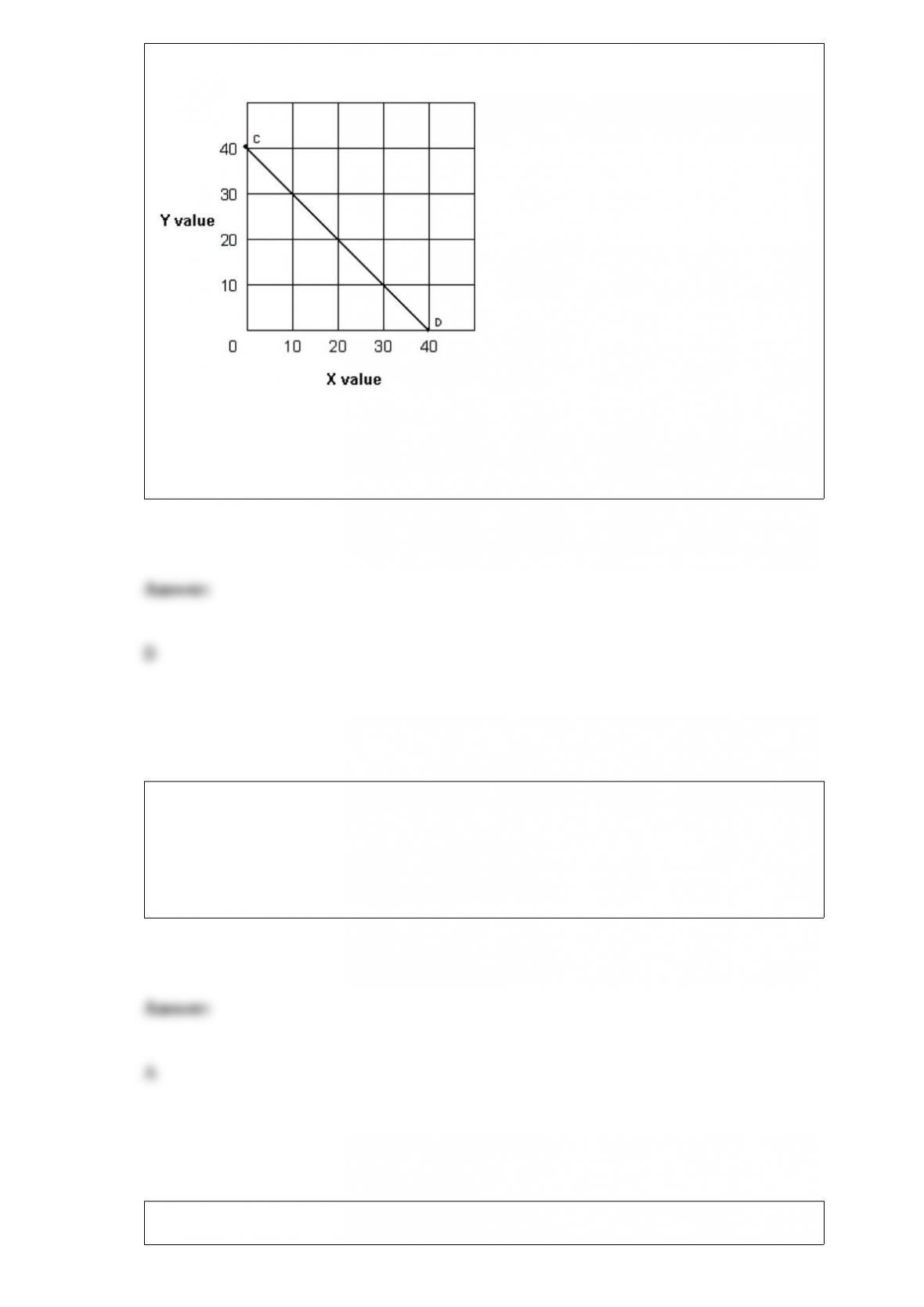
Exhibit 1A-5 Straight line
In Exhibit 1A-5, as X increases along the horizontal axis, corresponding to points C-D
on the line, the Y values decrease. The relationship between the X and Y variables is:
a. direct. c. independent.
b. inverse. d. variable.
The price elasticity of demand coefficient for a good will be greater:
a. if close substitutes exist.
b. if minor complements exist.
c. in the short-run.
d. if a small portion of the budget will be spent on it.
Assuming that Pepsi-Cola and Coca-Cola are substitutes, a rise in the price of

Pepsi-Cola, other things being equal, results in a(n):
a. upward movement along the demand curve for Coca-Cola.
b. downward movement along the demand curve for Coca-Cola.
c. leftward shift in the demand curve for Coca-Cola.
d. rightward shift in the demand curve for Coca-Cola.
Firms should hire additional units of a resource as long as the:
a. marginal product of the resource exceeds the price of the resource multiplied by the
quantity of output produced.
b. marginal product of the resource is less than the price of the resource.
c. price of the output produced is positive.
d. marginal revenue product of the resource exceeds the cost of an additional unit of the
resource.
A merger between two firms that have a supplier-purchaser relationship is:
a. horizontal.
b. vertical.
c. conglomerate.
d. illegal.
e. inefficient.

In Exhibit 11-7, which of the following could have caused the shift in labor demand
from D1 to D2?
a. Increase in wages.
b. Decrease in wages.
c. Decrease in price of product.
d. Decrease in demand for the product.
e. Increase in the demand for the product.
Macroeconomics deals with the analysis of all of the following questions except:
a. why do national economies grow.
b. what determines a nation’s savings and investments.
c. how does a central bank influence inflation.
d. why does a country experience recessions.
e. how does Microsoft price its software packages.
A reduction in production costs will result in a(n):
a. rightward shift of the supply curve.
b. increase in supply.
c. greater willingness and ability of producers to supply a larger quantity at any given

price.
d. greater willingness and ability of producers to supply the same quantity at a lower
price.
e. all of these.
At a price of $5, 24 units of the good would be sold; at a price of $7, 25 units of output
would be sold. The marginal revenue of the 25th unit of output is:
a. $14.
b. $55.
c. $6.
d. $168.
e. $175.
Exhibit 15-3 Potatoes and wheat output (tons per day)
In Exhibit 15-3, the United States has an absolute advantage in producing:
a. potatoes. c. both.
b. wheat. d. neither.

Command-and-control regulation, as compared to incentive-based regulation, is:
a. efficient in the short run and in the long run.
b. efficient in the short run, but not in the long run.
c. inefficient in the short run, but efficient in the long run.
d. inefficient in the short run and long run.
____ is the subjective measure of the physical and mental satisfaction that is anticipated
from consumption.
a. Demand
b. Supply
c. Recognition
d. Utility
e. Cognition
When a reduction in the price of a good allows a consumer to purchase more of all
goods, this effect is called the:
a. income effect.

b. substitution effect.
c. elasticity effect.
d. monetary effect.
Suppose you are traveling from the United States to Djibouti on vacation. You would be
better off on your vacation if:
a. exchange rates did not change after you bought Djiboutian francs.
b. you had purchased Djiboutian francs in Djibouti and not in New York.
c. the Djiboutian franc became more powerful with respect to the U.S. dollar.
d. the exchange rate increased.
e. the exchange rate decreased.
If population grows faster than GDP, then per capita GDP must fall.
The utility of a good measures its satisfaction rather than its usefulness.
Discuss the three fundamental economic questions that all nations must address.
Since 1959 the fraction of persons below the poverty line has fallen.
The marginal utility curve is downward sloping.

Changes in relative prices create substitution effects.
The fewer the substitutes for a good the greater will be the value of the price elasticity
of demand coefficient.