Product differentiation makes the demand for a monopolistically competitive firm’s
product:
a. perfectly elastic. c. more inelastic than for a monopoly.
b. more elastic than for a monopoly. d. perfectly inelastic.
Suppose a monopolist’s demand curve lies below its average variable cost curve. The
firm will:
a. earn an economic profit.
b. stay in operation in the short-run.
c. shut down.
d. none of these.
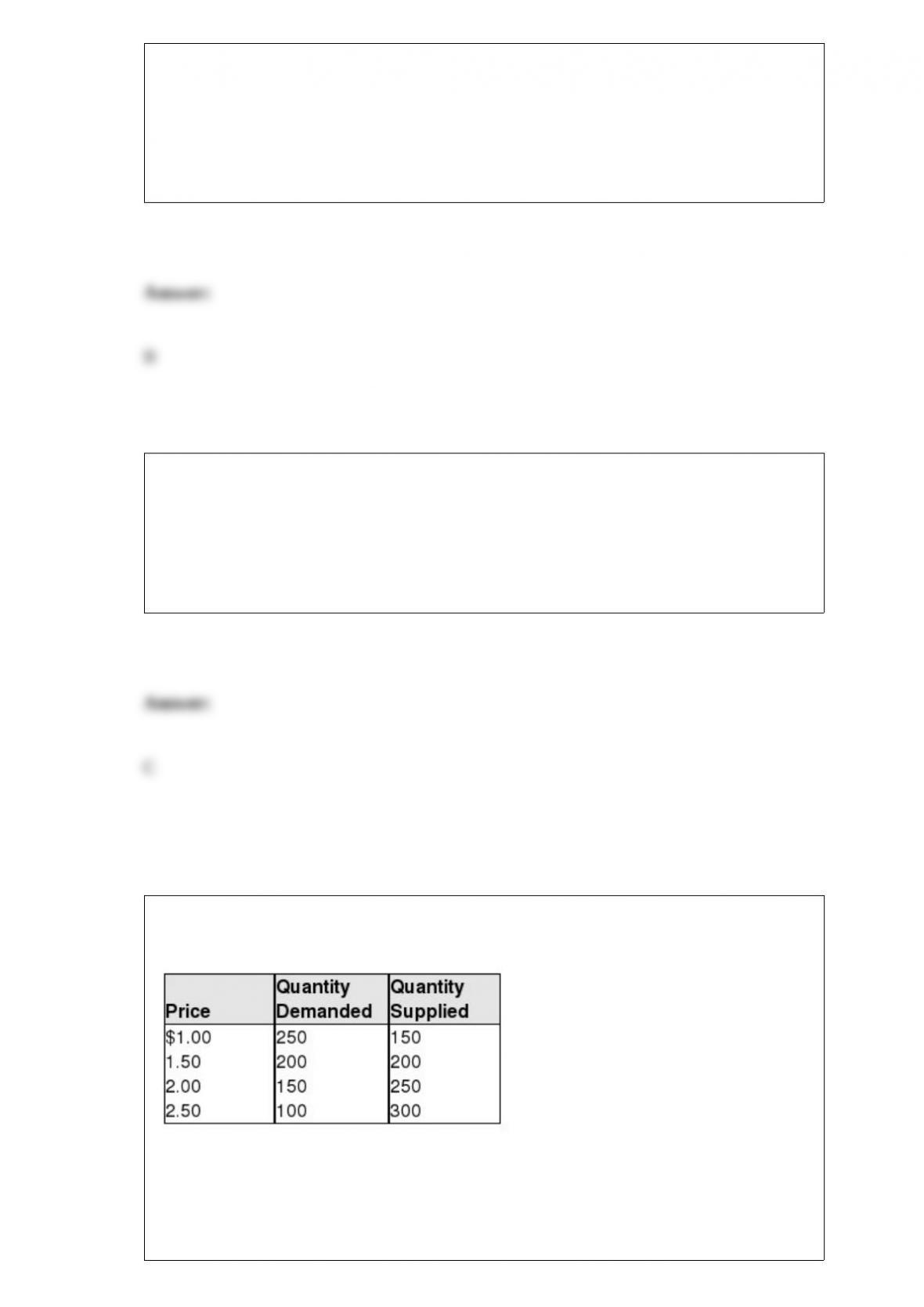
Exhibit 3-12 Supply and demand data
In Exhibit 3-12, at a price of $2.00 the market will experience a(n):
a. shortage of 150 units. c. shortage of 100 units.

b. surplus of 100 units. d. equilibrium.
Under perfect competition, which of the following are the same (equal) at all levels of
output?
a. Price and marginal cost.
b. Price and marginal revenue.
c. Marginal cost and marginal revenue.
d. All of these.
As compared to a firm that competes for labor, a monopsony will:
a. hire fewer workers and pay lower wages.
b. hire fewer workers by pay higher wages.
c. pay lower wages but hire more workers.
d. pay higher wages and hire more workers.
In long-run equilibrium for a perfectly competitive firm, price equals which of the

following?
a. Economies of scale.
b. Minimum short-run average total cost.
c. The sum of each short-run marginal cost curve.
d. All of these.
If a consumer is maximizing his/her utility for a given income, the:
a. marginal utility for every good purchased would be the same.
b. marginal utility per dollar spent for all goods would be the same.
c. marginal utility per dollar for all goods would be at a maximum.
d. total expenditure on each good would be the same.
e. number of units of each good consumed would be the same.
If a decrease in the price of football tickets increases the total revenue of the athletic
department, this is evidence that demand is:
a. price elastic. c. unit elastic with respect to price.
b. price inelastic. d. perfectly inelastic.

The perpetual problem in economics is:
a. our inability to work together effectively.
b. our inability to satisfy everyone’s wants with the available resources.
c. a recognition of continual class differences.
d. our inability to utilize resources efficiently.
e. likely to be solved in resource-rich countries.
Suppose that Fernando allocates his lunch money to pizza and Coke. A Coke costs $1
and a slice of pizza costs $1.50. The marginal utility of the last slice of pizza Fernando
ate today was 30, and the marginal utility of his last Coke was 25. Fernando spent all of
his lunch money. From this information, we can conclude that:
a. Fernando allocated his money in a way that maximized his total utility.
b. Fernando’s total utility would have been higher if he had purchased more Coke and
less pizza.
c. Fernando’s total utility would have been higher if he had purchased more pizza and
less Coke.
d. Fernando could have increased his total utility by purchasing more Coke but the
same quantity of pizza.
e. Fernando could have increased his total utility by purchasing more pizza but the same
quantity of Coke.
Which of the following is not a characteristic of capitalism?
a. Private ownership of resources.

b. Decentralized decision-making using markets.
c. Representative democracy.
d. Consumer sovereignty.
Exhibit 7-1 Production of pizza data
Exhibit 7-1 shows the change in the production of pizzas as more workers are hired.
The marginal product of the second employee equals:
a. 4.
b. 10.
c. 14.
d. 6.
e. 15.
Which of the following pairs is the most likely to exhibit an inverse relationship?
a. The amount of time you study and your grade point average.
b. People’s annual income and their expenditure on personal computers.
c. Baseball players’ salaries and their batting averages.
d. The price of a concert and the number of tickets people purchase.
Marginal revenue product is measured by:
a. MR price.
b. MR MC.
c. TR / MP.
d. MP price.
e. TC / MP.
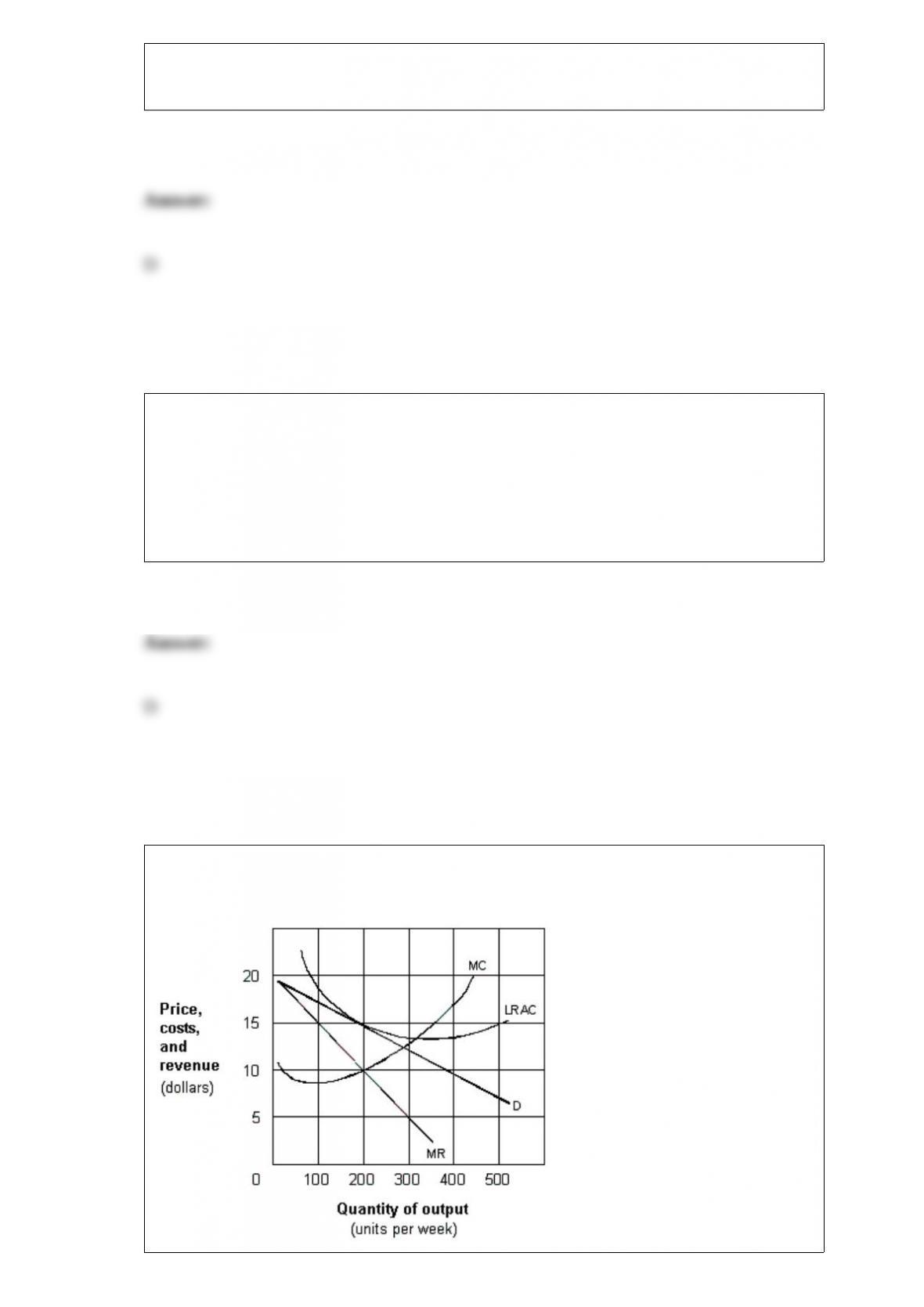
Exhibit 10-2 A monopolistic competitive firm

As presented in Exhibit 10-2, the long-run profit-maximizing output for the
monopolistic competitive firm is:
a. zero units per week.
b. 100 units per week.
c. 200 units per week.
d. 300 units per week.
e. 400 units per week.
An oligopoly market structure is characterized by firms closely watching their rivals’
pricing policies.
What is the difference between economic and accounting profit? Why is a distinction
between them important?

Excess quantity demanded for a good creates pressure to push the price of that good
down toward the equilibrium price.
Being too big a firm can be a per se violation of antitrust laws.
In the short run both the monopolistically competitive firm and the perfectly
competitive firm will charge a price equal to marginal cost.
Assume a ceiling price is set above the equilibrium price. The eventual result is a
shortage.

A conditional statement such as if event A occurs, then event B follows is an example of
normative economics.
One of the strengths of a socialist economy, according to those who advocate such a
system, is that government intervention will enable a more equitable distribution of
income and therefore goods and services produced.
Compare and contrast the four market models in terms of the profit-maximizing output
level for each, the shut-down rule for each, the probability of long-run economic profits
being earned, and their social desirability.

What is the profit maximizing (loss minimizing) quantity for the perfectly competitive
firm to produce?