
Under long-run perfect competition, which of the following are the same (equal) at all
levels of output?
a. Price and marginal cost.
b. Price and marginal revenue.
c. Marginal cost and marginal revenue.
d. All of these.
An example of price discrimination is the price charged for:
a. a postage stamp.
b. theater tickets that offer lower prices for children.
c. an economics textbook at a campus bookstore.
d. Any of these.
The strategy underlying price discrimination is to:
a. charge higher prices to customers who have better access to substitutes.
b. charge everyone the same price but limit the quantity they are allowed to buy.
c. increase total revenue by charging higher prices to those with the most inelastic
demand for the product and lower prices to those with the most elastic demand.
d. reduce per-unit costs by charging higher prices to those with the most elastic demand
and lower prices to those with the most inelastic demand.

A Lorenz curve shows the:
a. number of people in an economy living below the poverty line.
b. percentage of children in an economy who are not receiving adequate nutrition.
c. percentage of the economy’s population benefiting from government spending
programs.
d. percentage of an economy’s total income each part of the population receives.
e. percentage of the population whose income is dependent on sales to foreign
countries.
Suppose the prices of petroleum products, including gasoline and fuel oil, fell sharply.
Which of the following would most likely occur as the result of the lower prices of
petroleum products?
a. A reduction in the consumption of gasoline.
b. An increase in demand for solar heating systems.
c. An increase in demand for smaller, more efficient automobiles.
d. A reduction in the demand for home insulation products.
Consumers always prefer indifference curves that are ____ the origin.
a. closer to
b. tangent to
c. farther from
d. concave relative to
When economists say the quantity demanded of a product has increased, they mean the:
a. demand curve has shifted to the left.
b. demand curve has shifted to the right.
c. price of the product has fallen, and consequently, consumers are buying more of it.
d. price of the product has risen, and consequently, consumers are buying less of it.
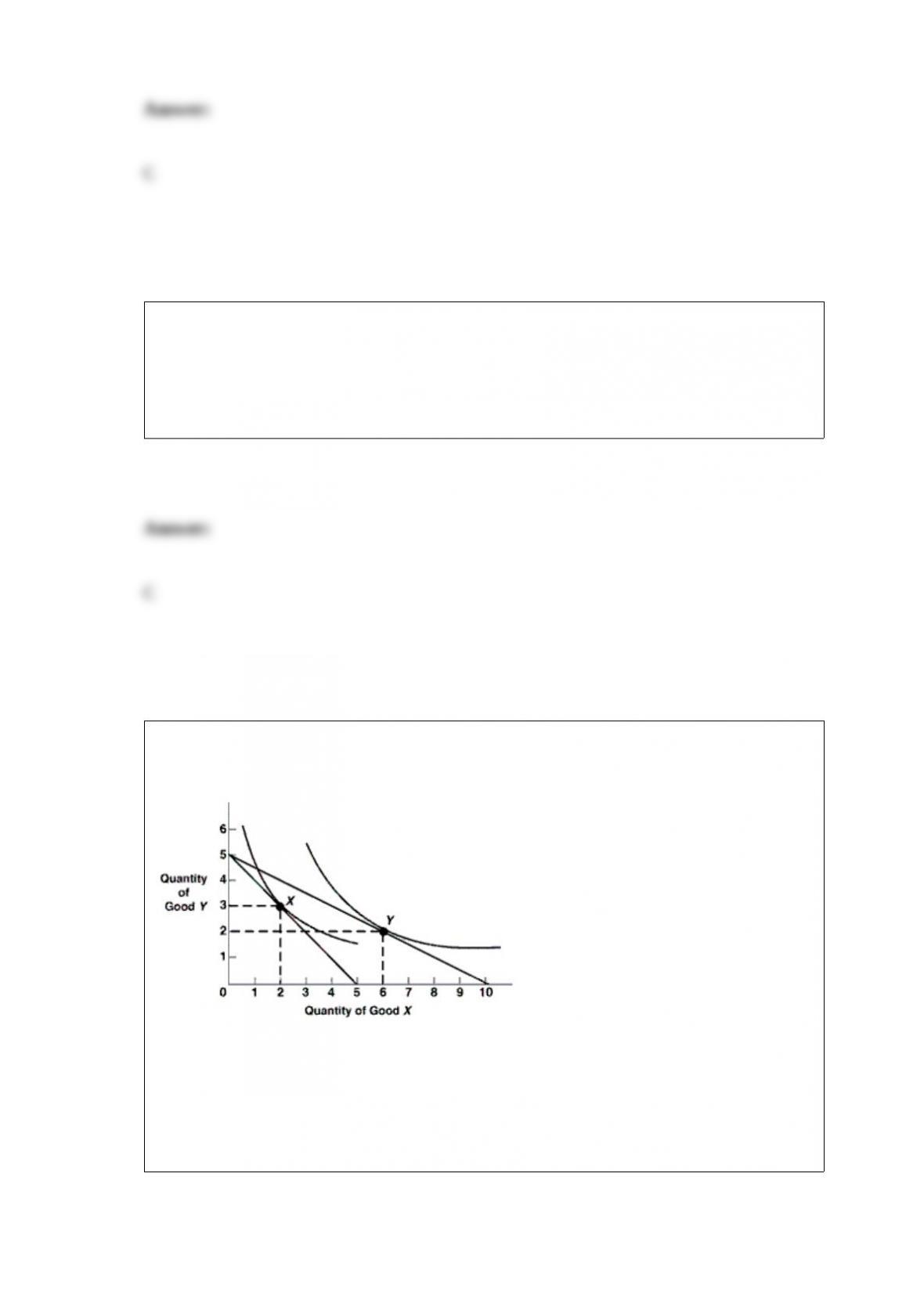
Exhibit 6A-6 Consumer equilibrium
As shown in Exhibit 6A-6, movement from consumer equilibrium at point A to point B
is caused by a(n):
a. increase in the price of good X.
b. decrease in the price of good X.
c. increase in the price of good Y.
d. decrease in the price of good Y.
Which of the following correctly describes the external benefit resulting from an
individual’s purchase of a winter flu shot?
a. The flu shot is cheaper than the cost of treatment when you get the flu.
b. The income of doctors increases when you get the flu shot.
c. The flu shot reduces the likelihood others will catch the flu.
d. The flu shot reduces the likelihood you will miss work as the result of sickness;
therefore, you will earn more income.
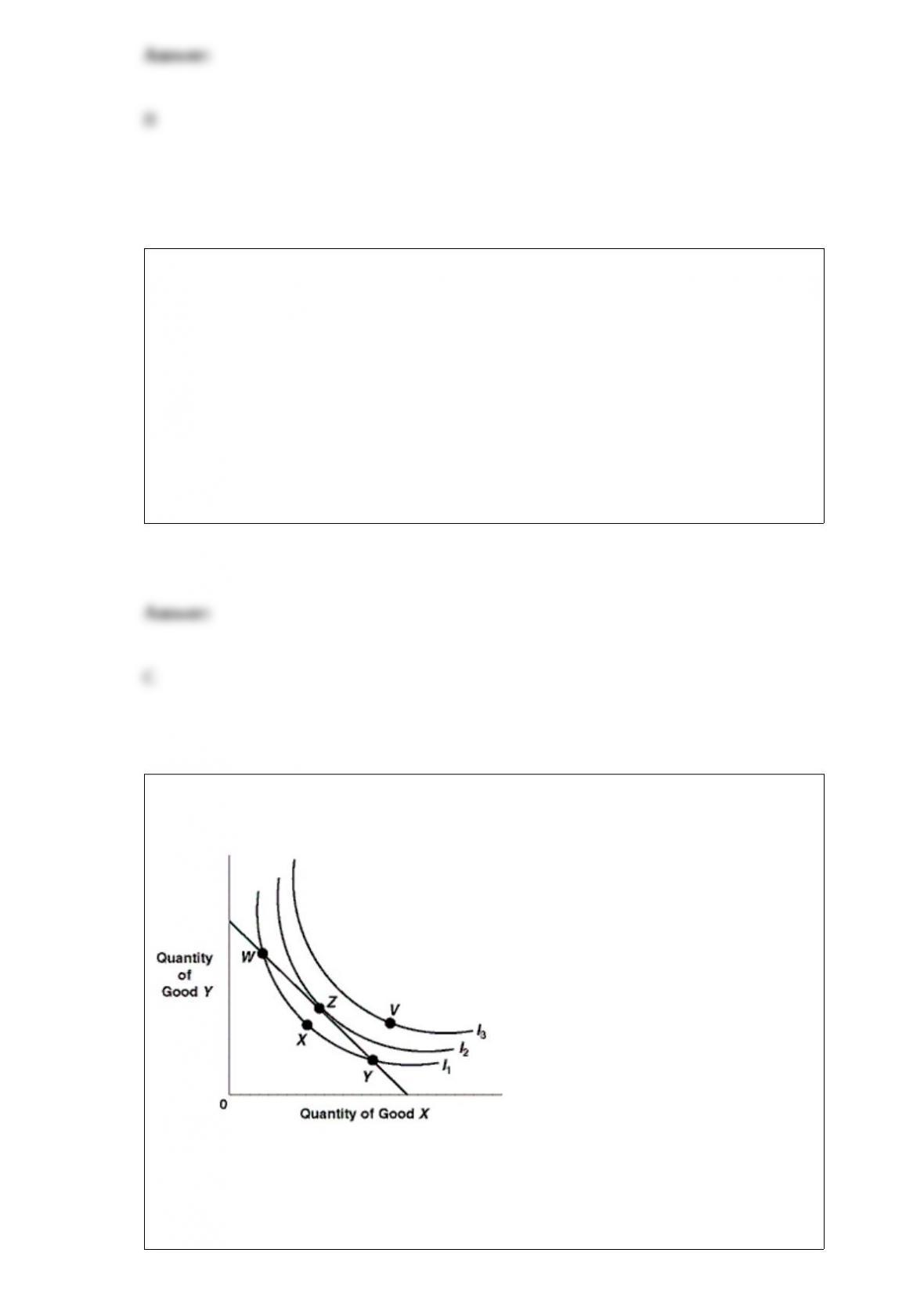
Exhibit 6A-2 Consumer equilibrium
Given the budget line and indifference curves shown in Exhibit 6A-2, at point Z:
a. Px exceeds Py.
b. MUx = MUy.
c. MRS = Px/ Py.

d. MRS = Py / Px.
Which of the following goods are most likely to be substitutes?
a. potato chips and chip dip c. ketchup and French fries
b. bread and peanut butter d. bananas and apples
Suppose that you have returned from your fishing expedition with 20,000 fish. The
market price is $3 per fish. Your average fixed cost was $1 and your total variable cost
was $5,000. If the price jumps to $3.50 before you sell your first fish, how much extra
profit, if any, do you earn?
a. c and d.
b. Extra profit is zero.
c. Extra profit is enough to cover half of the fixed cost of your next trip.
d. Extra profit is enough to cover all of the variable costs of your next two trips.
e. Extra profit is $45,000.
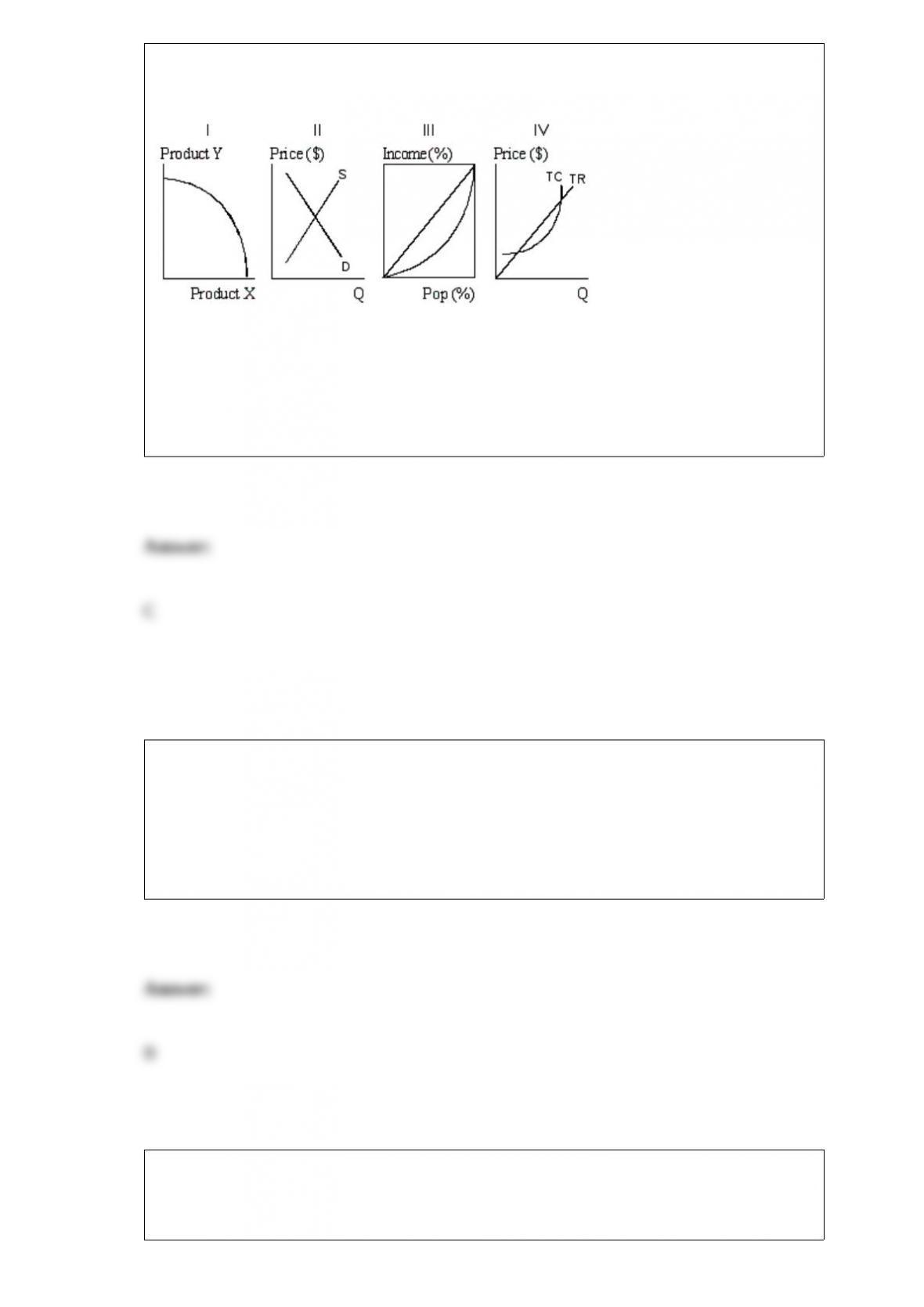
Exhibit 12-5 Economic curves
In Exhibit 12-5, a Lorenz curve is shown in diagram:
a. I.
b. II.
c. III.
d. IV.
e. both I and II.
A classless society and economic system where all the factors of production are owned
by workers and people share production according to their needs describes:
a. capitalism. c. the invisible hand.
b. communism. d. a mixed economy.
If pizza used to be produced in a perfectly competitive market, and now the pizza
market has become a monopoly, we can expect:
a. less pizza to be sold at a higher price.

b. more pizza to be sold at a higher price.
c. less pizza to be sold at a lower price.
d. more pizza to be sold at a lower price.
e. the same amount of pizza to be sold at the same price.
If the government wants to raise tax revenue and shift most of the tax burden to the
sellers it would impose a tax on a good with a:
a. flat (elastic) demand curve and a steep (inelastic) supply curve.
b. steep (inelastic) demand curve and a flat (elastic) supply curve.
c. steep (inelastic) demand curve and steep (inelastic) demand curve.
d. flat (elastic) demand curve and a flat (elastic) supply curve.
For the calculation of a Lorenz curve using quintiles, the:
a. first quintile contains the richest 50 percent of population.
b. first quintile contains the richest 20 percent of population.
c. first quintile contains the poorest 50 percent of population.
d. first quintile contains the poorest 20 percent of population.
e. last quintile contains the poorest 10 percent of population.

According to the law of demand, if:
a. product price increases, quantity demanded will decrease.
b. consumer income increases, quantity demanded will increase.
c. product price increases, quantity demanded will increase.
d. consumer income increases, quantity demanded will decrease.
e. supply increases, demand will increase.
A law requiring sellers to pay the government a tax per pack on cigarettes has the effect
of:
a. shifting the supply curve to the right.
b. shifting the demand curve to the right.
c. shifting the supply curve to the left.
d. shifting the demand curve to the left.
A perfectly competitive firm maximizes profits or minimizes losses in the short-run by
producing at the output level at which:
a. marginal revenue equals marginal cost.
b. total revenue equals total cost.
c. total revenue is at a maximum.
d. none of these.

Which of the following statements best describes the role played by prices in a
command economy such as the former Soviet Union?
a. Prices were used to allocate resources.
b. Prices played the same role as in a market economy.
c. Prices were used to ration final goods and services but not to allocate resources.
d. None of these statements is descriptive.
The curve that shows the relationship between the price of a good and the quantity that
consumers are willing to purchase at each price is the
a. supply curve. c. production possibilities curve.
b. demand curve. d. consumption curve.
Officers of five large building-materials companies meet and agree than none of them
will submit bids on government contracts lower than an agreed-upon level. This is an
example of:
a. price fixing. c. a tying contract.

b. vertical restriction. d. an interlocking directorate.
Which of the following is a true statement?
a. The LDC classification is of the questionable accuracy.
b. GDP per capita ignores the degree of income distribution.
c. GDP per capita is affected by exchange rate changes.
d. GDP per capita does not account for the difference in the cost of living among
nations.
e. All of these are true.
The short-run price elasticity of demand for airline travel is .05, while the long-run
elasticity is 2.36. This means that a significant increase in airline ticket prices will cause
airline companies to:
a. collect less revenue from short-notice travelers.
b. collect more revenue from travelers who book well in advance.
c. lose money on short-notice travelers.
d. collect less revenue from travelers who book well in advance.
e. lose many of its short-notice travelers.