
If we observe a decrease in the price of a good and a decrease in the amount of the good
bought and sold, this could be explained by a(an):
a. increase in the supply of the good. c. decrease in the demand for the good.
b. increase in the demand for the good. d. decrease in the supply of the good.
Which of the following was not illegal under the original Clayton Act?
a. Tying contracts.
b. Interlocking directorates.
c. Merger by purchase of assets with cash.
d. All of these were illegal under the original Clayton Act.
Exhibit 6A-3 Consumer equilibrium
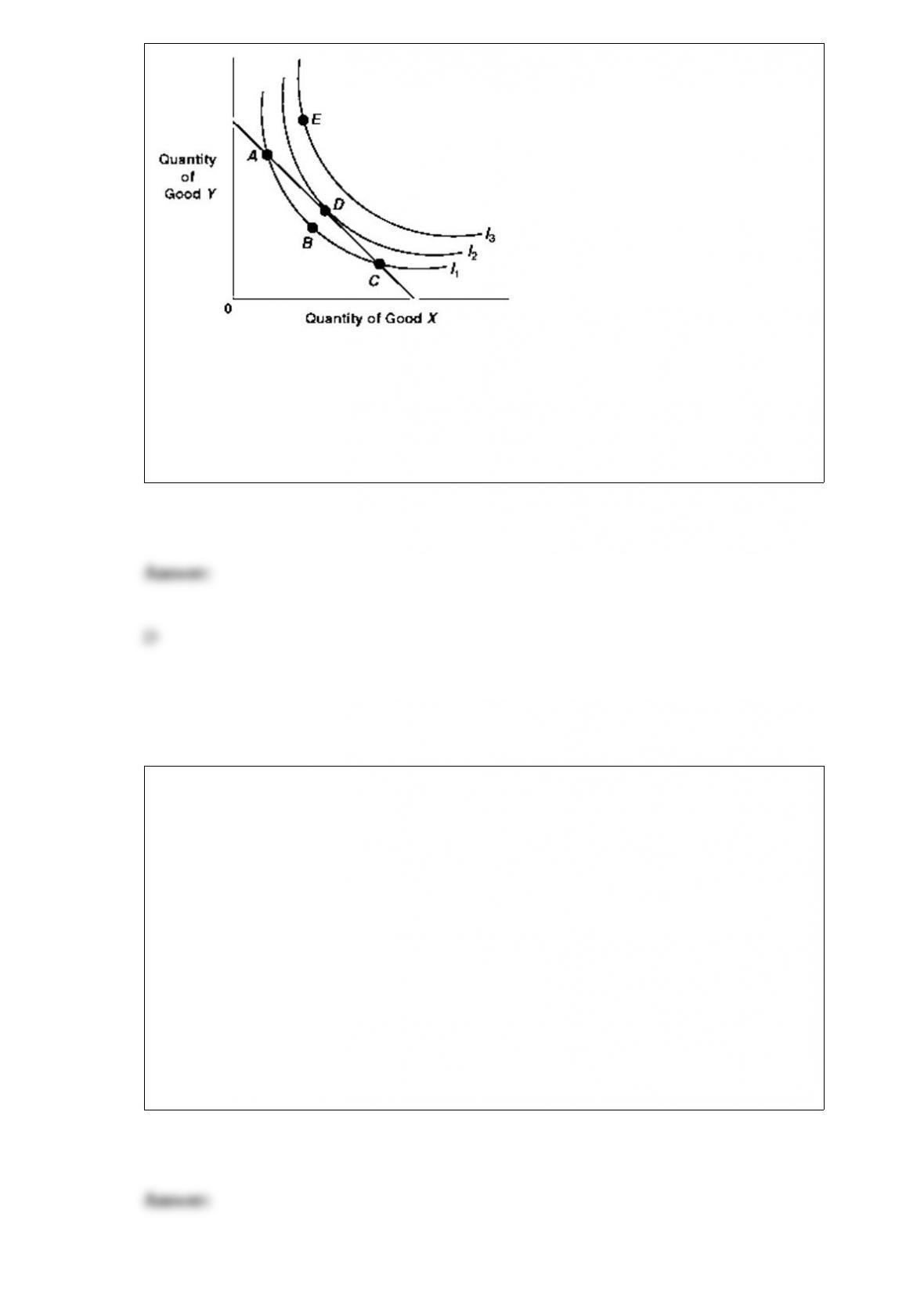
Given the budget line and indifference curves shown in Exhibit 6A-3, consumer
equilibrium occurs at point:
a. A.
b. B.
c. C.
d. D.
Which of the following statements best describes the price, output, and profit conditions
of monopolistic competition?
a. Price will equal marginal cost at the profit-maximizing level of output; profits will be
positive in the long-run.
b. Price will always equal average variable cost in the short run and either profits or
losses may result in the long run.
c. Marginal revenue will equal marginal cost at the short run, profit-maximizing level of
output; in the long run, economic profit will be zero.
d. Marginal revenue will equal average total cost in the short run; long-run economic
profits will be zero.

In a congressional debate about agricultural price supports, senators, members of
congress, and other experts made the following four statements. Which of these is a
normative statement?
a. “Price supports are important because America should preserve the small family
farm.”
b. “Without price supports, the price of wheat and corn will fall by over twenty
percent.”
c. “The decline in commodity prices caused by the removal of price supports will result
in fewer, larger farms.”
d. “The decline in commodity prices caused by the removal of price supports will
reduce the number of tractors sold in the United States.”
Price elasticity of demand refers to the ratio of the:
a. percentage change in price of a good in response to a percentage change in quantity
demanded.
b. percentage change in price of a good to a percentage increase in income.
c. percentage change in the quantity demanded of a good to a percentage change in its
price.
d. none of these.
The supply schedule shows the specific quantity of a good that suppliers are willing and
able to:

a. demand at various prices.
b. produce at various costs.
c. hold back from the market when competition is reduced.
d. provide at different prices.
e. demand at various costs.
Assume Qs represents the quantity supplied at a given price and Qd represents the
quantity demanded at the same given price. Which of the following market conditions
produce a downward movement of the price?
a. Qs = 1,000, Qd = 750. c. Qs = 750, Qd = 1,000.
b. Qs = 750, Qd = 750. d. Qs = 1,000, Qd = 1,000.
When a firm hires an additional unit of labor, the increase in a firm’s total revenues is
known as the marginal:
a. cost.
b. product.
c. utility product.
d. revenue product.
Which of the following is not true concerning consumer surplus?
a. It is graphically the area under the demand curve and above the market price.
b. It does not exist in equilibrium.
c. A leftward shift of the supply curve will decrease consumer surplus.
d. A rightward shift of the supply curve will increase consumer surplus.
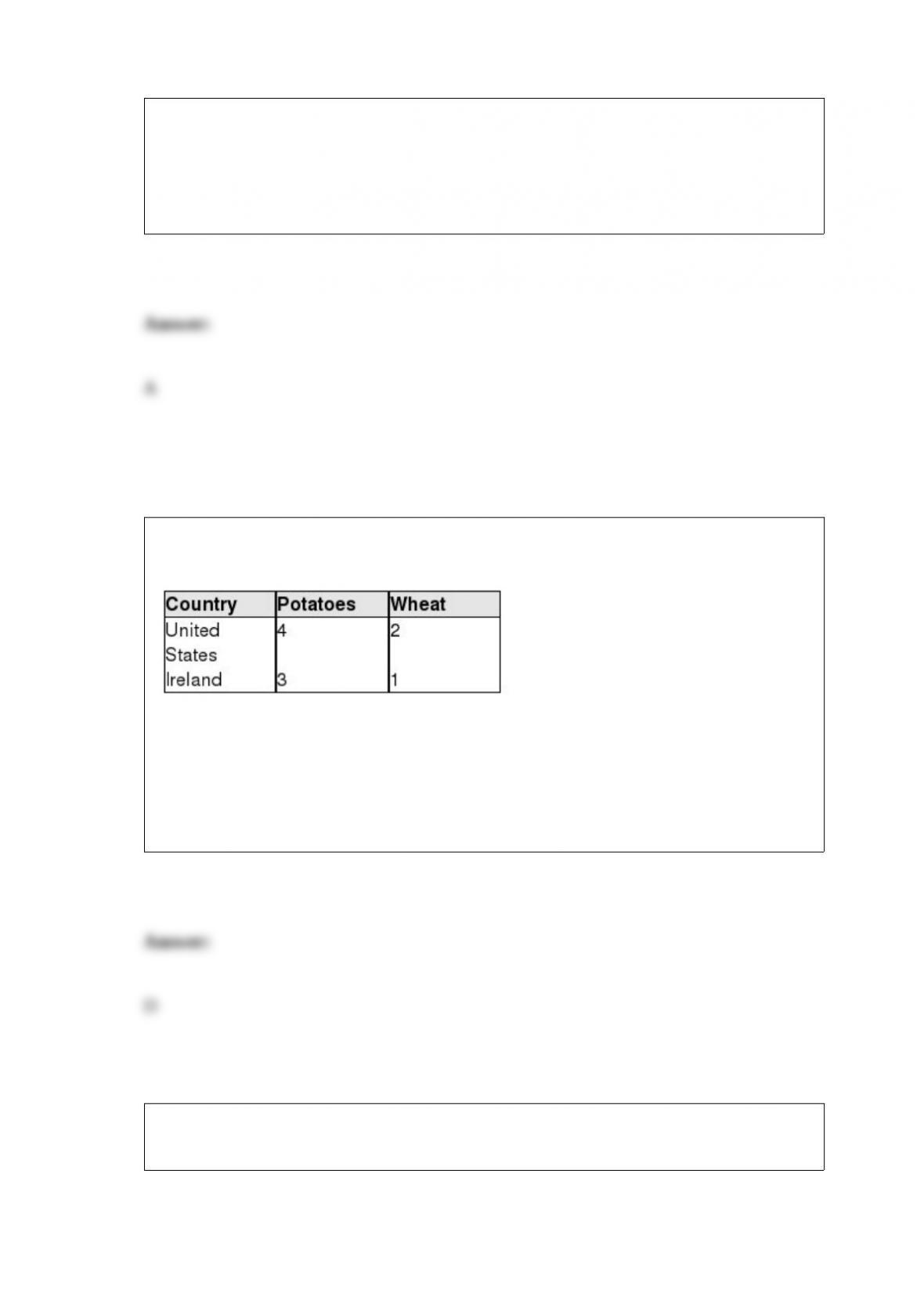
Exhibit 15-3 Potatoes and wheat output (tons per day)
If each nation in Exhibit 15-3 specializes in producing the good for which it has a
comparative advantage, then:
a. Ireland would produce neither potatoes or wheat.
b. the United States would produce both potatoes and wheat.
c. the United States would produce potatoes.
d. Ireland would produce potatoes.
Exhibit 1A-2 Straight line
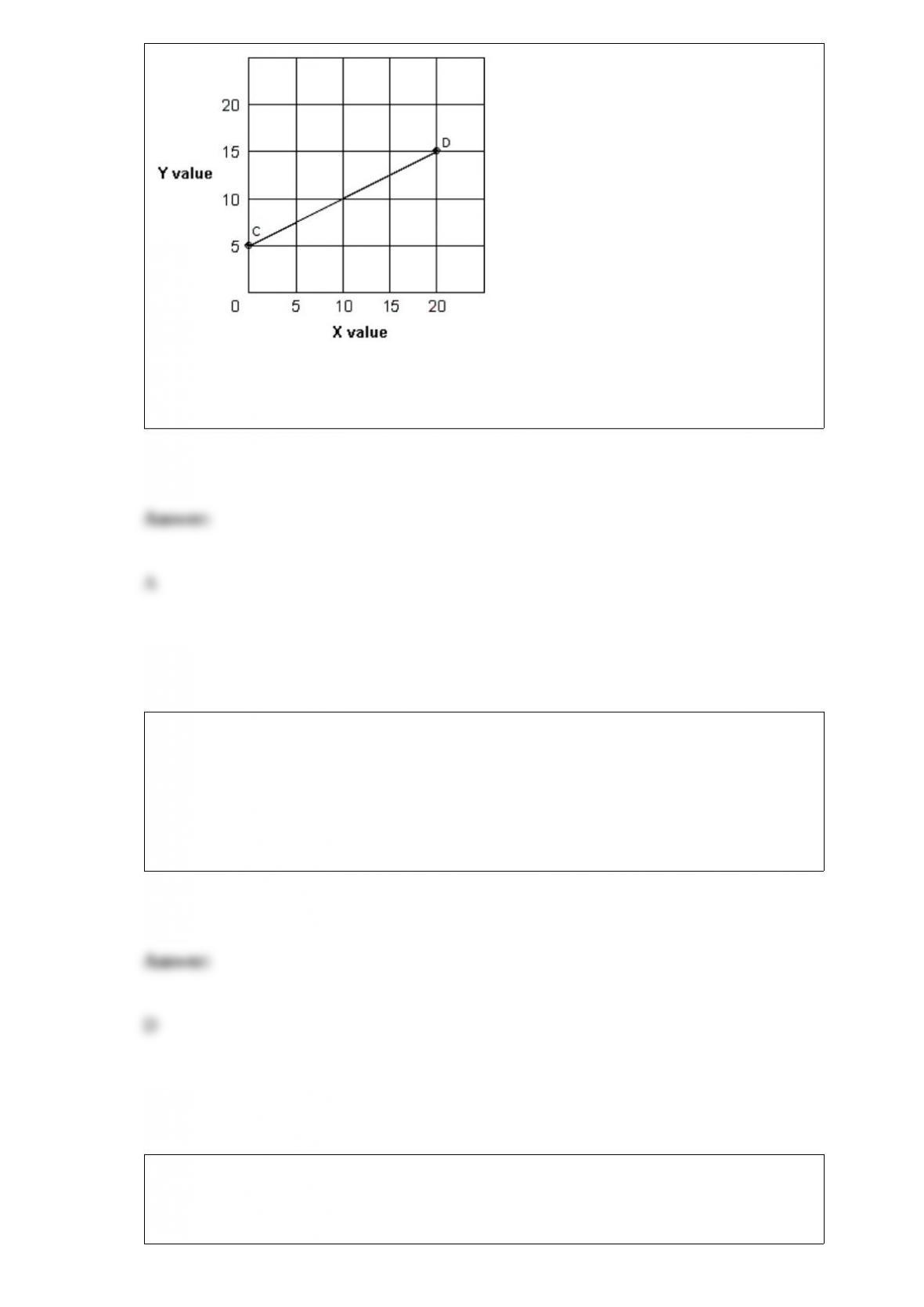
In Exhibit 1A-2, the slope of straight line CD is:
a. positive. c. negative.
b. zero. d. variable.
Implicit costs are best thought of as:
a. variable costs.
b. marginal costs.
c. accounting costs.
d. opportunity costs.
e. sunk costs.
Which of the following goods is likely to have the most elastic demand curve?
a. Tobacco products. c. Medical care.
b. Gasoline. d. Honda automobiles.

When the Lorenz curve lies above the diagonal,
a. the poorest 20 percent of the population receive more than 20 percent of income.
b. the richest 20 percent of the population receive more than 20 percent of income.
c. everyone receives the same income.
d. the country’s income has been rising over time.
e. it is wrong since it is impossible for the graph to look like this.
The Federal Trade Commission:
a. was abolished by the Celler-Kefauver Act.
b. was established when the Antitrust Division of the Justice Department was
eliminated.
c. largely deals with utility regulation.
d. is a weak and ineffective government agency.
e. investigates unfair and deceptive trade practices.

Which of the following is true if the price of coffee increases?
a. The demand for tea, a substitute good, will decrease.
b. The demand for coffee will increase.
c. The demand for coffee and tea will decrease.
d. Both the demand for coffee and tea will increase.
e. The demand for tea, a substitute good, will increase.
A market consequence of the establishment of a price floor program is that price will
be:
a. too low, and an excess supply will result.
b. too low, and a shortage will result.
c. too high, and an excess supply will result.
d. too high, and a shortage will result.
e. below the market equilibrium price.
Which of the following describes a situation in which demand must be inelastic?
a. Total revenue decreases by 10 percent when the price of spats rises by 10 percent.
b. Total revenue decreases by less than 10 percent when the price of spats rises by 10
percent.
c. Total revenue increases by more than 10 percent when the price of spats rises by 10
percent.
d. Total revenue decreases by $10 when the price of spats rises by $10.
e. Total revenue decreases by more than $10 when the price of spats rises by $10.

As cities prospered and per-capita incomes increased, the demand for bus travel
diminished. This suggests that:
a. cities could raise revenue by increasing bus fares.
b. the demand for bus travel is price elastic.
c. bus travel and automobile travel are complements.
d. bus travel is an inferior good.
Monopolistic competition is inefficient because:
a. firms earn positive economic profits.
b. the firms’ marginal costs and marginal revenues are not equal.
c. firms have excess capacity in the long run.
d. entry is difficult.

The economic system that answers the What, How and For Whom questions using
prices determined by the interaction of supply and demand is a:
a. market economy. c. soviet economy.
b. command economy d. traditional economy.
Suppose there is a technology to produce Grendels such that there are diseconomies of
scale after the first unit is produced. There are both fixed (a physical plant called a lair)
and variable (food that grows in lairs) costs of production. Which statement is true?
a. b and d.
b. Producing multiple units increases the average fixed cost.
c. There will be no more than one firm in this industry.
d. It is cheaper to make five Grendels by buying five lairs and producing one Grendel in
each lair than it is to produce five Grendels in one lair.
e. This is an impossible situation.
Ceteris paribus means:
a. an association of variables.
b. all other things remain constant.
c. a cause and effect relationship.
d. considering the influences of other variables.

The rule of reason would have not found a well-behaved, but gigantic, firm to be in
violation of the antitrust laws.
The government defines poverty as an income level less than four times the cost of a
minimal diet.
The vicious circle of poverty refers to the fact that LDCs are poor because other
countries do not want to buy their goods and services.
Price discrimination that substantially lessens competition is prohibited by the Clayton
Act.

A horizontal demand curve indicates perfectly elastic demand.
The statement “It would be better to put up with price controls than to have continuing
higher medical care prices” is an example of normative economic analysis.
Consumer equilibrium requires that the marginal utility per dollar spent be the same for
all goods.

If marginal revenue equals marginal cost in the short run, the perfectly competitive firm
earns zero profits.