
The long-run equilibrium condition for perfect competition is:
a. P = AVC = MR = MC.
b. P = ATC = MR = MC.
c. Q = AVC = MR = MC.
d. Q = ATC = MR = MC.
e. TR = ATC = MR = MC.
Measured between two points on a curve, the ratio of the change in the variable on the
vertical axis to the change in the variable on the horizontal axis is the:
a. axis. c. dependent curve.
b. slope. d. independent curve.
When the price of a good is below its equilibrium level, a:
a. shortage puts upward pressure on the price.
b. surplus puts downward pressure on the price.
c. shortage puts downward pressure on the price.
d. surplus puts upward pressure on the price.

A horizontal merger between two firms occurs when:
a. the products of the merging firms were not related in any manner before the merger.
b. one firm is a producer of products, and the other firm is a producer of services.
c. one firm is a domestic firm, and the other is a foreign company.
d. the firms stood in a buyer-seller relationship before the merger.
e. the merger partners were competitors.
If you were a government official that wanted to raise the equilibrium price of milk,
which of the following actions would you take?
a. Take milk from government storage and sell it.
b. Encourage farmers to produce more milk.
c. Subsidize purchases of dairy equipment.
d. Encourage farmers to produce less milk.
Exhibit 8-14 Total cost and total revenue curves
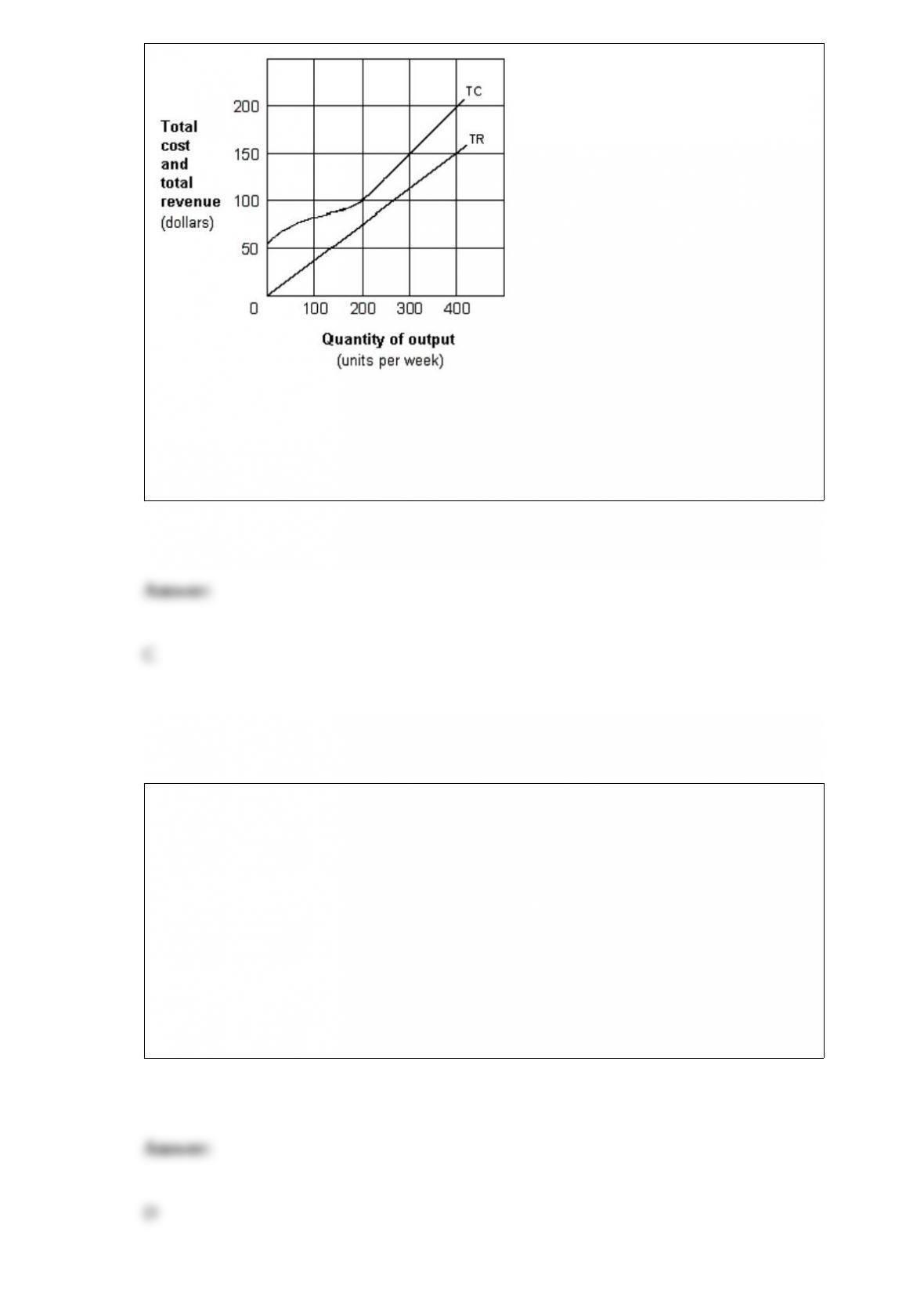
In Exhibit 8-14, if output is at 200 units per week, total economic profit for the firm is:
a. zero.
b. positive.
c. negative.
d. none of these.
A vertical merger occurs when:
a. the products of the merging firms were not related in any manner before the merger.
b. one firm is a producer of products, and the other firm is a producer of services.
c. one firm is a domestic firm, and the other is a foreign company.
d. the firms stood in a buyer-seller relationship before the merger.
e. the merger partners were competitors.
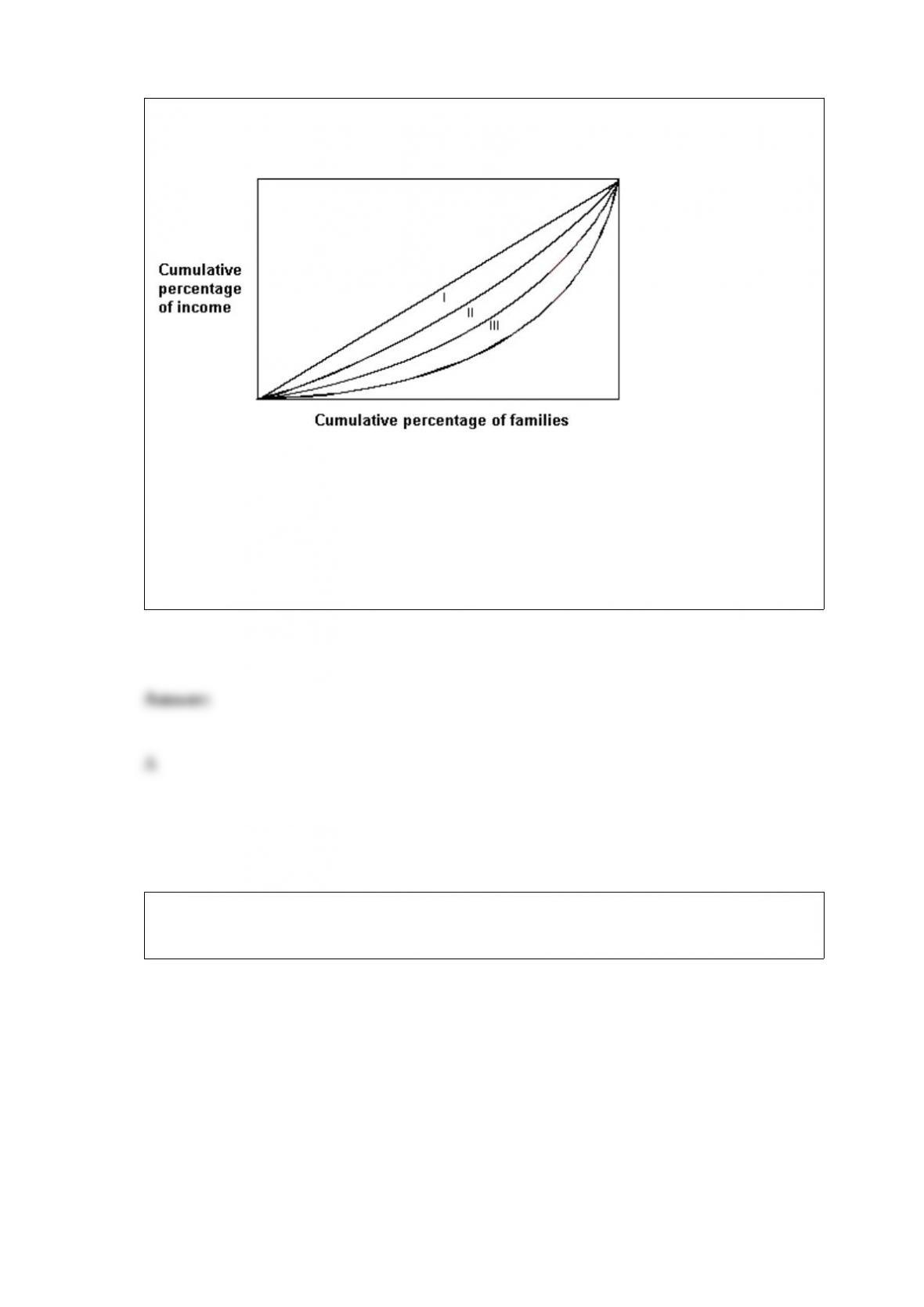
Exhibit 12-6 Lorenz curves
Exhibit 12-6 shows the Lorenz Curve for three countries, I, II, and III. Of the three
countries shown,
a. Country III has the most unequal income distribution.
b. Country II has the most unequal income distribution.
c. Country I has the most unequal income distribution.
d. Country III has the most equal income distribution.
e. Country II has a more equal income distribution than Country I.
Exhibit 1A-3 Straight line
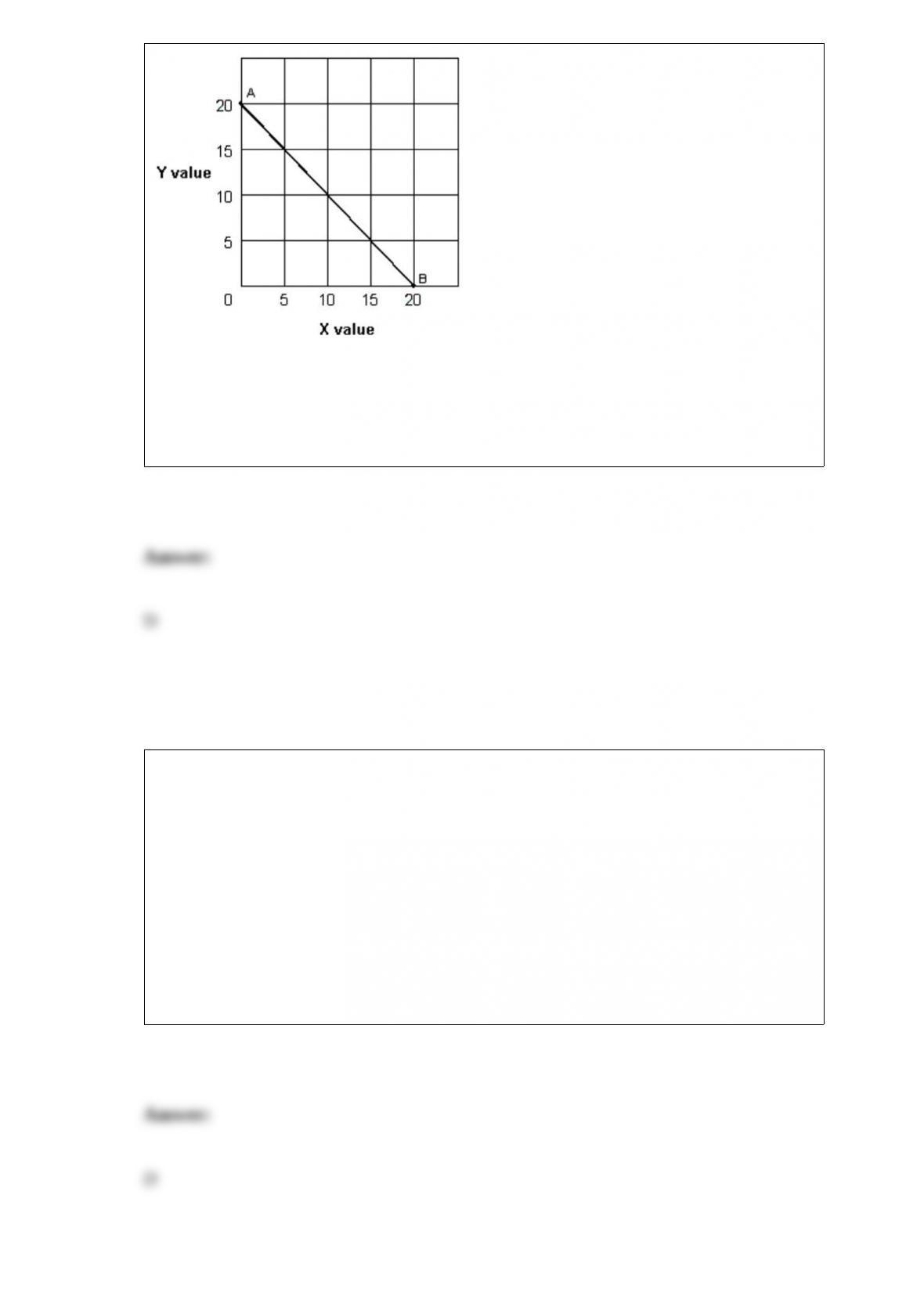
Straight line AB in Exhibit 1A-3 shows that:
a. increasing values for X reduces the value of Y.
b. decreasing values for X increases the value of Y.
c. there is an inverse relationship between X and Y.
d. all of these.
Cartel members have an incentive to cheat on the cartel because:
a. the cartel does not maximize profits.
b. the cartel price is the competitive price.
c. each member’s output quota is too high.
d. each member’s MR is not equal to the cartel’s MC.
e. the industry profit would be higher under competitive conditions.
In contrast to a perfectly competitive firm, a monopolist earns:
a. negative economic profit in the long run.
b. zero economic profit in the long run.
c. positive economic profit in the long run.
d. positive economic profit in the short run.
One big difference between tariffs and quotas is that tariffs:
a. raise the price of a good while quotas lower it.
b. generate tax revenues while quotas do not.
c. stimulate international trade while quotas inhibit it.
d. hurt domestic producers while quotas help them.
e. give the same outcome as free trade while quotas do not.
Compared to IACs, LDCs are often characterized by:
a. higher life expectancy. c. higher daily calorie supply.
b. higher adult literacy rates. d. lower per capita energy consumption.
The main problem with using the infant industries argument to justify protecting an
industry from foreign competition is that:
a. all industries will claim that they are infant industries in order to gain protection.
b. the protected industry will become too efficient and drive out foreign competition.
c. once in place, it is difficult to remove protection even as the industry matures.
d. it causes the goods that are produced in the protected industry to have lower prices.
e. this policy compromises national security if the infant industry produces military
goods.
If a surplus of a product currently exists in the market,
a. the market price is too low.
b. the quantity demanded exceeds the quantity supplied at the current price.
c. the quantity supplied exceeds the quantity demanded at the current price.
d. there is a shortage of the product.
e. there will be a tendency for the price to rise.
Denise is thinking about setting up a butterfly garden in her backyard. She estimates
that it will cost her $2,000 to purchase and install special plants and an irrigation system
to attract butterflies. The benefit she expects to receive is $1,800. In addition, neighbor
Billy will receive a benefit of $150 and neighbor Sammy will receive a benefit of $100.
From this, we can conclude that:
a. butterflies are a negative externality for Billy and Sammy.
b. Denise will set up the butterfly garden without any help from her free-rider
neighbors.
c. if Sammy refuses to contribute to the butterfly garden, he will be unable to enjoy its

benefits if it is built.
d. if Billy refuses to contribute to the butterfly garden, Denise will not have one.
e. if Billy and Sammy contribute the amounts at which they value the butterfly garden,
Denise will set it up.
Economic models are of limited use since they cannot be tested empirically with actual
data.
Economic development encompasses which of the following measures?
a. Distribution of income. c. Transportation structures.
b. Legal system. d. All of these.
The Celler-Kefauver Act is primarily concerned with prohibiting:
a. monopolization. c. predatory pricing.
b. unfair business practices. d. anticompetitive mergers.
Utility refers to the:
a. relationship of demand to the supply of a product.
b. satisfaction a consumer experiences after a good or service is purchased.
c. satisfaction a consumer expects to receive from a good or service.
d. ability of a good or a service to have value in the marketplace.
e. usefulness of the product consumed.
Which of the following represents an arbitrage transaction?
a. Traders buy silks where they are abundant and cheap, and haul them along a trail to
another place where they would be quite scarce and valued.
b. A trader buys a block of government bonds in one market where it is temporarily
priced below where it can be immediately resold in a different market.
c. Someone buys a block of Final Four tickets and scalp them at the game.
d. A senior citizen buys a block of theater tickets at a senior discount and scalps them to
teenagers behind the theater.
e. All of the above are example of arbitrage.
The law of diminishing marginal utility implies that the marginal utility of my fifth hot
dog is less than the marginal utility of my second soda, other things constant.
A command system uses a group of planners or central authority to make basic
economic decisions.
The Department of Justice has challenged the merger of two firms, and the case has
ended up in the Supreme Court. The two firms argue that they will not use their
monopoly power to raise prices or to cut output. Under what judicial standard would
their merger be allowed, and under what judicial standard would their merger be
disallowed?
Direct relationships are illustrated using upward-sloping lines and curves.
Voluntary programs are dependable ways to protect the environment.
A public good is any good or service that users collectively consume and there is no
way to bar free riders.
A monopsonist will hire fewer workers than will be hired in a competitive labor market.