By producing at the point where MR = MC, the firm:
a. is guaranteed a profit.
b. will earn a profit of zero.
c. will lose money.
d. profit is maximized.
e. output.
In the long run, both monopolistic competition and perfect competition result in:
a. a wide variety of brand-name choices for consumers.
b. an efficient allocation of resources.
c. zero economic profit for firms.
d. excess capacity.
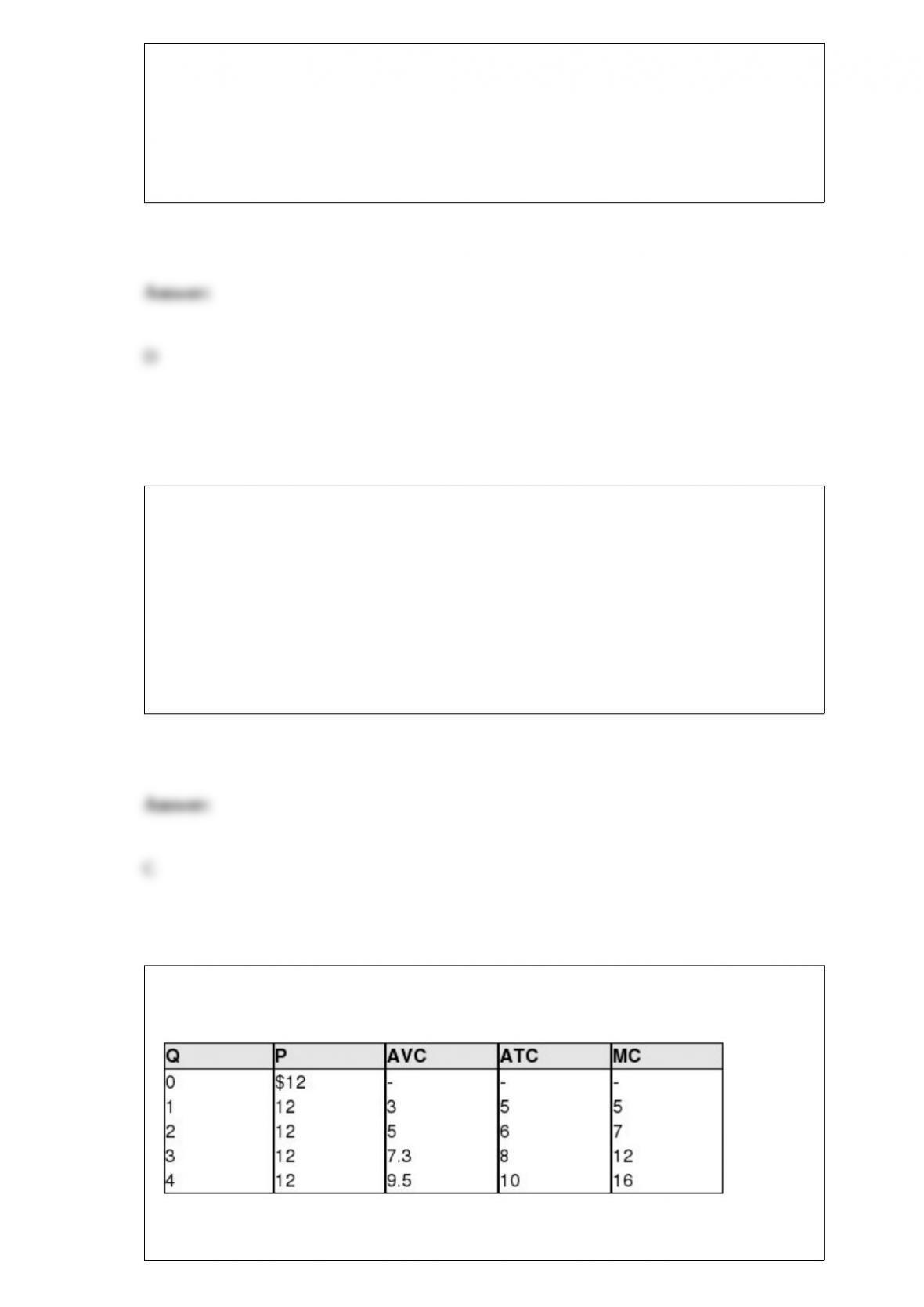
Exhibit 8-10 Price and cost data for a firm
In Exhibit 8-10, the maximum possible total profit is:
a. $36.

b. $24.
c. $20.
d. $12.
e. $8.
The definition of a model is a:
a. description of all variables affecting a situation.
b. positive analysis of all variables affecting an event.
c. simplified description of reality to understand and predict an economic event.
d. data adjusted for rational action.
Complementary goods are goods:
a. that are consumed jointly.
b. that are consumed one in place of the other.
c. for which demand increases when the price of its complementary goods increases.
d. for which demand decreases when the price of its complementary goods decreases.
e. that are inversely related.

A profit-maximizing firm will base its supply decisions on its marginal:
a. private cost. c. external cost.
b. social cost. d. transactions cost.
Incentive-based regulatory approaches:
a. are viewed favorably by most economists as a way to control pollution.
b. provide less flexibility than the command-and-control approach.
c. tend to hurt wealthier people more than poor people.
d. require that the government specify certain types of pollution control technology that
firms must adopt.
An outward shift of an economy’s production possibilities curve is caused by:
a. an increase in capital. c. an advance in technology.
b. an increase in labor. d. all of these.
Economic development encompasses which of the following measures?
a. Economic growth. c. Education.
b. The political environment. d. All of these.
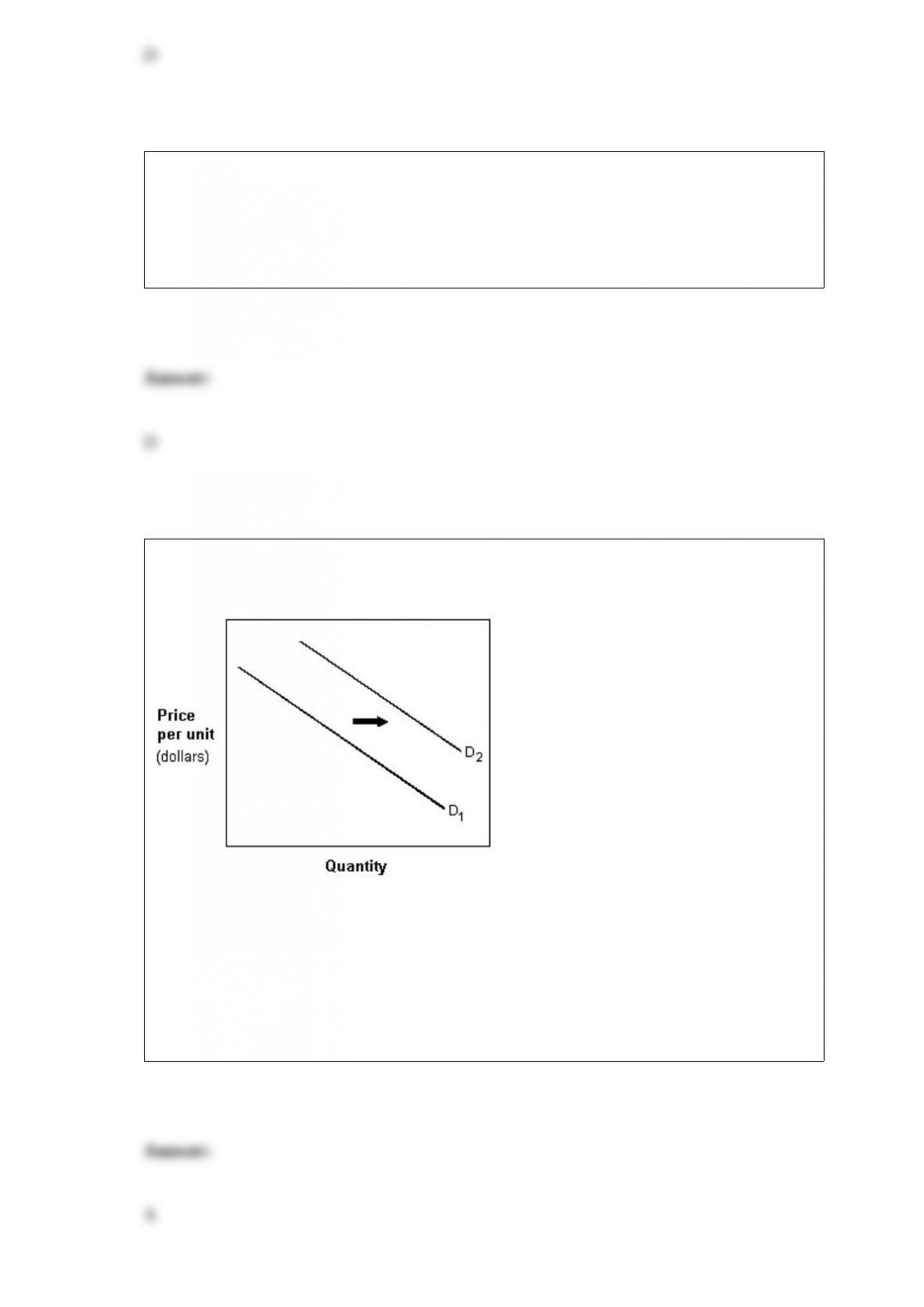
Exhibit 3-2 Demand curves
In Exhibit 3-2, which of the following could not have caused the shift in the demand
curve from D1 to D2?
a. Decrease in the number of consumers.
b. Increase in expected future prices.
c. Increase in the price of a substitute.
d. Decrease in the price of a complement.
e. Increase in income.

A local restaurant offers an “all you can eat” Sunday brunch for $12. Susan eats four
servings, but leaves half of a fifth helping uneaten. Why?
a. Her marginal value of a serving of brunch has fallen below $12.
b. Her marginal value of a serving has fallen below $2.36 ($12 divided by 5 servings).
c. Her marginal value of food has fallen to zero.
d. The total value she places on brunch today exactly equals $12.
Consider a consumer who spends all income on only two goods: bread and wine. An
extra loaf of bread would give the consumer 10 extra util, while an extra bottle of wine
would give the consumer 60 extra utils. Bread costs 50¢ per loaf, and wine costs $6
per bottle. In this situation, the consumer:
a. could increase utility by buying more bread and less wine.
b. could increase utility by purchasing more wine and less bread.
c. has maximized utility and attained consumer equilibrium.
d. is violating the law of diminishing marginal utility.
Suppose Gizmo Inc. is willing to sell one gizmo for $10, a second gizmo for $12, a
third for $14, and a fourth for $20, and the market price is $20. What is Gizmo Inc.’s
producer surplus?
a. $56 c. $20
b. $24 d. $10

For both a monopolist and a monopolistically competitive firm:
a. price equals average total cost. c. marginal revenue equals zero.
b. price is above marginal revenue. d. marginal cost equals zero.
If the price elasticity of demand is computed for two products, and product A measures .
79, and product B measures 1.6, then:
a. product A is more price elastic than product B.
b. product B is more price elastic than product A.
c. consumers are more sensitive to price changes in product A than in product B.
d. product B is more price inelastic than product A.
e. products A and B must be substitutes.
Exhibit 10-7 Two-Firm Payoff Matrix
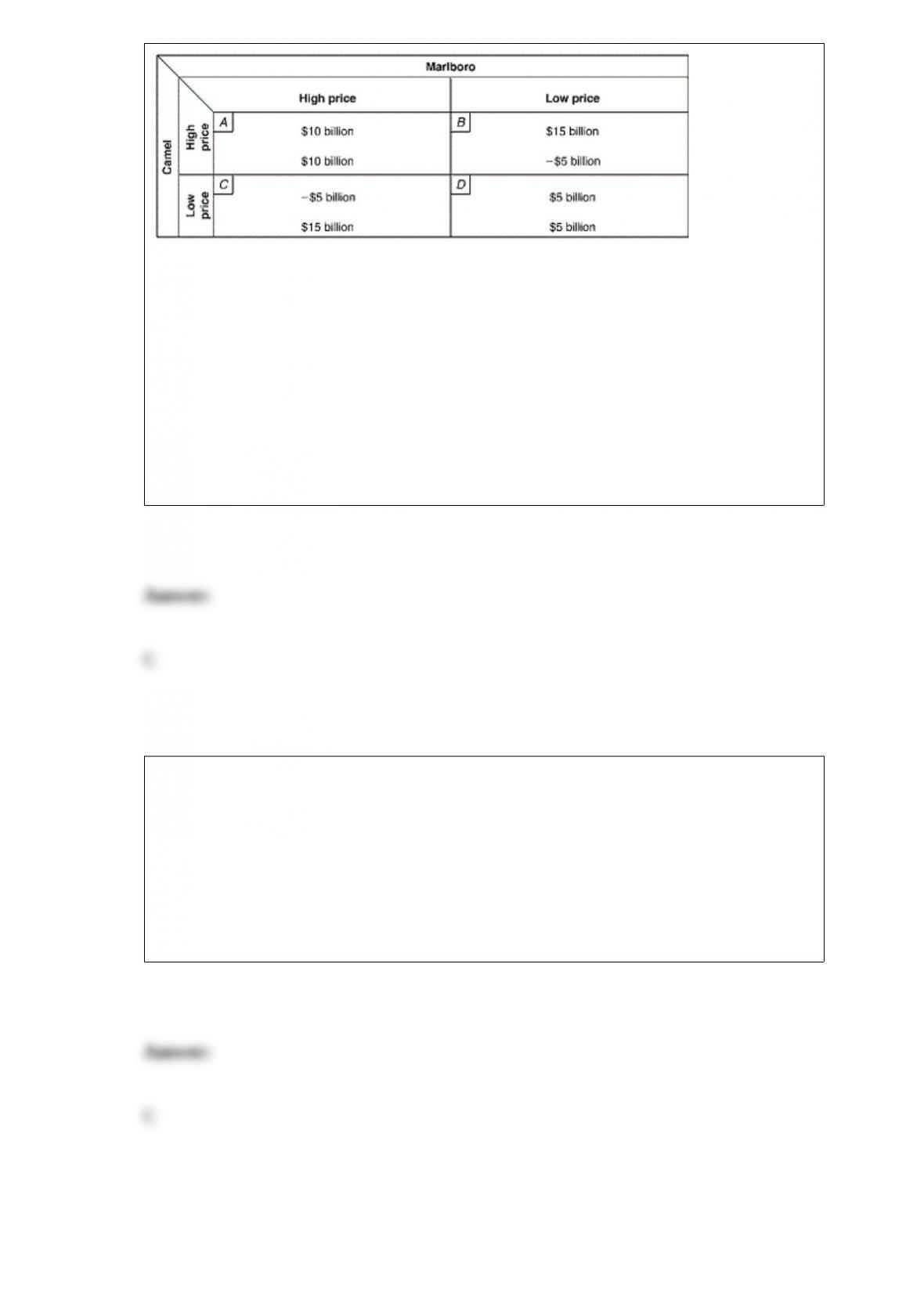
Assume costs are identical for the two firms in Exhibit 10-7. If both firms were allowed
to form a cartel and agree on their prices, equilibrium would be established by:
a. Camel charging the low price and Marlboro charging the high price.
b. Camel charging the high price and Marlboro charging the low price.
c. Camel charging the high price and Marlboro charging the high price.
d. Camel charging the low price and Marlboro charging the low price.
Greg spends his entire budget on two goods: he plays video games at the mall arcade
and he buys pizza. He discovers that his MU/P of video games is lower than his MU/P
of pizza. From this, we know that he would be:
a. happier eating less pizza and playing fewer video games.
b. happier eating less pizza and playing more video games.
c. happier eating more pizza and playing fewer video games.
d. indifferent to which selection he makes.
e. as happy as possible, since he is already maximizing total utility.

Each potential short-run average total cost curve is tangent to the long-run average cost
curve at:
a. the level of output that minimizes short-run average total cost.
b. the minimum point of the average total cost curve.
c. the minimum point of the long-run average cost curve.
d. a single point on the short-run average total cost curve.
The demand for labor is:
a. derived demand.
b. featherbedding demand.
c. marginal utility demand.
d. all of these.
If a firm’s long-run average cost curve is rising, it is experiencing:
a. a constant return to scale.
b. economies of scale.
c. diseconomies of scale.
d. none of these.

If two or more firms combine or conspire to monopolize trade, this would be in
violation of the:
a. Federal Trade Commission Act. c. Sherman Antitrust Act.
b. Clayton Act. d. Robinson-Patman Act.
If the opportunity cost of producing cheese is higher in Greece than it is in Italy, then:
a. Greece should specialize in producing cheese.
b. Italy should specialize in producing cheese.
c. both Greece and Italy should produce cheese.
d. Greece gives up fewer goods to produce cheese than Italy does.
e. Italy has a better economy than Greece.
If two goods are substitutes in consumption, a(n):
a. decrease in the price of one product will cause an increase in the demand for the
other product.
b. decrease in the price of one product will cause a decrease in the demand for the other
product.
c. increase in the price of one product will cause an increase in the supply of the other
product.
d. increase in the price of one product will cause a decrease in the supply of the other
product.
e. increase in the price of one product will cause a decrease in the demand for the other
product.

A tariff is a:
a. tax on an exported product.
b. limit on the number of goods that can be exported.
c. limit on the number of goods that can be imported.
d. tax on an imported product.
e. subsidy on an imported product.
If the demand curve is unit elastic, this implies that:
a. consumers do not react to a change in product price.
b. the good can only be purchased in units of 1.
c. this good has no good substitutes.
d. the good is a basic food staple.
e. the percentage change in the quantity demanded = the percentage change in product
price.