
If, at the point where MR = MC, the firm incurs losses, in the short run the firm should:
a. shut down.
b. increase output.
c. decrease output.
d. continue at its current output if P > AVC.
e. continue at its current output if P > ATC.
If nation A has an absolute advantage over nation B in the production of a product, this
implies that:
a. it requires fewer resources in A to produce the good than in B.
b. the cost of producing the good in terms of some other good’s production that must be
sacrificed is lower in A than in B.
c. nation B could not benefit by engaging in trade with A.
d. nation A should acquire this product by trading with B.
e. nation A could not benefit by engaging in trade with B.
An improvement in a firm’s technology that reduces its production costs will result in
a(n):
a. rightward shift of the supply curve.
b. increase in supply.
c. increase in quantity supplied at any given price.
d. all of these are true.
The opportunity cost to a city for using local tax revenues to construct a new park is
the:
a. best alternative foregone by building the park.
b. dollar cost of constructing the new park.
c. dollar cost of the old park.
d. increased taxes necessary to pay for maintenance of the new park.
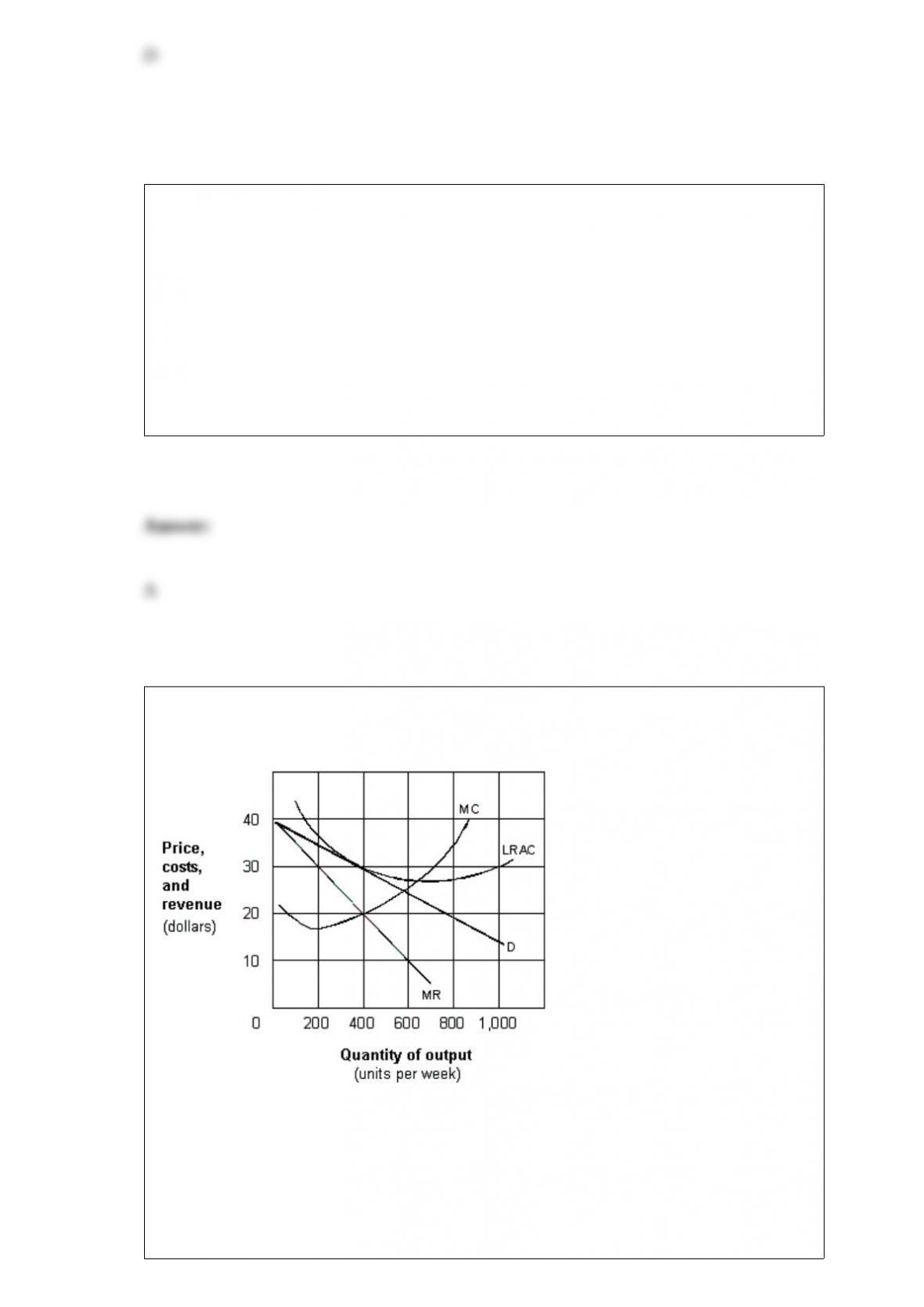
Exhibit 10-3 A monopolistic competitive firm in the long run
To maximize long-run profits, the monopolistically competitive firm shown in Exhibit
10-3 will charge a price per unit of:
a. zero.
b. $10
c. $20.
d. $30.
e. $40.
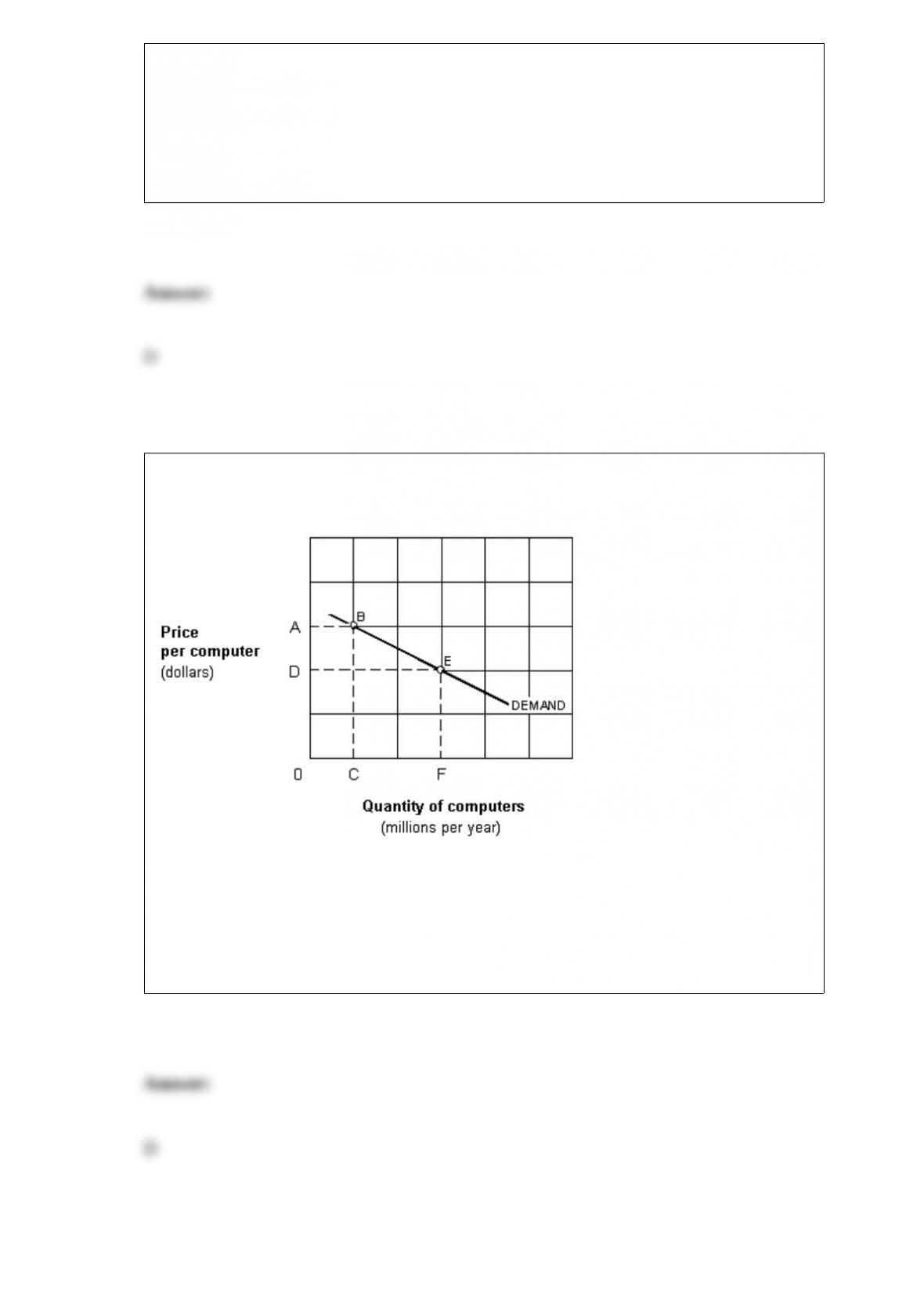
Exhibit 5-5 Demand curve for computers
In Exhibit 5-5, the total revenue at point E on the demand curve equals:
a. OD.
b. FE.
c. DE.
d. ODEF.
e. None of these.
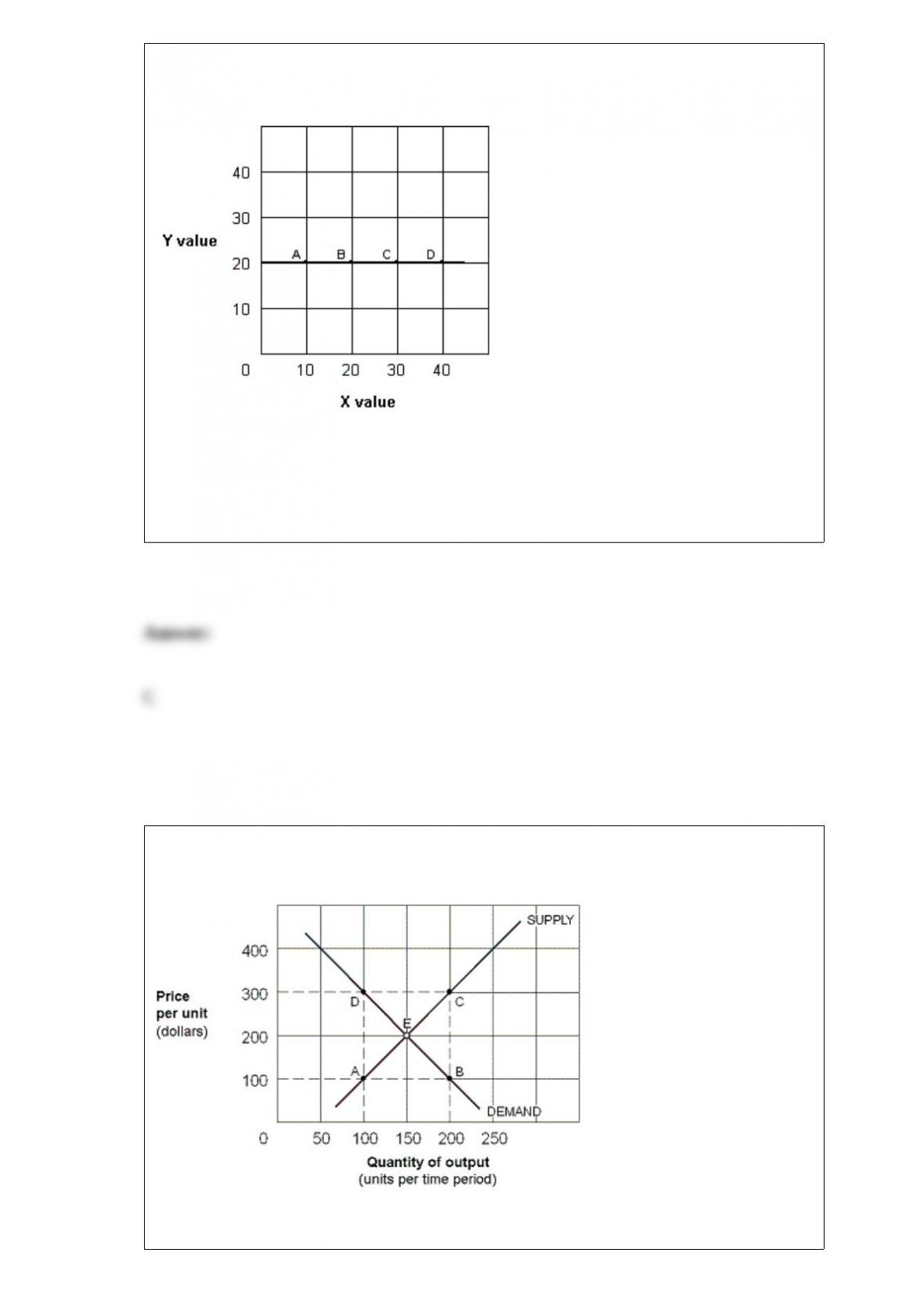
Exhibit 1A-6 Straight line
In Exhibit 1A-6, as X increases along the horizontal axis, corresponding to points A-D
on the line, the Y values remain unchanged at 20 units. The relationship between the X
and Y variables is:
a. direct. c. independent.
b. inverse. d. undefined.
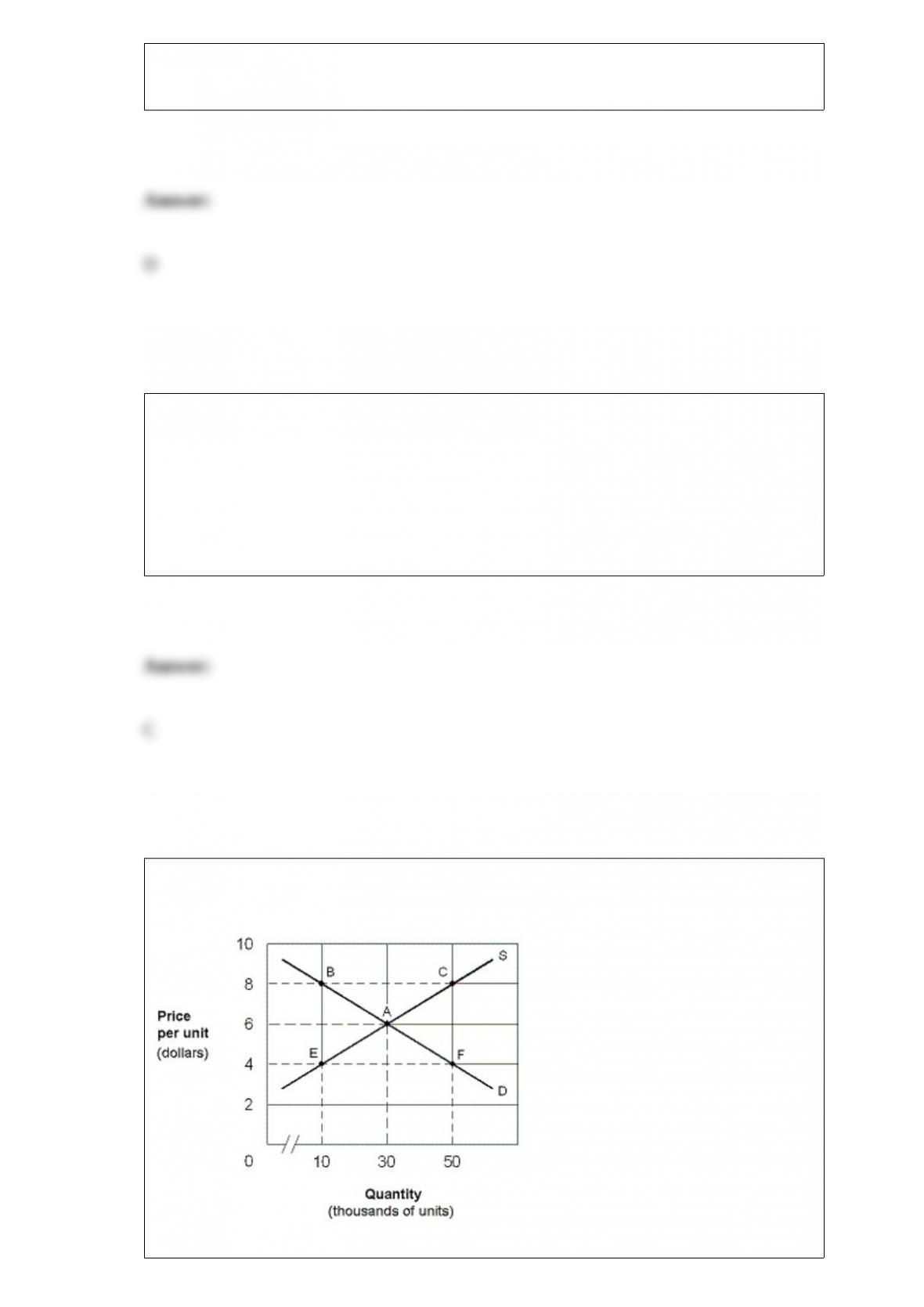
Exhibit 5-9 Supply and demand curves for good X
As shown in Exhibit 5-9, the price elasticity of demand for good X between points E
and D is:
a. 1/5 = 0.20. c. 1/2 = 0.50.
b. 3/7 = 0.43. d. 1.
If a firm’s marginal revenue from its 100th unit of output is $50 and the marginal cost
from its 100th unit of output is $45, then in the short run this firm should:
a. increase its plant size.
b. change its technology.
c. produce more than 99 units of output.
d. produce less than 100 units of output.
e. shut down.
Exhibit 3-10 Demand and supply curves

In Exhibit 3-10, which of the following is true about this graph?
a. When the price is $4, there is an excess supply.
b. When the price is $8, there is an excess demand.
c. When the price is $4, excess supply is greater than excess demand.
d. When the price is $8, excess demand is greater than excess supply.
e. When the price is $6, there is no excess demand or excess supply.
Which of the following is characteristic of the marginal revenue product schedule for a
resource?
a. It approximates the firm’s demand curve for the resource.
b. It measures the change in total revenue resulting from employing an additional unit
of the resource.
c. It is determined by multiplying the marginal product of the resource by the marginal
revenue of the good produced.
d. All of these are true.
Exchange rates are for currency what:
a. c, d and e.
b. discounts are for sales.
c. interest is for capital.
d. prices are for apples.
e. wages are for labor.

When using the traditional command-and-control approach to environmental regulation,
the government attempts to:
a. set a minimum requirement and then allows the firm to determine the most efficient
method for achieving this requirement.
b. determine the most efficient method for different industries.
c. make allowances for differences across industries and between firms.
d. set standards that are applicable to all situations and does not recognize unique
circumstances.
Suppose a monopsonist currently employs 100 workers at a wage of $400 per week. If
the firm wants to expand employment to 110 workers, and the 110th worker will only
work for $450 per week, what is the approximate marginal factor cost of the 110th
worker?
a. $450 per week.
b. $5,500 per week.
c. $950 per week.
d. $9,500 per week.
e. $49,500 per week.

Suppose the United States decides to impose a $1,000 tax on every Japanese minivan
sold in the United States. This is an example of:
a. a tariff.
b. free trade.
c. comparative advantage.
d. the diversity of industry argument.
e. a quota.
The long run is a planning period:
a. during which the firm can vary all inputs including its plant size.
b. less than six months.
c. less than one year.
d. less than five years.
Exhibit 7-12 Cost schedule for producing pizza
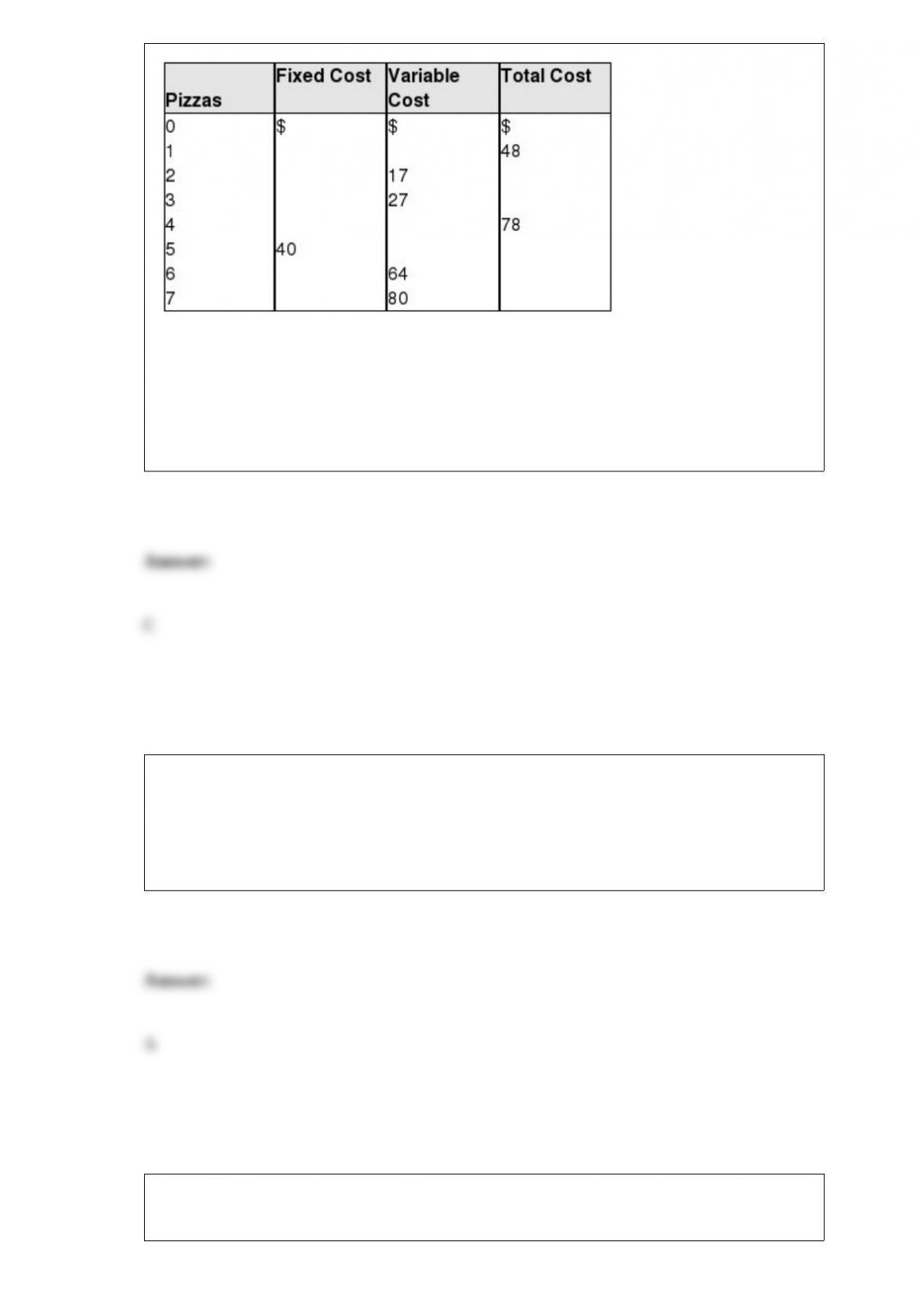
By filling in the blanks in Exhibit 7-12, the AVC of 3 pizzas is shown to be equal to:
a. $10.
b. $13.33.
c. $9.
d. $22.33.
e. $40.
Suppose the Pleasant Corporation cuts the price of its American Girl dolls by 10
percent, and as a result, the quantity of the dolls sold increases by 25 percent. This
indicates that the price elasticity of demand for the dolls over this range is:
a. 2.5. c. 0.5.
b. 0.4. d. 5.0.
Which of the following events would increase the supply of tomatoes?
a. The introduction of mechanized tomato pickers, which raises the cost of production.

b. An increase in wages for the tomato pickers.
c. A decrease in the cost of fertilizers for the tomato plants.
d. Unseasonably hot, dry weather in the tomato-growing regions of the nation.
e. A decrease in the price of pasta products.
Which of the following is a statement of positive economics?
a. Too much government spending is the biggest problem facing the U.S. economy.
b. Creating jobs is the most serious problem facing the U.S. economy.
c. Raising taxes provides additional revenue that should be used to finance health care.
d. If taxes are over 50 percent of national income, job creation falls.