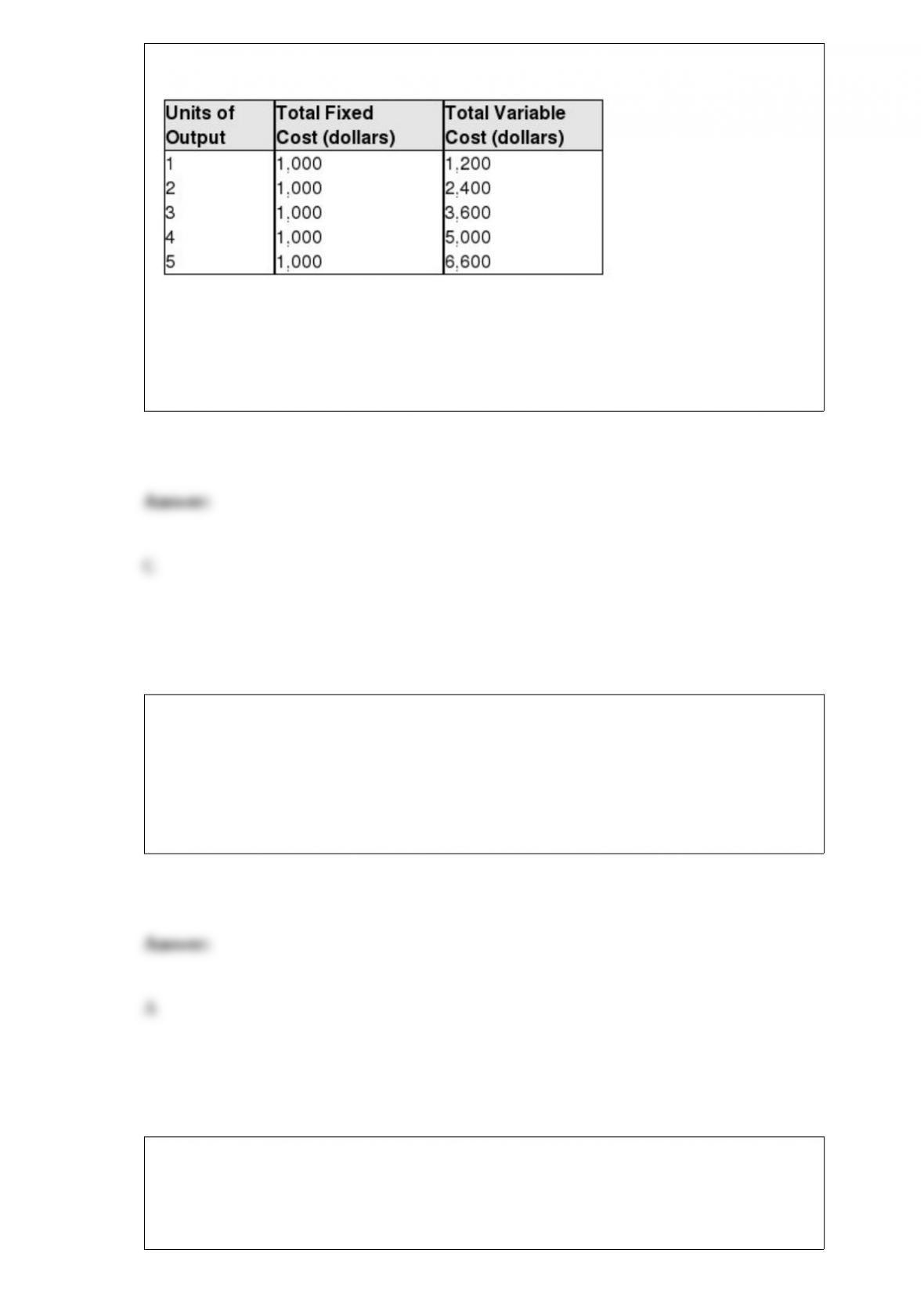
Use the table below to answer the following question.
What is the average total cost at an output level of four units?
a. $1,200.
b. $1,400.
c. $1,500.
d. $2,000.
The longer the time period under study,
a. the more elastic is the price elasticity of demand.
b. the less sensitive consumers will be to price changes.
c. the less adjustment consumers will make to price changes.
d. the more inelastic is the price elasticity of demand.
e. the more likely any given price cut will result in a smaller reaction by the consumer.
A nation can accelerate its economic growth by:
a. reducing the number of immigrants allowed into the country.
b. adding to its stock of capital.
c. printing more money.
d. imposing tariffs and quotas on imported goods.
Assuming that bus travel is an inferior good, a decrease in consumer income, other
things being equal, will cause:
a. a downward movement along the demand curve for bus travel.
b. no change in the demand curve for bus travel.
c. an upward movement along the demand curve for air travel.
d. a rightward shift in the demand curve for bus travel.
When the cost curves have U-shapes, at the point where marginal cost equals average
total cost:
a. b and c.
b. marginal cost is rising.
c. average total cost is at its minimum.
d. average variable cost is falling.
e. the fixed cost has been fully depreciated.
Which of the following states the definition of supply?
a. More of a good is supplied at a lower price.
b. There is a positive relationship between the price of a good and the quantity that
buyers purchase.
c. There is a positive relationship between the price of a good and the quantity offered
for sale by suppliers.
d. There is a negative relationship between the price of a good and the quantity offered
for sale by suppliers.
If a consumer is spending all of his/her income in a manner where MUa / Pa =
MUb / Pb, then the consumer:
a. should increase the consumption of A and decrease the consumption of B.
b. is maximizing his/her utility.
c. should increase the consumption of B and decrease the consumption of A.
d. should increase the consumption of both A and B.
e. should decrease the purchases of both A and B.
The WTO was:
a. formed shortly after World War II.
b. authorized in the American Constitution.
c. formed in 1995.
d. formed in 1876.
e. formed to unify the European continent.
If Mr. McLean thinks the last dollar spent on bowling yields more satisfaction than the
last dollar spent on hamburgers, and McLean is a utility-maximizing consumer, he
should:
a. bowl less, so the marginal satisfaction from expenditures in this area will increase.
b. spend more on hamburgers, so total satisfaction from that activity will increase.
c. eliminate spending on hamburgers.
d. bowl more and spend less on hamburgers.
Which of the following is an in-kind transfer payment?
a. Medicaid.
b. Social Security.
c. unemployment insurance.
d. Temporary Assistance to Needy Families.
Which of the following statements is correct?
a. Slope is the ratio of the vertical change (the rise or fall) to the horizontal change (the
run).
b. A direct relationship is one in which two variables change in the same direction.
c. An inverse relationship is one in which two variables change in opposite directions.
d. An independent relationship is one in which two variables are unrelated.
e. All of these.
Between 1929 and 2005 in the United States, as measured by the Lorenz curve, income
inequality:
a. was greater.
b. remain unchanged.
c. was less.
d. increased sharply.
Exhibit 10-3 A monopolistic competitive firm in the long run
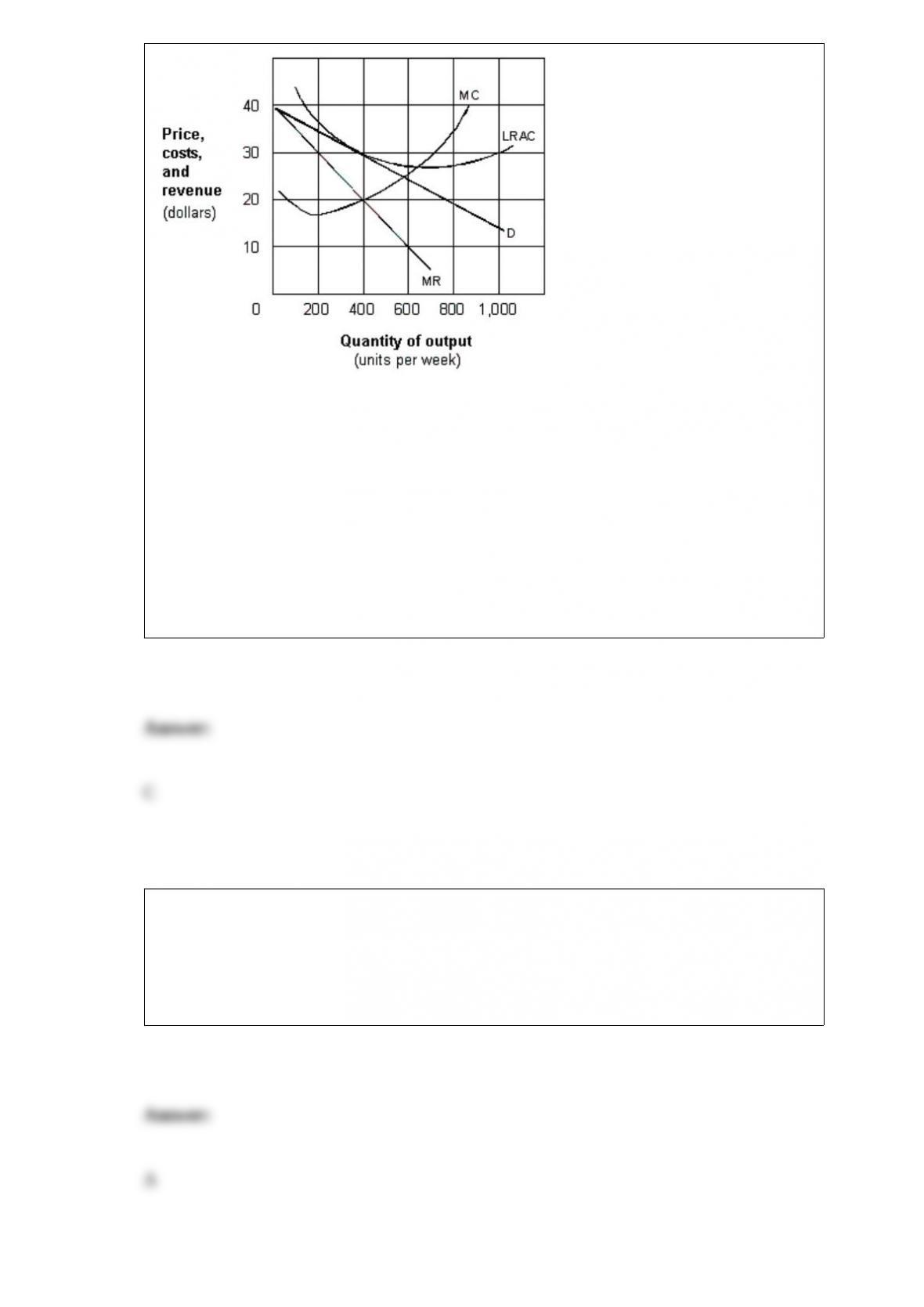
If all firms in a monopolistic competitive industry have demand and cost curves like
those shown in Exhibit 10-3, we would expect that in the long run:
a. a number of new firms will enter the industry.
b. some firms will leave the industry.
c. firms in the industry earn zero economic profits.
d. all firms will leave the industry.
Game theory is a model for describing oligopoly price decisions among firms that are:
a. interdependent. c. regulated
b. independent. d. merging
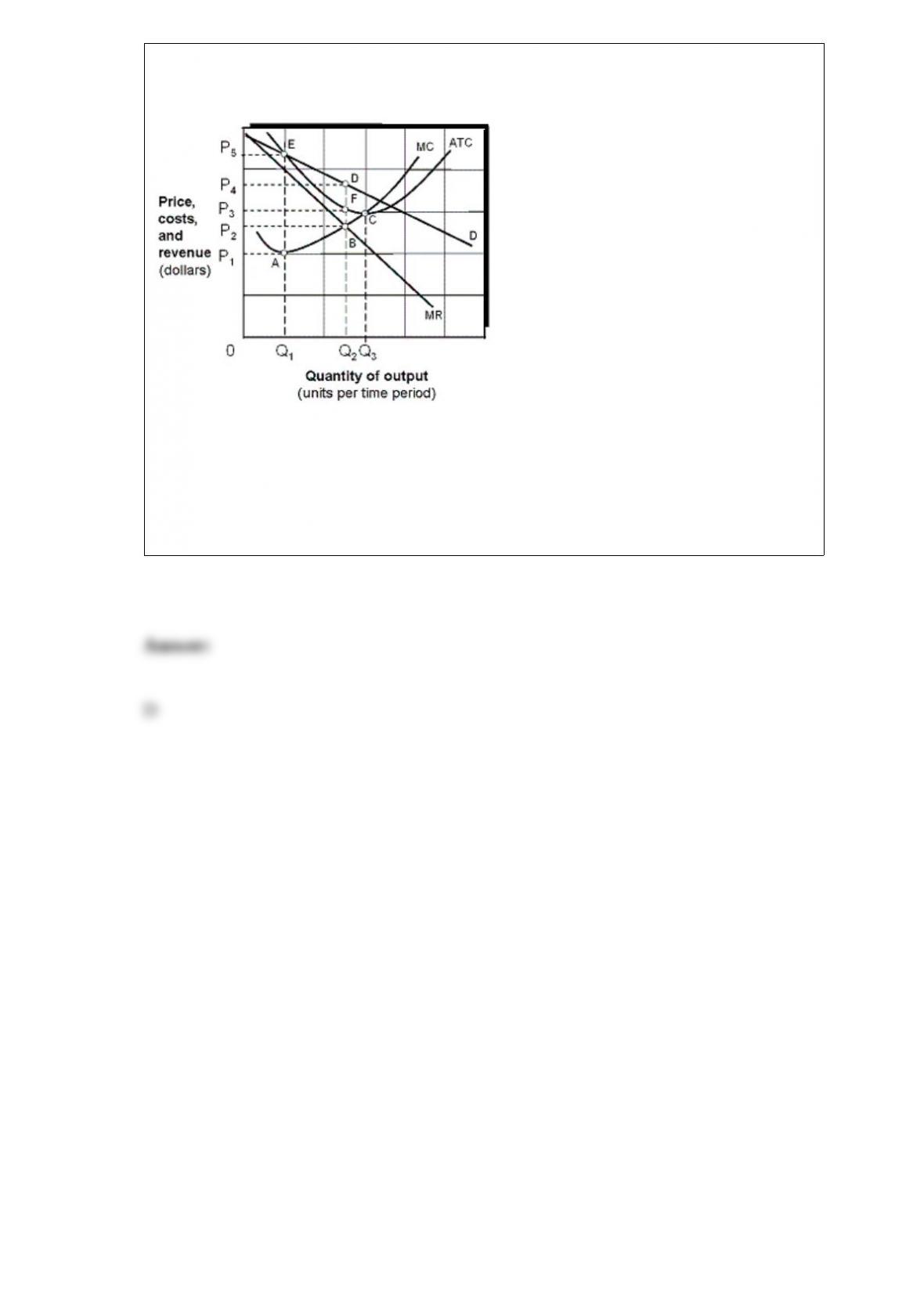
Exhibit 9-8 Profit maximizing for a monopolist
As shown in Exhibit 9-8, the monopolist’s profit maximizing price-quantity point is:
a. A
b. B
c. C
d. D
e. E