Which of the following is true about the production possibilities curve when a
technological progress occurs? The curve:
a. shifts inwards to the left.
b. becomes flatter at one end and steeper at the other end.
c. becomes steeper.
d. shifts outward to the right.
e. does not change.
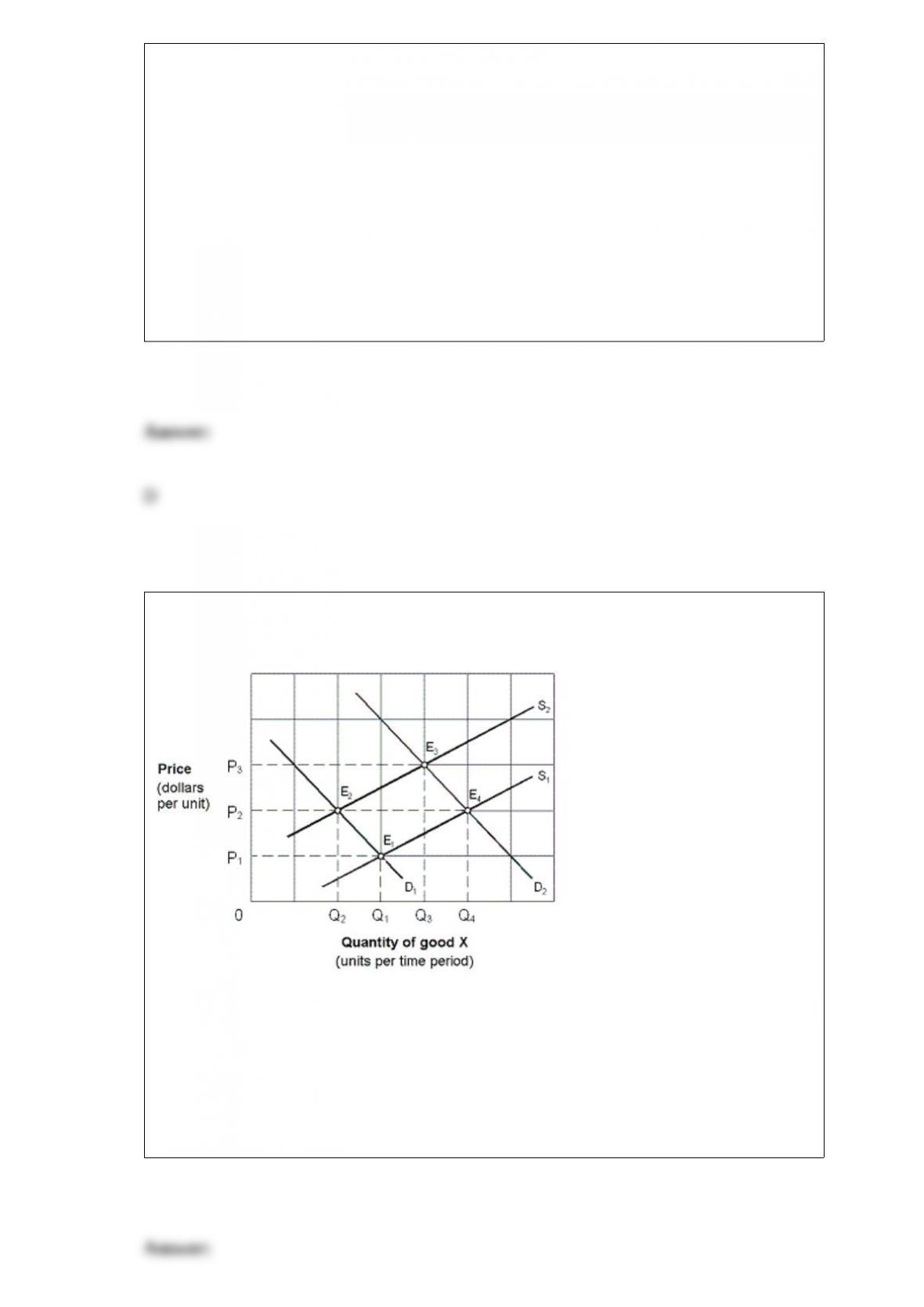
Exhibit 4-3 Supply and demand curves
In Exhibit 4-3, an increase in quantity supplied would cause a movement from which
equilibrium point to another, other things being equal?
a. E1 to E2. c. E4 to E1.
b. E1 to E4. d. E3 to E4.

Marginal cost pricing is a system of pricing in which the price charged equals the
marginal cost of:
a. the first unit produced. c. the last unit produced.
b. each unit produced. d. the profit-maximization unit.
If a firm reacts to other firms’ market decisions by anticipating how the other will then
react, this is:
a. not profit-maximizing behavior
b. a monopolistic competitive market
c. a market with a low concentration ratio
d. mutual interdependence
e. collusion by definition
Comparative advantage indicates that:
a. specialization and exchange will permit trading partners to maximize their joint
consumption.
b. a nation can gain from trade only if it is not at an absolute disadvantage in producing

all goods.
c. a nation can gain from trade only when its trading partners are not low-wage
countries.
d. countries should export products for which they are high-opportunity cost producers.
The exchange rate is the:
a. value of money.
b. quantity of dollars, yen, etc. that are traded.
c. amount of a foreign currency that is brought back to the United States by tourists.
d. number of units of your currency that it takes to buy one unit of a foreign currency.
e. number of units of a foreign currency that can be bought with one unit of your own
currency.
Which of the following best describes social benefits?
a. The external benefits to other members of society, ignoring the private benefits to
market participants.
b. The sum of external benefits and private benefits.
c. External benefits minus benefits.
d. Private benefits minus external benefits.

If resource prices rise and the per-unit cost of producing a product increases as the firms
in an industry expand output in response to an increase in demand, the long-run market
supply curve for the product will:
a. be perfectly elastic (a horizontal line).
b. be perfectly inelastic (a vertical line).
c. slope upward to the right.
d. be more inelastic than the short-run supply curve for the product.
An improvement in a firm’s technology that improves productivity results in a(n):
a. leftward shift of the supply curve.
b. upward movement along the supply curve.
c. willingness to supply a larger quantity than before at any given price.
d. downward movement along the supply curve.
Exhibit 7-5 Workers and output data

In Exhibit 7-5, the marginal product of the second worker is:
a. 0.
b. 8.
c. 10.
d. 12.
e. 20.
Tasha decides that when homes in her neighborhood are selling for $150,000 she will
not sell her home. When average prices rise to $175,000, she decides that she will put
her home on the market. This is an example of:
a. market demand.
b. market-day supply.
c. an excess supply of homes.
d. a positively-sloped supply curve.
e. a negatively-sloped supply curve.
Which of the following would most likely not cause market demand for a normal good
to decline?

a. An increase in the price of a substitute.
b. An increase in the price of a complement.
c. A decline in consumer income.
d. Consumer expectations that the good will go on sale in the near future.
e. An announcement by the Surgeon General that the product contributes to premature
death.death.
A vaccination shot provides a(n):
a. beneficial opportunity cost. c. out-resourcing benefit.
b. positive externality. d. managed-care opportunity benefit.
John loves to travel. He would never turn down the opportunity to go on a trip. This
means that, for John:
a. the total utility of travel always increases.
b. marginal utility of travel never decreases.
c. the law of diminishing marginal utility does not apply to travel.
d. marginal utility of travel is always zero.
e. extra travel yields zero consumer surplus.

Featherbedding allows unions to increase wages by:
a. limiting the supply of labor.
b. increasing firms’ demand for labor.
c. forcing firms to accept higher-than-equilibrium wages.
d. reducing labor share of payroll taxes.
If a perfectly competitive firm cannot cover all of its costs, then it should shut down in
the short run.
Capital resources include money and other financial assets.
The Sherman Antitrust Act was not specific enough to eliminate monopolies in the
United States.

The law of diminishing marginal utility states that marginal utility must diminish after
the first unit of consumption of every good or service.
The Utah Pie case is an example of a violation of the Celler-Kefauver Act.
Of all the points on the production possibilities curve, only one point represents an
efficient point.

In a competitive labor market a firm will continue to employ workers for as long as an
additional worker’s marginal revenue product is below the wage rate.
If people buy more of a generic brand when consumer income falls, it is an inferior
good.