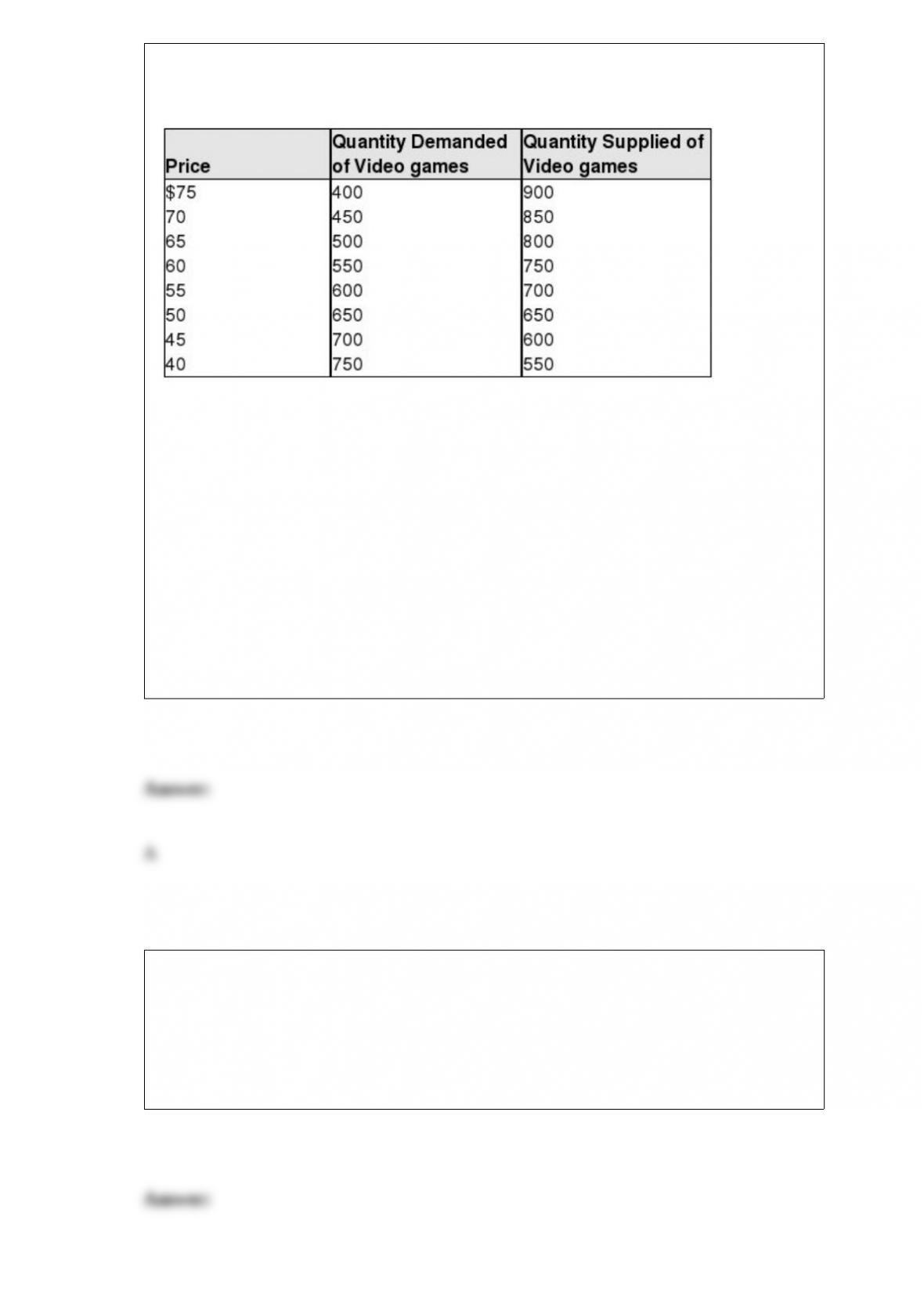
Exhibit 3-8 Demand and supply data for Video games
In Exhibit 3-8, if there is a surplus of video games of 200 units, the current price of
video games must be:
a. $60.
b. $55.
c. $50.
d. $45.
e. $40.
For a monopolist:
a. price equals average total cost.
b. price is above marginal revenue.
c. marginal revenue equals zero.
d. marginal cost equals zero.
e. average total cost equals marginal cost.

Which of the following is true for the monopolist?
a. Marginal revenue is less than the price charged.
b. Economic profit is possible in the long-run.
c. Profit maximizing or loss minimizing occurs when marginal revenue equals marginal
cost.
d. All of the above.
e. None of the above.
Other things being equal, the effects of an increase in the price of crackers on the
market for soup is represented by a(n):
a. downward movement along the demand curve for soup.
b. upward movement along the demand curve for soup.
c. rightward shift in the demand curve for soup.
d. leftward shift in the demand curve for soup.
Public goods differ from private goods in that:
a. they produce negative externalities.
b. they are not scarce.
c. their benefits cannot be denied to anyone.
d. their consumption must be regulated by the government.
e. their benefits are very narrow.
If an increase in the price of a product from $1 to $2 per unit leads to a decrease in the
quantity demanded from 100 to 80 units, then according to the averaging equation, the
value of price elasticity of demand in absolute terms is:
a. 0.33.
b. 2.33.
c. 0.25.
d. 3.
e. 0.66.
Exhibit 15-5 International currency markets
Exhibit 15-5 displays the international currency market for yen in terms of dollars and
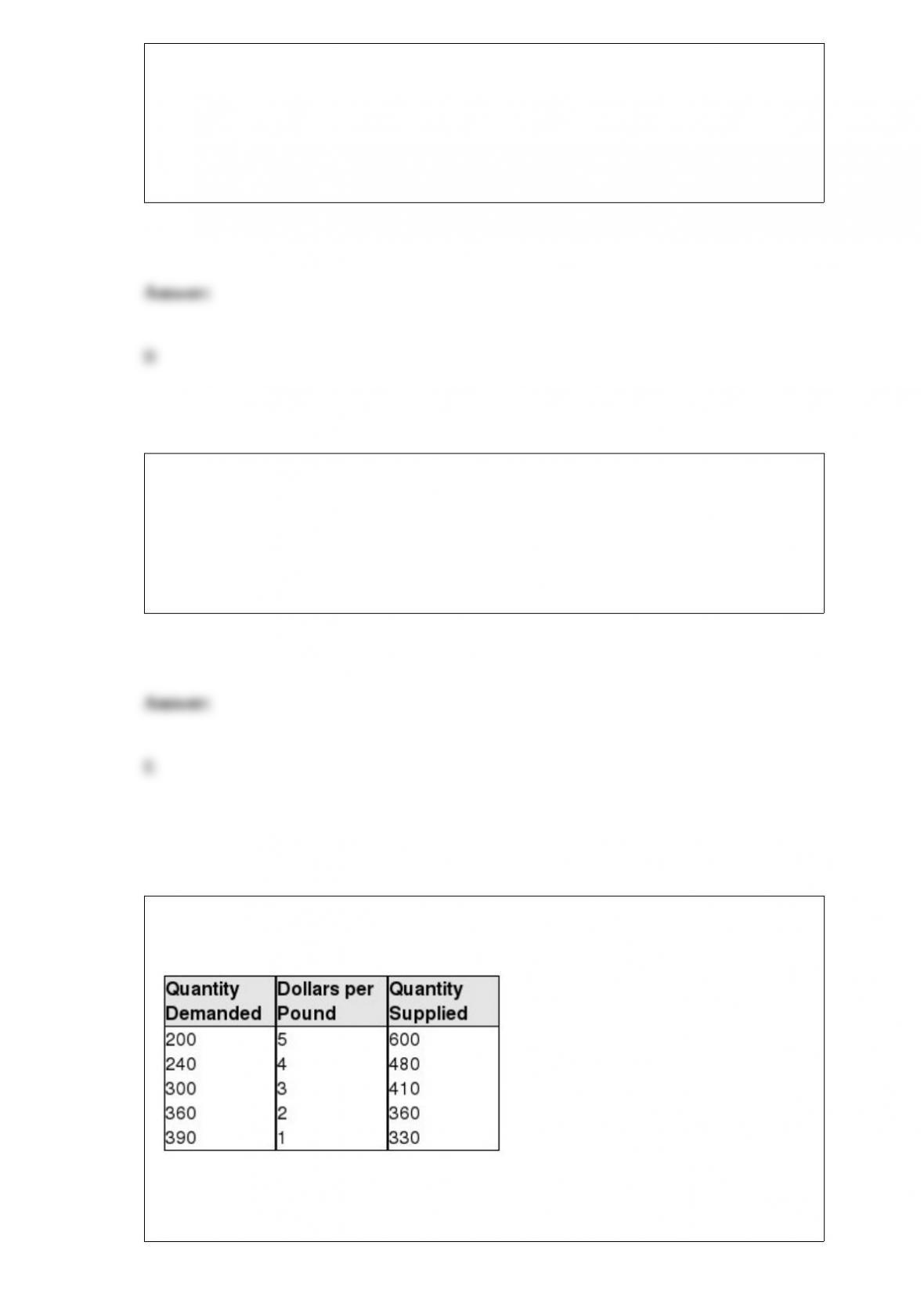
dollars in terms of yen. The demand curve in graph 15-5(A) is determined by:
a. U.S. citizens attempting to purchase Japanese-made goods.
b. Japanese attempting to purchase U.S.-made goods.
c. U.S. businesses attempting to sell to the Japanese.
d. Japanese businesses attempting to sell to the U.S.
e. the U.S. government attempting to unload dollars to the international market.
A positive economic statement:
a. contains personal and social value judgments.
b. is always a mathematical expression.
c. should never be used by an economist.
d. is proper provided the advocator is clear the position rests on personal assessment.
e. is an unbiased report of the facts of the economy.
Exhibit 15-6 Dollars per British pound
In Exhibit 15-6, when the exchange rate is 3 dollars per pound,
a. there is an excess supply of 110 pounds.
b. there is an excess demand of 110 pounds.

c. there is an excess supply of 110 dollars.
d. there is an excess demand of 110 dollars.
e. the market is in equilibrium.
The basic purpose of economic models is to:
a. construct simplifying assumptions about the real world.
b. explain reality in all its complexity.
c. construct situations where controlled experiments can be carried out.
d. provide explanations for, and predictions of the relationship between variables.
Which of the following is infrastructure?
a. IBM computer plant. c. Services of doctors.
b. Training and education. d. None of these.
Which of the following most closely represents the share of total U.S. income to the
poorest 20 percent of all U.S. families?

a. 47 percent.
b. 23 percent.
c. 10 percent.
d. 4 percent.
Which of the following is a macroeconomic subject?
a. Shipping rates. c. Market price of Japanese cars.
b. Price of corporate stock. d. Unemployment rate in the nation.
A public good will:
a. be efficiently provided by the free market as long as its total benefits exceed its total
costs.
b. be efficiently provided by the free market as long as its marginal benefits exceed its
marginal costs.
c. be provided in less than efficient quantities by the free market.
d. be provided in efficient quantities by voluntary contributions.
e. not be provided by the government.
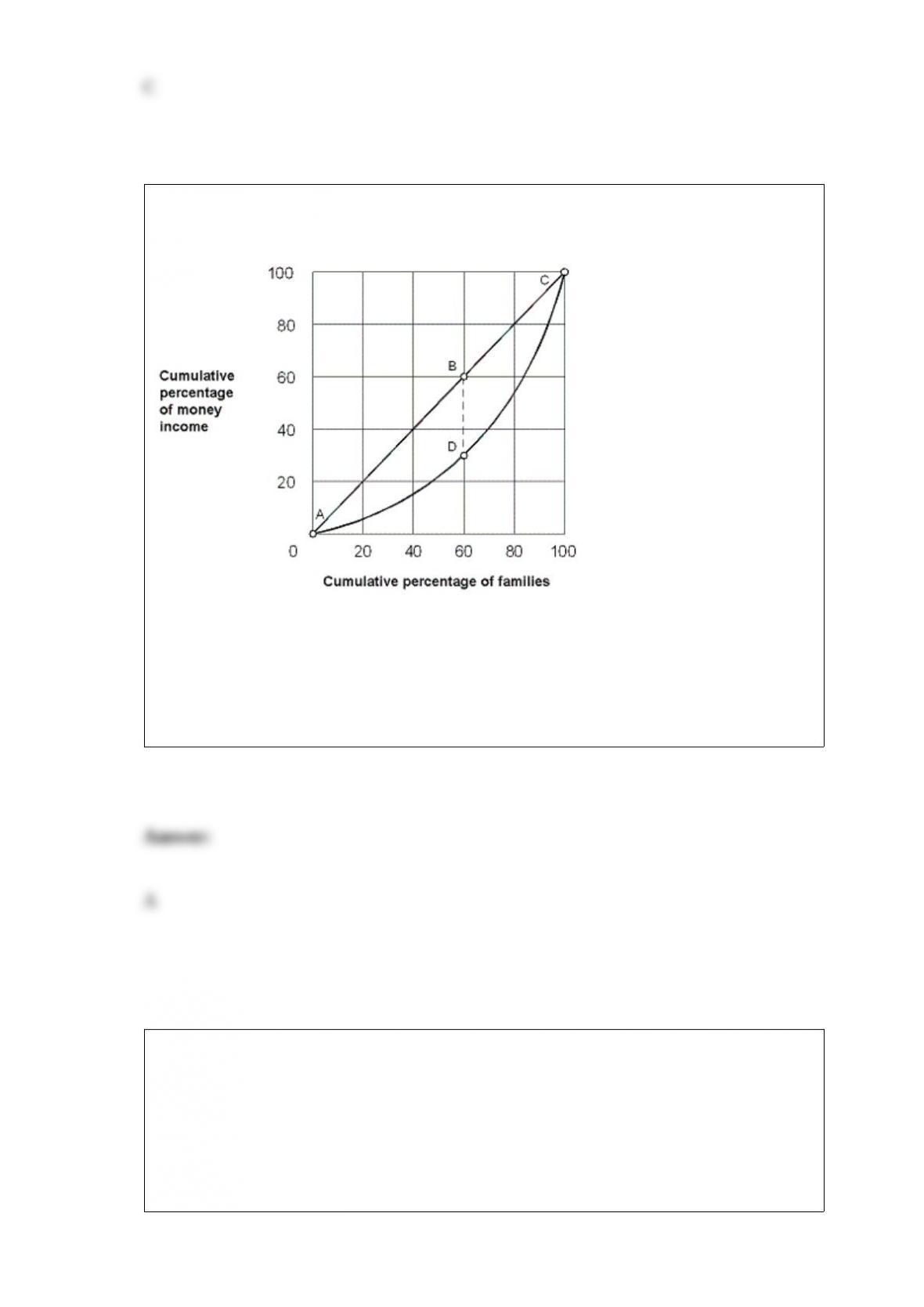
Exhibit 12-2 Lorenz curve
As shown in Exhibit 12-2, the distance between points B and D means that 60 percent
of families earn ____ less of total income than required for perfect equality.
a. 30 percent
b. 60 percent
c. 90 percent
d. insufficient information to answer question.
Assuming gasoline and oil to be complementary goods, the effect on the oil market of
an increase in the price of gasoline (other things being equal) would best be described
as a(n):
a. increase in the demand for oil.
b. decrease in the demand for oil.
c. increase in the quantity of oil demanded.
d. increase in the quantity of oil demanded.

Sally is an average shopper, with average income. When she is in the store she buys a
few items which cost more than $20, several items which cost between $5 and $20, and
many items which cost less than $1. The price elasticity of Sally’s demand for these
goods most likely ____.
a. increases as the price decreases
b. decreases as the price decreases
c. increases as the price increases
d. decreases as the price increases
e. remains constant over all price ranges
Marginal revenue is the change in:
a. total revenue resulting from a one unit change in output.
b. total revenue resulting from a change in marginal cost.
c. price resulting from a one unit change in output.
d. none of these.
Which of the following is not an explicit cost?
a. Salaries.

b. Sales taxes.
c. Utilities, such as gas and electricity.
d. Insurance.
e. The firm owner’s time.
If one country can produce a good with fewer resources than another country, this is
called:
a. specialization.
b. geographic advantage.
c. comparative advantage.
d. absolute advantage.
e. free trade.
Exhibit 12-2 Lorenz curve
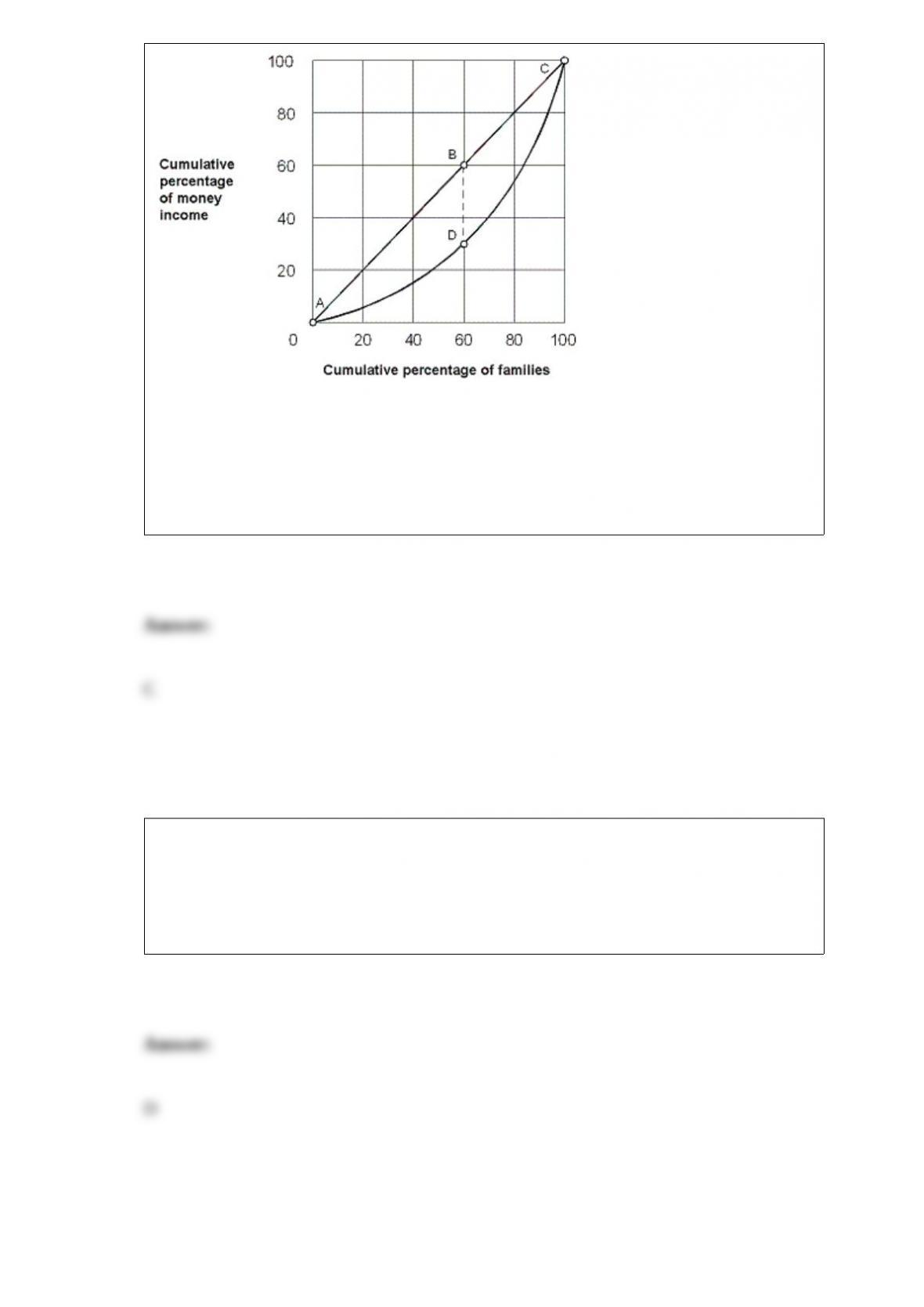
As shown in Exhibit 12-2, 60 percent of families earned a cumulative share of about
____ of income.
a. 5 percent
b. 15 percent
c. 30 percent
d. 50 percent
A theory is:
a. based only on critical factors or variables.
b. a simplified abstraction of the real world.
c. a detailed description of reality.
d. a and b.

Which of the following is least likely to increase the demand for new tires?
a. a decrease in the price of tires
b. a decrease in the price of cars
c. an increase in consumer income
d. an increase in the number of miles people drive per year