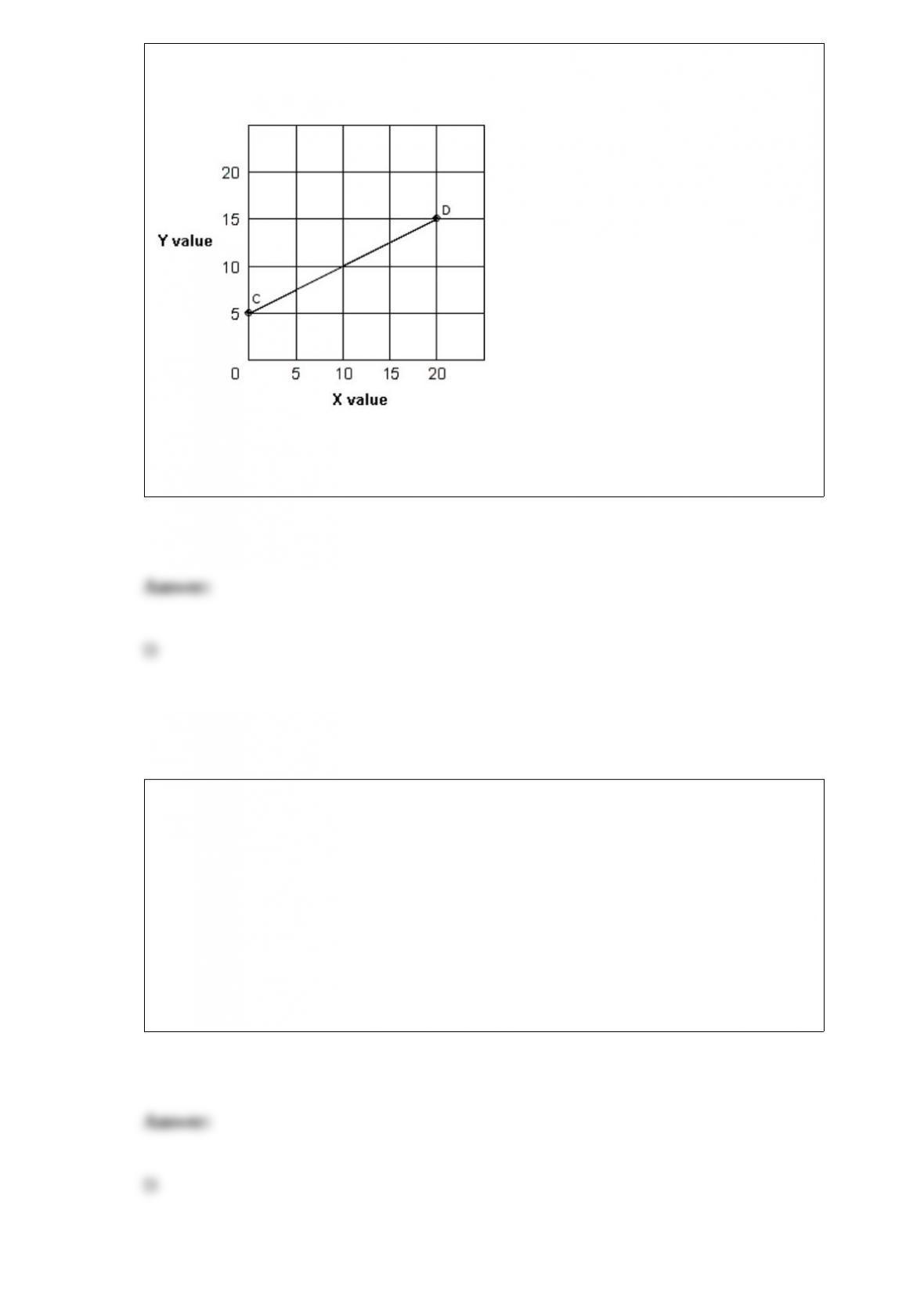
Exhibit 1A-2 Straight line
As shown in Exhibit 1A-2, the slope of straight line CD:
a. decreases with increases in X. c. increases with decreases in X.
b. increases with increases in X. d. remains constant with changes in X.
The Coase theorem says that, if the appropriate property right is assigned to ____, an
efficient solution to an externality problem will be achieved.
a. the party causing the externality
b. the victim of the externality
c. the party that can avoid the externality at the higher cost
d. either one of the parties involved
The antitrust legislation that made it illegal for a firm to buy a competitor’s voting stock
was the:
a. Sherman Antitrust Act.
b. Celler-Kefauver Act.
c. FTC Act.
d. Robinson-Patman Act.
e. Clayton Act.
Which of the following will not shift the demand curve for grapefruit?
a. An announcement that eating a grapefruit before every meal will induce weight loss.
b. A technical development that allows machines to replace the workers who harvest
grapefruit.
c. An announcement that eating lots of grapefruit causes skin problems.
d. A newspaper story reporting that the preference for oranges has skyrocketed.
e. An announcement that grapefruit will definitely cost more next week.
The landmark antitrust case which established that size alone can be an antitrust
violation is the:
a. U.S. Steel case.
b. Brown Shoe case.
c. Von’s Grocery case.
d. ALCOA case.
e. Pabst Brewing case.
If a product’s price increases, then its:
a. MP will increase.
b. MFC will increase.
c. MRP will increase.
d. MP will decrease.
Opportunity cost is the:
a. cost incurred when one fails to take advantage of an opportunity.
b. price paid for goods and services.
c. cost of the best option forgone as a result of choosing an alternative option.
d. undesirable aspects of an option.

When the price of a good is a constant, the marginal revenue per unit of output is the
same as:
a. total revenue.
b. average total cost.
c. price.
d. quantity of output.
e. profit per unit.
Compared to a perfectly competitive firm with the same cost structure, a monopoly firm
will charge a:
a. higher price and sell more.
b. lower price and sell more.
c. higher price and sell less.
d. lower price and sell less.
e. similar price and sell the same.
If a country’s real GDP is growing at 5 percent and the population is also growing at 5
percent, its:
a. per capita real GDP grows at an increasing rate.
b. per capita real GDP grows at a constant rate.
c. population growth will eventually exceed real GDP.
d. per capita real GDP decreases at a constant rate.
e. per capita real GDP does not change.
Suppose that X and Y are substitute goods. If the price of good X increases, we can
expect:
a. the demand for good X to shift to the left.
b. an upward movement along the demand curve for good Y.
c. the demand curve for good Y to shift to the right.
d. a downward movement along the demand curve for good Y.
e. the demand curve for good Y to shift to the left.
If Congress decides to reduce the tax per pack paid by sellers of cigarettes, other things
being equal, the price of cigarettes will fall. This fall in prices can be attributed a(n):
a. upward movement along the supply curve for cigarettes.
b. rightward shift of the supply curve for cigarettes.
c. downward movement along the demand curve for cigarettes.
d. leftward shift of the supply curve for cigarettes.
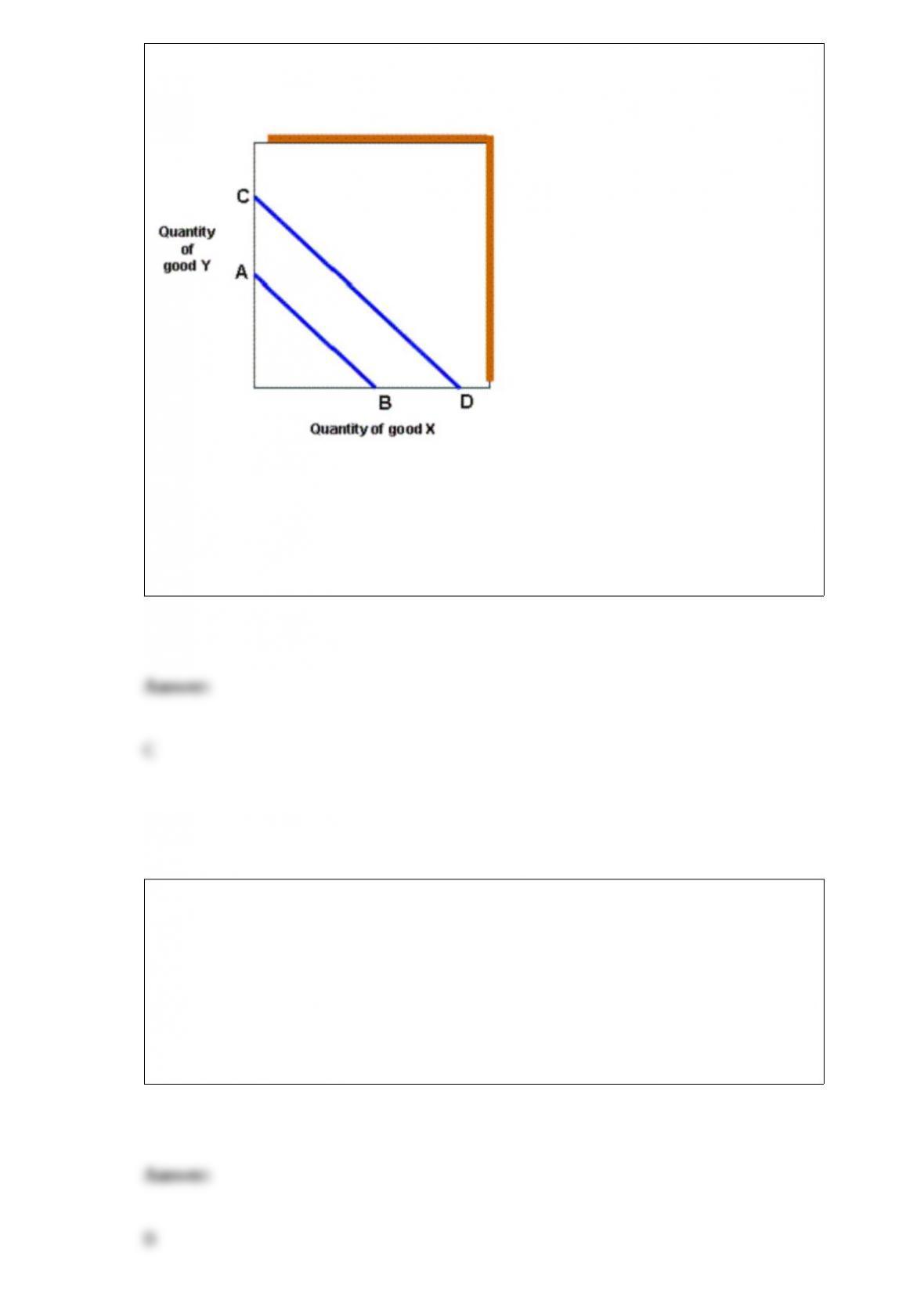
Exhibit 6A-1 Budget line
As shown in Exhibit 6A-1, a leftward shift in the budget line from CD to AB would
result from:
a. a price reduction in good X.
b. a price reduction in good Y.
c. a decrease in consumer income.
d. an increase in consumer income.
Suppose a monopolist charges a price corresponding to the intersection of the marginal
cost and marginal revenue curves. If this price is between its average variable cost and
average total cost curves, the firm will:
a. earn an economic profit.
b. stay in operation in the short-run, but shut down in the long run if demand remains
the same.
c. shut down.
d. none of these.

Which of the following is characteristic of a monopolistically competitive firm?
a. The firm faces an upward-sloping demand curve.
b. The firm faces an inelastic demand curve.
c. The firm faces a horizontal demand curve.
d. The firm produces a differentiated product.
A retailer cannot sell Campbell Soup if it also sells other brands of soup. This is an
example of:
a. resale price maintenance. c. a tying agreement.
b. price discrimination. d. exclusive dealing.
Exhibit 5-8 Supply and demand curves for good X
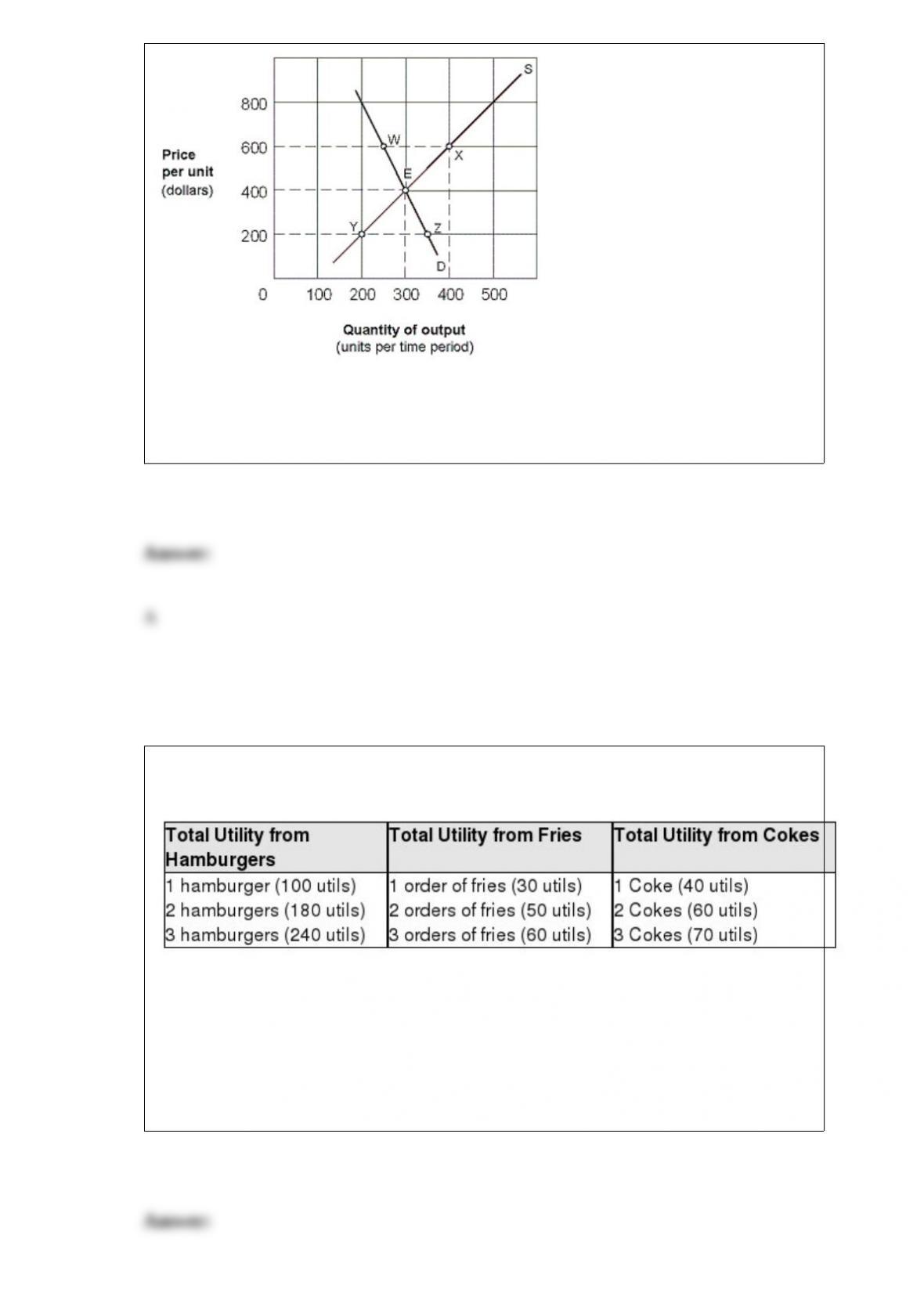
As shown in Exhibit 5-8, the price elasticity of demand for good X between points E
and Z is:
a. 3/13 = 0.23. c. 1/3 = 0.33.
b. 13/3 = 4.33. d. 1.
Exhibit 6-2 Total utility for hamburgers, fries, and Cokes
In Exhibit 6-2, assume that the price of hamburgers is $2 each, fries cost 50 cents each,
and Cokes cost $1 each. Suppose the consumer has $6 to spend on hamburgers, fries,
and Cokes. Which of the following meals gives the consumer the most utility?
a. 3 hamburgers, no fries, and no Cokes.
b. 2 hamburgers, no fries, and 2 Cokes.
c. 2 hamburgers, 2 orders of fries and 1 Coke.
d. 1 hamburger, 2 orders of fries, and 3 Cokes.

Indifference curve slopes upward from left to right because consumers always prefer
more of a good to less.
As we move down a person’s demand curve, marginal utility declines.
A weaker dollar will stimulate sales of U.S. exports.