
Which of the following would be illegal under the Robinson-Patman Act?
a. Ford and General Motors meet to fix the price of cars.
b. Computer makers form a cartel.
c. General Mills and Kelloggs decide to merge.
d. Exxon sells gas at a higher wholesale price to independent gas retailers than to Exxon
retailers.
e. Exxon Oil and Mobil Oil elect the same person to their boards of directors.
Which of the following applies to a real-world socialistic economy?
a. Private ownership of all factors of production.
b. Government ownership of all factors of production.
c. Government ownership of most of the factors of production.
d. Lack of central planning.
Exhibit 2-1 Production possibilities curve data
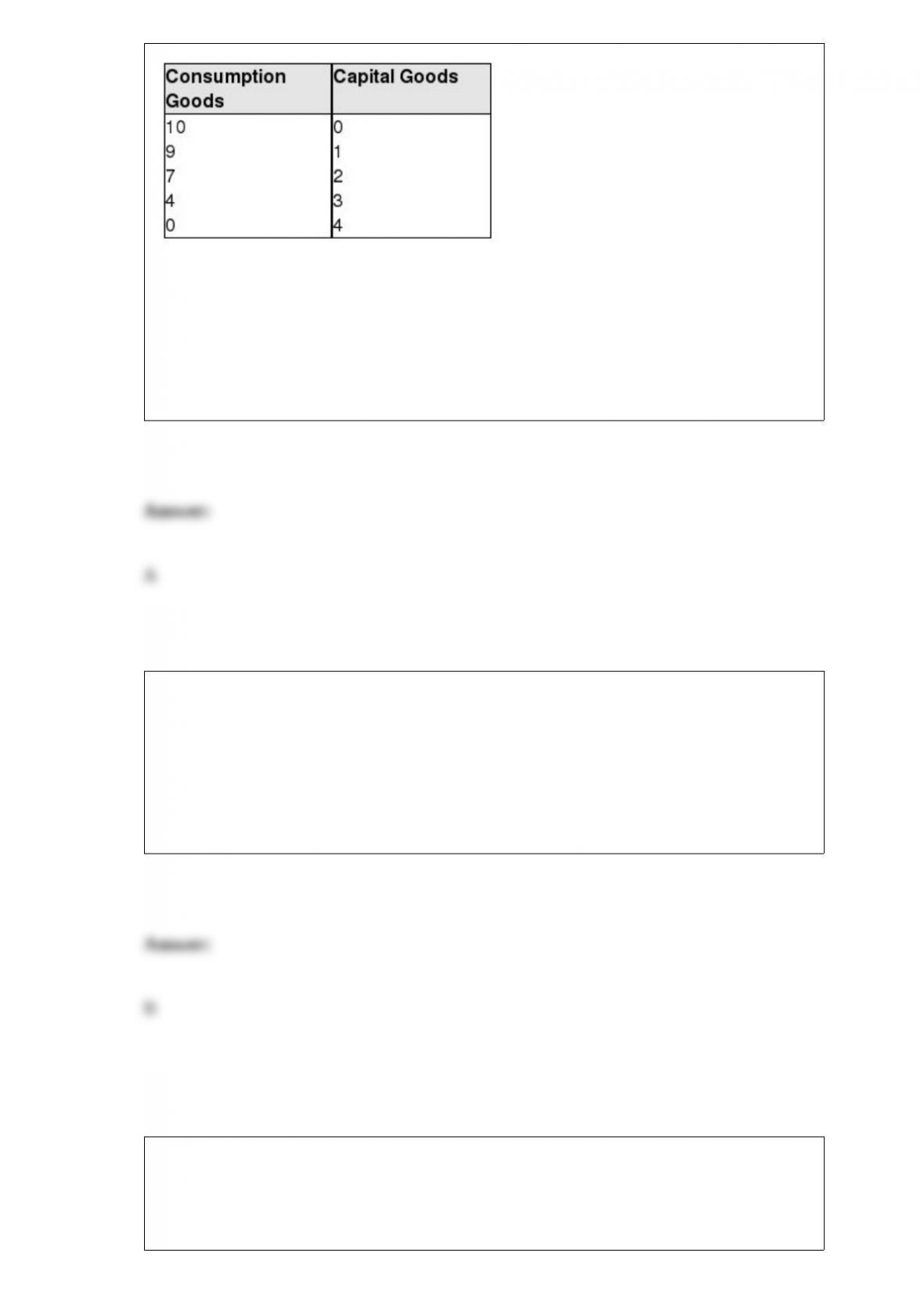
In Exhibit 2-1, according to the information, the opportunity cost of producing 3 units
of capital is:
a. 3 units of consumption goods. c. 6 units of consumption goods.
b. 4 units of consumption goods. d. 7 units of consumption goods.
JoAnn considers cola and plain sparkling water to be good substitutes. Suppose the
price of sugar, a key ingredient used to produce cola, falls. According to the substitution
effect, which of the following is most likely to occur?
a. JoAnn will purchase less cola and more sparkling water.
b. JoAnn will purchase more cola and less sparkling water.
c. JoAnn will purchase more of all goods due to her higher real income.
d. JoAnn’s demand curve will decrease (shift in), causing her to purchase less cola.
A study of consumers in an area found that as family income increased from $25,000
per year to $35, 000 per year, other factors held constant, the number of houses
purchased increased from 7,000 per year to 11,000 per year. This finding indicates an
income elasticity of demand coefficient for housing over this family income range of:

a. 0.22. c. 1.33.
b. 0.75. d. 4.50.
The economic system in which the basic economic questions are answered through
markets with some government intervention is a:
a. command economy. c. market economy.
b. mixed economy. d. planned economy.
Which of the following is a market structure of monopoly?
a. Few firms operating as price takers.
b. Single firm operating as a price taker.
c. Single firm that is a price maker.
d. All of these are true.
When the price of a good is above its equilibrium price, a:
a. surplus puts upward pressure on the price.
b. surplus puts downward pressure on the price.
c. shortage puts upward pressure on the price.
d. shortage puts downward pressure on the price.
Which of the following is a correct characterization of socialism?
a. Tradition answers the basic economic questions.
b. Markets are used exclusively to answer the basic economic questions.
c. Central planning is seldom used to answer the basic economic questions.
d. Government ownership of many resources and centralized decision-making answers
the basic economic questions.
In the long run, total fixed cost:
a. falls.
b. rises.
c. is constant.
d. does not exist.
Consider a firm with the following cost and revenue information: ATC = $8, AVC = $7,
and MR = MC = $6. If the firm produces Q = 60 in the short run, it:
a. is minimizing losses.
b. makes a total loss of $60.
c. should produce more output.
d. is making a mistake and should shut down.
e. is maximizing total profit.
Exhibit 6A-1 Consumer Equilibrium
Given the budget lines and indifference curves shown in Exhibit 6A-1, point D yields:
a. more total utility than point A.
b. more total utility than point E.
c. less total utility than point F.
d. less total utility than points B, F, and C

Suppose a wallet firm has been dumping its wastes into the local river. The government
finds out and insists that the firm pay for the cost of the river cleanup. As a result, we
can expect:
a. more wallets to be produced at a lower price.
b. more wallets to be produced at a higher price.
c. fewer wallets to be produced at a lower price.
d. fewer wallets to be produced at a higher price.
e. the same number of wallets to be produced at a higher price.
A nation should specialize in the production of the product for which it has a(n):
a. absolute advantage.
b. exchange rate.
c. specialization.
d. comparative advantage.
e. terms of trade.
Exhibit 1A-10 Multi-curve graph
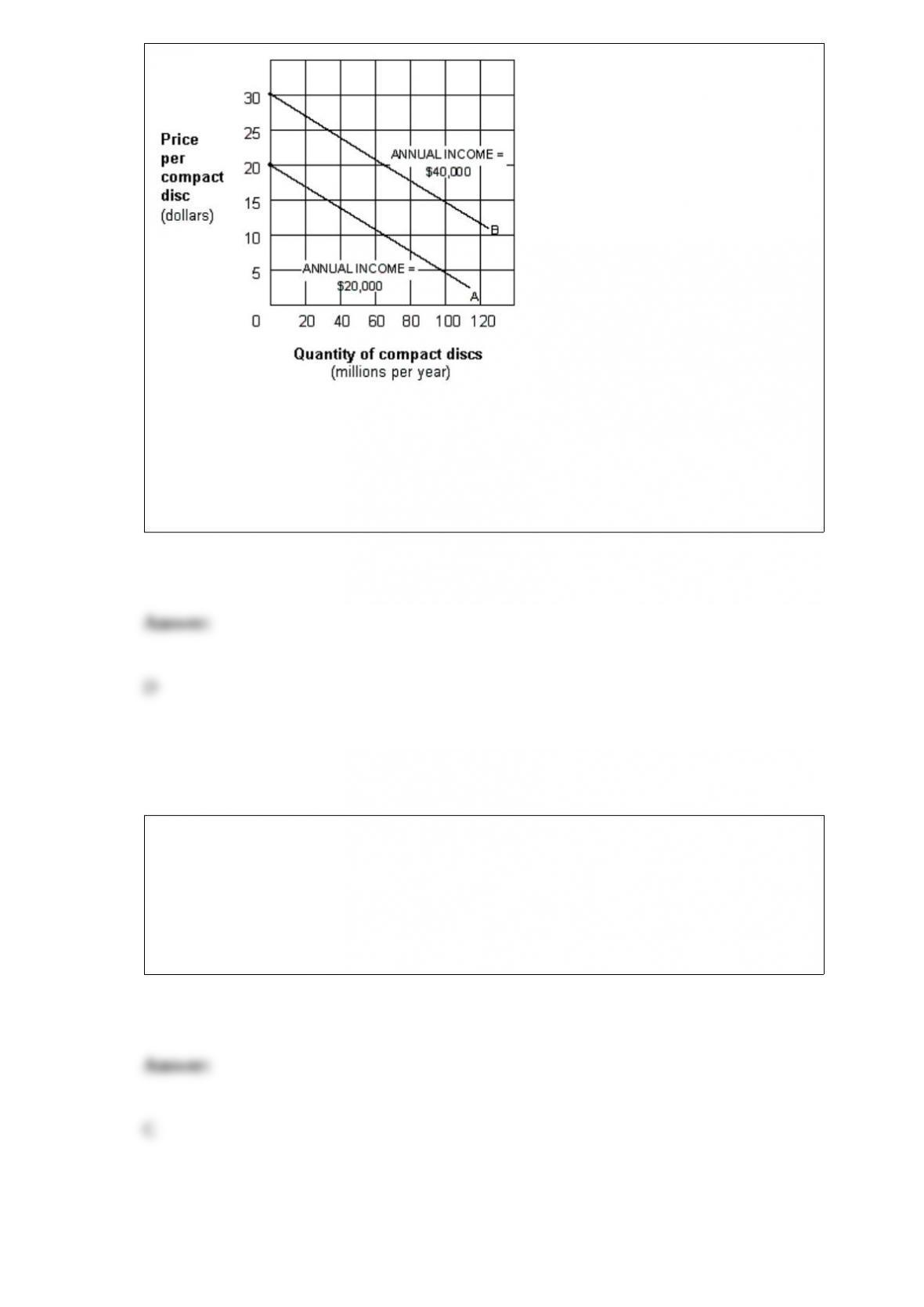
Exhibit 1A-10 represents a three-variable relationship. As the annual income of
consumers rises from $20,000 (line A) to $40,000 (line B), the result is a:
a. rightward movement along each curve.
b. leftward movement along each curve.
c. leftward shift in curve B to curve A.
d. leftward shift in curve A to curve B.
Consumers should continue to rearrange their consumption of two goods until:
a. the prices of the two goods are equal for the last dollar spent on each good.
b. marginal utility is the same for each good for the last dollar spent on each good.
c. the marginal utility per dollar’s worth of the two goods is the same for the last dollar
spent on each good.
d. the same amount of each is purchased.

If a firm increases output when MR > MC, then:
a. profit will equal zero.
b. profit will increase.
c. profit will decrease.
d. profit will remain the same.
e. the firm is minimizing losses.
Suppose a steel firm and a cookware company merge. This merger would be classified
as:
a. a horizontal merger.
b. a vertical merger.
c. a conglomerate merger.
d. either a horizontal or conglomerate merger, depending on the nationality of the
companies.
e. either a horizontal or conglomerate merger, depending on the market shares of the
two companies.
Suppose Sam buys a good for $100 at a yard sale. If consumer surplus from the sale is
$75, Sam would have been willing to pay:
a. $100. c. $25.
b. $175. d. equal to the deadweight loss.

Collusive action among producers creates higher prices for consumers because it:
a. causes overproduction and inefficiency.
b. creates negative externalities.
c. forces producers to be more competitive.
d. allows producers to artificially restrict their supply.
An import quota on a product protects domestic industries by:
a. reducing the foreign supply to the domestic market and, thereby, raising the domestic
price.
b. increasing the foreign supply to the domestic market and, thereby, lowering the
domestic price.
c. increasing the domestic demand for the product and, thereby, increasing its price.
d. providing the incentive for domestic producers to improve the efficiency of their
operation and, thereby, reduce their per-unit costs of production.
Which of the following is an example of a normative economic statement?
a. The inflation rate in the United States decreased from 4 percent last year to 3 percent
this year as a result of lower energy prices.
b. The economy grew at an annual rate of 5 percent during the first quarter of this year.
c. If two automobile companies merge, it is likely that the price of automobiles will rise.
d. An increase in international trade benefits some workers but hurts others.
e. The minimum wage should be increased so that low income workers can afford to
keep up with the cost of living.
If demand is price elastic, then when price decreases, total revenue:
a. decreases.
b. increases.
c. does not change.
d. is less than one.
e. is negative.
Which of the following would lead to an increase in the demand for computer software?
a. A decrease in the price of computer software.
b. A decrease in the price of personal computers.
c. An decrease in the cost of producing computer software.
d. An decrease in personal income.

Which of the following would generate positive externalities?
a. Flu vaccinations.
b. Farmers’ use of pesticides.
c. Cigarette smoking in elevators.
d. Litter left at the beach.
e. An unkept front yard.
Price elasticity remains constant along a straight-line demand curve.
Indifference curves that are closest to the origin are preferable to ones that are farther
from the origin.

A perfectly competitive industry must have a perfectly elastic long-run supply curve.
In-kind assistance programs are based on the direct transferring of goods and services to
the poor.
A monopolist will charge a lower price and produce more output than if it was
operating in a competitive market.
It’s easy for a private firm to provide a public good because of free riders.
Why are all costs really “opportunity costs”?
Karl Marx envisioned communism as an economic system that blends the best elements
of capitalism and socialism.