An example of the command-and-control approach to environmental policy is:
a. allowing individuals to sue freon producers if CFC emissions exceed a
government-set standard.
b. allowing coal producers to buy and sell permits to allow CFC emissions.
c. placing a tax on freon to reduce its use and the corresponding CFC emissions (which
contribute to the ozone hole).
d. none of these.
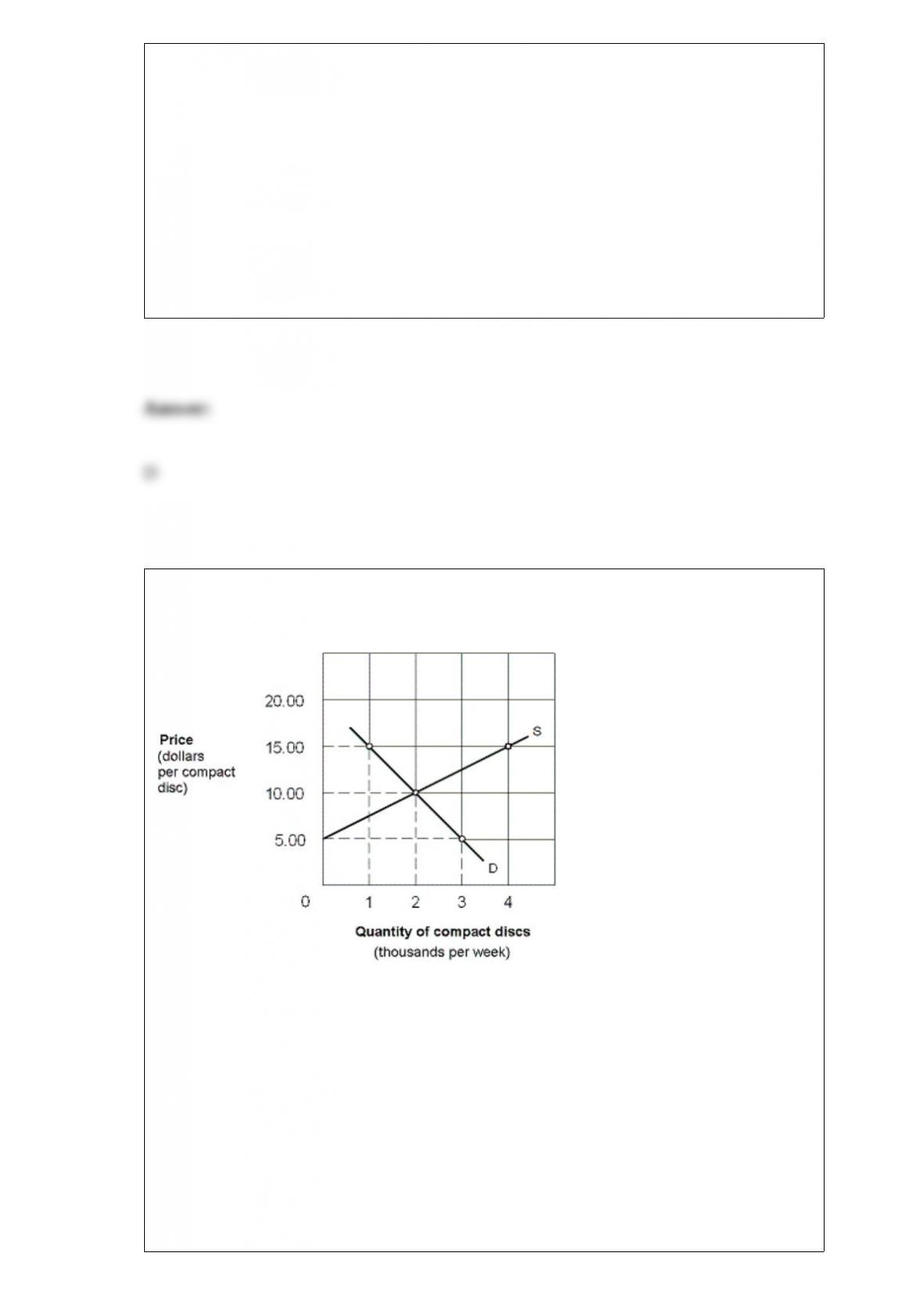
Exhibit 3-14 Supply and demand curves
In Exhibit 3-14, assume that the price of compact discs is $5 each. This price is:
a. an equilibrium price.
b. not an equilibrium price because there is an excess quantity supplied at a price of $5.
c. not an equilibrium price because there is an excess quantity demanded at a price of
$5.
d. not an equilibrium price because the quantity supplied of compact discs is greater
than the quantity demanded.

Suppose you are the manager of a local water company, and you are instructed to get
consumers to reduce their water consumption by 10 percent. If the price elasticity of
demand for water is 0.25, by how much would you have to raise the price of water?
a. 10 percent c. 40 percent
b. 25 percent d. 100 percent
A util represents a unit of measurement for the:
a. dollars a consumer spends on a good.
b. profit a firm makes from producing a good.
c. way a consumer will respond to a change in price.
d. happiness a person obtains from consuming a good.
e. way a producer will respond to a change in price.
Which of the following is a distinction between perfectly competitive and monopolistic
competition?
a. Perfectly competitive firms must compete with rival sellers; monopolistically

competitive firms do not confront rival sellers.
b. Monopolistically competitive firms can raise their price without losing sales;
perfectly competitive firms must lower their price in order to sell more of their product.
c. Perfectly competitive firms confront a perfectly elastic demand curve;
monopolistically competitive firms face a downward-sloping demand curve.
d. Perfectly competitive firms may make either economic profits or losses in the short
run, but monopolistically competitive firms always earn an economic profit.
An increase in both supply and demand causes which of the following?
a. Equilibrium price falls.
b. Equilibrium price rises.
c. Equilibrium price change is indeterminate.
d. Equilibrium quantity decreases.
e. Equilibrium quantity change is indeterminate.
Which of the following is infrastructure?
a. Highways. c. Airports.
b. Bridges. d. All of these.

Suppose that you have returned from your fishing expedition with 20,000 fish. The
market price is $3 per fish. Your average fixed cost was $1 and your total variable cost
was $5,000. If the price jumps to $3.50 before you sell your first fish, how much extra
profit, if any, do you earn?
a. $10,000.
b. $25,000.
c. $30,000.
d. $45,000.
e. $70,000.
Which of the following statements is true?
a. There is no single correct strategy for economic growth and development.
b. In general, GDP per capita is highly correlated with alternative quality of life
measures.
c. The World Bank is affiliated with the United Nations and makes long-term
low-interest loans to LDCs.
d. All of these.

A price ceiling that sets the price of a good below market equilibrium will cause:
a. An increase in quantity demanded of the good.
b. A decrease in quantity supplied of the good.
c. A shortage of the good.
d. All of these.
Price discounts to selected buyers with the intent of driving out smaller competitors is:
a. widespread in all industries.
b. common in the retailing industry only.
c. illegal under the Robinson-Patman Act.
d. allowed if the four-firm concentration ratio is less than 50 percent.
e. beneficial to consumers in the long run.
If an individual’s income increases, then the demand for a normal good will:
a. decrease.
b. increase.
c. remain constant.
d. rotate.
e. fall to zero.
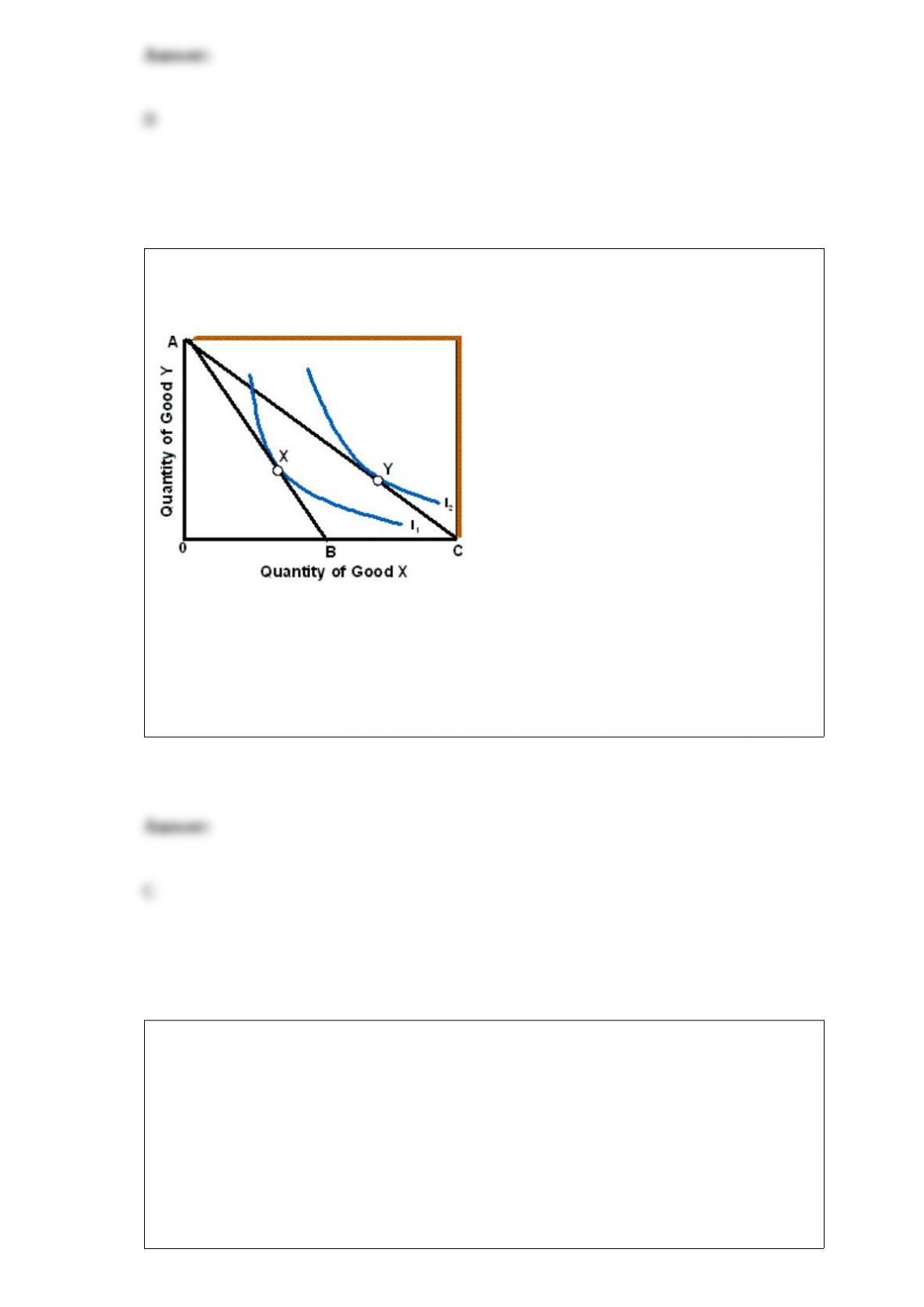
Exhibit 6A-4 Consumer Equilibrium
Given the budget lines and indifference curves shown in Exhibit 6A-4, if the budget
line shifts from AB to AC, then the:
a. price of good Y has increased.
b. price of good X has decreased.
c. price of good X has increased.
d. consumer’s budget has decreased.
A young chef is considering opening his own sushi bar. To do so, he would have to quit
his current job, which pays $20,000 a year, and take over a store building that he owns
and currently rents to his brother for $6,000 a year. His expenses at the sushi bar would
be $50,000 for food and $2,000 for gas and electricity. What are his explicit costs?
a. $26,000.
b. $66,000.
c. $78,000.
d. $52,000.
e. $72,000.
Paul Bergen and Virginia Clancy each own a 100-acre soybean farm in Soyburg,
Illinois. Together they grow 1/1000th of 1 percent of the nation’s soybeans. When they
merge, it will:
a. b and e.
b. be a horizontal merger.
c. reduce competition in the soy market.
d. increase the market power of Paul and Virginia.
e. probably go unnoticed outside of Soyburg.
Which of the following type of firm is not a price taker in the market in which the firm
buys its inputs?
a. Perfect competition.
b. Monopsony.
c. Oligopoly.
d. Monopoly.

The vicious circle of poverty refers to the fact that in LDCs,
a. low living standards lead to declines in population growth.
b. too much spending leads to periods of recession.
c. people are poor because too much is spent on capital goods.
d. there are not enough people in the under-15 age groups.
e. poverty leads to low investment in capital goods.
A cartel is:
a. a joint venture of two companies.
b. a joining of firms for the purpose of fixing prices and controlling output.
c. a breaking up of a company into two or more parts.
d. the joining of industry with government to solve a specified problem.
e. the joining of two firms with unrelated products.
The difference between a firm’s total revenues and total costs when all explicit and
implicit costs are included is the firm’s:
a. economic profit.
b. accounting profit.
c. opportunity cost of capital.
d. long-run average total cost.
When firms advertise their products, they are attempting to:
a. shift the supply curve of the product to the right.
b. shift the supply curve of the product to the left.
c. shift the demand for the product to the right.
d. shift the demand for the product to the left.
e. create a surplus of the product.
Which of the following is a game theory strategy for oligopolists to avoid a low-price
outcome?
a. Tit-for-tat c. Last in-first out
b. Win-win d. Second best
An increase in the cost of chicken feed will reduce the supply of eggs.
The income effect is the concept that changes in consumption of a good result from
changes in purchasing power.
A traditional system solves basic economic questions by long-standing customs.
Investment is an economic term for the act of increasing the stock of money available
for business loans.

Discrimination raises the average wage of members of one group of workers in spite of
laws that require equal pay for all workers.
An argument in favor of price discrimination is that this pricing strategy permits some
consumers who otherwise would be excluded from a market to buy a good or service.
An economic justification for government providing public goods and services is that
many people can benefit regardless of whether they pay or not.
Other things being equal, an increase in the price of gasoline will decrease the quantity
demanded for gasoline.