
The horizontal summation of individual demand curves gives:
a. a supply curve.
b. a Phillips curve.
c. a market demand curve.
d. the quantity supplied.
e. a production function.
If the minimum points of all the possible short-run average total cost curves become
successively lower as quantity of output increases, then:
a. the firm should try to produce less output.
b. total fixed costs are constant along the LRAC curve.
c. there are economies of scale.
d. the firm is probably having significant management problems.
e. when output is doubled, total costs are doubled.
If Pete raises his price of muffins from $2 to $3 and his sales revenue increases from
$35,000 to $38,000, then:
a. the demand for Pete’s muffins in this range is price elastic.
b. the demand for Pete’s muffins in this range is price inelastic.
c. the demand for Pete’s muffins in this range is unit elastic.
d. the percentage change in quantity demanded must exceed the percentage change in
product price.
e. this is impossible since this would violate the law of demand.

Which of the following will cause a movement upward along a supply curve?
a. Increases in raw-material costs.
b. Increases in labor costs.
c. Increases in the cost of machinery.
d. Increases in the market price of a good, other things being equal.
Which phrase(s) is (are) associated with normative statements?
a. c and e.
b. Has been shown.
c. Should be.
d. Can be.
e. More than.
Exhibit 4-10 Supply and demand data for apricots

In Exhibit 4-10, the equilibrium price is:
a. $1. c. $3.
b. $2. d. $4.
The equilibrium price is best defined as the price at which:
a. demand is smaller than supply.
b. suppliers want to supply more goods.
c. demanders want to buy more goods.
d. quantity demanded is equal to quantity supplied.
e. the quantity demanded increases.
Which of the following is one common criticism of capitalism?

a. Poor product quality and little product diversity.
b. Inefficiency of nationalized industries.
c. Inability to adjust quickly to changing economic conditions.
d. Inadequate environmental protection.
When the Lorenz curve moves closer to the diagonal, this shows:
a. the rich getting richer and the poor getting poorer.
b. total income is rising.
c. the distribution of income is becoming more even.
d. the population is decreasing.
e. the prices of goods are rising.
Which of the following statements is true with respect to a tariff on imported cheese?
a. It lowers the price of cheese.
b. It lowers domestic cheese producers’ profits.
c. It creates tax revenues for the government.
d. It cannot result in retaliation.
e. It increases the amount of foreign cheese sold.

Exhibit 15-4 Coffee and tea output (pounds per hour)
As shown in Exhibit 15-4, the opportunity cost to Brazil of producing one pound of
coffee is:
a. 1 pound of tea. c. 1/2 pound of tea.
b. 5 pounds of tea. d. 10 pounds of tea.
The ability of an economy to produce greater levels of output in the same period of time
is called:
a. positive economics.
b. negative economics.
c. economic growth.
d. marginal productivity.
A firm is currently operating where the MC of the last unit produced = $64, and the MR
of this unit = $70. What would you advise this firm to do?
a. Shut down.
b. Increase output.
c. Stay at current output.
d. Decrease output.
e. Decrease price.
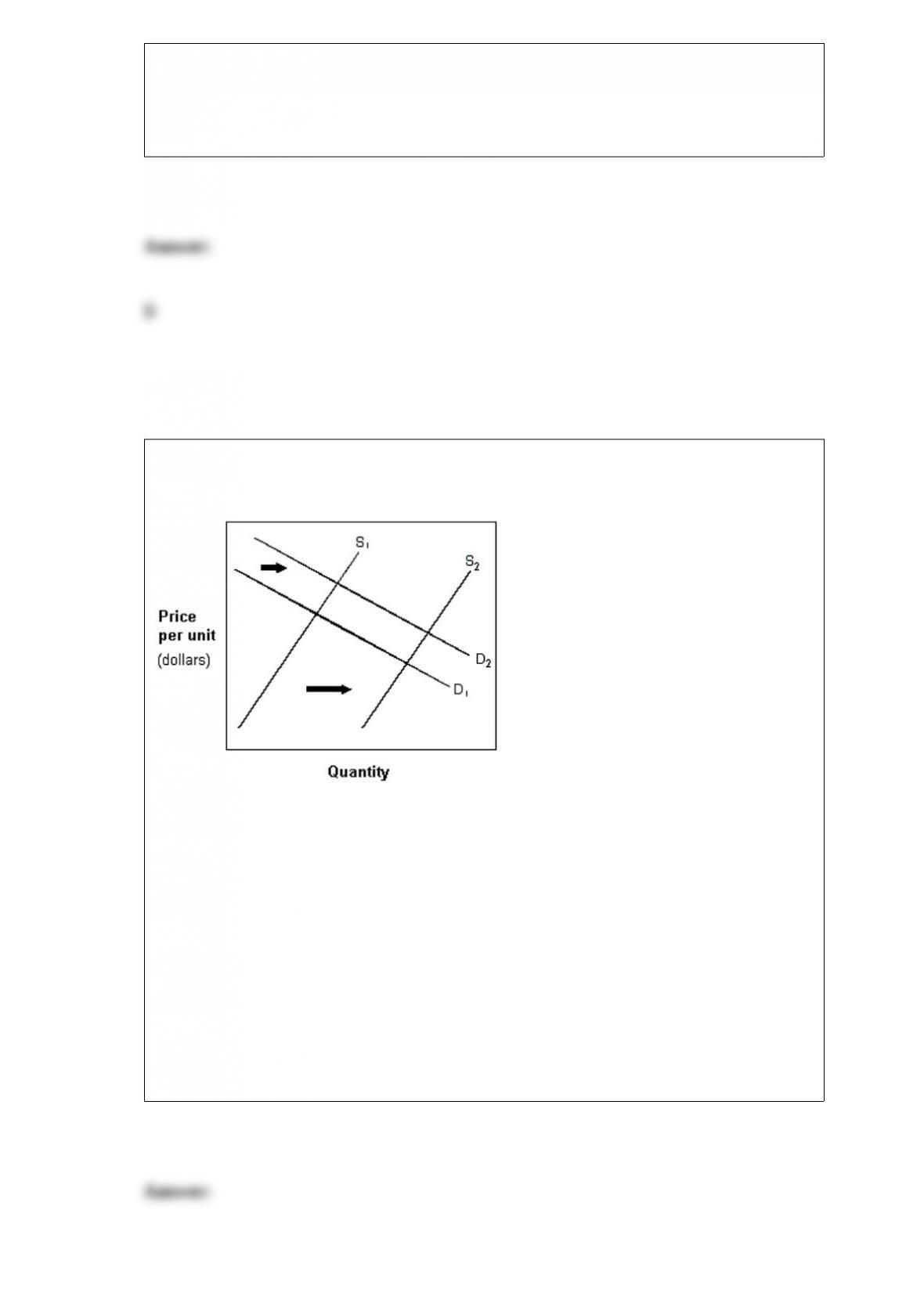
Exhibit 4-6 Demand and supply curves
If the market demand and supply curves shift as given in Exhibit 4-6, the resulting new
equilibrium will show a(n):
a. increase in market price and a decrease in the quantity exchanged.
b. decrease in market price and a decrease in the quantity exchanged.
c. increase in market price and an increase in the quantity exchanged.
d. decrease in market price and an increase in the quantity exchanged.
e. decrease in market price and no change in the quantity exchanged.
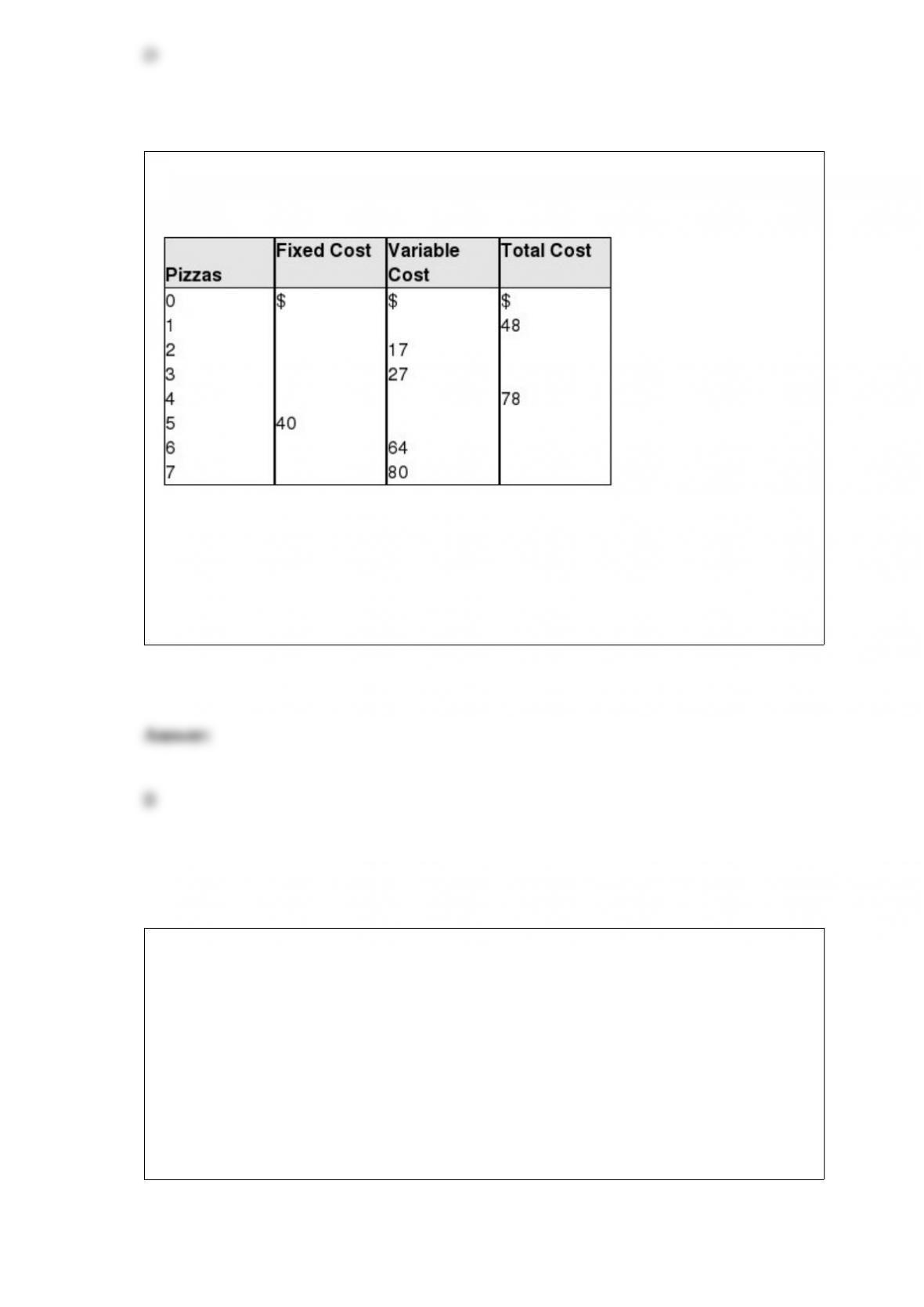
Exhibit 7-12 Cost schedule for producing pizza
By filling in the blanks in Exhibit 7-12, the AVC of 4 pizzas is shown to be equal to:
a. $10.
b. $9.50.
c. $19.50.
d. $40.
e. $78.
Which of the following would raise both the equilibrium price and the equilibrium
quantity of strawberries?
a. A decrease in the demand for strawberries.
b. An increase in the demand for strawberries.
c. A decrease in the supply of strawberries.
d. An increase in the supply of strawberries.

The law of demand refers to the:
a. tendency of prices to increase as more units of a product are demanded.
b. increase in price that results from an increase in demand for a good with a limited
supply.
c. inverse relationship between the price of a good and the quantity of the good
demanded.
d. increase in the quantity of a good available as the price of the good increases.
Which of the following offers the fullest explanation of why ‘price equals marginal cost’
is the rule from marginal analysis that indicates the profit-maximizing output level?
a. If output were reduced from the profit-maximizing level, then the firm would be
giving up marginal revenue that exceeds marginal cost, and thus reducing the level of
profit.
b. If output were increased from the profit-maximizing level, then the firm would be
gaining marginal revenue that is less than the marginal cost incurred in producing this
additional unit, and thus reducing the level of profit.
c. Because the firm colludes with other similar firms to set price equal to marginal cost.
d. Both a. and b. above are correct.
Which of the following is a key characteristic of the long-run competitive equilibrium

that distinguishes it from the short-run competitive equilibrium?
a. Free entry to reduce short-run profits, or free exit to reduce short-run losses.
b. Economic profits are positive, but cannot be negative.
c. Marginal revenue is greater than marginal cost.
d. Average revenue is less than average cost.
A favorable balance of trade occurs when:
a. goods exports are greater than goods imports.
b. goods imports are greater than goods exports.
c. international trade is an increasing share of total output.
d. the balance on capital account equals the balance on current account.
e. unilateral transfers are positive.
A group of firms that collude to limit competition is called a(n):
a. conglomerate.
b. oligopoly.
c. cartel.
d. kinked demand.
e. market concentration.

According to the law of demand, if the price of a good increases, other things being
equal, the quantity demanded will decrease.
Water is plentiful in most of the world, so its price and total utility are low.
The per se rule was applied in the Alcoa case.
Interlocking directorates are illegal under the Clayton Act only when their effect is to
lessen competition substantially.

The two theoretical extremes of the market structure spectrum are occupied at one end
by perfect competition and on the other end by monopoly.
As one moves down and along a budget line, its slope decreases.
Total GDP is the best way to identify a less-developed country