
When economists say the quantity supplied of a product has decreased, they mean the:
a. supply curve has shifted to the left.
b. supply curve has shifted to the right.
c. price of the product has risen, and consequently, suppliers are producing more of it.
d. price of the product has fallen, and consequently, suppliers are producing less of it.
Price floors are used as a method to:
a. ensure buyers that goods won’t be cheaper tomorrow.
b. see that production levels don’t fall too low.
c. guarantee there will be enough food for everyone.
d. combat excess demand in the market.
e. ensure sellers a minimum price for their goods.
A nation’s infrastructure includes all of the following except its:
a. market system.
b. educational system.
c. energy system.
d. railroad system.
e. religious system.
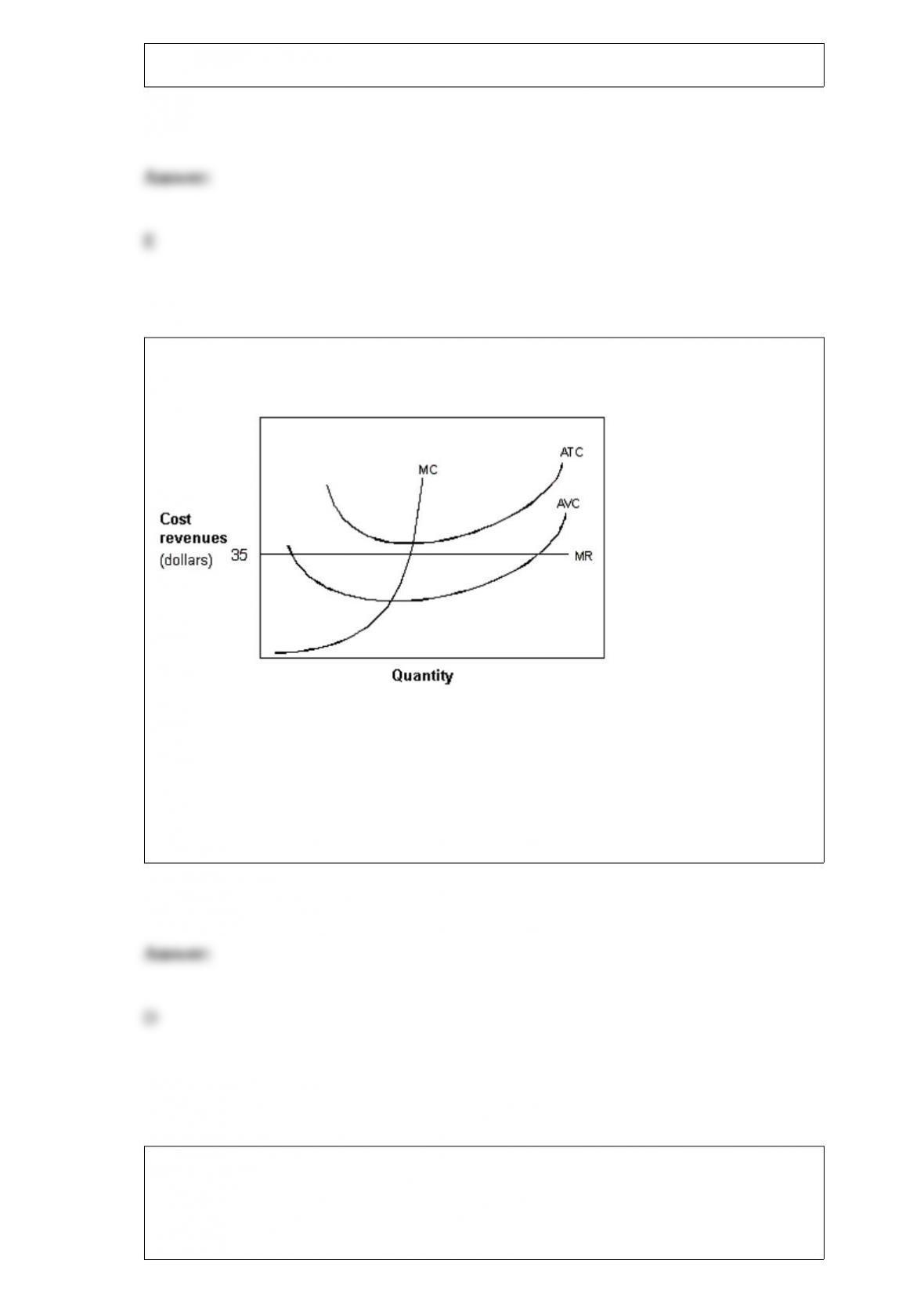
Exhibit 8-8 A firm’s cost and marginal revenue curves
In Exhibit 8-8, product price in this market is fixed at $35. This firm is currently
operating where MR = MC. What do you advise this firm to do?
a. This firm should shut down.
b. This firm could increase profits by increasing output.
c. This firm could increase profits by decreasing output.
d. This firm should continue to operate at its current output.
e. This firm should decrease price.
Three basic decisions must be made by all economies. What are they?
a. How much will be produced, when it will be produced, and how much it will cost.

b. What the price of each good will be, who will produce each good, and who will
consume each good.
c. What will be produced, how goods will be produced, and for whom goods will be
produced.
d. How the opportunity cost principle will be applied, if and how the law of
comparative advantage will be utilized, and whether the production possibilities
constraint will apply.
In the United States, approximately what percentage of the total income is earned by the
highest 5 percent of the families?
a. 10 percent.
b. 20 percent.
c. 30 percent.
d. 40 percent.
Which of the following is not an example of a factor of production?
a. A forest. c. A labor leader.
b. A computer program. d. Dollars.

If the value of the price elasticity of demand is 0.2, this means that:
a. a 20 percent decrease in price causes a 1 percent increase in quantity demanded.
b. a 0.2 percent decrease in price causes a 1 percent increase in quantity demanded.
c. a 5 percent decrease in price causes a 1 percent increase in quantity demanded.
d. a 0.2 percent decrease in price causes a 0.2 percent increase in quantity demanded.
e. a 100 percent decrease in price causes a 200 percent increase in quantity demanded.
If people buy less chewing gum at every price when their incomes fall, then:
a. chewing gum is a normal good.
b. the demand for chewing gum is positively sloped.
c. demand for chewing gum has increased.
d. the price of chewing gum has increased.
e. there has been a decrease in population that changed demand.
Proponents of a command economy argue that it promotes:
a. efficiency. c. consumer sovereignty.
b. equity. d. economic growth.

“Dividing the economic pie more equally may reduce the size of the economic pie.”
This argument is characterized as:
a. untrue.
b. a form of discrimination.
c. a conflict between equity and efficiency.
d. a conflict between full employment and economic growth.
e. b and c.
Under the Clayton Act, which of the following was illegal, even if it was not shown to
lessen competition substantially?
a. Price discrimination.
b. Tying contract.
c. Horizontal mergers by stock acquisition.
d. Interlocking directorates.
Externalities get their name from the fact that they are:
a. b and d.
b. unintended.

c. short lived.
d. outside of decisions.
e. outside of marketplace.
If a regulatory commission sets the regulated price equal to marginal cost for a natural
monopoly:
a. losses will result.
b. government subsidies will be unnecessary.
c. the firm will earn economic profits.
d. new firms will want to enter.
e. resource use will not be optimal.
Exhibit 7-17 Long-run average cost curve
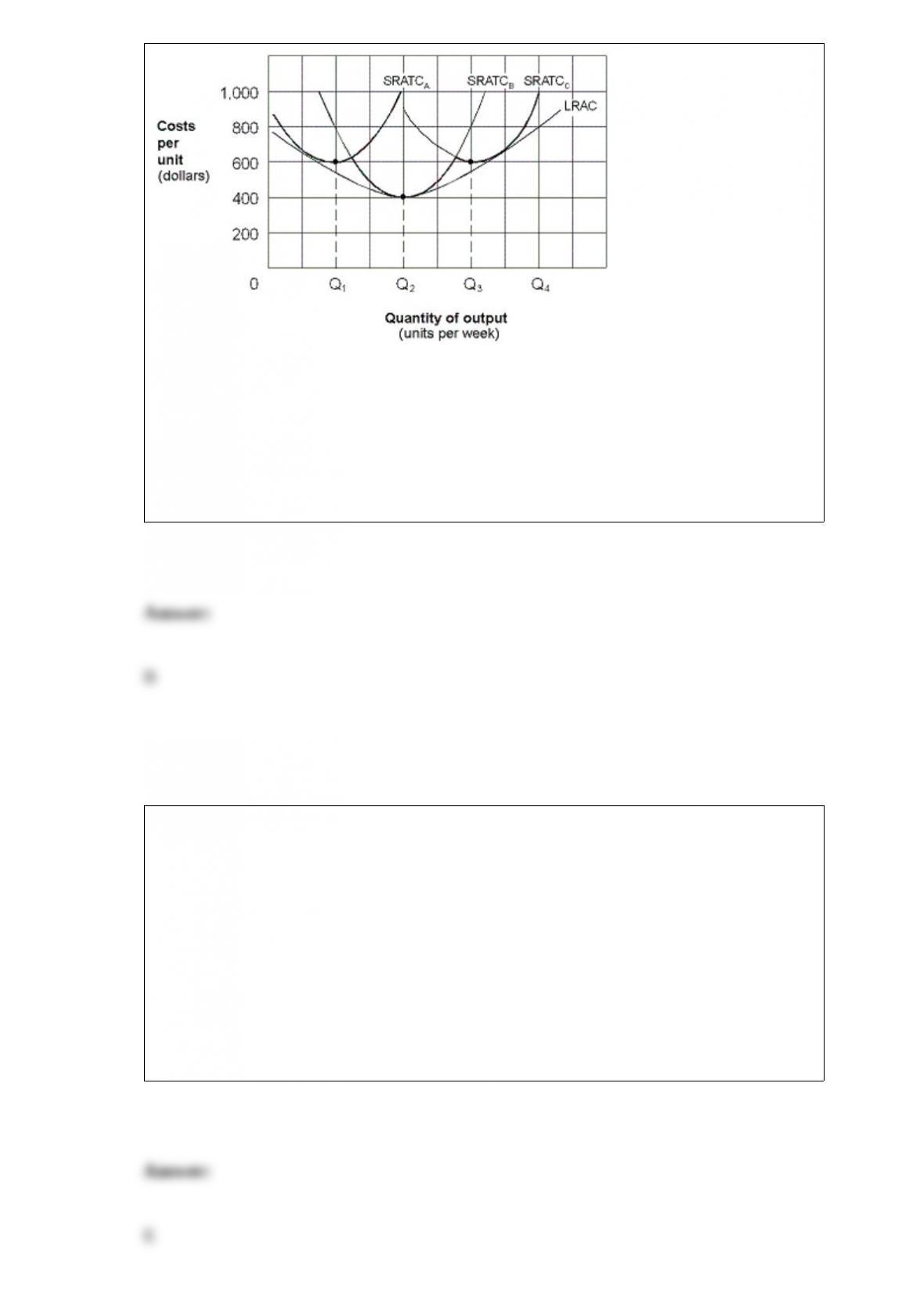
In Exhibit 7-17, short-run average total cost, short-run marginal cost, and long-run
average cost are all equal at which level of output per week?
a. Q1 units.
b. Q2 units.
c. Q3units.
d. Q4 units.
Which of the following is correct?
a. Economic development is more quantitative than economic growth.
b. A country cannot achieve economic growth with a limited base of natural resources.
c. Infrastructure is capital provided by the private sector.
d. All of the above are true.
e. All of the above are false.

In the former Soviet economy, the supreme planning board that transmitted economic
decisions down to producing and consuming units was called the:
a. Soviet Ministry.
b. Polit Bureau.
c. Gosplan.
d. Soviet Central Committee for Economic Planning.
Explain why wage rates might rise at Joe’s Quik-Print Shop if Joe replaces his aging
copy machines with state-of-the-art copy machines.
When the official price for goods and services is below the equilibrium price in a
market, prices no longer perform their rationing function efficiently.

The Sherman Antitrust Act was an amendment to the Clayton Act.
In the long run, a competitive firm will earn zero economic profit.
The monopolist faces the market demand curve.
In long-run equilibrium, a perfectly competitive firm’s short-run marginal cost curve
crosses the long-run average cost curve at the lowest point on the long-run average cost
curve.

Each short-run average total cost curve is tangent at its lowest point to the long-run
average cost curve.
Critics of an equal distribution of income argue that the effect would be to reduce the
incentive to be productive.
If the income elasticity of demand for a good is positive, the good is a normal good.
The monopolistic competition market structure is characterized by a few large firms

which account for a large percentage of industry sales.