Suppose there are two countries, X and Y. If the exchange rate, as measured in X’s
currency, is currently 9, what do citizens of the nation of Y see when they read their
newspapers?
a. The exchange rate for X’s currency is 9.
b. The exchange rate for X’s currency is more than 9.
c. The exchange rate for X’s currency is 3.
d. The exchange rate for X’s currency is 0.11.
e. Knowing one exchange rate does not mean we can tell the other exchange rate.
When an inverse relationship is graphed, the resulting line or curve is:
a. horizontal. c. upward-sloping.
b. vertical. d. downward-sloping.
In order to achieve social efficiency, the size of an effluent tax should be based on:
a. the external cost created by the pollutant.
b. people’s willingness to pay for a cleaner environment.
c. the expense of installing new “green” equipment.
d. the number of free riders in the industry.
Which of the following pairs of goods would be considered substitutes?
a. Milk and cookies.
b. Tires and automobiles.
c. Ink and pens.
d. Coca-Cola and Pepsi.
e. Computers and computer software.
An industrially advanced country (IAC) is defined as a country with a GDP per capita
among the top ____ countries in the world.
a. 5 c. 20
b. 10 d. 27
In the presence of positive externalities, a free market will choose a price which is too
____ and produce an output which is too ____ compared with the social optimum.
a. high; low
b. low; low
c. high; high
d. low; high
e. marginal; inequitable
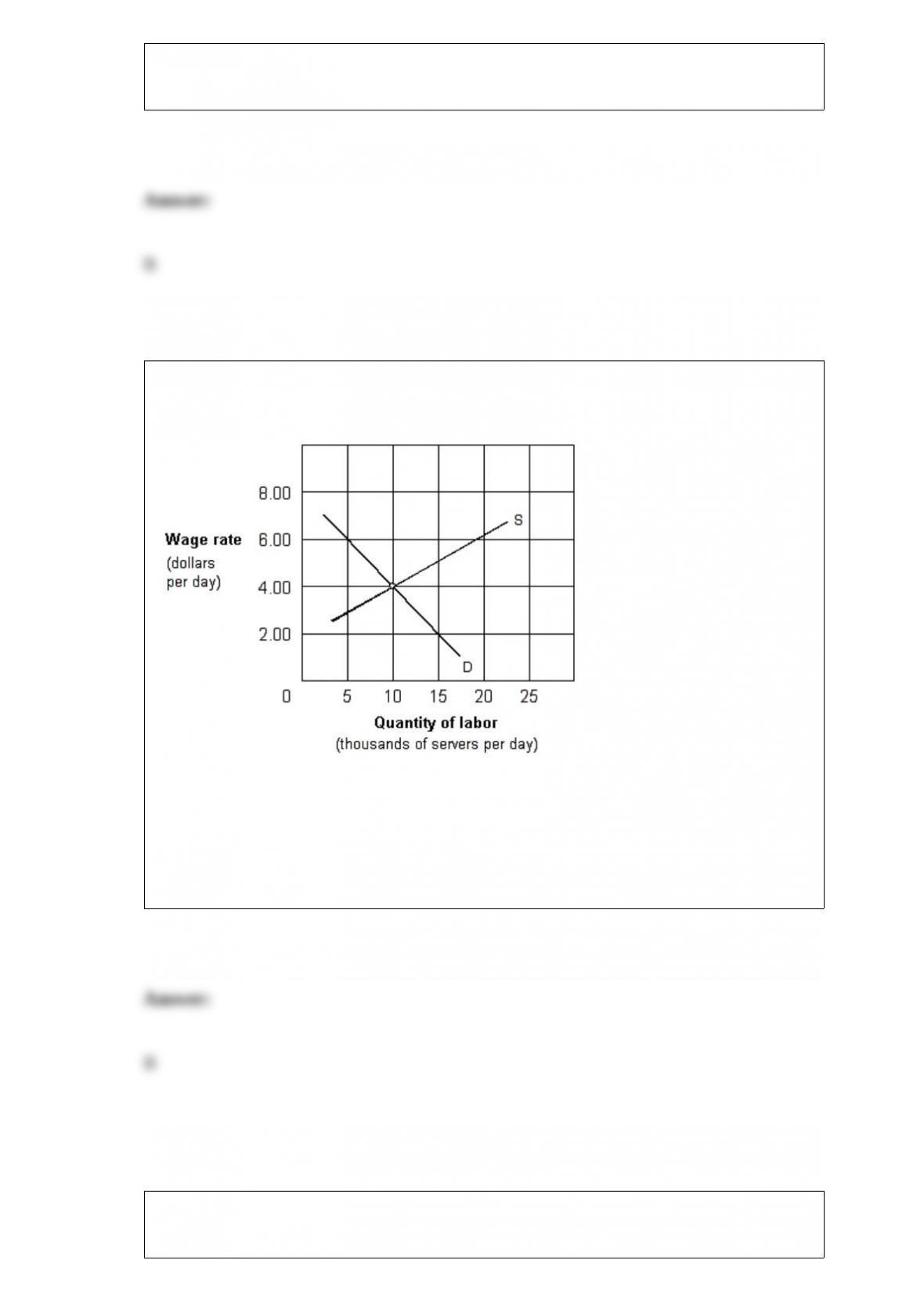
Exhibit 11-4 Supply and demand curves for food servers
In Exhibit 11-4, the equilibrium wage and the number of food servers employed per
day, respectively, are:
a. $2.00 and 5,000.
b. $4.00 and 10,000.
c. $6.00 and 15,000
d. $8.00 and 20,000.
In differentiating between the short- and long-run elasticities, when economists talk
about short-run elasticities,
a. b and c.
b. there is no need to mention short versus long run.
c. the only issues are price and quantity.
d. short-run elasticities are usually higher.
e. short-run elasticities are usually lower.
A cost or benefit of a good imposed on people other than the consumers or producer of
a good is called a(n):
a. public good. c. private good.
b. merit good. d. externality.
Deadweight loss is not the result of:
a. an efficient market. c. zero consumer surplus.
b. an inefficient market. d. zero producer surplus.

If the price of potato chips increases, other things constant, demand for potato-chip dip
will:
a. not change; only quantity demanded will change.
b. increase, because the goods are substitutes.
c. decrease, because the goods are substitutes.
d. decrease, because the goods are complements.
e. increase, because the goods are complements.
If I buy 3 cups of coffee, paying $1 for each cup, and I would have been willing to pay
up to $3 for the first cup, up to $2 for the second cup, and up to $1 for the third cup,
then my consumer surplus is:
a. $6.
b. $5.
c. $3.
d. $2.
e. $1.
Adding more resources causes:
a. downward movement along a production possibilities curve.
b. the production possibilities curve to shift in.
c. upward movement along a production possibilities curve.
d. the production possibilities curve to shift out.
e. the production possibilities curve to become positively sloped.
An efficient economy:
a. uses available resources fully.
b. uses the best division of labor.
c. produces an output combination at some point along the production possibility curve.
d. all of these.
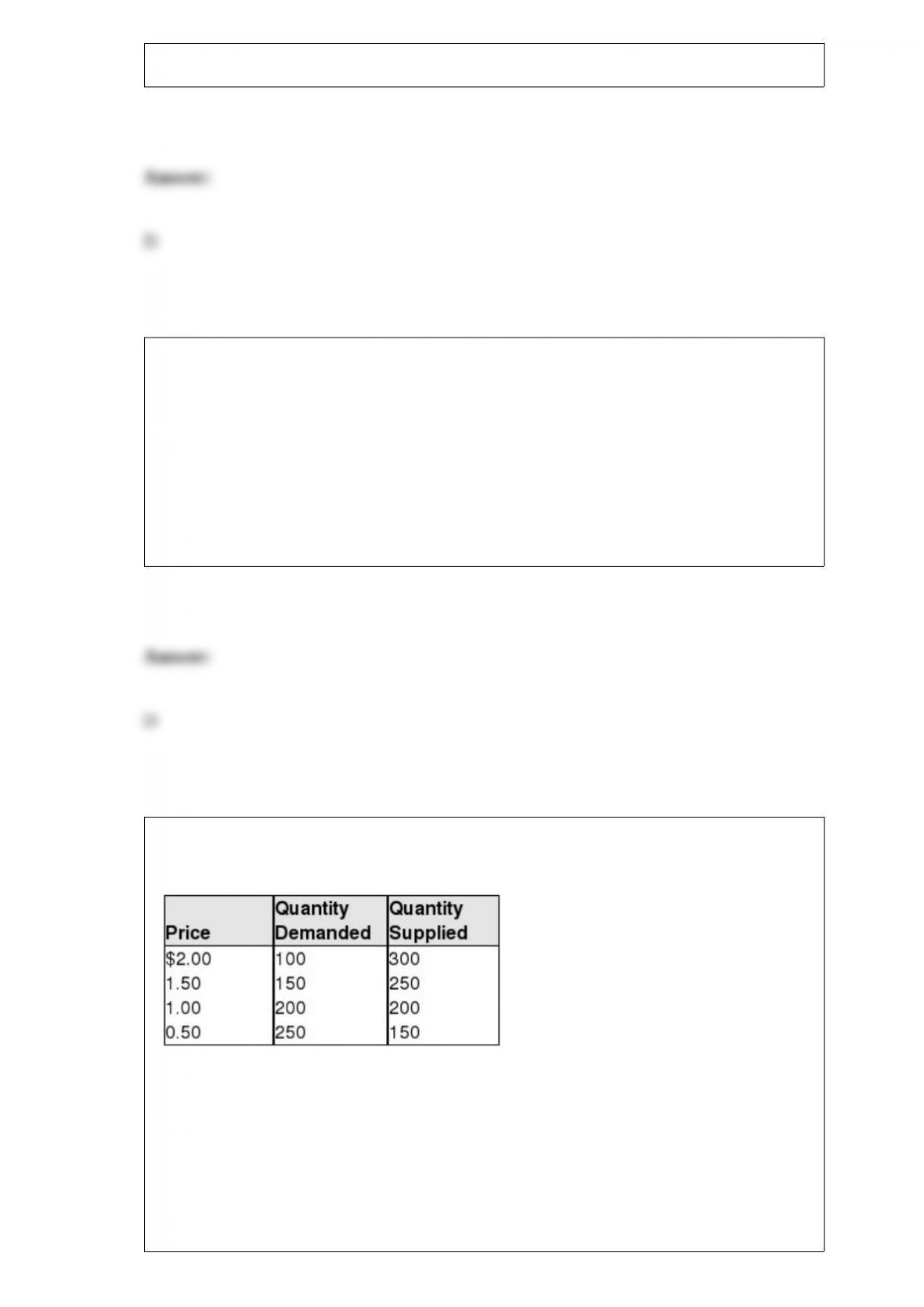
Exhibit 4-9 Data on supply and demand
In Exhibit 4-9, which of the following would occur at a price of $2.00?
a. Inventories would put upward pressure on price.
b. Quantity demanded exceeds quantity supplied, putting downward pressure on price.
c. Inventories would put downward pressure on price.

d. The surplus would be so small that there would be only slight downward pressure on
price.
GATT stands for:
a. Good and Total Trade.
b. General Agreement on Tariffs and Trade.
c. Greater Agreements Toward Trade.
d. Gold and Trade Totals.
e. Greater Area Trade Transactions.
Dana is an art historian who needs to travel to Italy to do research. Art historians
usually don’t have a lot of money, and therefore are very sensitive to price changes.
Dana’s funding agency pays her a fixed amount to travel. At current exchange rates,
Dana can stay in Italy for 35 days. If the exchange rate improves by 10 percent, she can
stay for 40 days. What is Dana’s price elasticity of demand for days spent in Italy?
a. It is approximately equal to 2.3.
b. It is approximately equal to 1.6.
c. It is approximately equal to 1.4.
d. It is approximately equal to 0.4.
e. It is approximately equal to 0.1.

Which of the following is most likely to be true of economic and accounting profits?
a. Economic profits are less than accounting profits.
b. Accounting profits are less than economic profits.
c. Economic profits plus accounting profits equal zero.
d. Accounting profits minus economic profits equal zero.
When the government imposes a price ceiling on a good whose price is too high,
a. surpluses are created.
b. supply will increase to meet the demand.
c. rationing is not necessary.
d. quantity demanded of the good will fall.
e. chronic excess demand occurs.
Exhibit 8-11 A firm’s cost and marginal revenue curves
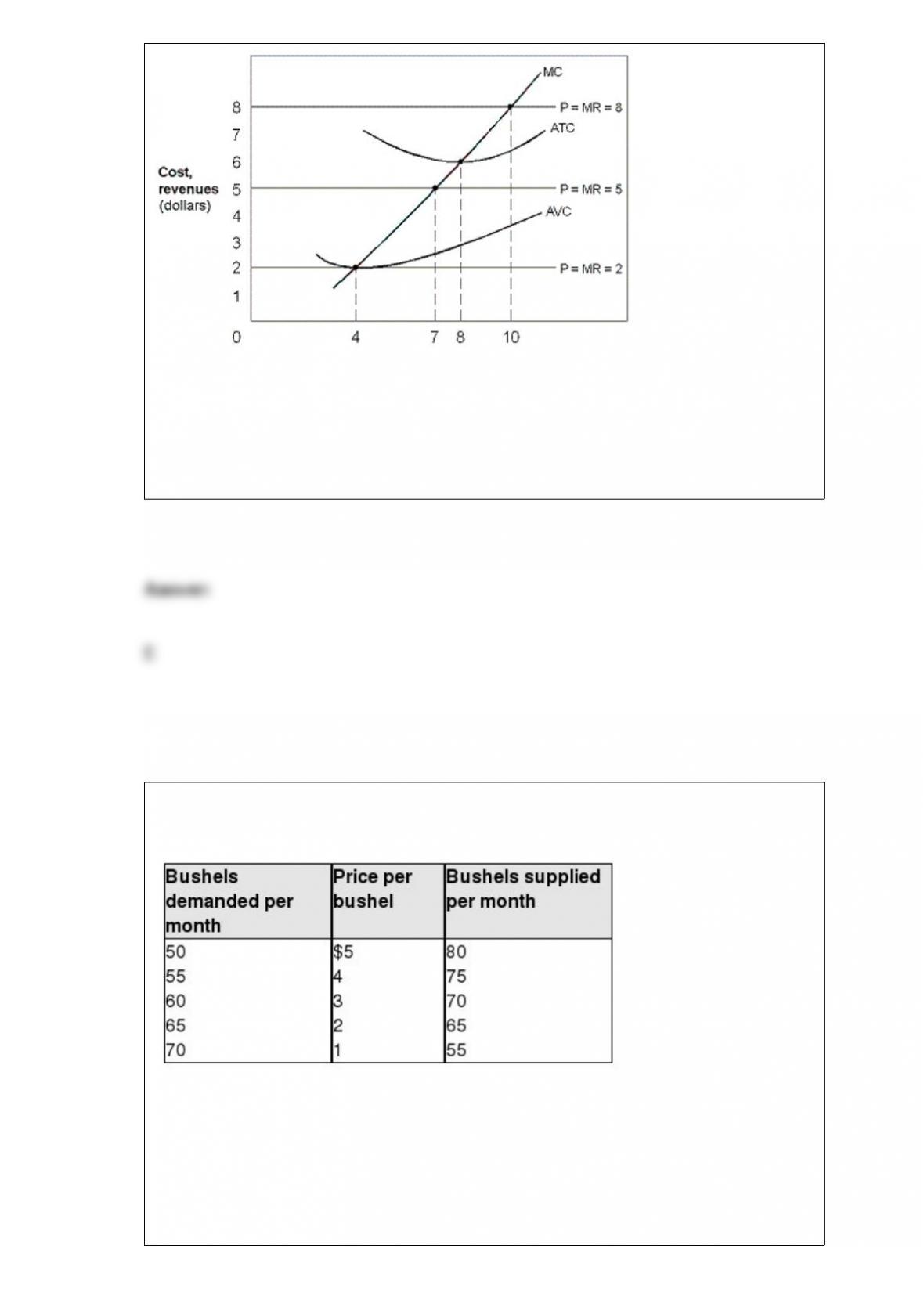
In Exhibit 8-11, when the price is $5, the firm:
a. is making an economic profit of $21.
b. should produce output equal to 10.
c. is breaking even.
d. should shut down.
e. should produce output equal to 7.
Exhibit 4-10 Supply and demand data for apricots
In Exhibit 4-10, assume that the government initially sets a price floor of $4 for
apricots, and then removes the $4 price floor. What effect will this price change have?
a. The price of apricots will rise.
b. The quantity of apricots demanded will fall.

c. The quantity of apricots supplied will decline.
d. Quantity supplied will continue to exceed quantity demanded.
Suppose that Spain has a comparative advantage in hats and Portugal has a comparative
advantage in doormats. Under a system of free trade, each country specializes and then
trades with the other. If the price starts at four hats per doormat, and then increases to
five hats per doormat, then:
a. people in Portugal will not want to buy as many hats.
b. Spain no longer has a comparative advantage in hats.
c. Portugal is flooding the market with too many doormats.
d. some of the gains from trade shift to Portugal.
e. some of the gains from trade shift to Spain.