
Assuming that soybeans and tobacco can both be grown on the same land, a decrease in
the price of tobacco, other things being equal, causes a(n):
a. rightward shift of the supply curve for tobacco.
b. upward movement along the supply curve for soybeans.
c. rightward shift in the supply curve for soybeans.
d. leftward shift in the supply curve for soybeans.
The socially efficient level of output is determined where:
a. marginal social cost equals marginal social benefit.
b. marginal private cost equals marginal social benefit.
c. average social cost equals average social benefit.
d. average private cost equals average social benefit.
A strong U.S. dollar is one that has:
a. c and e.
b. d and e.
c. depreciated.
d. appreciated.
e. helped U.S. exporters.
The Federal Trade Commission is charged with:
a. supervising cartels in the United States.
b. aiding small business in contract negotiations with foreign companies.
c. investigating unfair and deceptive trade practices.
d. approving contracts between businesses and government.
e. bringing criminal complaints.
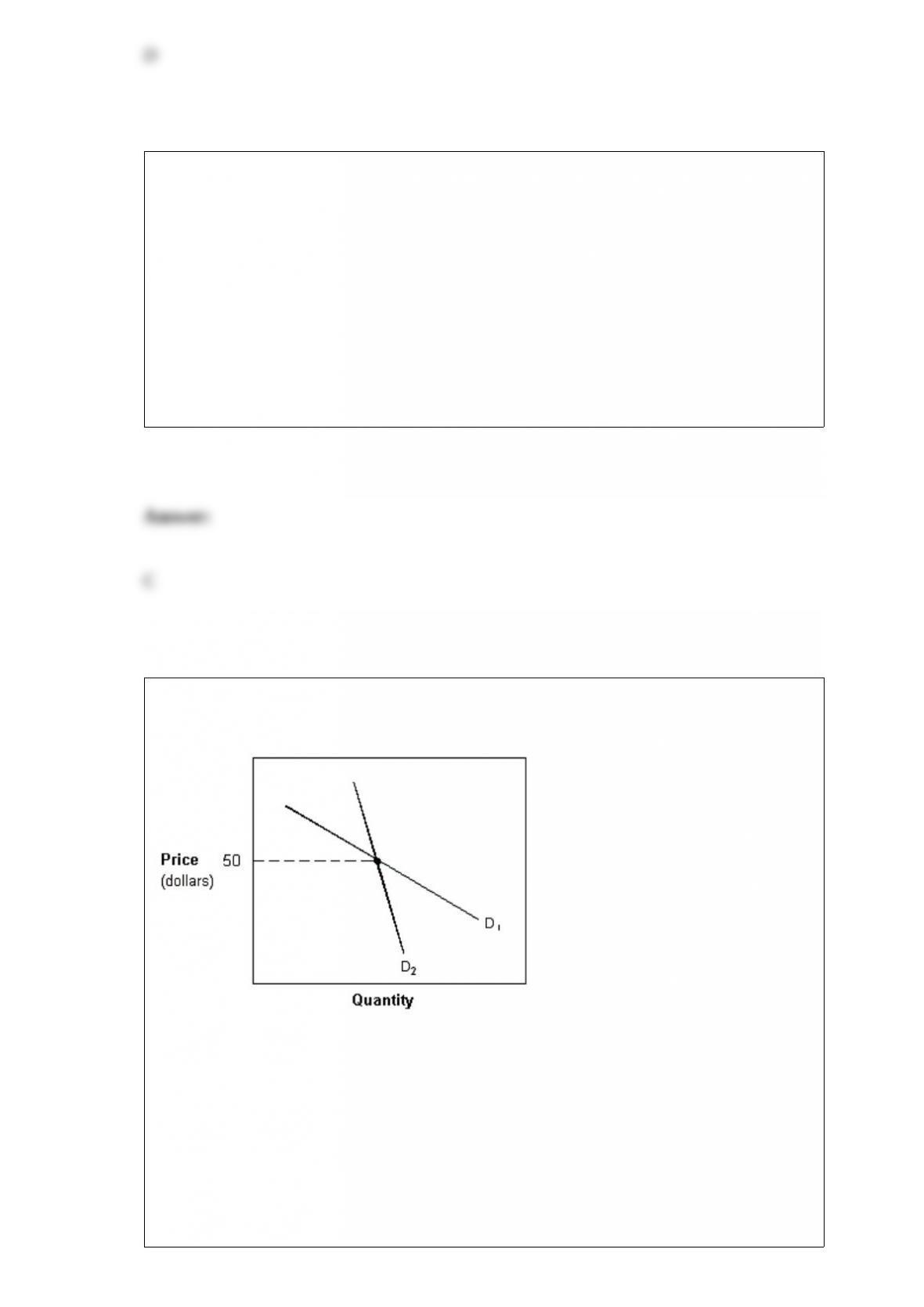
Exhibit 10-4 Kinked demand curves
In Exhibit 10-4, the exhibit represents a kinked-demand oligopoly model. Suppose the
current price is $50. If one firm in the oligopoly now attempts to raise price, all firms
will:
a. follow along demand curve D1.
b. follow along demand curve D2.

c. ignore this price increase and cause the price-raising firm to move along D1.
d. ignore this price increase and cause the price-raising firm to move along D2.
e. lower their prices.
The Lorenz curve shows the:
a. growth of income over time compared to potential growth of income.
b. relative percentage of income going to each of the resources.
c. demand for unskilled versus unskilled labor.
d. actual cumulative percentage of income received compared to a perfectly equal
cumulative percentages of income.
Which of the following would be a private cost to a cigarette manufacturer?
a. Price of leaf tobacco.
b. Cost to the government of the hospital expenses of indigent smokers.
c. Increased risk of cancer to the nonsmoking passengers in the smoker’s carpool.
d. Price of a pack of cigarettes.
e. The loss in utility received because the smoker must stand outside her office building
in the winter to smoke.

If the equilibrium price of aspirins is $2.50 and a price ceiling is imposed at $3.00, the
eventual result after market adjustment will be a(n):
a. surplus. c. accumulation of inventories.
b. shortage. d. equilibrium.
The ozone layer:
a. protects us from ultraviolet rays which can cause cancer and blindness.
b. has been damaged as a result of the Montreal Protocol.
c. has been damaged as a result of the ban on CFCs.
d. is another term for the greenhouse effect.
The total utilities associated with the first 5 units of consumption of good X are 15, 30,
40, 47, and 50, respectively. What is the marginal utility associated with the third unit?
a. 15.
b. 70.
c. 85.

d. 10.
e. 45.
Assume that a computer is a normal good. An increase in consumer income, other
things being equal, would:
a. cause an upward movement along the demand curve for computers.
b. cause a downward movement along the demand curve for computers.
c. shift the demand curve for computers to the left.
d. shift the demand curve for computers to the right.
Bill lives in Montana and likes to grow zucchini. He applies fertilizer to his crops twice
during the growing season and notices that the second layer of fertilizer increases his
crop, but not as much as the first layer. What economic concept best explains this
observation?
a. The law of diminishing marginal utility.
b. The law of diminishing returns.
c. Return equalization principle.
d. The principal-agent problem.

Cindy discovers that when she goes to the beach, she does not have to bring her radio.
She can put her blanket near someone who has a radio and listen all day (without
having to carry her radio, get sand in her speakers, or buy new batteries). This is an
example of:
a. private property abuse. c. a negative externality.
b. external costs. d. a positive externality.
A principal feature of a command economy is that ____________.
a. production decisions are made by profit-maximizing firms.
b. there is a central planning board at the top, which transmits economic decisions down
to the various producing and consuming units below.
c. consumers are allowed to determine that is produced based on their demand for
goods and services.
d. regulatory agencies constrain the most egregious forms of market power in a market
system of allocation.
Exhibit 11-1
Use the information in the accompanying chart to answer the following question(s). The
firm hires labor competitively and sells its product in a competitive price-taker market.
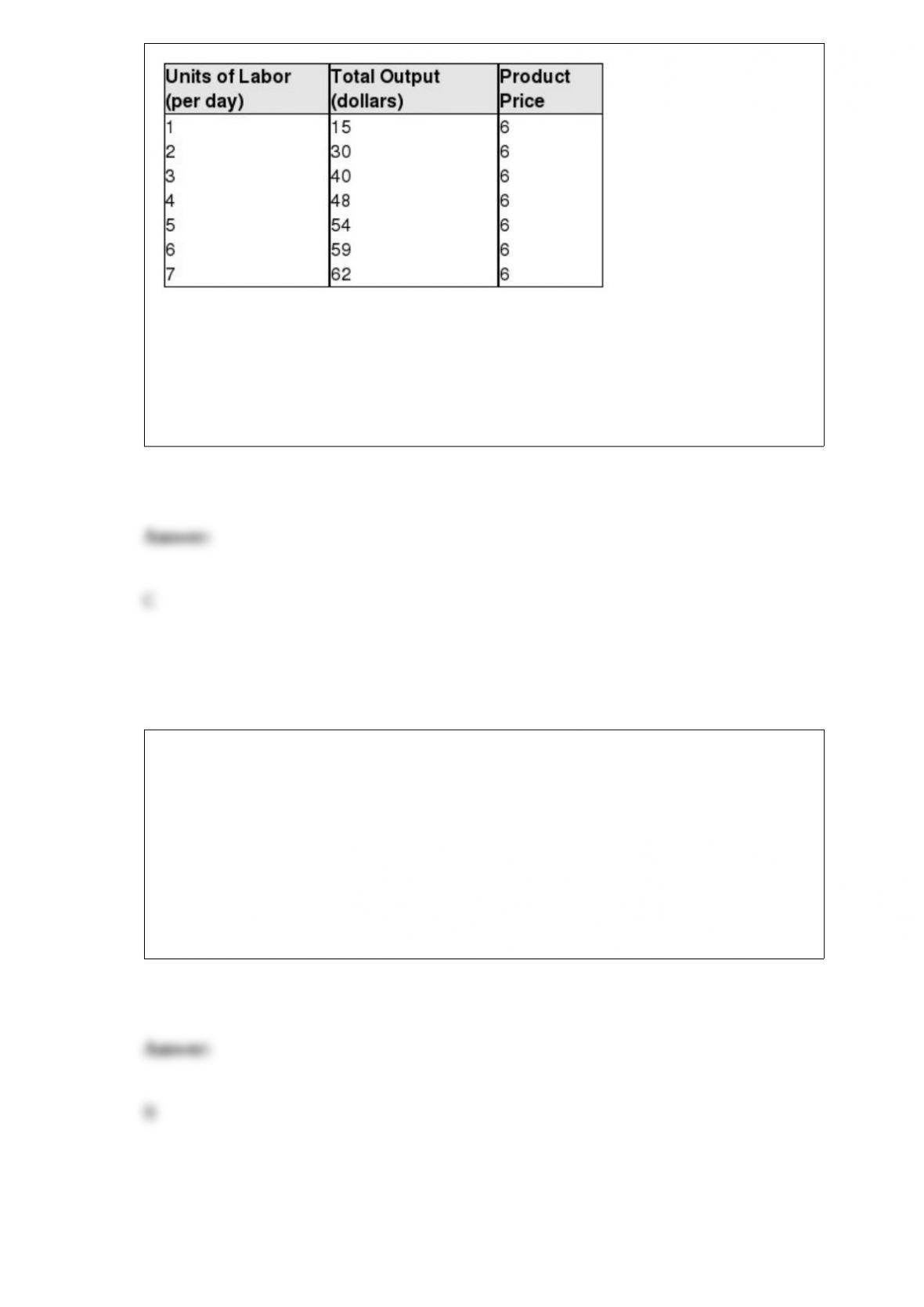
Refer to Exhibit 11-1. If the market wage rate is $25 per day, how many workers should
the firm hire if it wants to maximize profits?
a. 4.
b. 5.
c. 6.
d. 7.
Suppose that an individual consumes just two goods: Big Macs and milkshakes. In
order to reach consumer equilibrium, the individual must arrange the consumption of
Big Macs and milkshakes so that the:
a. marginal utility of the two goods is equal for the last dollar spent on each good.
b. ratio of marginal utility to price is the same for both goods for the last dollar spent on
each good.
c. ratio of marginal utility of milkshakes to the marginal utility of Big Macs is 1 for the
last dollar spent on each good.
d. price paid for the two goods is the same.

Which of the following is a free rider?
a. Butch breeds the feared pit bulls, and his neighbors now erect fences around their
property.
b. Fred watches many public television programs, but he has never sent in a
contribution.
c. Barry steals candy from the store where he works.
d. Betty regularly uses the local public library.
e. Joe drives 20,000 miles a year on public streets, but he pays no more in taxes than
Sam, who only drives 1,000 miles.
The amount by which an additional unit of a good or service increases a consumer’s
total utility is:
a. marginal bliss.
b. marginal benefit.
c. marginal utility.
d. marginal.
One necessary condition for effective price discrimination is:
a. identical tastes among buyers.
b. difference in the price elasticity of demand among buyers.
c. a single, homogeneous market.
d. two or more markets with easy resale of products between them.

Your scarcity problem would disappear if you were rich.
A utility-maximizing consumer equalizes marginal utilities per dollar spent across all
goods.
In the Alcoa case, the Supreme Court abandoned the per se rule and established the rule
of reason.

If the income elasticity of demand for a good is negative, the good is an inferior good.
An economic justification for government providing public goods and services is that
many people can benefit regardless of whether they pay or not.
The Lorenz curve represents the distribution of non-cash benefits.
The law of supply indicates that an increase in price will cause an increase in supply
which is reflected graphically as a rightward shift of the supply curve.
What is the official definition of the poverty line? What are some causes of poverty?