
According to the law of supply:
a. more of a good is desired by consumers as the price falls.
b. less of a good is desired by consumers as the price rises.
c. more of a good will be offered by suppliers as the price rises.
d. less of a good will be offered by suppliers as the price rises.
Wage and MFC differ for a monopsonist because:
a. the monopsonist is forced to pay a wage greater than the worker’s MFC.
b. the monopsonist must accept the market wage rate.
c. workers are not as efficient when employed by a monopsonist.
d. any wage increase applies to all workers, not just to the next hired.
e. wage rate decreases force workers to work longer hours.
If the cross-elasticity of demand for two goods is negative, this means that:
a. only the poor will buy the goods. c. the goods are substitutes.
b. they are normal goods. d. the goods are complements.

Which of the following represents key strengths of the market economy as a system of
allocation?
a. Goods and services are allocated based on willingness and ability to pay, rather than
based on need.
b. Producers have strong incentives to innovate because successful innovators are
rewarded with higher profit.
c. Since price is freely set based on supply and demand, shortages and surpluses are
minimized.
d. Both b. and c. above are correct.
Exhibit 12-1 Income distribution for three countries
Exhibit 12-1 shows the percentage of income received by each population quintile. In
Country II we can conclude that the:
a. least-wealthy 20 percent of the population received 75 percent of the economy’s
income.
b. least-wealthy 20 percent of the population received 25 percent of the economy’s
income.
c. richest 20 percent of the population received 25 percent of the economy’s income.
d. richest 40 percent of the population received 25 percent of the economy’s income.
e. least-wealthy 40 percent of the population received 25 percent of the economy’s
income.

Assume consumer demand for CD-ROMs increases. The result is a(n):
a. increase in derived demand for workers in the CD-ROM industry.
b. increase in the marginal revenue product of firms in the CD-ROM industry.
c. rightward shift in the market demand for labor curve in the CD-ROM industry.
d. all of the above.
e. none of the above.
A competitive firm maximizes its profits (or minimizes is losses) by producing the
quantity where the market price equals the firm’s:
a. marginal cost.
b. average total cost.
c. average variable cost.
d. average fixed cost.
Which of the following may result in a higher equilibrium price for a product?
a. Advertising
b. Expectations
c. Imperfect information
d. All of the above answers are true.
e. None of the above answers a.-c. are true.
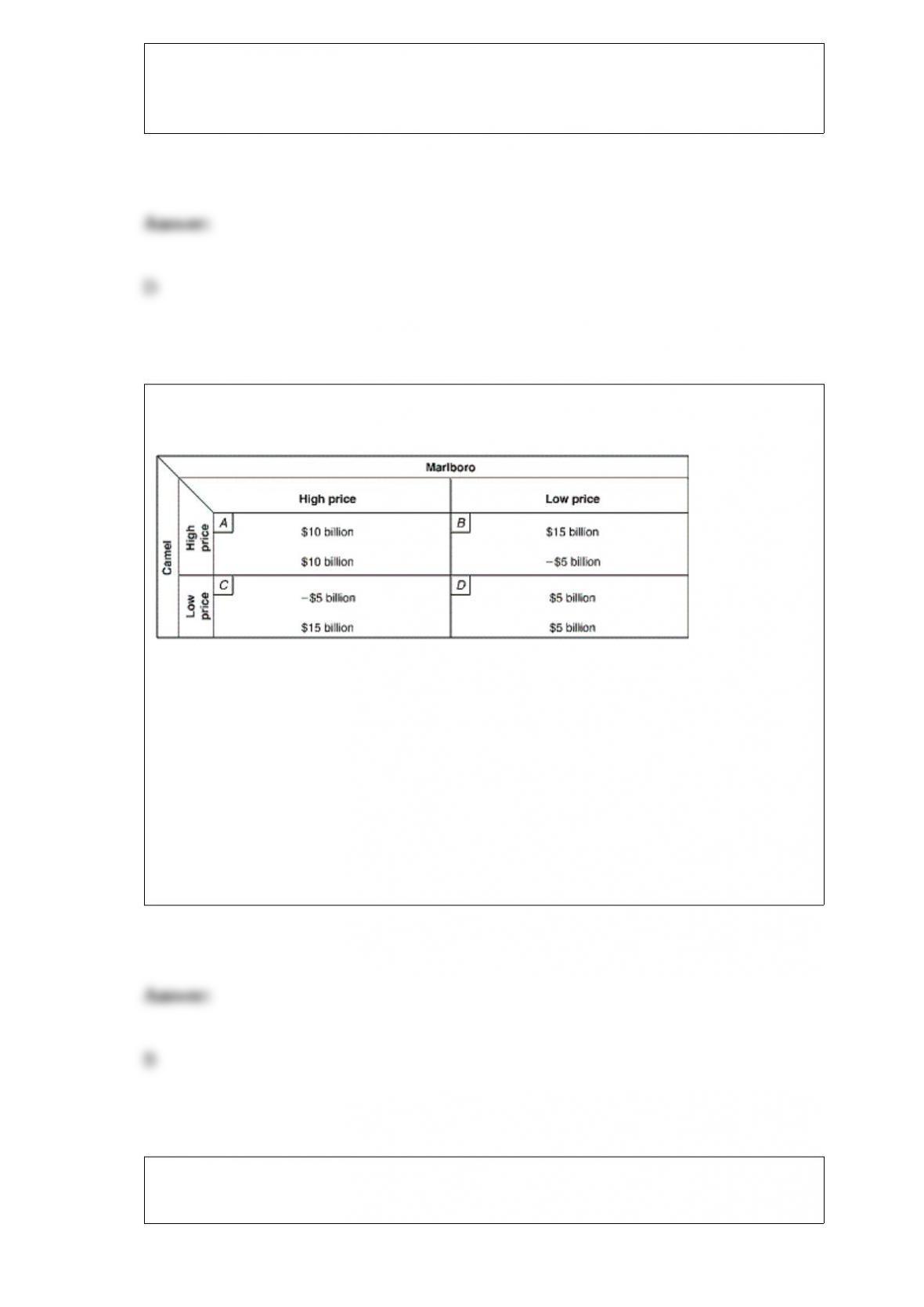
Exhibit 10-7 Two-Firm Payoff Matrix
Suppose costs are identical for the two firms in Exhibit 10-7. If both firms assume the
other will compete and charge a lower price, equilibrium will be established by:
a. Camel charging the high price and Marlboro charging the high price.
b. Camel charging the low price and Marlboro charging the low price.
c. Camel charging the low price and Marlboro charging the high price.
d. Camel charging the high price and Marlboro charging the low price.
Exhibit 3-8 Demand and supply data for Video games

In Exhibit 3-8, at any market price of video games below $50, a(n) ____ would result,
causing price to ____.
a. excess demand; rise
b. excess supply; rise
c. excess demand; fall
d. excess supply; fall
e. surplus; rise
A monopoly:
a. faces the market demand curve which is downward sloping.
b. has a marginal revenue curve which slopes downward and lies below its demand
curve.
c. will maximize profits by producing an output level where MR = MC.
d. all of these.

Each year around Valentine’s Day, we would expect:
a. the demand for roses to increase. c. the quantity of roses sold to increase.
b. the price of roses to increase. d. all of these.
At the market output and price for a good whose production causes pollution:
a. pollution is eliminated.
b. the marginal social cost of production exceeds the marginal social benefit of
production
c. the private cost of production equals the private benefit of production.
d. the marginal social benefit of production equals the marginal social cost of
production.
There is news that the price of Tucker’s Root Beer will increase significantly next week.
If the demand for Tucker’s Root Beer reacts only to this factor and shifts to the right, the
position of this demand curve has reacted to a change in:
a. tastes.
b. income levels.
c. the price of other goods.
d. the number of buyers.
e. expectations.

The television network newscaster reports that the national inflation rate the past year
equaled 4 percent. This report would be of particular interest to a ____.
a. microeconomist.
b. normative economist.
c. macroeconomist.
d. Ceteris paribus.
e. social science economist.
If a government imposed price ceiling legally sets the price of beef below market
equilibrium, which of the following will most likely happen?
a. The quantity of beef demanded will decrease.
b. The quantity of beef supplied will increase.
c. There will be a surplus of beef.
d. There will be a shortage of beef.