Which of the following is included in the current account?
a. Net unilateral transfers.
b. Goods imports.
c. Goods exports.
d. All are included in the current account.
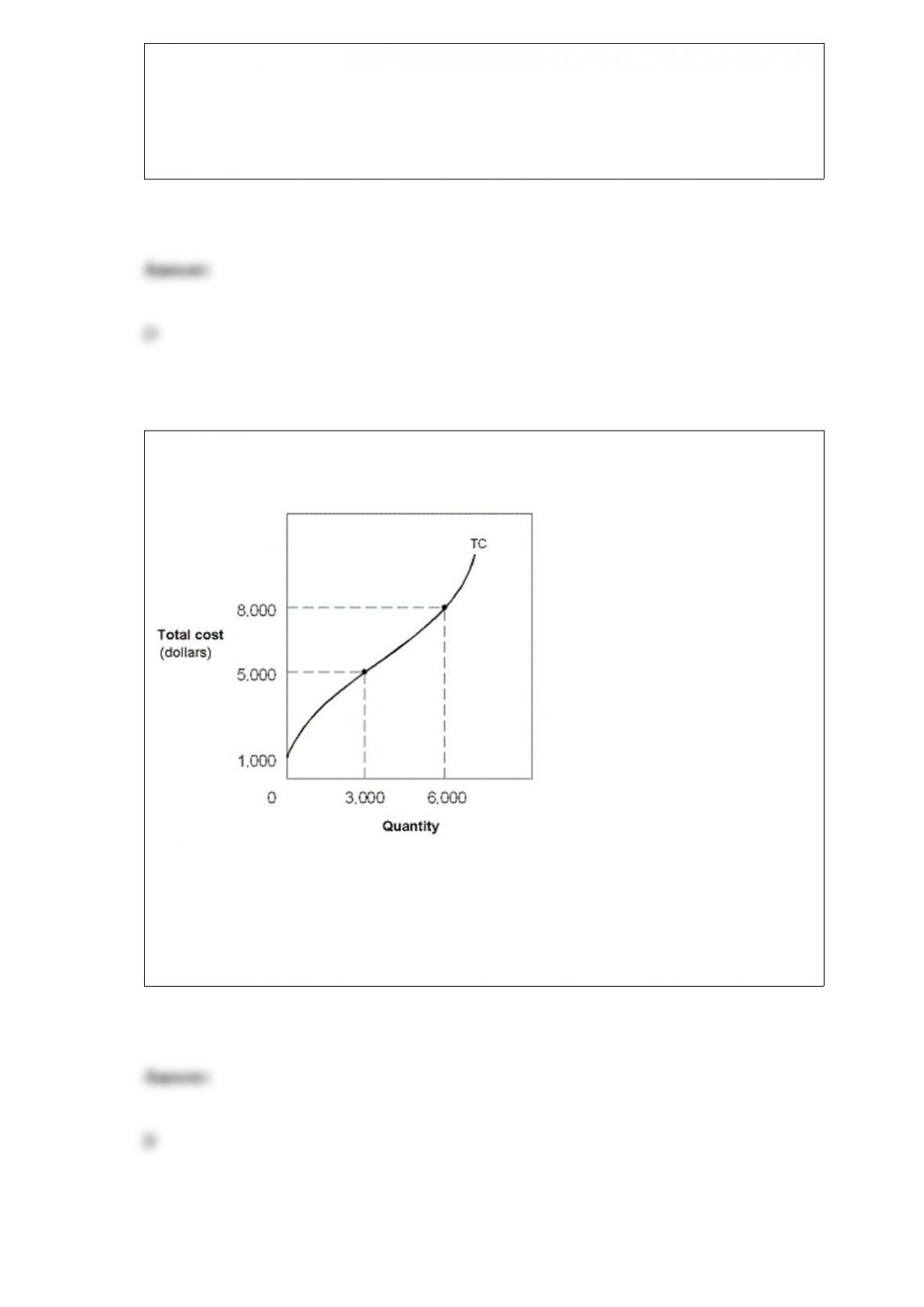
Exhibit 7-6 Total cost curves
In Exhibit 7-6, the total fixed cost is:
a. 0.
b. 1,000.
c. 3,000.
d. 5,000.
e. 6,000.
What famous economist said that the market economy seemed to be controlled by an
invisible hand?
a. Alfred Marshall. c. Karl Marx.
b. Adam Smith. d. Robert L. Heilbroner.
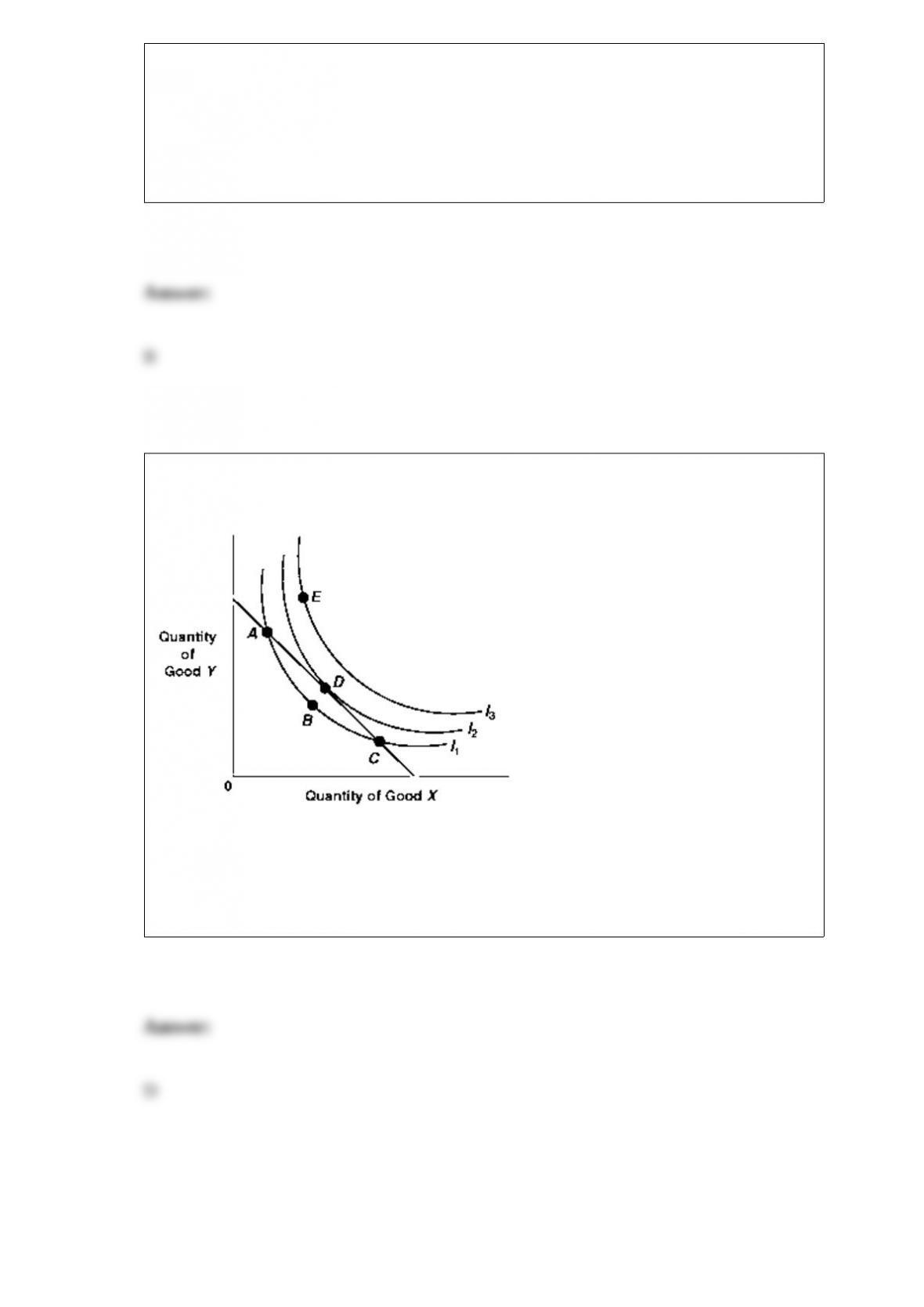
Exhibit 6A-3 Consumer equilibrium
Given the budget line and indifference curves shown in Exhibit 6A-3, point E is:
a. inferior to point X.
b. lowest attainable level of total utility.
c. consumer equilibrium.
d. unobtainable.

A decrease in the price of coffee, other things being equal, causes a(n):
a. leftward shift in the demand curve for coffee.
b. downward movement along the demand curve for coffee.
c. rightward shift in the demand curve for coffee.
d. upward movement along the demand curve for coffee.
If Jackie needs special film to go with her new camera, then for her these two goods
have what type of relationship?
a. Substitute.
b. Complementary.
c. Nonlinked.
d. Reversed.
e. Insensitive.
Normal profit is defined as a(n):
a. foregone percent rate of return.
b. opportunity profit.
c. implicit profit.
d. minimum necessary to keep a firm in operation.

Suppose an increase in symphony tickets prices reduces the total revenue. This is
evidence that demand is:
a. price elastic.
b. price inelastic.
c. unitary elastic.
d. perfectly elastic.
According to Adam Smith, the ‘invisible hand’ refers to which of the following?
a. The ‘best interests of society (public interest) will occur as an outcome of the market
process coordinating the self-interested interactions of buyers and sellers (private
interest).
b. Government interference is the invisible hand of inefficiency.
c. Bribes and graft is the invisible hand of inefficiency.
d. The ‘best interests of society’ will occur as an outcome of careful guidance by
government authorities in allocating scarce goods and services.
From an economic viewpoint, the optimal amount of pollution:
a. is zero since all pollution imposes costs on society.
b. is that amount which firms create when they maximize economic profits by setting
their marginal private costs equal to market price.

c. is that amount where the marginal social costs of producing a good precisely equals
the price of the good.
d. b and c are correct.
If Congress decides to increase the tax per pack paid by sellers of cigarettes, other
things being equal, the price of cigarettes will rise. This rise in prices can be attributed
to a(n):
a. upward movement along the supply curve for cigarettes.
b. rightward shift of the supply curve for cigarettes.
c. upward movement along the demand curve for cigarettes.
d. leftward shift of the supply curve for cigarettes.
Exhibit 5-9 Supply and demand curves for good X

In Exhibit 5-9, the price elasticity of supply for good X between points E and C is:
a. 7/5 = 1.40. c. 5/7 = 0.71.
b. 1/5 =0.20. d. 1.
The poverty line:
a. separates those on welfare from those not on welfare.
b. equals three times an economy food budget.
c. equals the median income level.
d. all of these.
Jim Smith runs a company that sells encyclopedia sets for $200 each. When he employs
5 workers, they can sell 20 sets per week, while only 17 sets are sold when 4 workers
are employed. If the wage of workers in this skill category is $500 per week, should the
fifth worker be hired?
a. No, because the MRP of the fifth worker is less than $500 per week.
b. No, because the MRP of the fifth worker is more than $500 per week.
c. Yes, because the MRP of the fifth worker is less than $500 per week.
d. Yes, because the MRP of the fifth worker is more than $500 per week.
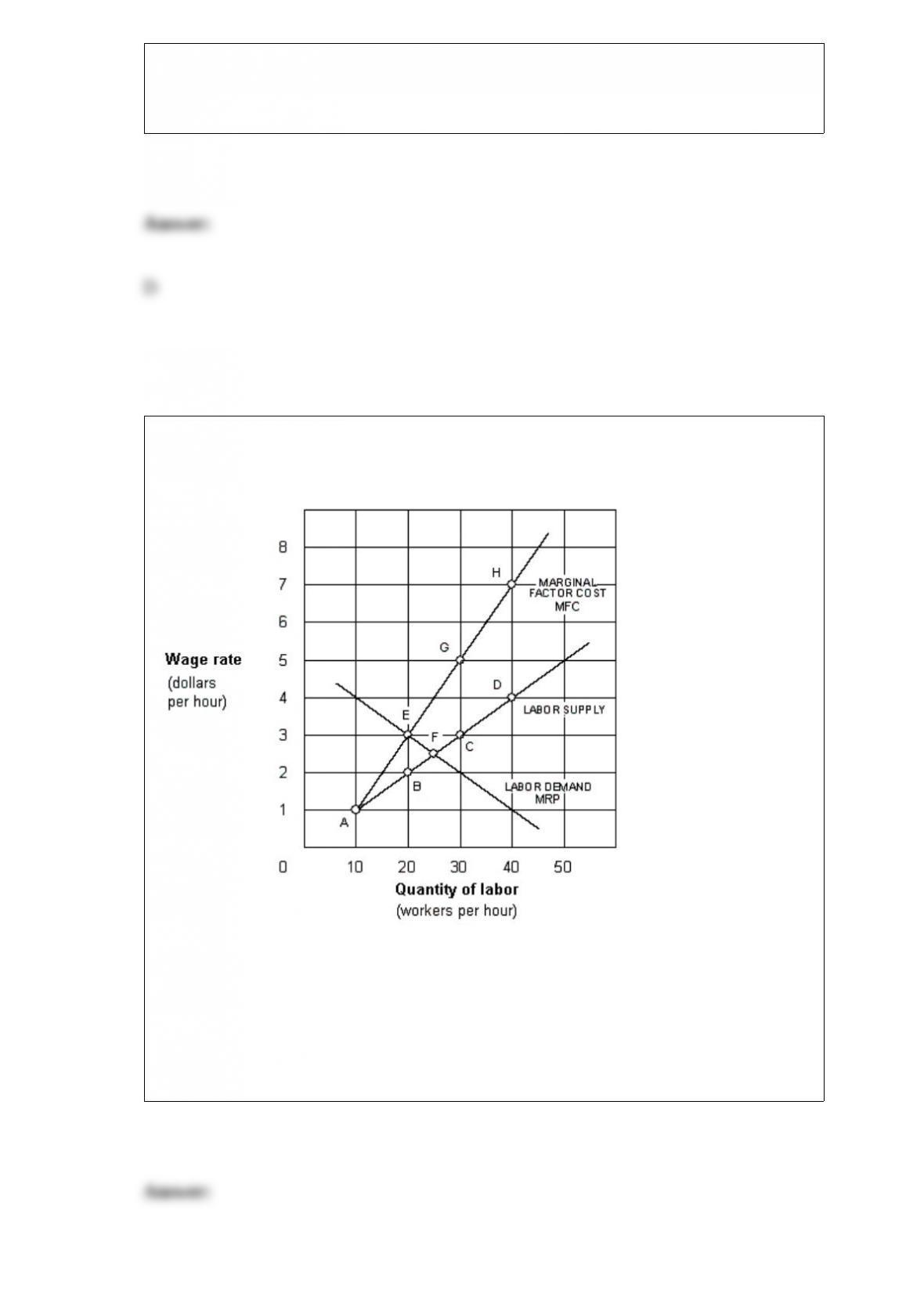
Exhibit 11-8 A labor market
If the labor market shown in Exhibit 11-8 is competitive, the wage rate and number of
workers employed will be determined at point:
a. A.
b. B.
c. C.
d. D.
e. F.

The silly clothes worn by a circus clown are an example of:
a. a natural resource. c. labor.
b. capital goods. d. entrepreneurship.
Along an indifference curve for goods X and Y, the vertical and horizontal axes
measure the:
a. prices of X and Y.
b. total utilities of X and Y.
c. quantities of X and Y.
d. marginal utilities of X and Y.
Which of the following is an amendment to the Clayton Act that strengthened it against
price discrimination?
a. The Sherman Antitrust Act. c. The Robinson-Patman Act.
b. The Federal Trade Commission Act. d. The Celler-Kefauver Act.

Specialization and trade allow an economy to expand its:
a. production possibilities. c. technological advantage.
b. consumption possibilities. d. absolute advantage.
The entry of new firms into a monopolistic competitive industry will shift the:
a. market demand curve to the right.
b. market demand curve to the left.
c. existing firm’s demand curve to the right.
d. existing firm’s demand curve to the left.
e. market supply curve to the left.
If regulation imposes marginal cost pricing on a natural monopoly, then the monopoly
will:
a. suffer persistent economic losses.
b. earn a fair, but not excessive, return on its assets.
c. produce too little output to achieve efficiency.

d. experience diseconomies of scale.
If the supply curve decreases while the demand curve remains unchanged, the
equilibrium price would increase.
Centralized planning agencies are a key feature of command economies.
What is the difference between socialism and communism? What are some examples of
countries that are largely socialistic and some that are communistic?

The Lorenz curve is best used to measure international competitiveness.
Other factors held constant, if there are few close substitutes for a good, demand is
more elastic for it.