An economist at the University of Alaska at Anchorage has been asked to explain why
the price of Alaskan crude oil has fallen recently. In order to develop a model, the
professor should take which steps?
a. Identify the problem, develop a model based on simplifying assumptions and test the
model to formulate a conclusion.
b. Gather data on crude oil prices and seemingly unrelated variables in order to look for
associations, then formulate a hypothesis based on those unexpected associations.
c. Ask people in Alaska why they are not purchasing oil.
d. None of these. The oil industry is controlled by a cartel; therefore price changes in
the industry cannot be explained using economic theories.
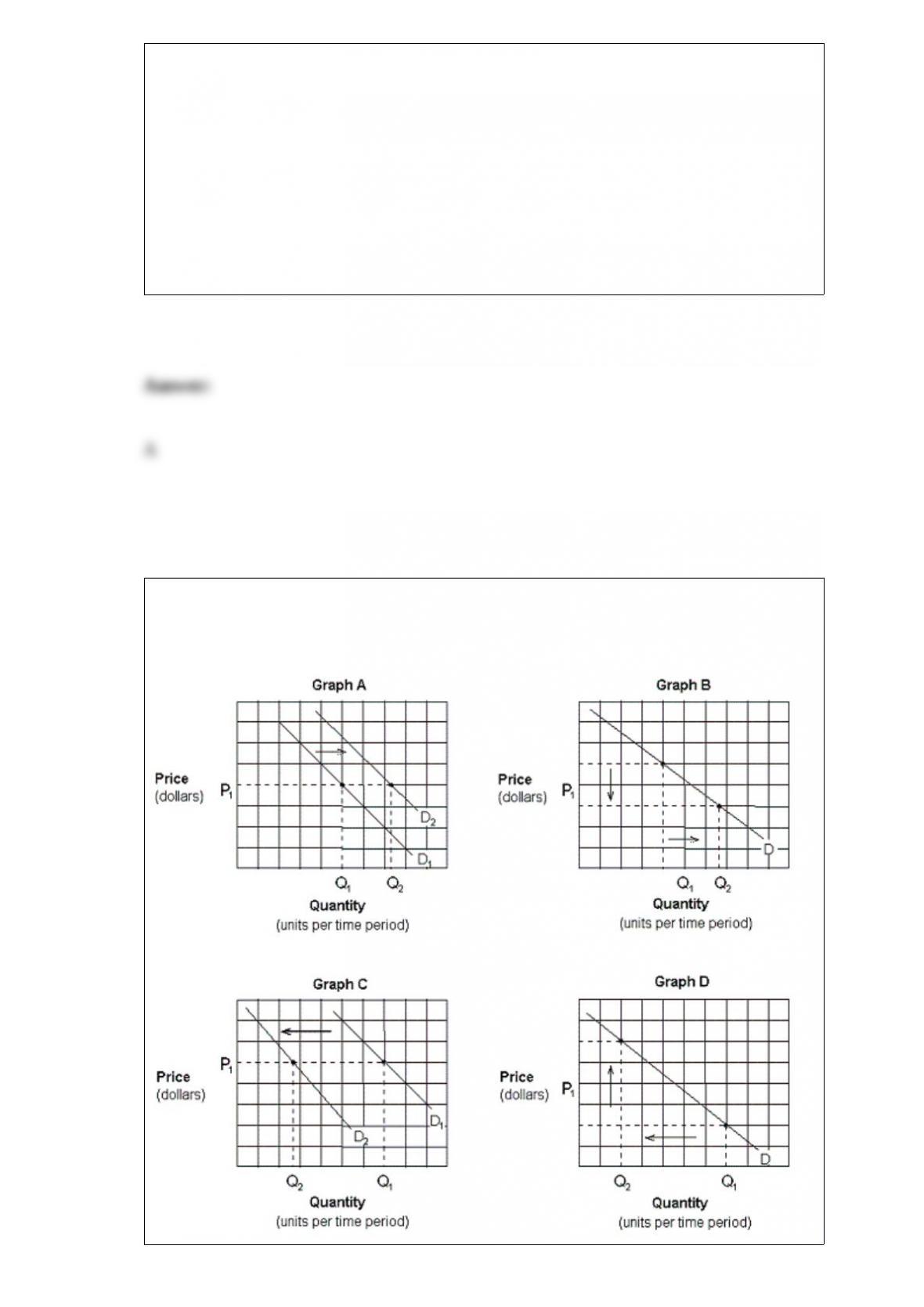
Exhibit 3-3 Demand curves
Assume that consumers expect the price of gasoline to rise sharply in the future. Which
of the graphs in Exhibit 3-3 depicts this effect?
a. Graph A. c. Graph C.
b. Graph B. d. Graph D.
Policies to lower the price level of goods in the nation are a concern of:
a. macroeconomics.
b. microeconomics.
c. both microeconomics and macroeconomics.
d. political science.
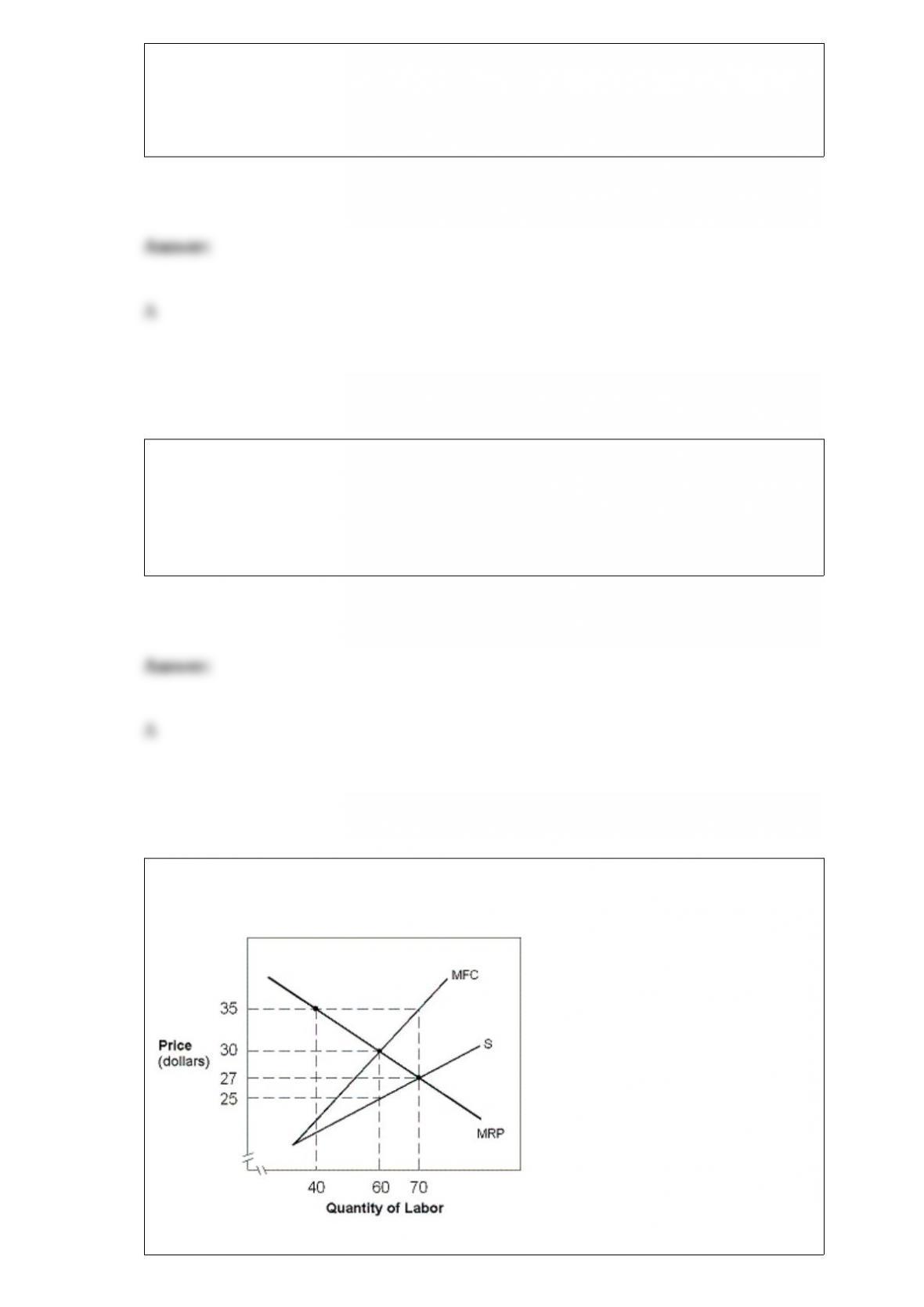
Exhibit 11-12 A monopsonist
In Exhibit 11-12, we know this exhibit shows a monopsonistic labor market because:
a. the MRP curve slopes down.
b. the market supply of labor curve is horizontal.
c. the MFC curve lies above the supply of labor curve.
d. the MRP curve lies below the supply of labor curve.
e. wages are below the supply of labor curve.
If OPEC is an effective cartel,
a. price changes are dictated by changes in demand.
b. output changes are dictated by changes in demand.
c. members agree on output quotas.
d. all of these.
Assuming that generic brands are inferior goods, an increase in consumer income, other
things being equal, will cause a(n):
a. leftward shift in the demand curve for generic goods.
b. downward movement along the demand curve for generic goods.
c. rightward shift in the demand curve for generic goods.
d. upward movement along the demand curve for generic goods.
Which of the following is included in the study of macroeconomics?
a. Salaries of college professors. c. Unemployment in the nation.
b. Computer prices. d. Silver prices.
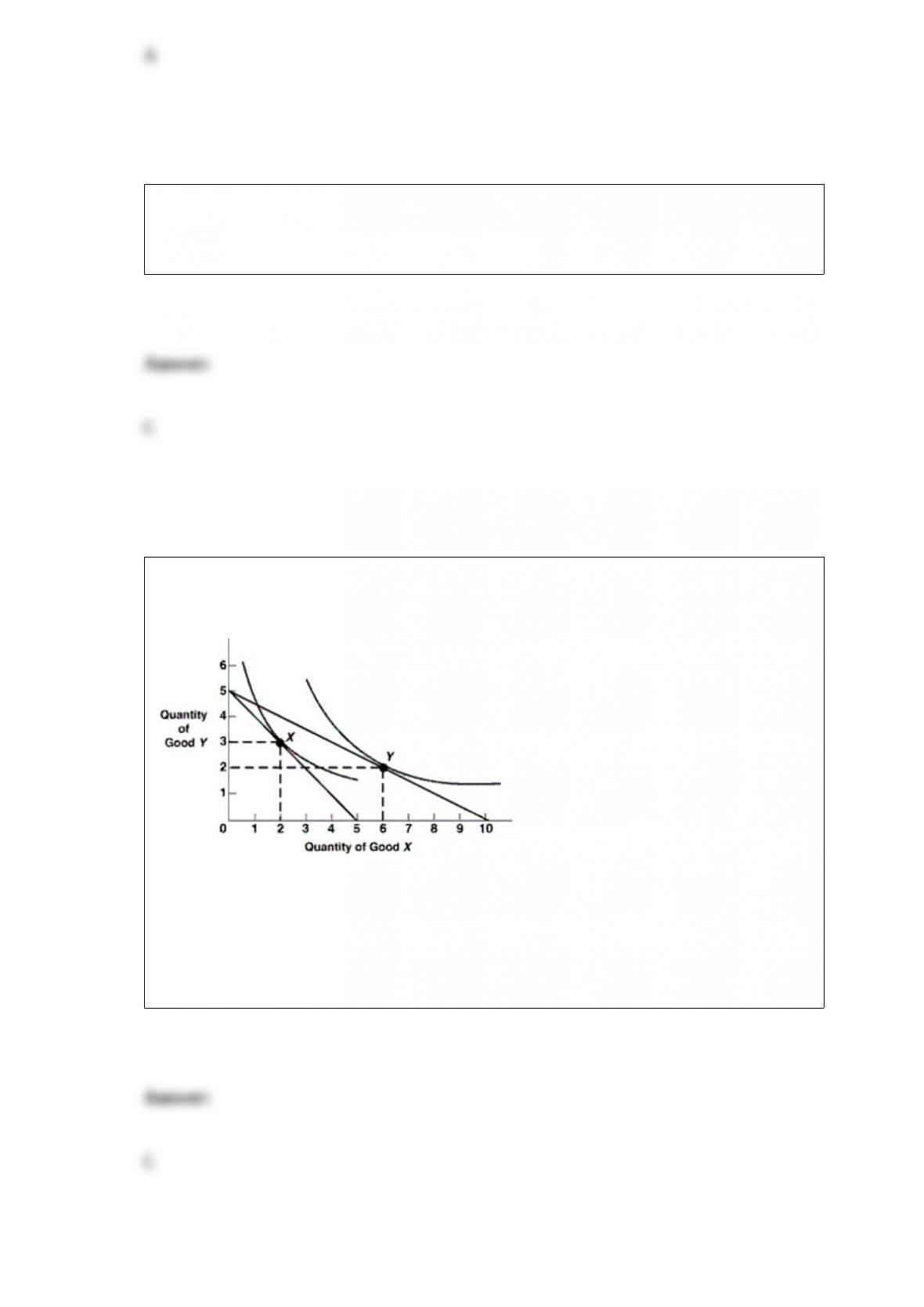
Exhibit 6A-6 Consumer equilibrium
As shown in Exhibit 6A-6, the marginal rate of substitution (MRS) at point B is equal
to:
a. 0.33.
b. 2.0.
c. 0.5.
d. 3.0.
How will the price and output of a monopolist compare with perfect competition?
a. The output of the monopolist will be too large and the price too high.
b. The output of the monopolist will be too large and the price too low.
c. The output of the monopolist will be too small and the price too high.
d. The output of the monopolist will be too small and the price too low.
American Airlines makes numerous nonstop flights from Chicago’s O’Hare Airport to
the airport at Dallas-Fort Worth. The distance between those two cities is 1,000 miles.
The only variable cost, fuel, costs $.06 for each passenger-mile it flies. Bob, on his way
to an emergency business meeting, buys a ticket in coach class for $1,300 at the very
last minute. The marginal cost of flying Bob from Chicago to Dallas-Fort Worth is:
a. b and e.
b. higher than the average cost of previous passengers.
c. $600.
d. $160.
e. $60.
Total profit can be calculated by:
a. c and e.
b. subtracting total revenue from total costs.
c. subtracting total costs from total revenue.
d. finding the product of the difference between average profit and average total cost
and the quantity produced.
e. quantity produced times the difference between average revenue and average total
cost.
A perfectly competitive firm’s supply curve follows the upward-sloping segment of its
marginal cost curve above the:
a. average total cost curve.
b. average variable cost curve.
c. average fixed curve.
d. average price curve.
Which word best completes the following sentence? A rational decision maker always
chooses the option for which marginal benefit is __________ marginal cost.
a. less than
b. equal to
c. unrelated to
d. more than
Suppose that Starbucks reduces the price of its premium coffee from $2.20 to $1.80 per
cup, and as a result, the quantity sold per day increased from 350 to 450. Over this price
range, the price elasticity of demand for Starbucks coffee is:
a. 0.40. c. 1.25.
b. 0.80. d. 2.50.
Assume that the production of a good imposes external costs upon third parties. If the
price and quantity of this good is set by supply and demand the price will be too:
a. high and quantity too low for efficient resource allocation.
b. low and quantity too low for efficient resource allocation.
c. low and quantity too high for efficient resource allocation.
d. high and quantity too high for efficient resource allocation.
Exhibit 9-7 Monopolist
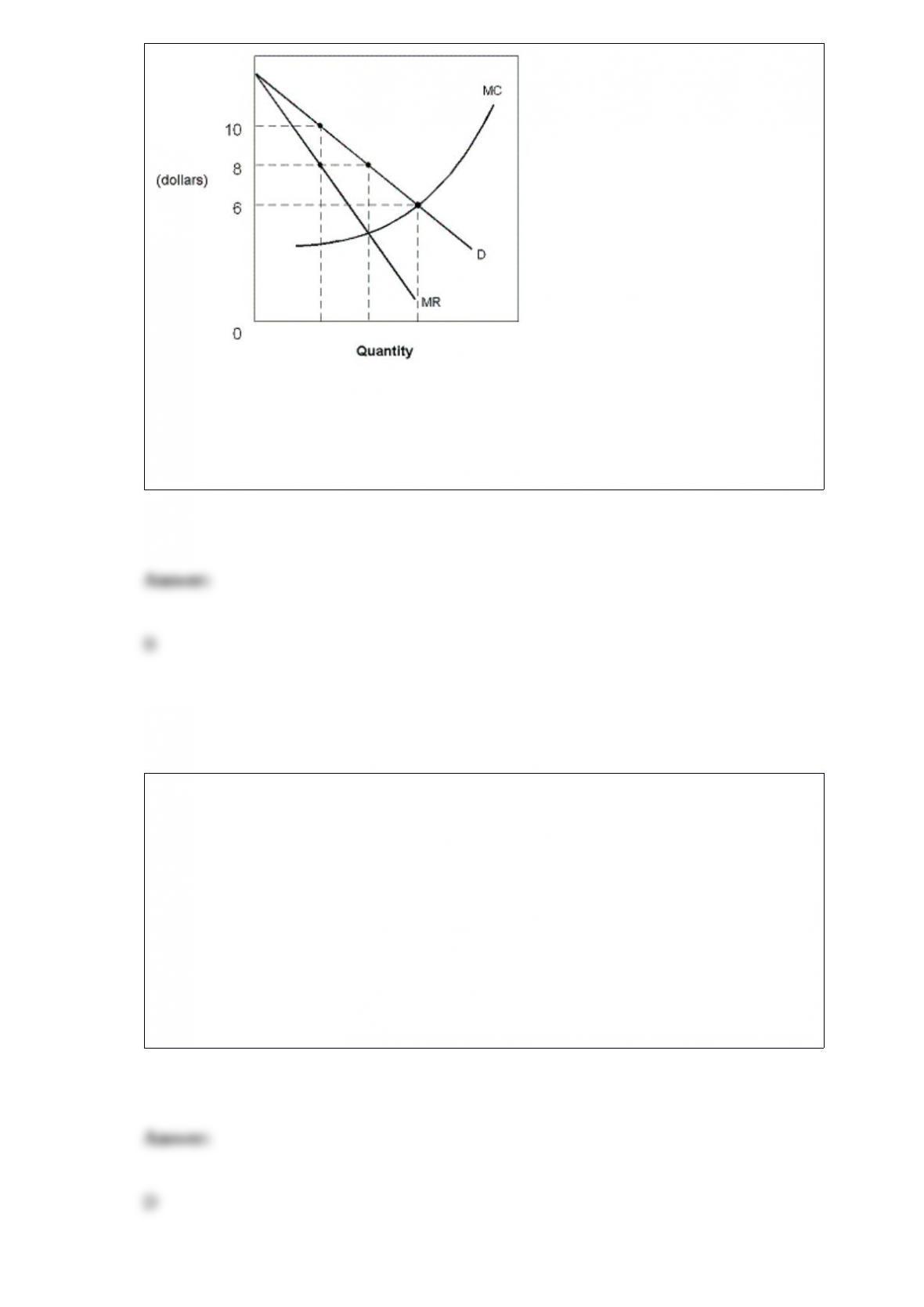
As shown in Exhibit 9-7, in the short run, the monopoly will:
a. earn an hourly profit of $240.
b. earn an hourly profit of $80.
c. break even (i.e., earn zero economic profit).
d. suffer an hourly loss of $160.
Which two pieces of legislation were passed in 1914?
a. Sherman Antitrust and Clayton Act
b. Clayton Act and Robinson-Patman Act
c. Robinson-Patman Act and Celler-Kefauver Act
d. Clayton Act and Federal Trade Commission Act
e. Sherman Antitrust Act and Federal Trade Commission Act.
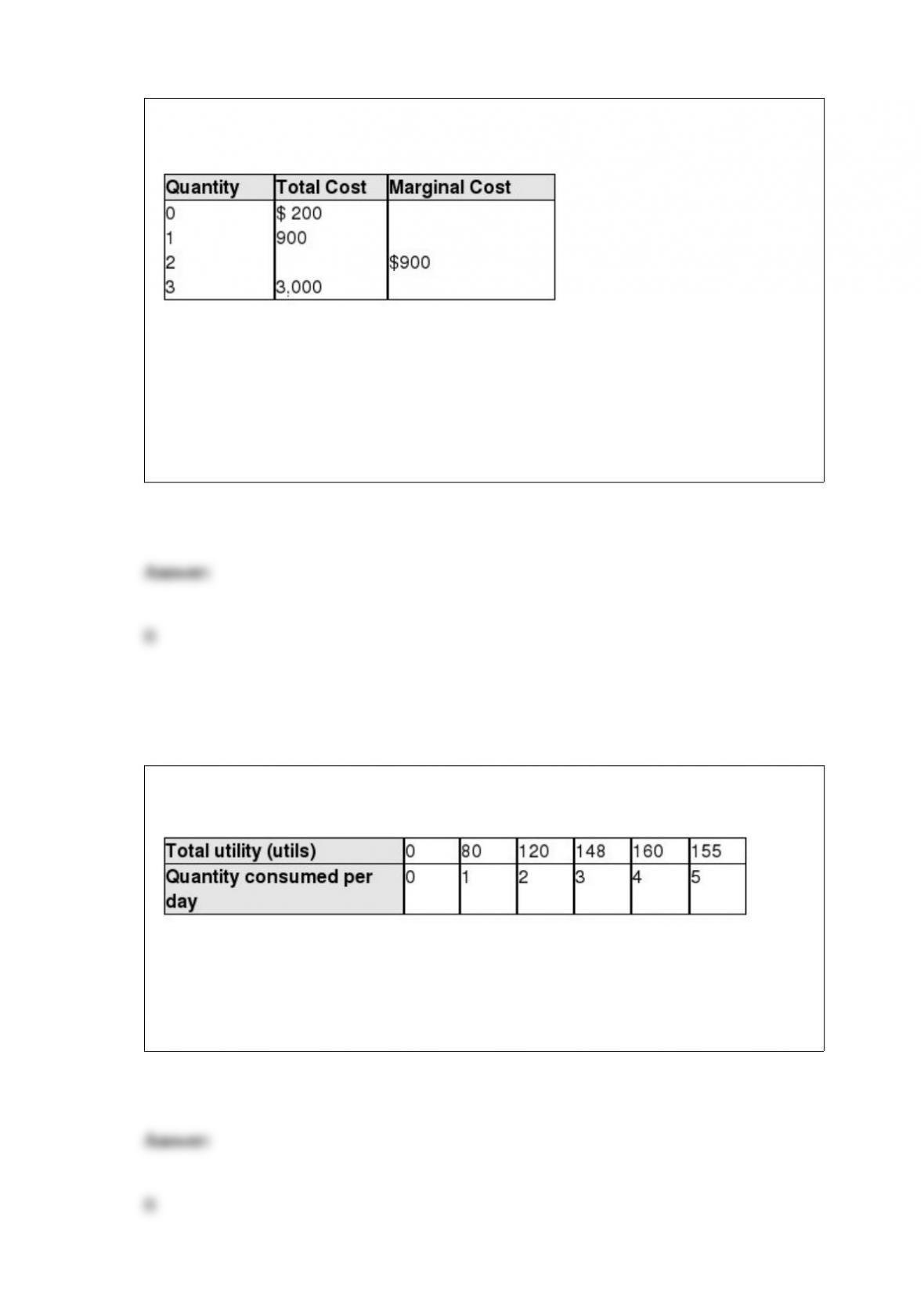
Exhibit 7-7 Cost schedule for a firm
In Exhibit 7-7, by filling in the blanks it can be determined that the marginal cost of the
first unit of output is:
a. 200.
b. 700.
c. 900.
d. 1,000.
e. 3,000.
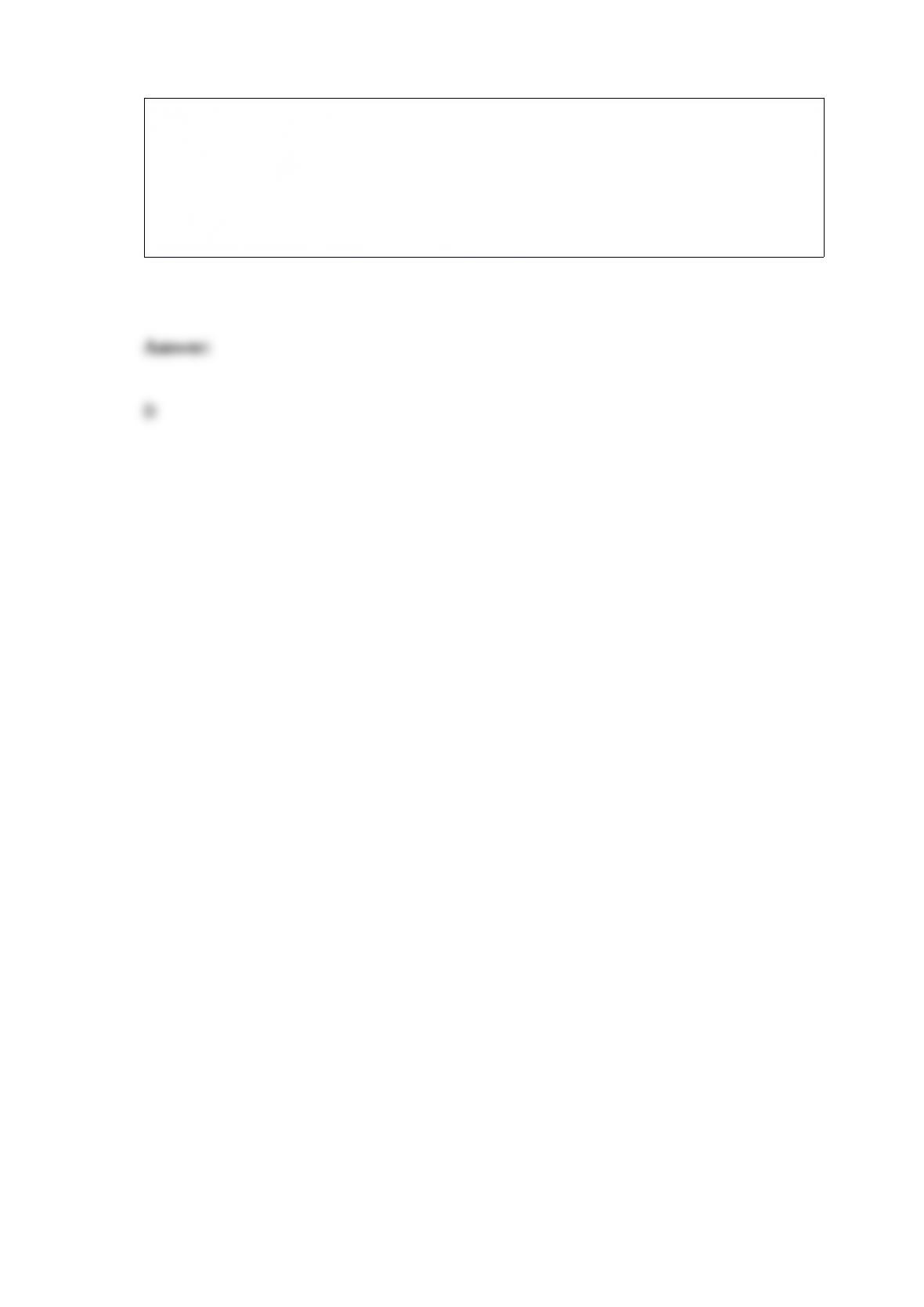
Exhibit 6-1 Total utility for good X
As shown in Exhibit 6-1, the marginal utility for the second unit consumed is:
a. 0.
b. 40.
c. 80.
d. 200.
Which of the following mergers would result from the purchase of a computer chip
company by IBM?
a. A horizontal merger. c. A conglomerate merger.
b. A vertical merger. d. An interlocking merger.