
The more elastic the supply of a product, the more the actual burden of a tax on the
product will:
a. fall on sellers.
b. fall on buyers.
c. fall equally on both buyers and sellers.
d. create a smaller deadweight loss (or excess burden).
An outward shift of an economy’s production possibilities curve is caused by:
a. an increase in capital. c. an advance in technology.
b. an increase in labor. d. all of these.
Suppose the government imposes rent control (a price ceiling) below the equilibrium
price for rental housing. Which of the following could result?
a. Tenants risk breaking rent control law.
b. The quality of existing rental housing deteriorates.
c. Shortages.
d. All of these.
The economic system that answers the What, How and For Whom questions the way
they have always been answered is a:
a. market economy. c. soviet economy.
b. command economy d. traditional economy.
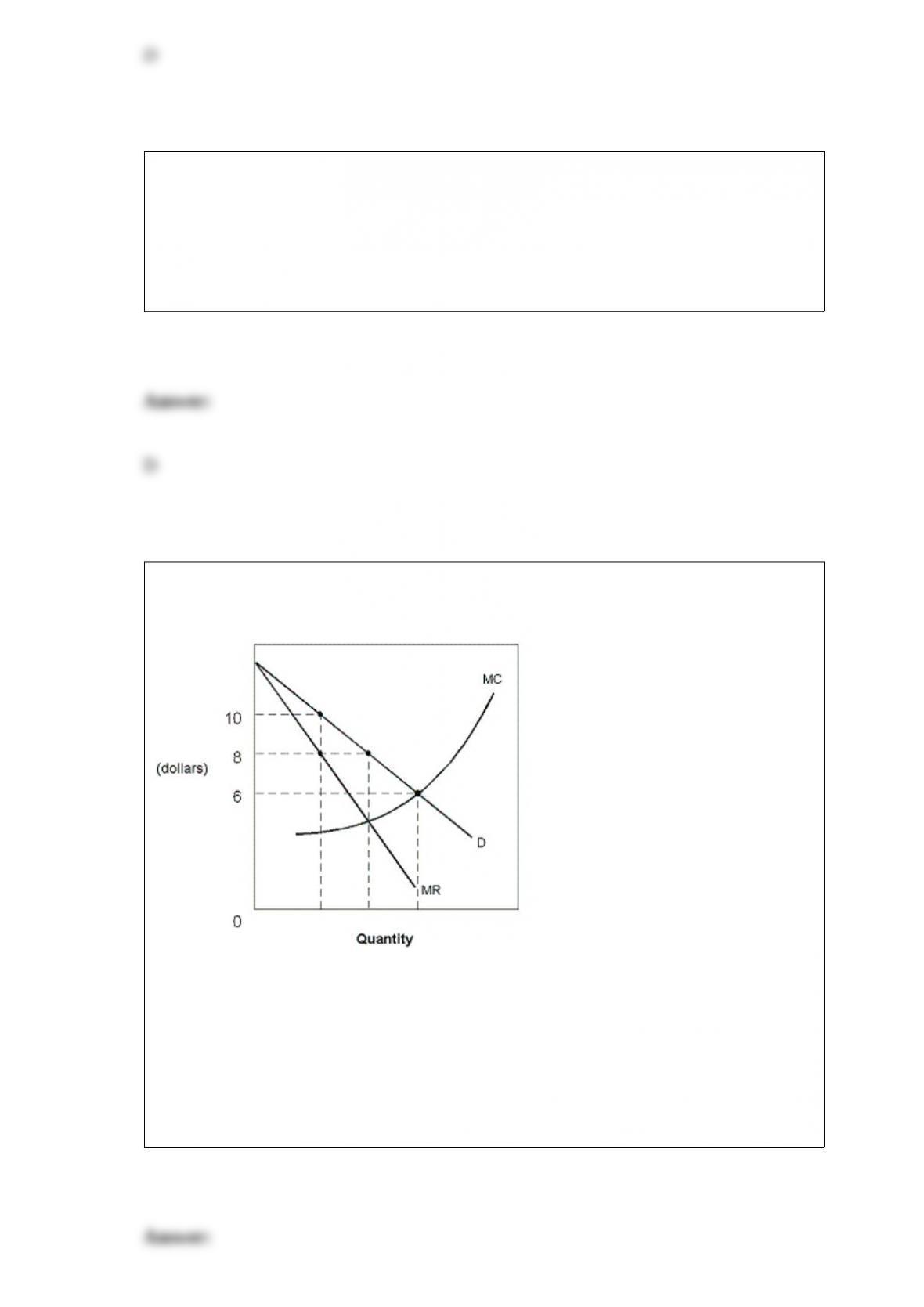
Exhibit 9-7 Monopolist
According to the information provided in Exhibit 9-7, if the Rudd Ice Company was a
monopoly and is currently charging a price of $10, what would you advise Rudd to do?
a. Stay where he is currently operating because he is charging the profit-maximizing
price.
b. Increase price and increase output.
c. Decrease price and increase output.
d. Increase output and hold price constant.
e. Increase price and hold output constant.

Consider a law that limits women’s access to certain “dangerous” occupations like coal
mining and military combat service. Such a law would likely reduce women’s wages
because:
a. women would be overqualified for “non-dangerous” jobs.
b. labor supply in female-intensive occupations would increase.
c. women would be less likely to obtain college degrees.
d. comparable worth would no longer exist between men’s and women’s occupations.
The negative slope of the demand curve reflects the:
a. positive relationship between price and quantity.
b. proportional relationship between price and quantity.
c. inverse relationship between price and quantity.
d. positive relationship between income and quantity.
e. inverse relationship between income and price.
Exhibit 11-11 Labor wage and cost data

In Exhibit 11-11, the marginal factor cost of the 14th employee is equal to:
a. $9.00.
b. $126.00.
c. $46.50.
d. $23.30.
e. $28.80.
The rule of reason was an antitrust law guideline that emphasized the importance of
____ over ____.
a. price; quantity
b. quantity; price
c. law; the economy
d. size; behavior
e. behavior; size

Of the following choices, which is the best example of a nation’s economic
infrastructure?
a. Natural resources.
b. Highway system.
c. Government.
d. Religious and cultural beliefs.
e. Population growth rate.
All points on the production possibilities curve are:
a. unattainable. c. efficient.
b. fair. d. optimal.
Suppose a consumer is spending all of his/her income on two goods, A and B, in a
manner where MUa = 15 and MUb = 80, and the Pa = $5 and the Pb = $20. Then the
consumer:
a. is maximizing his/her utility.
b. should increase his/her purchases of B and decrease the purchases of A.
c. should spend more money on both goods.
d. should spend less money on both goods.
e. should increase the purchases of A and decrease the purchases of B.

In the short run, a firm should shut down its business if price is less than:
a. ATC.
b. AR.
c. MC.
d. AVC.
e. AFC.
Which of the following is not a resource?
a. Land. c. Money.
b. Labor. d. Capital.
The law of diminishing marginal utility is the principle that the marginal utility curve
____ as people consume more of a product in a given period.
a. rises.
b. falls.
c. remains unchanged.
d. first falls and then rises.

From an economic perspective, the socially best amount of pollution control is that
amount in which:
a. there is zero pollution.
b. the private plus external marginal costs are equal to the private plus external marginal
benefits.
c. the private plus external marginal costs are less than the private plus external
marginal benefits.
d. the private marginal costs are equal to the private marginal benefits.
e. the external costs equal the external benefits.
The vertical and horizontal axes intercepts of the budget line represent the:
a. quantity of goods that will be purchase if only that good is purchased.
b. preference of one good compared to another good.
c. quantity of each good that is outside the consumer’s income.
d. only two choices that will spend the entire budget.

In order to obtain a conviction for price fixing under the Sherman Antitrust Act, the
government needs to prove:
a. only that an attempt to fix prices was made.
b. that there was a price-fixing agreement that actually lessened competition.
c. that there was a high concentration ratio for the industry.
d. all of these.
A surplus means a(n):
a. excess demand for this product.
b. situation where the current market price is too low.
c. situation where the quantity demanded exceeds the quantity supplied.
d. situation where the quantity supplied is less than the quantity demanded.
e. excess supply of the product at the current price.
If India has an absolute advantage in rug production when compared to England, then:
a. India should export rugs to England.
b. England should export rugs to India.
c. international trade should not occur.
d. England uses fewer resources to produce rugs than India.
e. India uses fewer resources to produce rugs than England.

Inferior goods have an income elasticity of demand that is:
a. positive.
b. negative.
c. 0.
d. greater than 1 in absolute value.
e. equal to 1 in absolute value.
Which of the following best represents the effects of an increase in the price of coffee,
other things being equal?
a. A leftward shift in the demand curve for coffee.
b. A downward movement along the demand curve for coffee.
c. A rightward shift in the demand curve for coffee.
d. An upward movement along the demand curve for coffee.
Scarcity:
a. is a problem only in the poorer countries of the world.
b. can be solved by rapid advances in technology.
c. is a problem that exists in every economy.
d. is not a problem for the very rich.

Recently, the State of Tennessee discovered chemical compounds in their drinking
water which may cause cancer. Since Tennessee’s drinking water comes from the
Pigeon River in North Carolina, the source of these chemicals is the waste discharges of
industrial paper plants in North Carolina. This is an example of a(n):
a. external cost imposed on the citizens of Tennessee by the industrial plants of North
Carolina.
b. market failure where the market price of the output of these industrial plants does not
fully reflect the social cost of producing these goods.
c. externality where the marginal social costs of producing these industrial goods differ
from the marginal private costs.
d. all of these.
Compared to IACs, LDCs are often characterized by:
a. lower life expectancy. c. lower per capita energy consumption.
b. lower adult literacy. d. All of these.

What is an economic theory or model? What constitutes a “good” economic theory or
model?
If a good gives rise to substantial external benefits to society that are associated with its
production and/or consumption, then the good likely has too many resources devoted to
its production.
“Ceteris paribus” is a Latin expression that essentially means “holding everything else
constant.”

A firm’s demand curve for labor coincides with the marginal factor cost of labor curve.
Investment in capital accumulation, as well as investment in education and other labor
productivity enhancing programs, is necessary for economic growth.
The points along the supply curve represent the maximum willingness of firms to
accept payment for a product offered for sale at various prices.