
As one moves down a straight-line, down-sloping demand curve, price elasticity will:
a. change from elastic, to unit elastic, then to inelastic.
b. remain the same between any two points.
c. change from inelastic, to elastic, then to unit elastic.
d. change from unit elastic, to elastic, then to inelastic.
e. change from elastic, to inelastic, then to unit elastic.
Ever since the creation of the interstate highway system, the railroads have had to
compete with trucks for freight shipments. Union Pacific, the nation’s largest railroad,
now offers door-to-door services to clients, using their own trains and trucks. This must
be the result of:
a. horizontal merger.
b. vertical merger.
c. conglomerate merger.
d. deregulation.
e. high fuel prices.
In an economy where the poorest quintile of the population receives 5 percent of the
income, the Lorenz curve:
a. is the diagonal of the box.
b. lies below the diagonal in the box.
c. lies above the diagonal in the box.
d. is the lower right corner of the box.

e. is the upper left corner of the box.
Which of the following correctly describes price discrimination?
a. Selling different products to different people for the same price.
b. Selling different products to identical people for different prices.
c. Selling the same product to different people for different prices.
d. Selling the same product to the same person for the same price.
Which of the following mergers would result from the purchase of a retail clothing
chain by a computer software company?
a. A horizontal merger. c. A conglomerate merger.
b. A vertical merger. d. A monopoly merger.
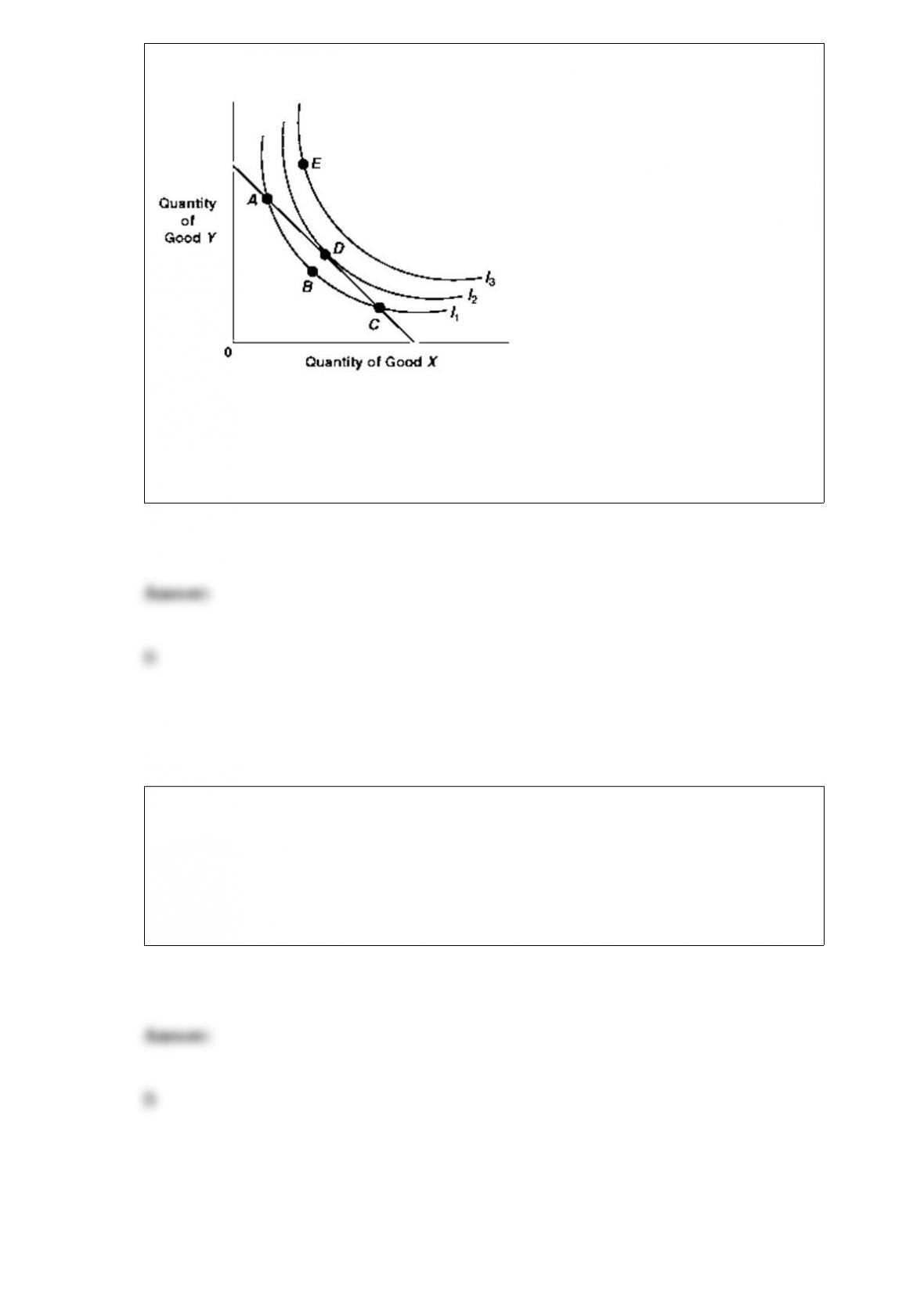
Exhibit 6A-3 Consumer equilibrium
Given the budget line and indifference curves shown in Exhibit 6A-3, point E is:
a. consumer equilibrium.
b. unattainable.
c. on the highest attainable indifference curve.
d. a point that yields less total utility than other point in the exhibit.
A negative income tax system would provide all households, including the poor, with:
a. cash payments.
b. incentives to earn income.
c. higher income levels.
d. medical assistance.
e. lower tax bills than it does .

The person who assumes the risks and uncertainties of starting a new business is
considered to be:
a. the manager. c. a sales representative.
b. the out-resourcer. d. an entrepreneur.
A rightward (an outward) shift of a nation’s production possibilities curve could be
caused by:
a. a decrease in technology.
b. an increase in resources.
c. producing more consumer and fewer capital goods.
d. a decline in the labor force’s level of education and skills.
The economic systems of the former Soviet Union, the People’s Republic of China, and
Cuba are best classified as:
a. traditional economies. c. market economies.
b. command economies. d. decentralized economies.

Other things being equal, a decreased supply of natural resources would be represented
on a production possibilities curve by a(n):
a. movement off the curve to a point inside the curve.
b. movement down along the curve.
c. movement up along the curve.
d. inward shift of the entire curve.
There is no change in total revenue when the demand curve for a good is:
a. unitary elastic.
b. perfectly inelastic.
c. elastic.
d. inelastic.
e. perfectly elastic.
When the price of bread increases by 3 percent, the quantity demanded of crackers
increases by 2 percent. The cross elasticity of demand between crackers and bread is:
a. 0.67.
b. 1.5.
c. 2.5.
d. 3.2.

e. 5.0.
Which of the following would be of particular interest to a microeconomist?
a. The price of fruit the typical household consumes.
b. The nation’s inflation rate.
c. The nation’s rate of unemployment.
d. The budget of the national government.
e. The growth of the economy.
The branch of economics that focuses on economywide variables like inflation and
unemployment is called:
a. macroeconomics. c. free-market economics.
b. microeconomics. d. aggregate economics.
The demand curve for Japanese yen is downward sloping because when the exchange

rate (measured in dollars per yen) falls,
a. Japanese goods become relatively cheaper so foreigners buy more of them and need
more yen to do so.
b. foreigners need more dollars to buy one yen so they can now afford more Japanese
goods.
c. the yen demand curve shifts to the right as foreigners try to buy more Japanese
goods.
d. the dollar becomes weaker and this reduces the strength of both economies.
e. everyone wants fewer yen because they have lost some of their underlying value.