
A production possibility graph slopes down because of:
a. the law of increasing costs.
b. nonhomogeneous resources.
c. inefficiency.
d. improper output mix.
e. unemployment.
Bobby’s neighbor is growing a tree that is blocking Bobby’s ocean view. Bobby is
considering taking his neighbor to court. This is most likely an example of a:
a. considerate neighbor.
b. public good.
c. free rider.
d. positive externality.
e. negative externality.
If the government imposes a price floor above the market equilibrium price, then:
a. b and e.
b. there will be excess supply.

c. there will be excess demand.
d. consumers will benefit.
e. producers will benefit.
A decrease in the marginal product of labor would be represented by a(n):
a. increase in labor demand.
b. decrease in labor demand.
c. increase in the quantity demanded of labor.
d. decrease in the quantity demanded of labor.
e. increase in wages.
For a monopsonist, the supply of labor facing the firm is:
a. an insignificant portion of the market supply.
b. perfectly horizontal.
c. downward sloping.
d. the summation of each firm’s demand for labor.
e. identical to the supply curve facing the market.
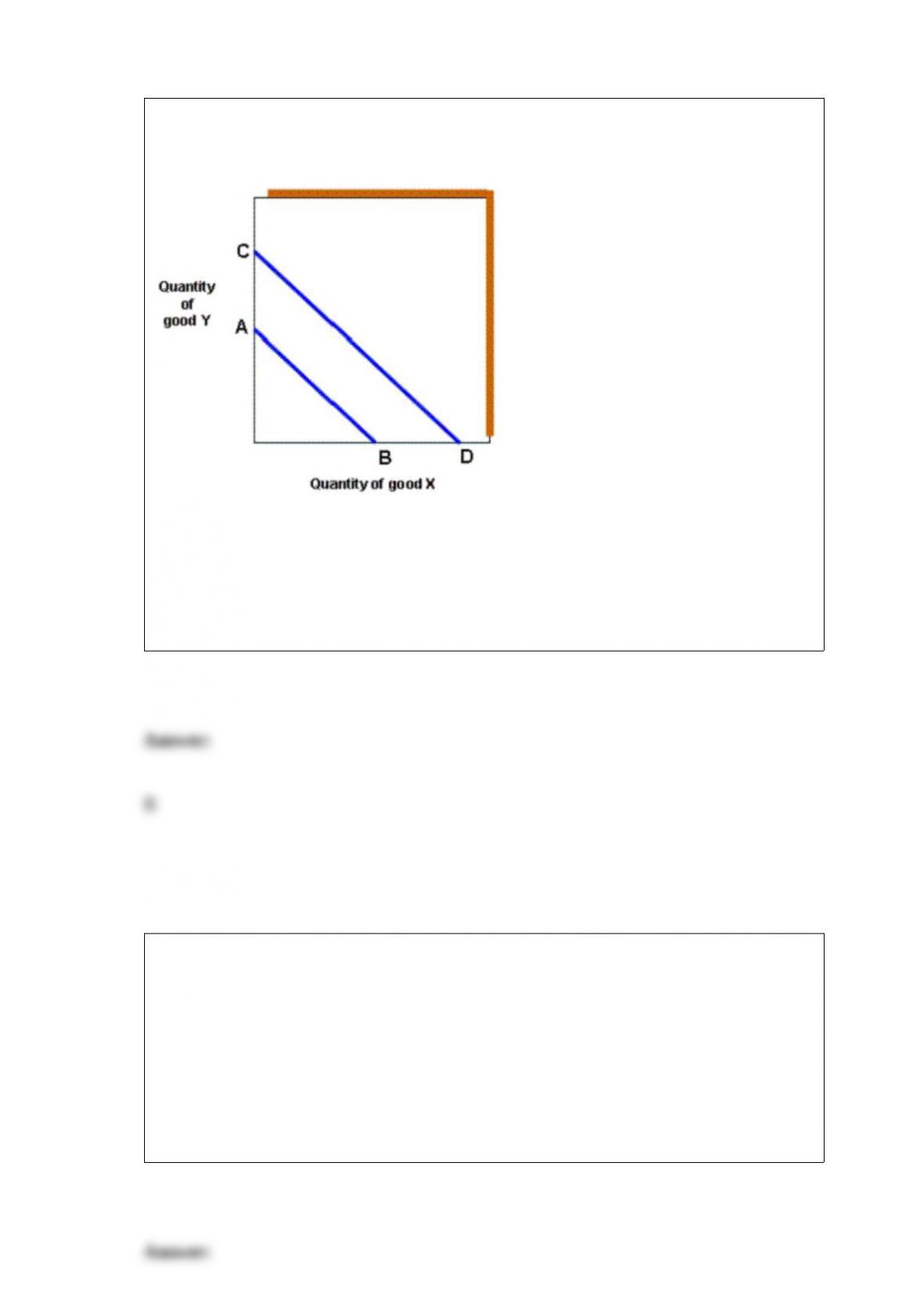
Exhibit 6A-1 Budget line
The ratio of the price of good X on the horizontal axis to the price of good Y on the
vertical axis is the ____ of the budget line.
a. marginal rate
b. slope
c. marginal utility
d. equalization rate
As a general rule, if pollution costs are external, firms will produce:
a. too little of a polluting good.
b. too much of a polluting good.
c. an optimal amount of a polluting good.
d. cannot be determined without additional information.

A technological breakthrough lowers the cost of manufacturing DVDs. As a result, the
market changes to a new equilibrium because of a(n):
a. upward movement along the demand curve for DVDs.
b. rightward shift in the demand curve for DVDs.
c. rightward shift in the supply curve for DVDs.
d. shortage of DVDs.
A profit-maximizing monopolist will continue expanding output as long as:
a. marginal revenue exceeds marginal cost.
b. marginal revenue is positive.
c. the cost of producing an additional unit exceeds the marginal revenue derived from
the unit.
d. economic profit is more than zero.
Exhibit 11-10 Labor and wage rate data
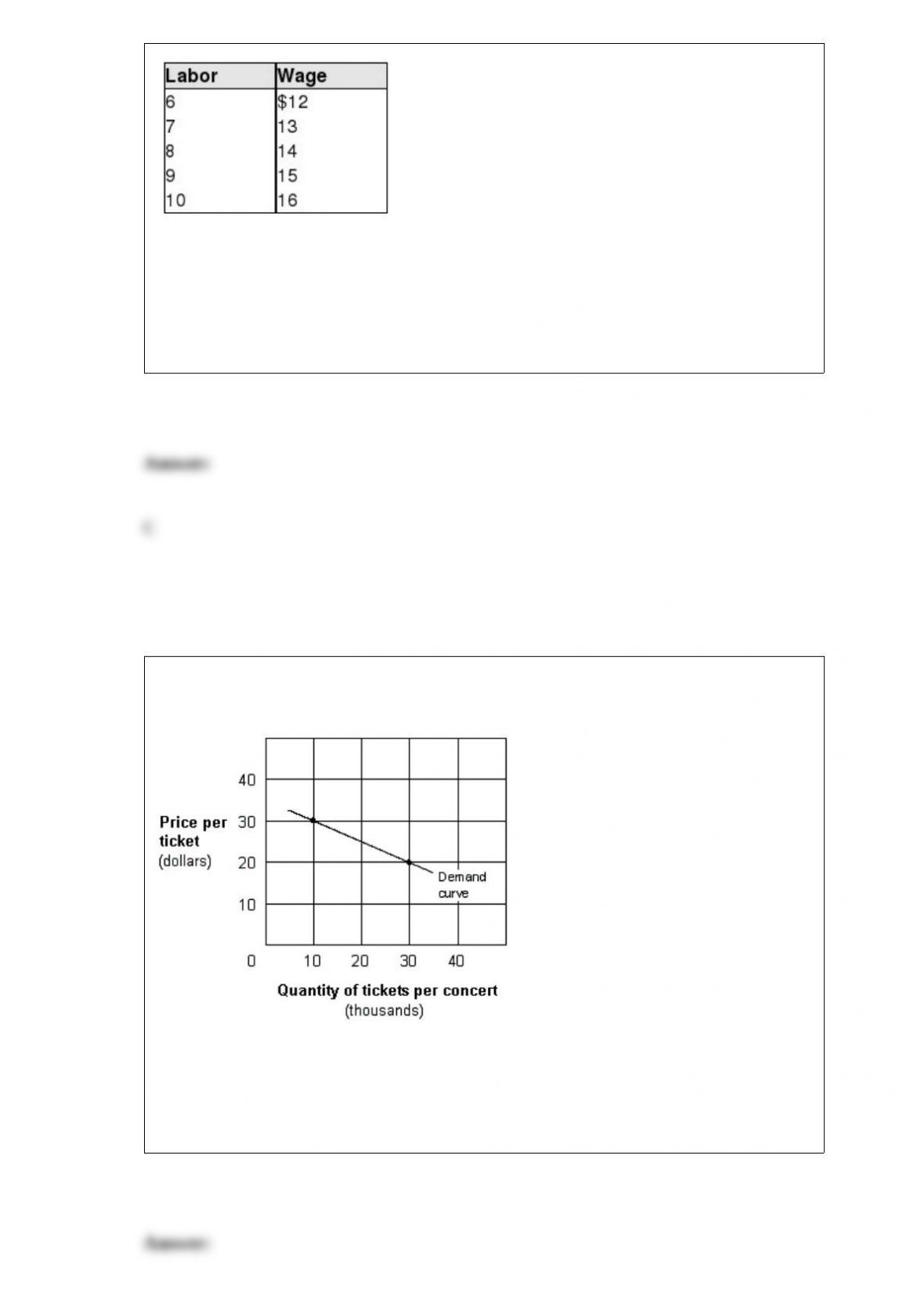
In Exhibit 11-10, the marginal factor cost of the 8th employee is:
a. $14.
b. $13.
c. $21.
d. $23.
e. $112
Exhibit 5-6 Demand curve for concert tickets
In Exhibit 5-6, if promoters lower their ticket price form $30 to $20, then:
a. they will receive less money from their ticket sales.
b. people will continue to buy the same number of tickets.
c. customers will spend less total money on concert tickets.
d. both ticket sales and total revenue will rise.

Elasticity has which special meaning for economists?
a. b and c.
b. A ratio of percentage changes.
c. How easily prices adjust to market changes.
d. How price changes as quantities demanded change.
e. When consumers will no longer react to price changes.
Suppose Alice sells a good for $60 on eBay. If the producer surplus from the sale is
$25, Alice’s cost of the good must have been:
a. $35. c. $60.
b. $25. d. $85.
The landmark antitrust case which established that size alone is not sufficient to prove
an antitrust violation is the:
a. U.S. Steel case.
b. Brown Shoe case.
c. Von’s Grocery case.
d. ALCOA case.
e. Pabst Brewing case.
A price-discriminating monopoly charges the lowest price to the group that:
a. has the most elastic demand.
b. purchases the largest quantity.
c. engages in the most arbitrage.
d. is least responsive to price changes.
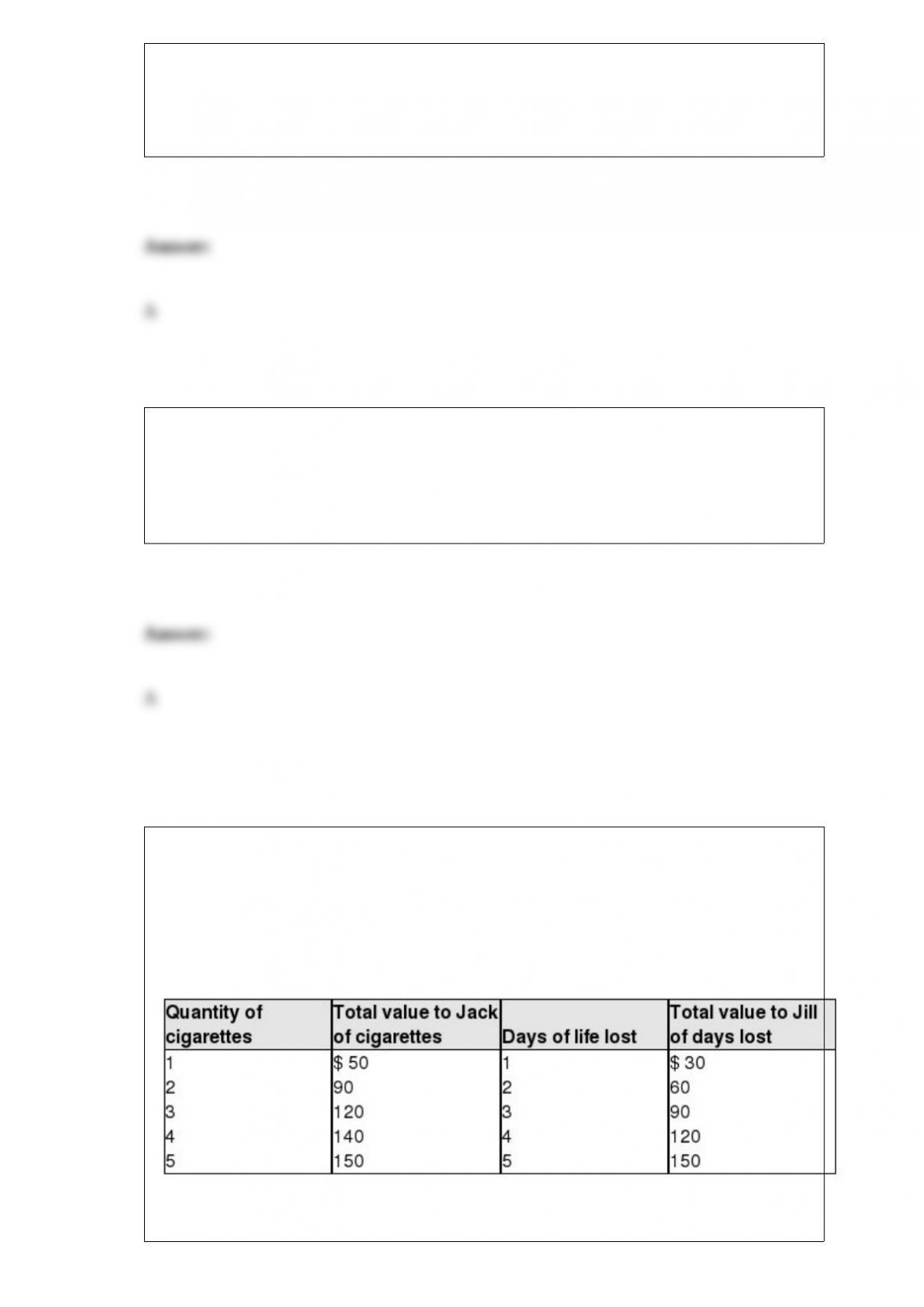
Exhibit 14-2 Cigarette smoking data
Jack enjoys smoking, while Jill fears that second-hand smoke will shorten her life. The
following table shows the value Jack places on each cigarette he smokes, and the value
Jill places on her shortened life. Use the table to answer the following question(s):
As shown in Exhibit 14-2, what is the socially efficient number of cigarettes?

a. 0. c. 3.
b. 1. d. 5.
If the price of tea is below its equilibrium level, then:
a. the demand for tea will decrease. c. sellers will be stuck with unsold tea.
b. the market for tea has cleared. d. there is a shortage of tea.
The marginal revenue product curve is:
a. c and d are correct.
b. c and e are correct.
c. given by the marginal product curve multiplied by the price of the good.
d. the marginal contribution of an additional worker to firm’s revenues.
e. the change in total cost that results from employing an additional worker.

People are unlikely to choose to pay extra for a low-emissions automobile, because
they:
a. do not fully understand the environmental benefits of lower emissions.
b. are better off “free-riding” on others’ attempts to reduce emissions.
c. would have to sacrifice fuel efficiency and automotive performance.
d. cannot afford the extra expense of “green” technology.
If the price of a product falls below average total cost in the short run, the firm:
a. has an economic profit.
b. cannot cover total fixed costs.
c. experiences a loss.
d. must always shut down.
e. should expand output until MC = MR.
Price discrimination occurs when:
a. firms maximize their profit by setting price equal to marginal cost.
b. a seller charges different prices to different consumers of the same product or service.
c. a seller charges the same price to consumers of a different product or service.
d. a seller charges different prices to consumers, discriminating by race or gender of the
consumer.
Which of the following is the best example of a firm operating in a monopolistically
competitive market?
a. A Kansas wheat farmer. c. U.S. Postal Service.
b. TGI Fridays, a family restaurant. d. Boeing, an aircraft manufacturer
The account which records a nation’s foreign economic transactions is called the:
a. Trade Account. c. Exchange Market.
b. T account. d. Balance of Payments.
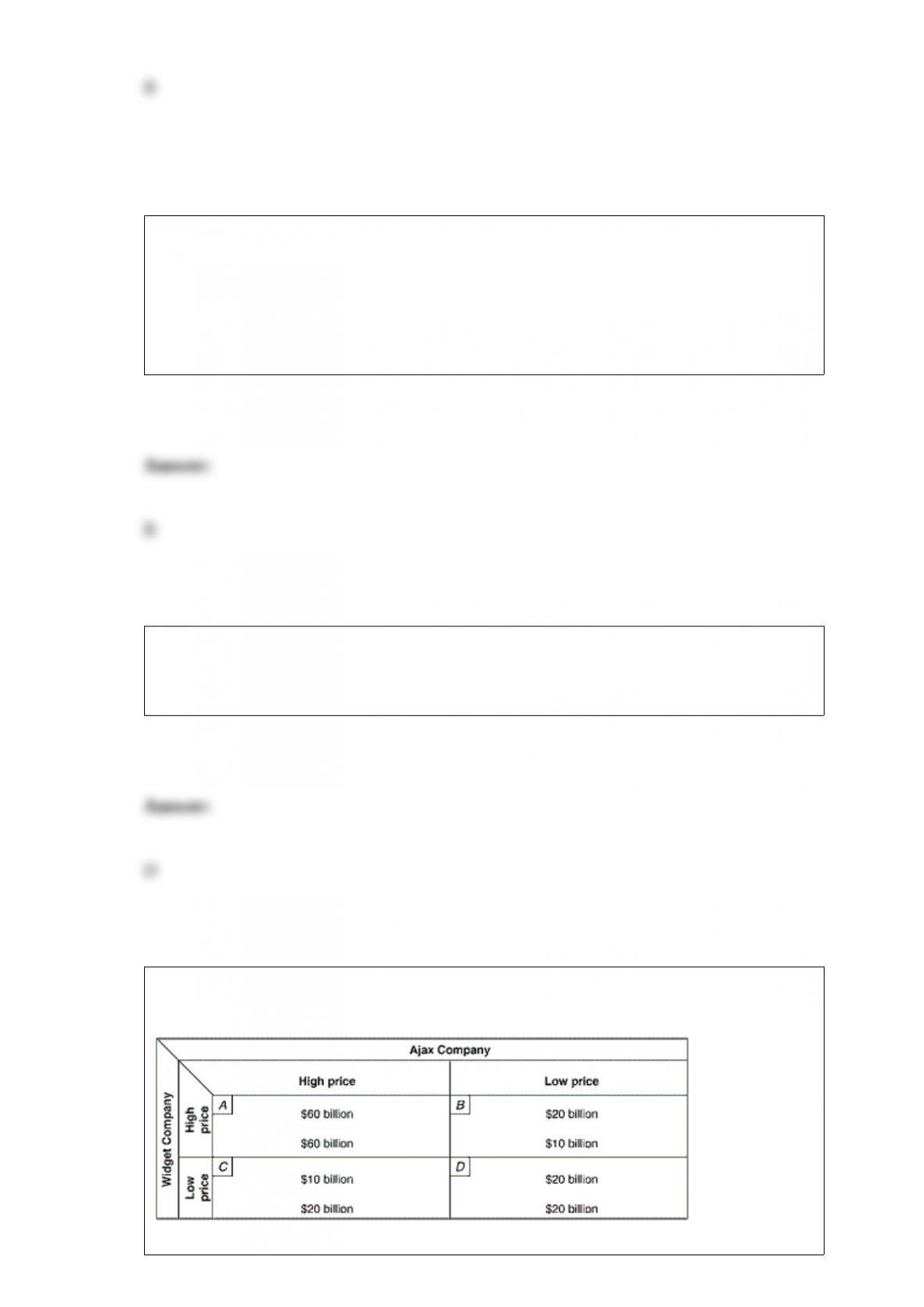
Exhibit 10-6 Two-Firm Payoff Matrix

Suppose costs are identical for the two firms in Exhibit 10-6. Each firm assumes
without formal agreement that if it sets the high price its rival will not charge a lower
price. Under these “tit-for-tat” conditions, equilibrium will be established by:
a. Widget Co. charging the high price and Ajax Co. charging the low price.
b. Widget Co. charging the high price and Ajax Co. charging the high price.
c. Widget Co. charging the low price and Ajax Co. charging the low price.
d. Widget Co. charging the low price and Ajax Co. charging the high price.
If total utility increases from 10 to 15 for the second unit of a good consumed, the
marginal utility of the second unit is 5.
Indifference curve analysis is based on numerical measurement of utility.

Assume a price floor is set above the equilibrium price. The result is a shortage.
Tariffs help consumers by lowering the price of imported goods.
Economics is the study of decisions made necessary by the problem of unlimited wants
and limited means to satisfy them.
Other things being equal, a fall in the price of Coca-Cola will increase the quantity of
Coca-Cola demanded.

A budget line represents all combinations of bundles of two goods that give a consumer
equal total utility.
An improvement in technology that increases the marginal product will shift the
demand for labor curve to the left.