
Economics is the study of how people:
a. vote for political leaders who decide what is to be produced.
b. make choices to produce and consume goods and services.
c. establish social institutions that maximize well-being.
d. develop value systems that affect their consumption choices.
Governments seeking to maximize total tax revenue will place unit taxes on goods with
the:
a. b and c.
b. lowest income elasticity.
c. highest cross elasticity.
d. lowest price elasticity.
e. fewest complements.
Which of the following is most likely to increase the supply of corn?
a. The farm worker’s union successfully negotiates a pay increase for corn harvest
workers.
b. The Surgeon General announces that eating corn bread contributes to baldness in
men.
c. Congress and the President eliminate subsidies formerly paid to corn farmers.
d. Farmers that grow soybeans can also grow corn, and the price of soybeans drops by
75 percent.

The kinked demand curve:
a. applies when competitors match price decreases but not price increases.
b. could apply to market demand in any market structure.
c. applies when competitors match price increases but not price decreases.
d. applies to the price leadership model.
e. applies when competitors act independently.
The price of a good will fall if:
a. there is an excess demand of the good.
b. demand and supply of the good are the same.
c. there is an excess supply of the good.
d. the price is below the equilibrium price.
e. the price is near the equilibrium price.
In the long run, the economic profits of Hoot’s Chicken ‘n’ Ribs, a monopolistic
competitor, are:
a. not eliminated, because competition is not perfect.
b. not eliminated, because the demand curve slopes downward.
c. eliminated due to firms entering the industry.
d. eliminated due to firms leaving the industry.
e. not eliminated, because firms cannot enter the industry.
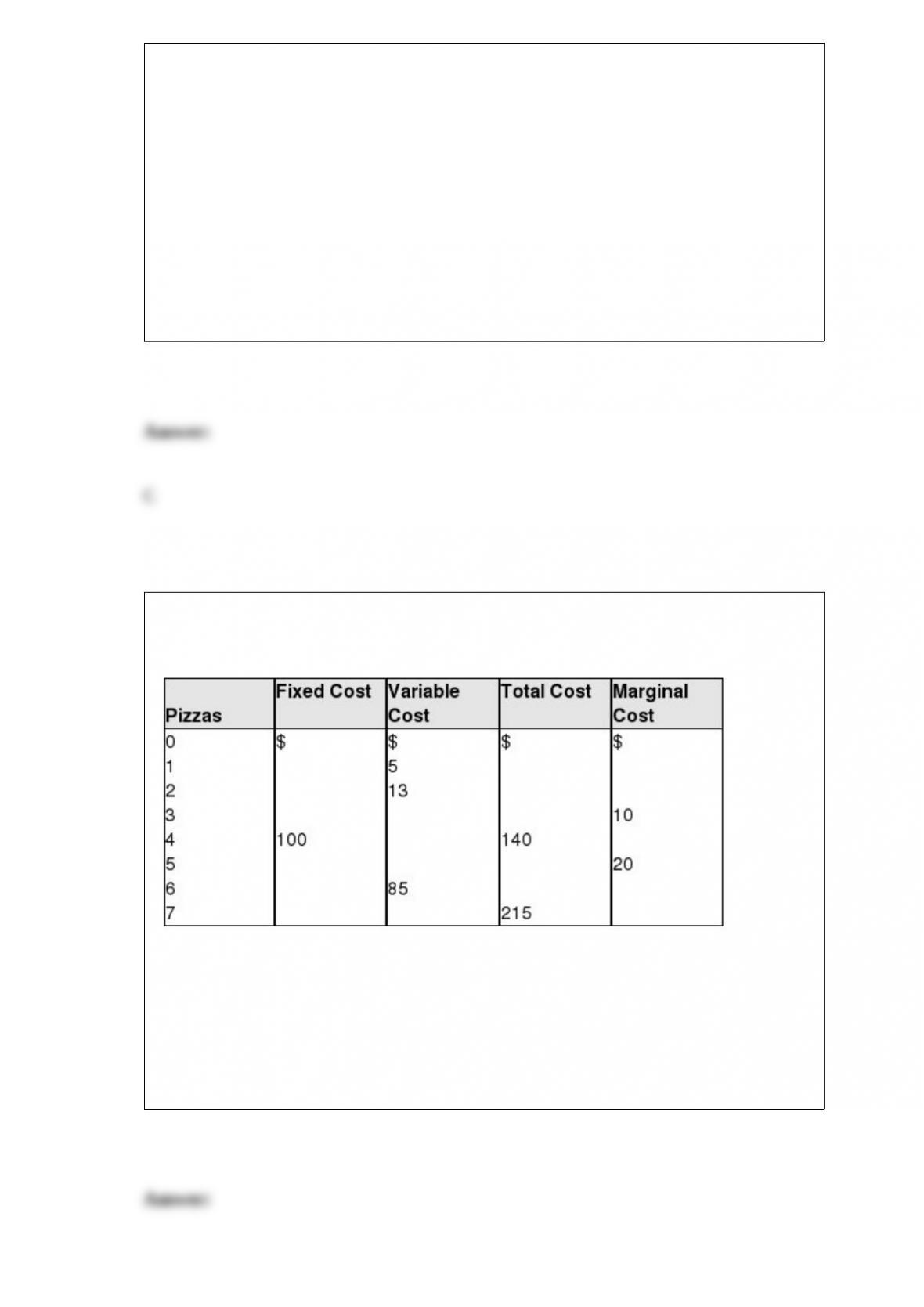
Exhibit 7-8 Costs schedules for producing pizza
By filling in the blanks in Exhibit 7-8, the total cost of producing 3 pizzas is shown to
be equal to:
a. $100.
b. $105.
c. $113.
d. $123.
e. $23.

Under a rule of reason approach, an act is illegal:
a. only if it is shown to result in an anticompetitive outcome.
b. if two parties merge.
c. if a firm engages in price discrimination.
d. if two firms engage in price fixing.
e. if two firms undertake a joint venture
Assume a monopolist’s marginal cost and marginal revenue curves intersect and the
demand curve passes above its average total cost curve. The firm will:
a. make an economic profit.
b. stay in operation in the short run, but shut down in the long run.
c. shut down in the short run.
d. lower the price.
A farm is able to produce 5,000 bushels of peaches per season on 100 acres. Assume it
adds one more acre and is able to produce 6,000 bushels per season. The marginal
product of the additional acre of land for this farm is:
a. 6,000 bushels per acre per year.
b. 5,000 bushels per acre per year.
c. 1,000 bushels per acre per year.
d. 11,000 bushels per acre per year.
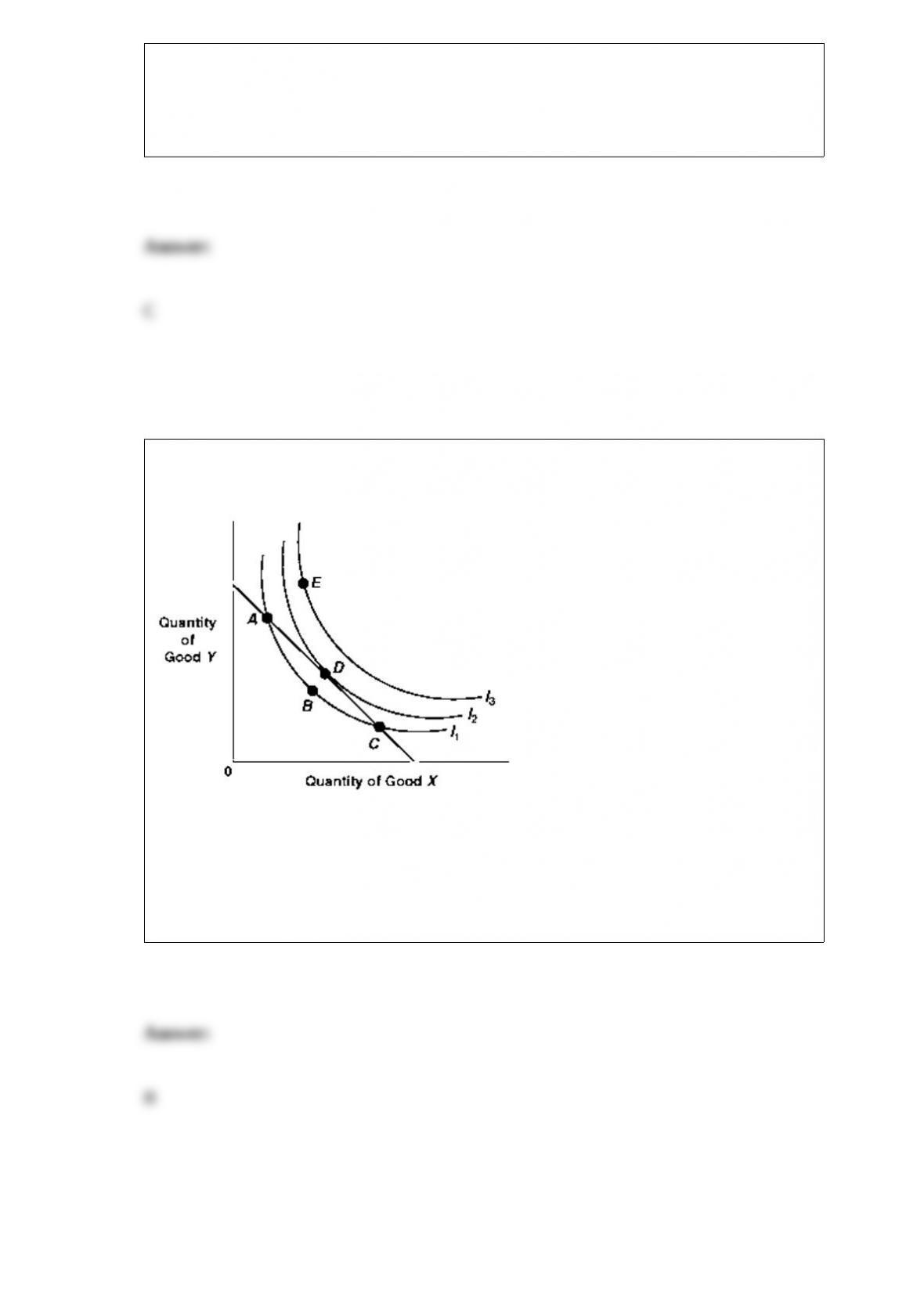
Exhibit 6A-3 Consumer equilibrium
Given the budget line and indifference curves shown in Exhibit 6A-3, at point D:
a. Px exceeds Py.
b. MRS = Px / Py.
c. MUx= MUy.
d. MRS = Py / Px.

Microeconomics deals with the analysis of all the following questions except how:
a. the wages of carpenters are determined.
b. high did unemployment rise during the Great Depression.
c. does Ford decide how to price its cars.
d. does a college student decide how to spend her income.
e. do monopolies and competitive markets differ.
If there is employment discrimination against minorities, this will cause the:
a. supply of their services to increase, and their wages to fall.
b. demand for their services to decline, and their wages to fall.
c. supply of their services to decline, and their wages to rise.
d. demand for their services to decline, and their wages to rise.
Exhibit 15-3 Potatoes and wheat output (tons per day)
In Exhibit 15-3, the United States has a comparative advantage in producing:
a. potatoes. c. both.
b. wheat. d. neither.

The Celler-Kefauver Act of 1950 amended the:
a. Sherman Antitrust Act. c. Federal Trade Commission Act.
b. Clayton Act. d. Robinson-Patman Act.
Total producer surplus is measured by the total area under the equilibrium price and
below the supply curve.
The substitution effect is the concept that changes in consumption of a good result from
changes in the relative price of a competing good.

If a monopsonist’s labor supply curve is positively sloped, the marginal factor cost
(MFC) will be below the wage rate.
Absolute advantage governs the potential for gains from trade.
According to the infant industry argument, a new domestic industry needs protection
because it has higher costs than established foreign competitors.
An increase in the demand for a product will shift the demand curve for labor producing
the product to the left.