
Farmers can choose to produce eggs or milk. If there is an increase in the price of milk
then what will be the effect in the egg market?
a. The quantity of eggs demanded will increase.
b. Egg demand will decrease.
c. Egg supply will increase.
d. Egg supply will decrease.
Which of the following is a key criticism of the market economy as a system of
allocation?
a. Goods and services are allocated unequally based on ability to pay.
b. Producers have strong incentives to innovate because successful innovators are
rewarded with higher profit.
c. Consumers can transmit their preference for product quality and variety by way of
their ‘dollar votes’ cast in the marketplace. Since price is freely set based on supply and
demand, there are few shortages or surpluses.
d. None of the above.
Which of the following could cause the supply of carrots to decrease?
a. Consumers’ incomes decrease.
b. There is a technological advance in carrot production.
c. Fertilizer costs increase.
d. The number of farmers growing carrots increases.
e. The price of carrots decreases.

A monopolist will maximize profits by:
a. setting his price as high as possible.
b. setting his price at the level that will maximize per-unit profit.
c. producing the output where marginal revenue equals marginal cost.
d. producing the output where price equals marginal cost.
The Robinson-Patman Act is primarily concerned with:
a. mergers.
b. price fixing.
c. price discrimination.
d. monopoly.
e. unfair and deceptive practices.

Which of the following is true in a market economy?
a. Central planners determine answers to the basic economic questions.
b. Resources are used efficiently.
c. The distribution of wealth is equal.
d. Information for production and distribution decisions pass directly to buyers from the
government.
As more bananas are consumed, other things constant, marginal utility tends to decrease
at:
a. the same rate for all people.
b. the same rate for all goods for a given person.
c. the same rate for all people.
d. different rates for different people and for other goods.
e. different rates for different people, but at the same rate as other goods.
The opportunity cost of an activity means the:
a. amount of money the activity costs.
b. number of hours that is required to engage in this activity.
c. expected gains by engaging in the activity.
d. amount of other things that must be sacrificed in order to engage in the activity.

e. expected gains minus the expected costs of engaging in the activity.
The firm’s demand for labor curve is exactly the same as the:
a. wage rate.
b. price of the output.
c. MRP curve.
d. MP curve.
e. labor supply curve.
Total fixed cost are costs that are fixed with respect to:
a. the rate of output.
b. time.
c. technology.
d. the minimum wage or price supports.
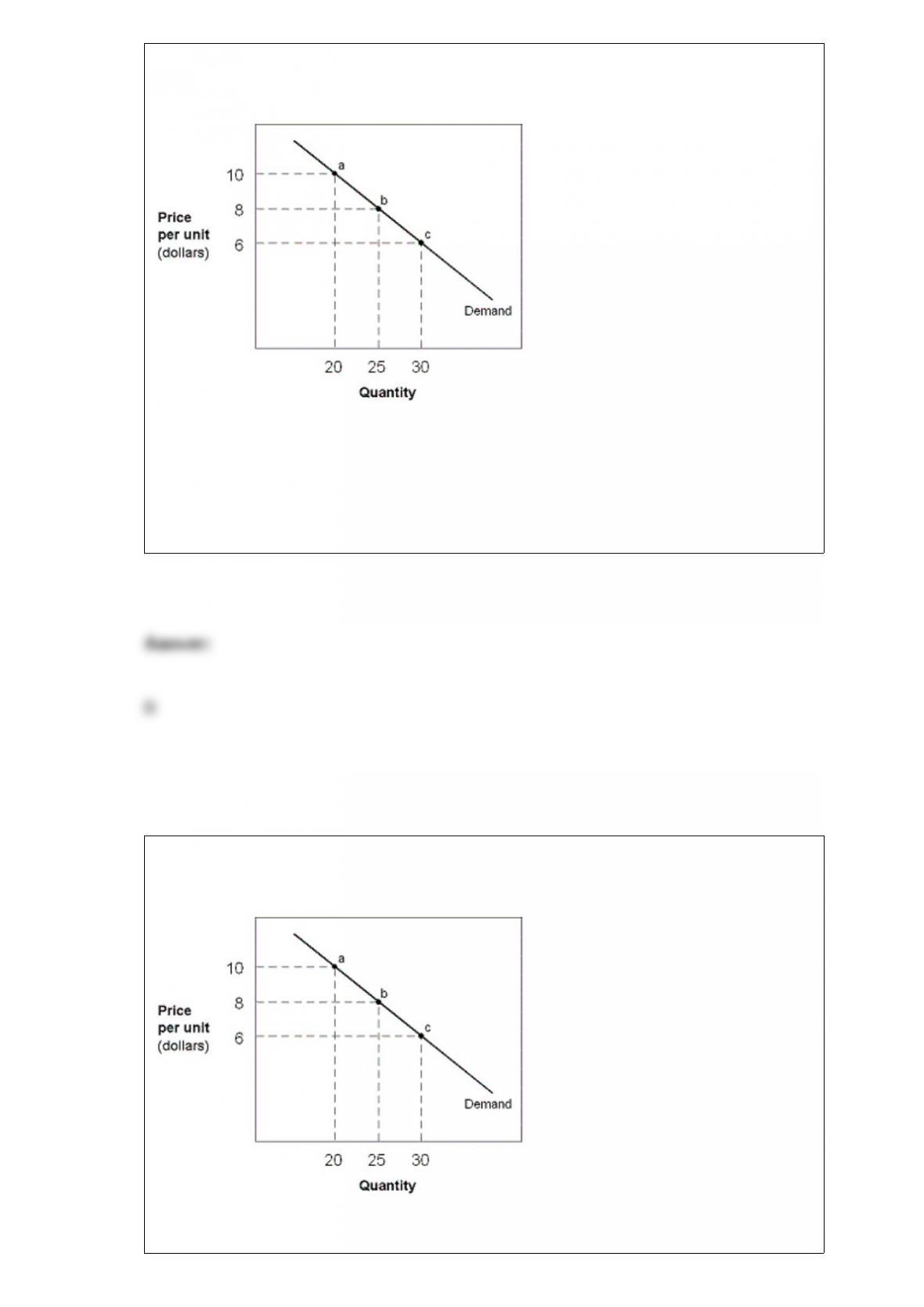
Exhibit 5-1 Demand curve
In Exhibit 5-1, the demand curve between points b and c is:
a. price elastic.
b. price inelastic.
c. unit elastic.
d. perfectly elastic.
e. perfectly inelastic.
Exhibit 5-1 Demand curve
In Exhibit 5-1, between points a and b, the price elasticity of demand measures:
a. 0.67.

b. 1.5.
c. 2.0.
d. 1.56.
e. 1.0.
If the United Auto Workers union can obtain a substantial wage increase for auto
workers, there will be a(n):
a. decrease in the supply of automobiles, which is a shift to the right of the supply
curve.
b. decrease in the supply of automobiles, which is a shift to the left of the supply curve.
c. increase in the supply of automobiles, which is a shift to the right of the supply curve.
d. increase in the supply of automobiles, which is a shift to the left of the supply curve.
Natural resources are:
a. not considered scarce because no one pays for them.
b. only desired for use in producing other goods.
c. included in the category of resources called land.
d. available in unlimited quantities.
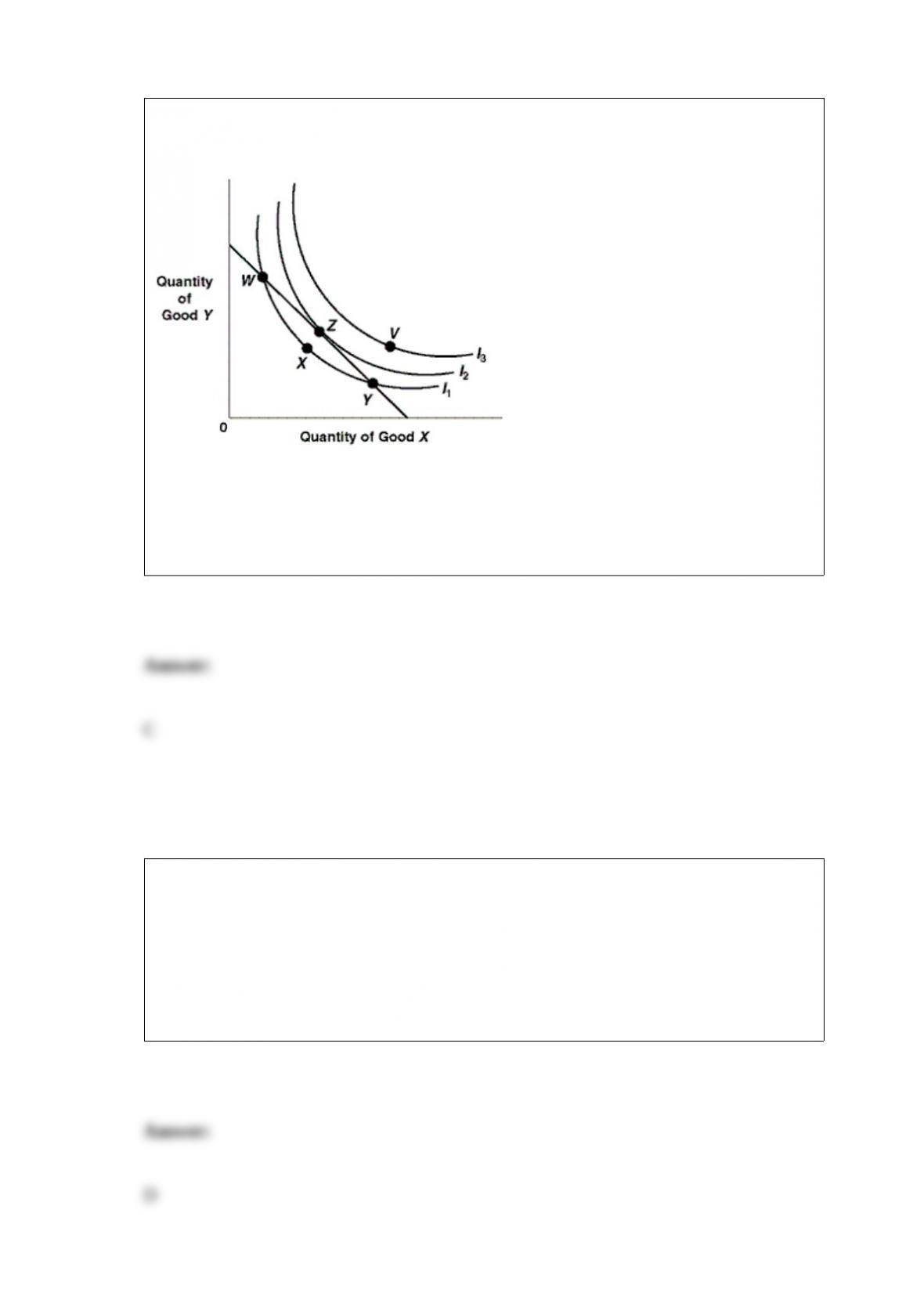
Exhibit 6A-2 Consumer equilibrium
Given the budget line and indifference curves shown in Exhibit 6A-2, point V is:
a. inferior to point X.
b. lowest attainable level of total utility.
c. unobtainable.
d. consumer equilibrium.
Which of the statements below does not describe a demand curve that is unit elastic?
a. The percentage change in the quantity demanded = percentage change in product
price.
b. An increase in product price will not change total revenue.
c. The price elasticity of demand equals one.
d. A change in price does not change quantity demanded.
e. A decrease in product price will not change total revenue.

Which of the following will increase the demand for large automobiles?
a. A fall in the price of small automobiles.
b. A rise in insurance rates for large automobiles.
c. A fall in the price of large automobiles.
d. A rise in buyers’ incomes (assuming large automobiles to be a normal good).
A product would be more demand price elastic:
a. the shorter the time the consumer has to adjust to price changes.
b. the lower the price of the good.
c. the fewer the number of good substitutes.
d. the less the essential nature of the good.
e. if the supply is more price elastic.
If the United States were to adopt a policy of free trade with European countries and
Japan, this policy would:
a. help the United States and hurt the other countries because the United States has a
larger population.
b. help all of the countries involved because every country would have a comparative
advantage in the production of some goods.
c. hurt all of the countries involved because all the countries are capable of producing
anything that could be produced in one of the other countries.
d. help the United States and hurt the other countries because the United States has
more natural resources than the other countries.
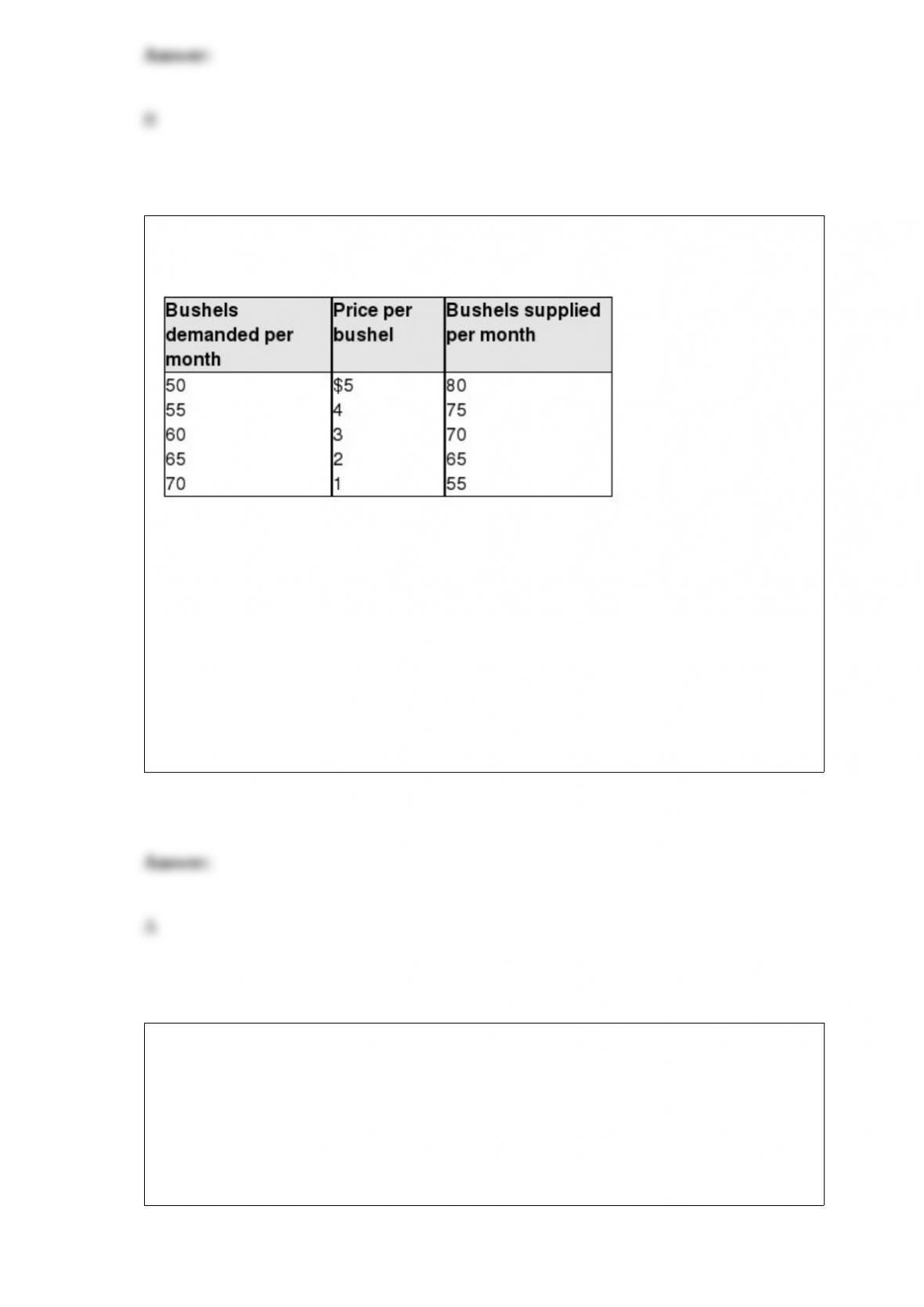
Exhibit 4-10 Supply and demand data for apricots
Which of the following would occur if the government set a price ceiling of $1 in the
market shown in Exhibit 4-10?
a. There would be a shortage of apricots.
b. Buyers would not want to purchase all of the apricots that are supplied.
c. There would be a surplus of apricots.
d. Farmers would reduce the number of acres allocated to the growing of apricots.
Which of the following would be recorded in the U.S. goods export account?
a. Harry, an American citizen, spends 1,000 francs on vacation in the south of France.
b. A machine shop in Ohio purchases a grinder made in Italy.
c. Martha receives a $50 dividend check on stock she owns in a business in Germany.
d. The U.S. government subsidizes American farmers for planting corn for export.
e. France purchases a new jet fighter aircraft from the Boeing Company in the United
States.
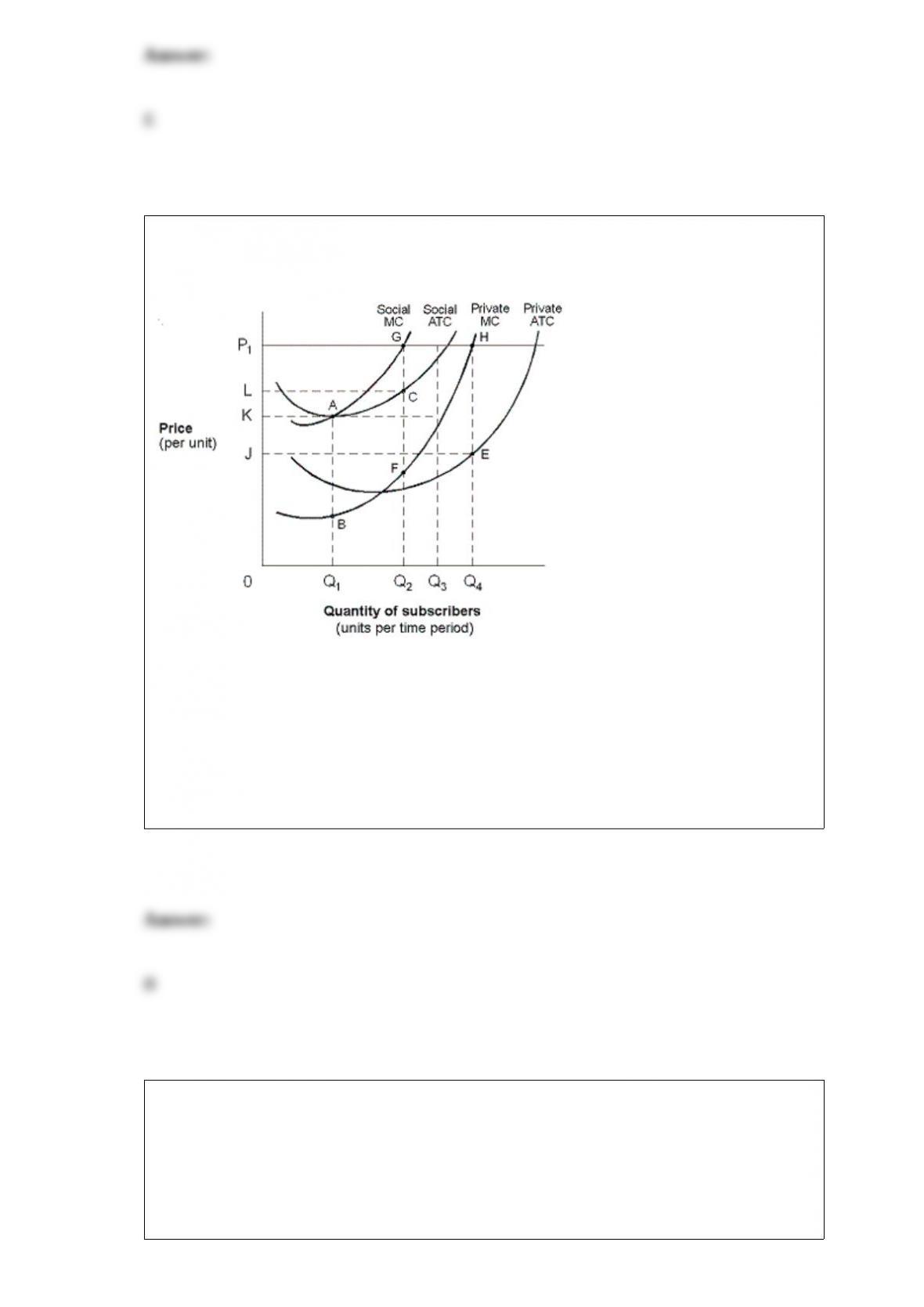
Exhibit 14-1 Private and social cost
Use Exhibit 14-1 to answer the following question. To maximize social welfare, the
firm should produce at the output rate:
a. zero. c. Q3.
b. Q2. d. Q4.
Exhibit 14-3 Impact of flights on house value
Each time Orville flies over Wilber’s house, the noise reduces the value of Wilbur’s
house. The table shows the profits to Orville of each flight, and the value of Wilbur’s
house.
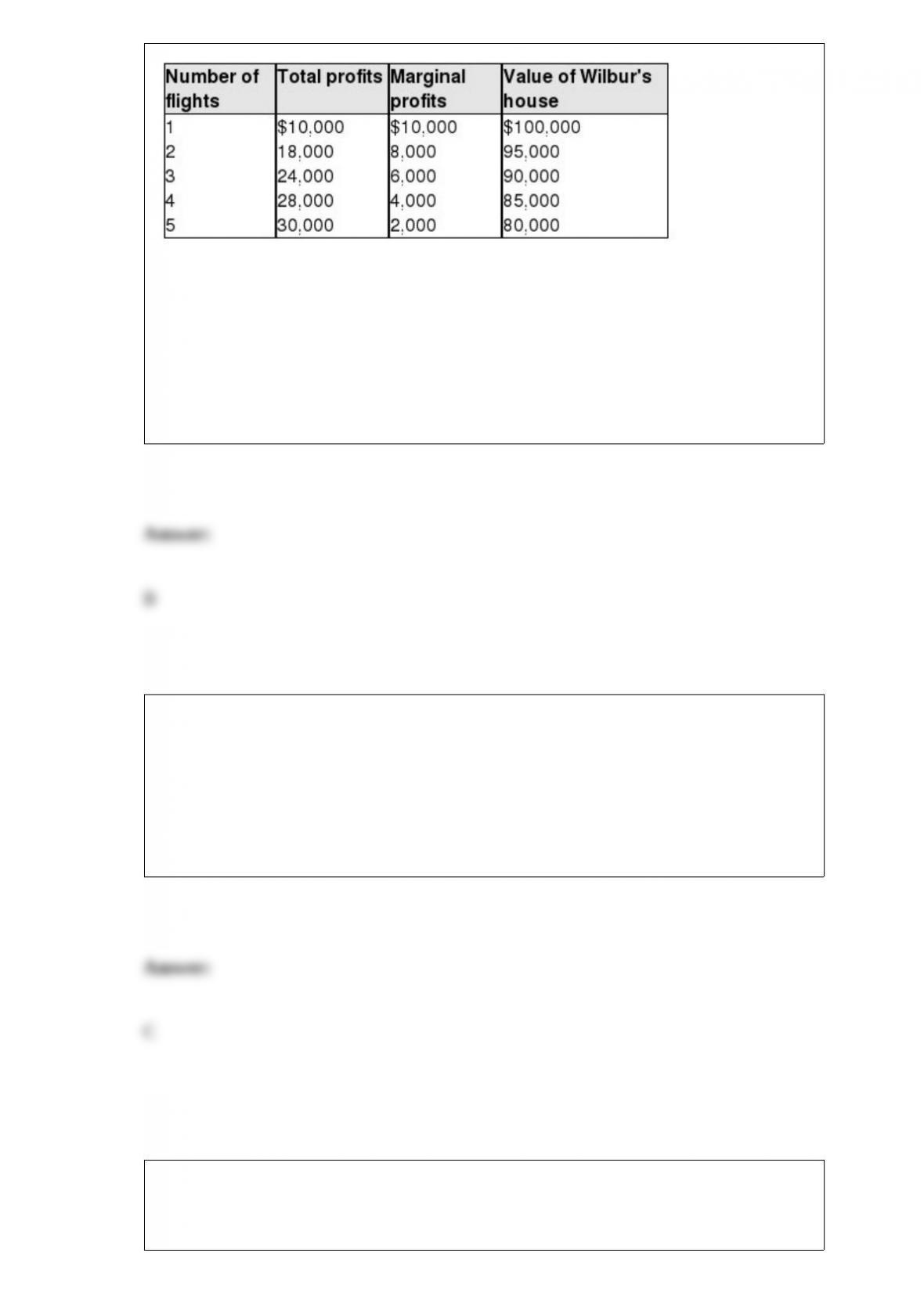
As shown in Exhibit 14-3, if Orville has the property right to fly over Wilbur’s house,
but Wilbur is allowed to negotiate with Orville on the number of flights, what will be
the number of flights?
a. 2. c. 4.
b. 3. d. 5.
Elasticity measures how ‘sensitive” consumers are by measuring their change in ____ as
the price of the product changes.
a. attitude
b. income
c. quantity demanded
d. supply
e. taxes
Perfect competition is a market structure in which there is:
a. a contest among firms to provide good service after the sale.
b. competition in product quality.
c. rivalry in product design.
d. none of these.
What are the characteristics of an oligopoly?
Abstracting from reality is an important element of all economic models.
When faced with an economic loss, a competitive firm will shut down its operations in
the short run.
A cartel is a formal agreement among firms to control price and output of a product.
You are the mayor of your home town, and one day you arrive at city hall to find angry
voters demonstrating against you. They are mad because your office created a
garbage-collection monopoly by awarding only one company a permit to collect
garbage in your town. The voters claim that the company is overcharging and providing
poor service. They want you to do something that will lower rates and improve service.
You call your staff economist, who presents evidence that there are substantial
economies of scale to garbage collection. What are your options if you are interested in
efficiency?
In a competitive labor market a firm will continue to employ workers for as long as an
additional worker’s marginal revenue product exceeds the wage rate.

To earn an economic profit in the short-run, a monopolist sets marginal revenue equal
to zero.
A pollution tax that is exactly equal to marginal external cost will shift the market
supply curve to the social-cost supply curve. This tax will thus correct the market
inefficiency due to negative externalities by causing price to reflect the full marginal
cost of production.