
Which of the following is true at the point where diminishing returns set in?
a. Both marginal product and marginal cost are at a maximum.
b. Both marginal product and marginal cost are at a minimum.
c. Marginal product is at a maximum and marginal cost at a minimum.
d. Marginal product is at a minimum and marginal cost at a maximum.
The first major piece of antitrust legislation was:
a. Clayton Act.
b. Celler-Kefauver Act.
c. Sherman Antitrust Act.
d. Rockefeller Act.
e. Robinson-Patman Act.
Using the Lorenz curve, the degree of income inequality is measured by the:
a. line connecting all points for which a given percentage of families receives exactly
that cumulative percentage of income.
b. distance of the Lorenz curve from the line of perfect equality.
c. flat diagonal line that applies to a perfectly elastic demand curve.
d. number of times the Lorenz curve crosses the line of perfect equality.
At the equilibrium price, deadweight loss is:
a. minimized.
b. zero.
c. maximized.
d. equal to the equilibrium price multiplied by the quantity exchanged.
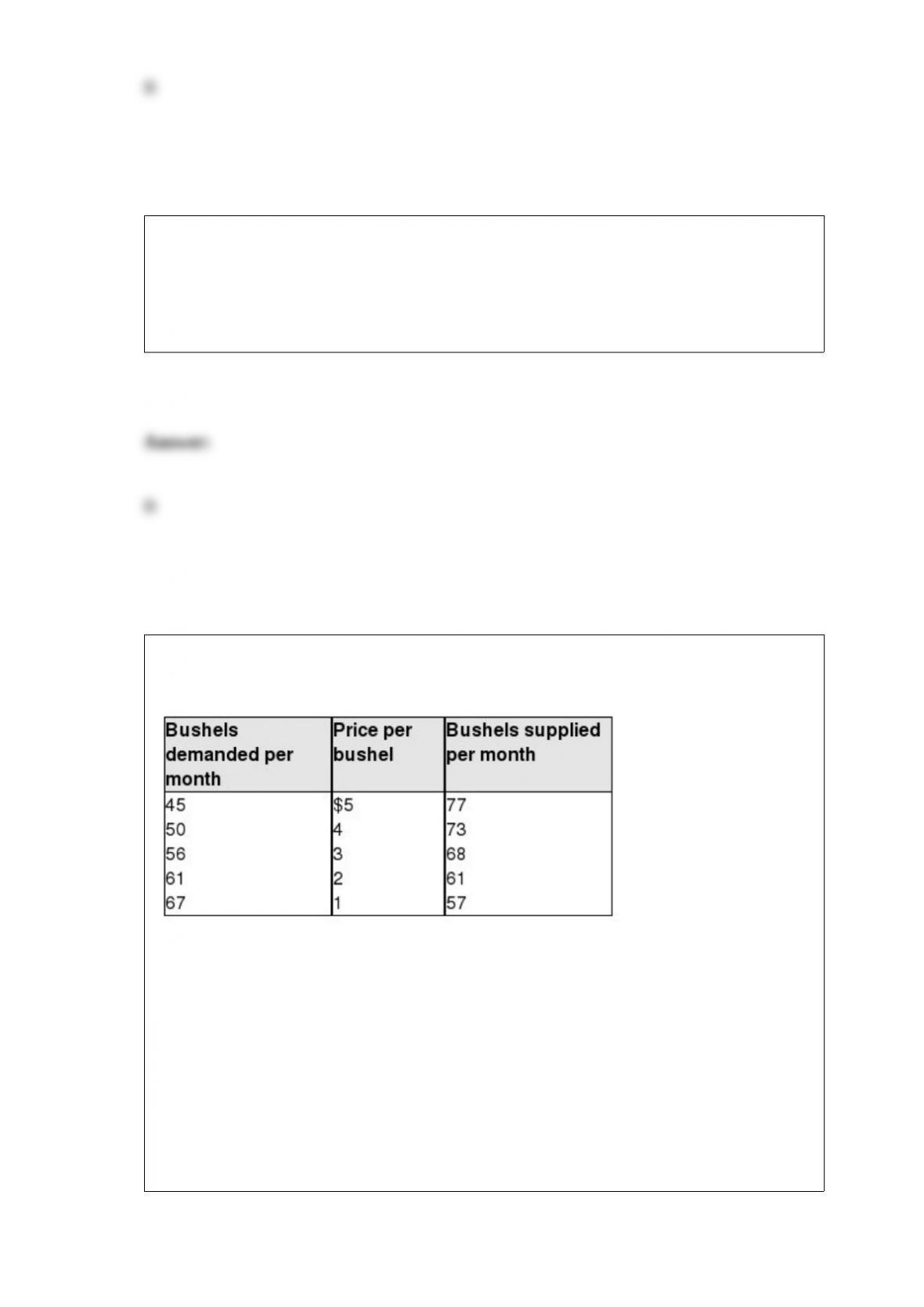
Exhibit 4-11 Data on supply and demand
Which of the following would occur if the government imposed a price floor (support
price) of $4 per bushel in the wheat market shown in Exhibit 4-11?
a. Buyers would want to purchase more wheat than is supplied.
b. Buyers would not purchase all of the wheat grown.
c. Shortage of wheat would increase the price of wheat.
d. Farmers would grow less wheat.
In order for Ethiopia to increase its future economic growth, it must choose a point that
is:
a. below its production possibilities curve.
b. further along on its production possibilities curve toward the capital goods axis.
c. further along on its production possibilities curve toward the consumption goods
axis.
d. further along on its production possibilities curve away from the population axis.
e. above its production possibilities curve.
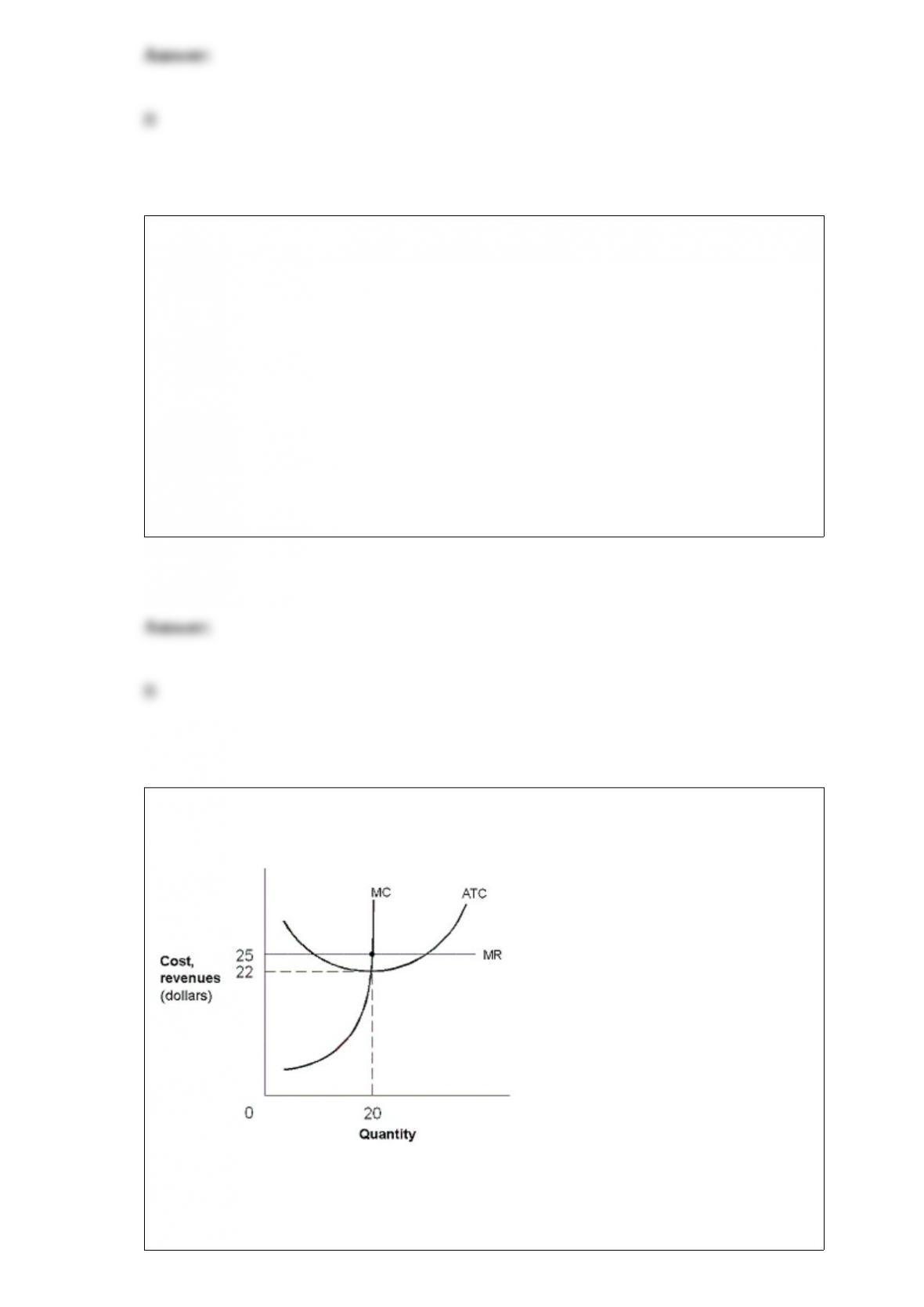
Exhibit 8-7 A firm’s cost and MR curves
In Exhibit 8-7, if this firm is currently producing 20 units of output, this firm:
a. is at its profit-maximizing point.
b. is losing $20.
c. is earning a total profit of $60.

d. should shut down.
e. is earning a total profit of $3.
All of the following apply to the description of a market in equilibrium except:
a. quantity supplied equals quantity demanded.
b. the intersection of the supply and demand curves.
c. no excess supply exists.
d. no excess demand exists.
e. the price of the good is falling.
Exhibit 11-3 Labor supply curve

In Exhibit 11-3, the wage for the 6th employee is equal to:
a. $18.
b. $36.
c. $3.
d. $108.
e. unable to determine with this information.
A market situation where a small number of sellers dominate the entire industry is
called:
a. monopolistic competition. c. monopoly.
b. monopsony. d. oligopoly.
The social security tax is called FICA, which stands for:
a. Federal Investment Corporation of America.
b. Federal Income Contributions to Americans.

c. Funding from Individuals and Corporations in America.
d. Federal Insurance Contributions Act.
If the MRP of labor decreases, labor:
a. demand will decrease.
b. demand will increase.
c. supply will increase.
d. supply will decrease.
e. demand and supply will be unaffected.
As the period for firms to expand output is lengthened, the elasticity of the market
supply curve will:
a. approach zero.
b. increase.
c. decrease.
d. remain the same since time does not affect the elasticity of market supply.

Firms in a monopolistically competitive market structure maximize their profit by
producing an output where:
a. price equals average total cost.
b. marginal cost equals average total cost.
c. marginal cost equals price.
d. marginal revenue equals marginal cost.
Assume the price of Coca-Cola increases. As a result, your real income decreases and
you decrease the quantity of Coca-Cola purchased each month. This is an example of
the:
a. income effect. c. revenue effect.
b. consumer price effect. d. substitution effect.
Compared to a perfectly competitive firm, a monopolist:
a. charges a higher price.
b. produces lower output.
c. fails to achieve an efficient allocation of resources.
d. all of these.
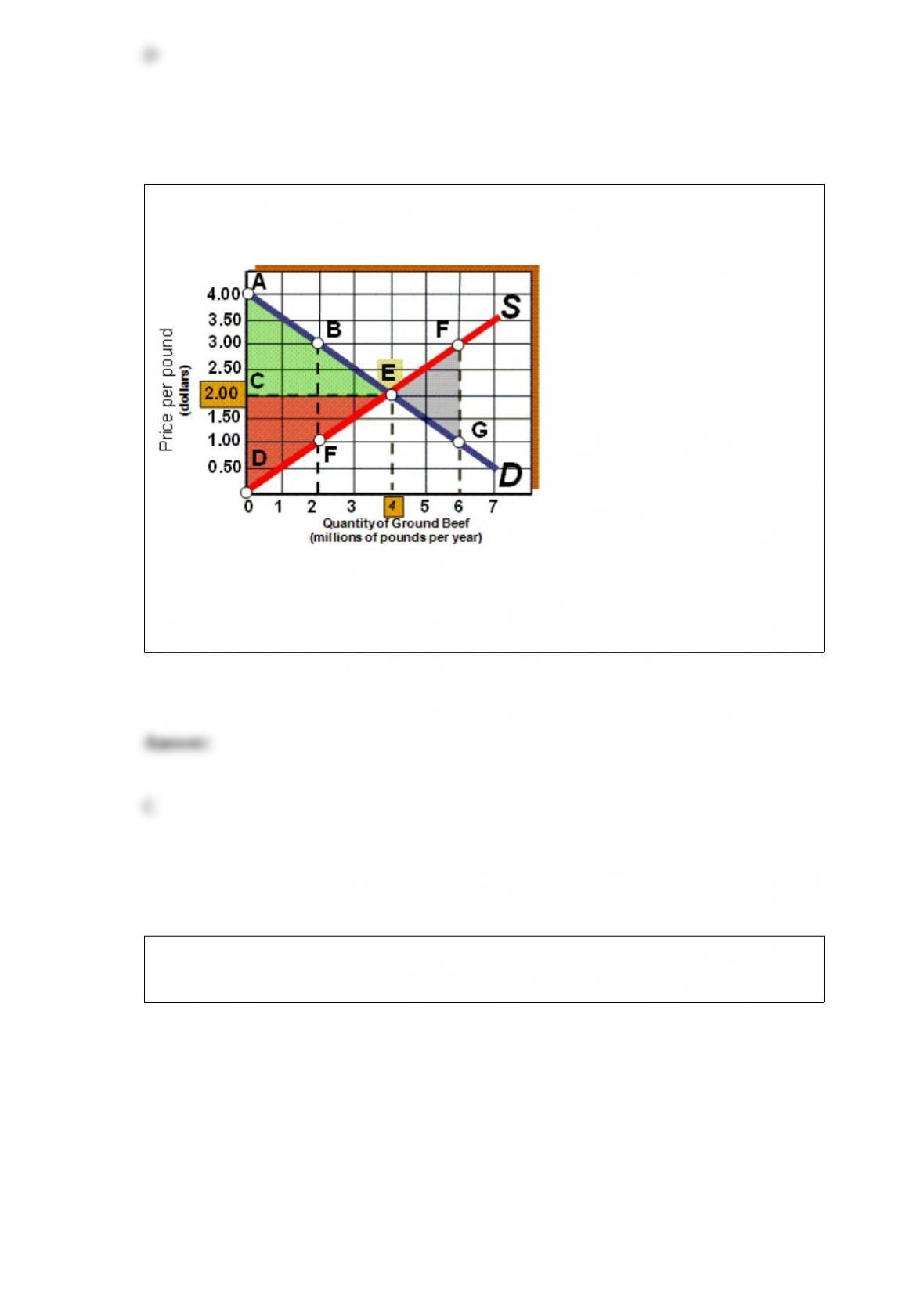
Exhibit 3A-1 Comparison of Market Efficiency and Deadweight Loss
As shown in Exhibit 3A-1, if the market price falls from $2.00 to $1.00, then area ____
appears.
a. ABEFD c. EGF
b. ABEC d. BEF
Exhibit 2-5 Production possibilities curve
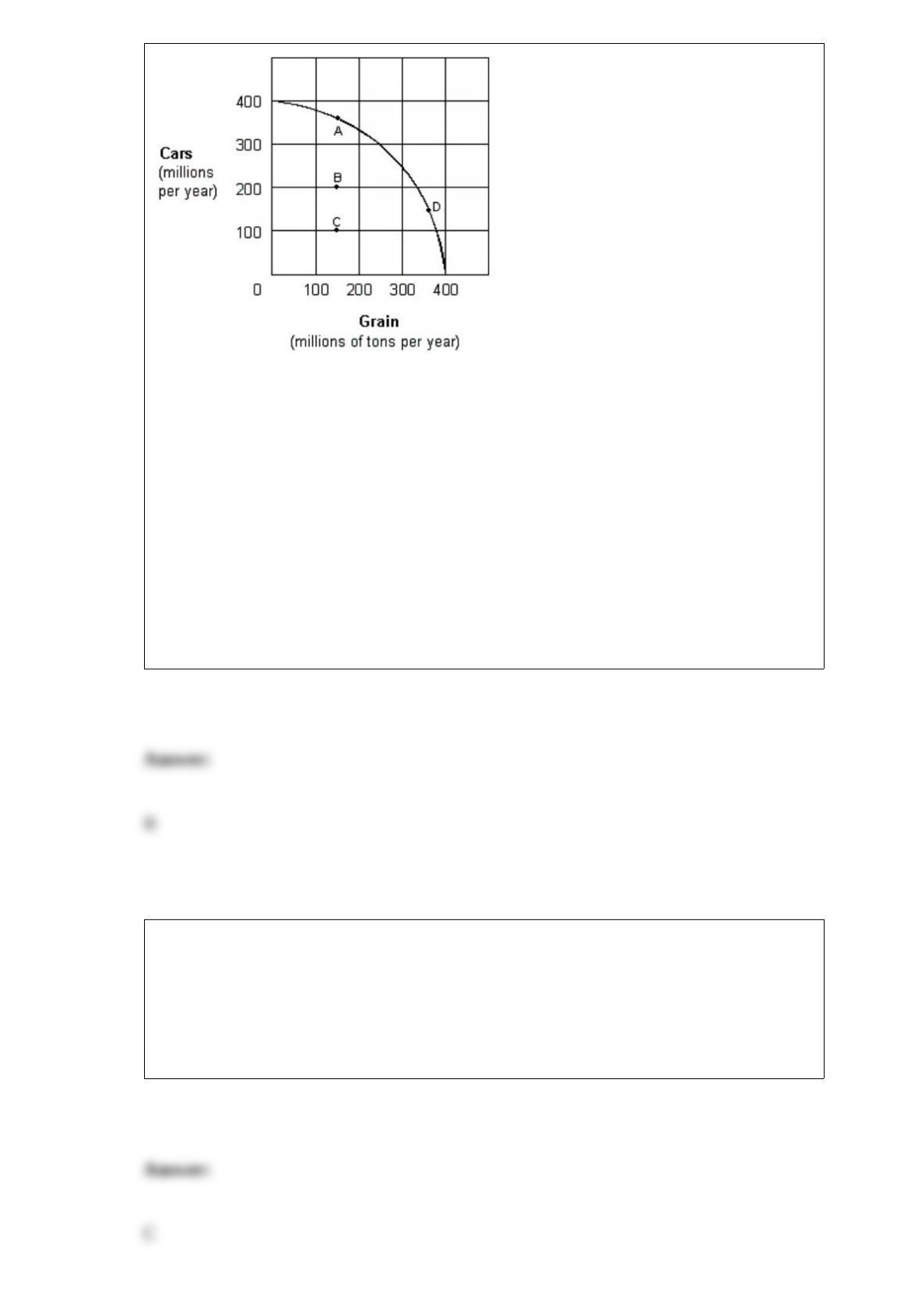
In Exhibit 2-5, movement between which of the following points represents an increase
in economic efficiency?
a. A to C.
b. C to D.
c. D to B.
d. A to B.
e. A to D.
The antitrust law that prohibits firms from combining or conspiring to restrain trade in
interstate commerce is the:
a. Federal Trade Commission Act. c. Sherman Antitrust Act.
b. Clayton Act. d. Robinson-Patman Act.

Consider the market for chicken. Assuming that chicken and beef are substitutes, an
increase in the price of beef will:
a. decrease the demand for chicken creating a lower price and a smaller amount of
chicken purchased in the market.
b. decrease the supply of chicken creating a higher price and a smaller amount of
chicken purchased in the market.
c. increase the demand for chicken creating a higher price and a greater amount of
chicken purchased in the market.
d. increase the supply of chicken creating a lower price and a greater amount of chicken
purchased in the market.
According to marginal analysis, you should spend more time studying economics if the
extra benefit from an additional hour of study:
a. is positive.
b. outweighs the extra cost.
c. exceeds the benefits of the previous hour of study.
d. will raise your exam score.
Assume that a firm’s marginal revenue just barely exceeds marginal cost. Under these

conditions the firm should:
a. expand output.
b. contract output.
c. maintain output.
d. There is insufficient information to answer the question.
Which of the following is an example of a negative externality?
a. Planting flowers in your front yard.
b. Talking loudly when others are trying to study economics.
c. People donating money to charity.
d. The price of bread increases.
e. Accidentally pushing someone as you try to cross the street.
Which of the following statements is true?
a. All people in poverty are on welfare.
b. Unemployment compensation is an example of an in-kind transfer.
c. Temporary Assistance to Needy Families (TANF) is an example of a cash payment
made by government to the impoverished.
d. After cash assistance and in-kind transfers are considered the distribution of income
in the United States is more unequal.
e. All of these.

If two or more firms collude to fix prices, this would be outlawed by the:
a. Federal Trade Commission Act. c. Robinson-Patman Act.
b. Clayton Act. d. Sherman Antitrust Act.
A nation can accelerate economic growth by increasing its production of consumer
goods.
Oligopolies with kinked demand curves change their prices quickly and frequently.

In a competitive labor market, the demand for labor X that produces product Y will
increase if the demand for product Y increases.
The Robinson-Patman Act strengthened the merger provisions of the Clayton Act.
Equilibrium in a market exists when there is neither a surplus nor a shortage of the item.
An oligopolist operating with a kinked demand curve would expect rivals to match both
its price increases and price decreases.