
The importance of the Federal Trade Commission Act of 1914 is that it:
a. set up an independent antitrust agency with the power to bring court cases.
b. strengthened the law against mergers.
c. strengthened the law against price discrimination.
d. all of these.
Suppose that the quantity of apples sold increases by 30 percent after the price of pears
increases by 15 percent. What is the coefficient of cross elasticity of demand?
a. 3.0.
b. 1.5.
c. 0.2.
d. 2.0.
e. 0.3.
Which of the following is a criticism of capitalism?
a. Unequal distribution of income. c. Exploitation of workers.
b. Failure to protect the environment. d. All of these.
Two goods are considered substitutes only if a(n):
a. decrease in the demand for one leads to a decrease in the supply of the other.
b. increase in the demand for one leads to a decrease in the supply of the other.
c. increase in the price of one leads to an increase in the demand for the other.
d. decrease in the price of one leads to an increase in the demand for the other.
e. decrease in the supply of one leads producers to switch to production of the other.
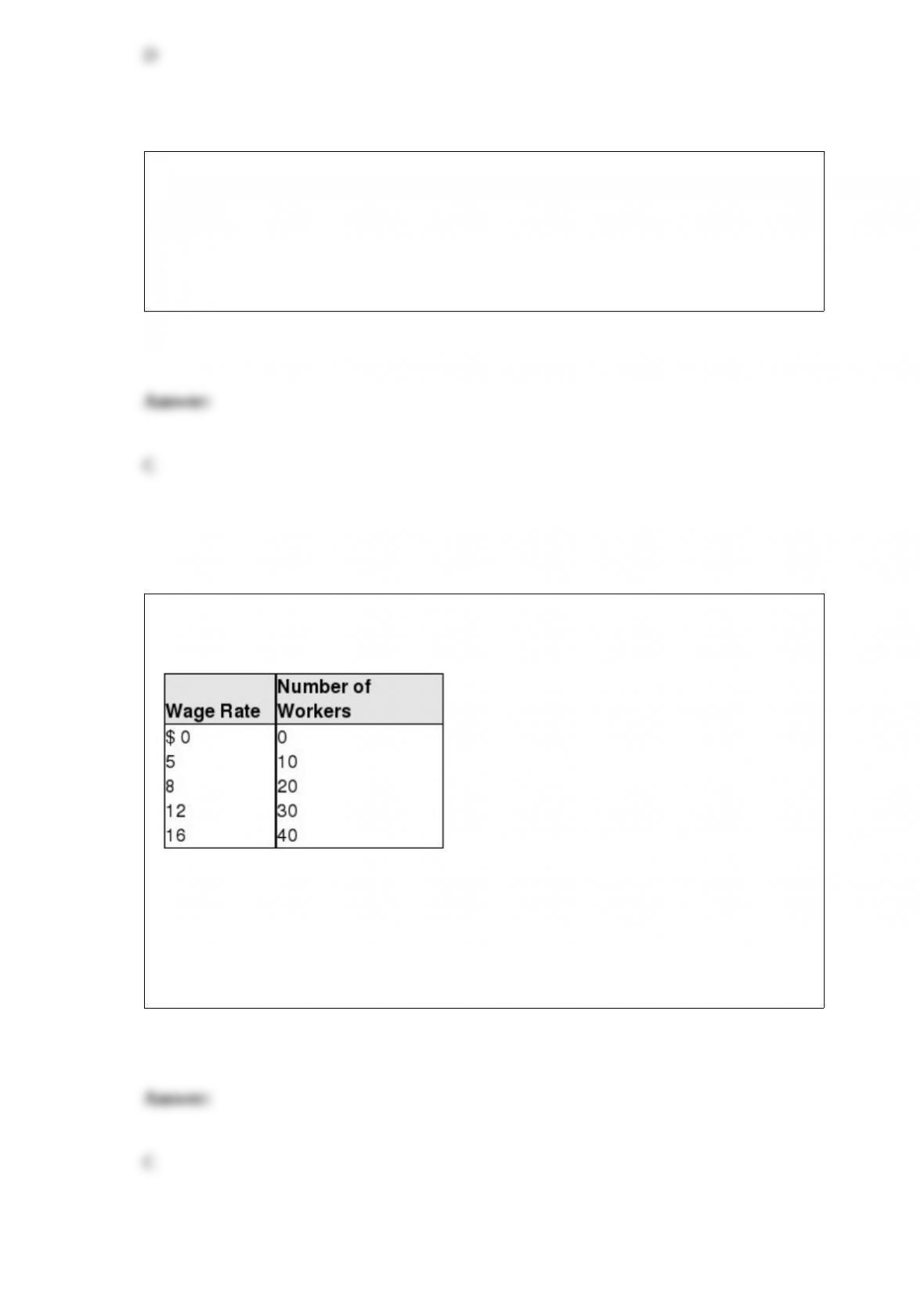
Exhibit 11-14 Labor cost data for a monopsonist
In Exhibit 11-14, when the monopsonist hires 30 workers, total wage cost is:
a. $12.
b. $30.
c. $360.
d. $480.
e. $640.
The theory of comparative advantage suggests that nations should produce a good if
they:
a. have the lowest opportunity cost.
b. have the lowest wages.
c. have the most resources.
d. can produce more of the good than any other nation.
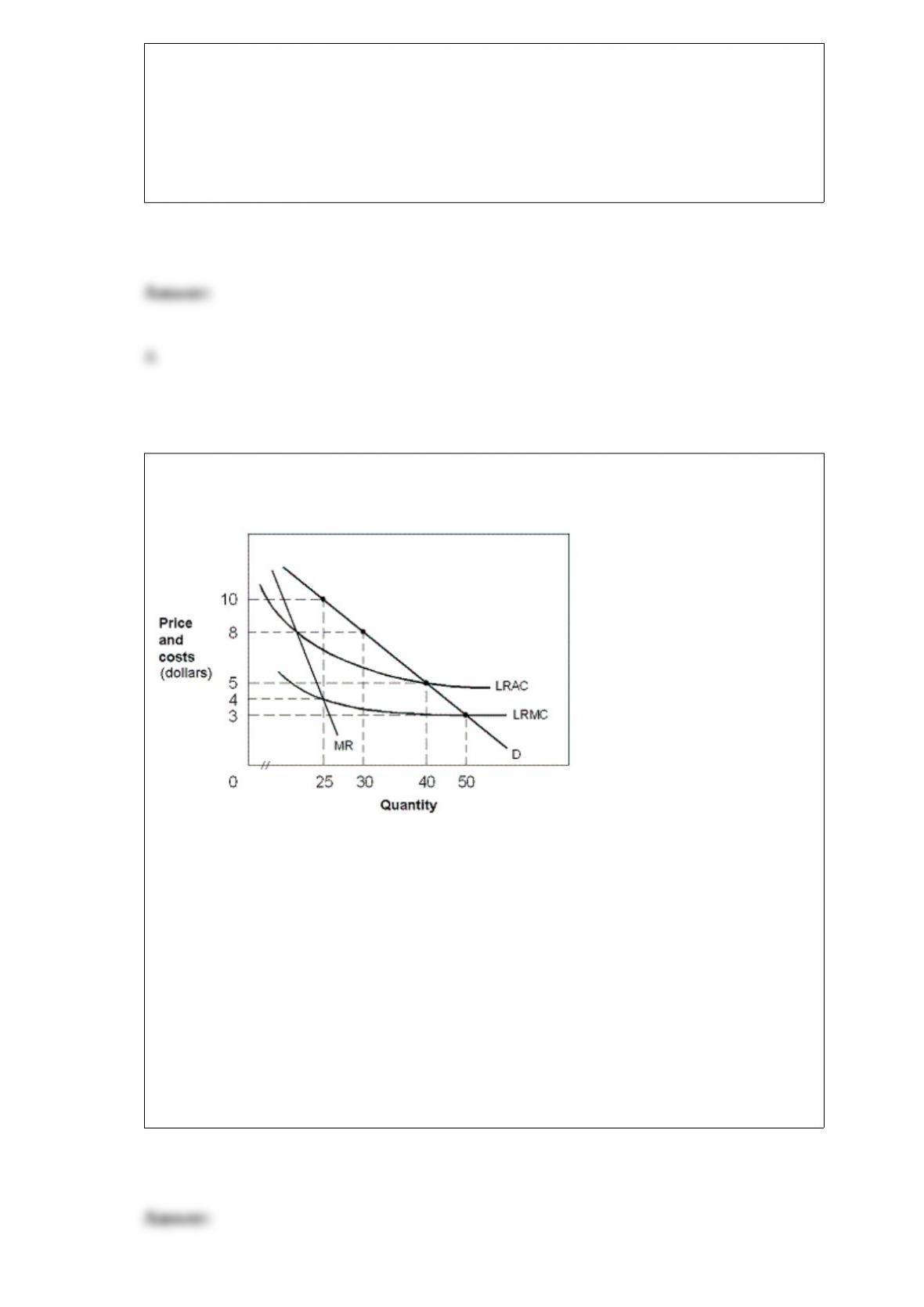
Exhibit 13-3 A monopolist
In Exhibit 13-3, if this industry is regulated and the regulatory commission wants
revenue to just cover cost, the proper price and output combination to be set is:
a. price = $8; output = 25.
b. price = $8; output = 30.
c. price = $5; output = 40.
d. price = $4; output = 25.
e. price = $10; output = 25.
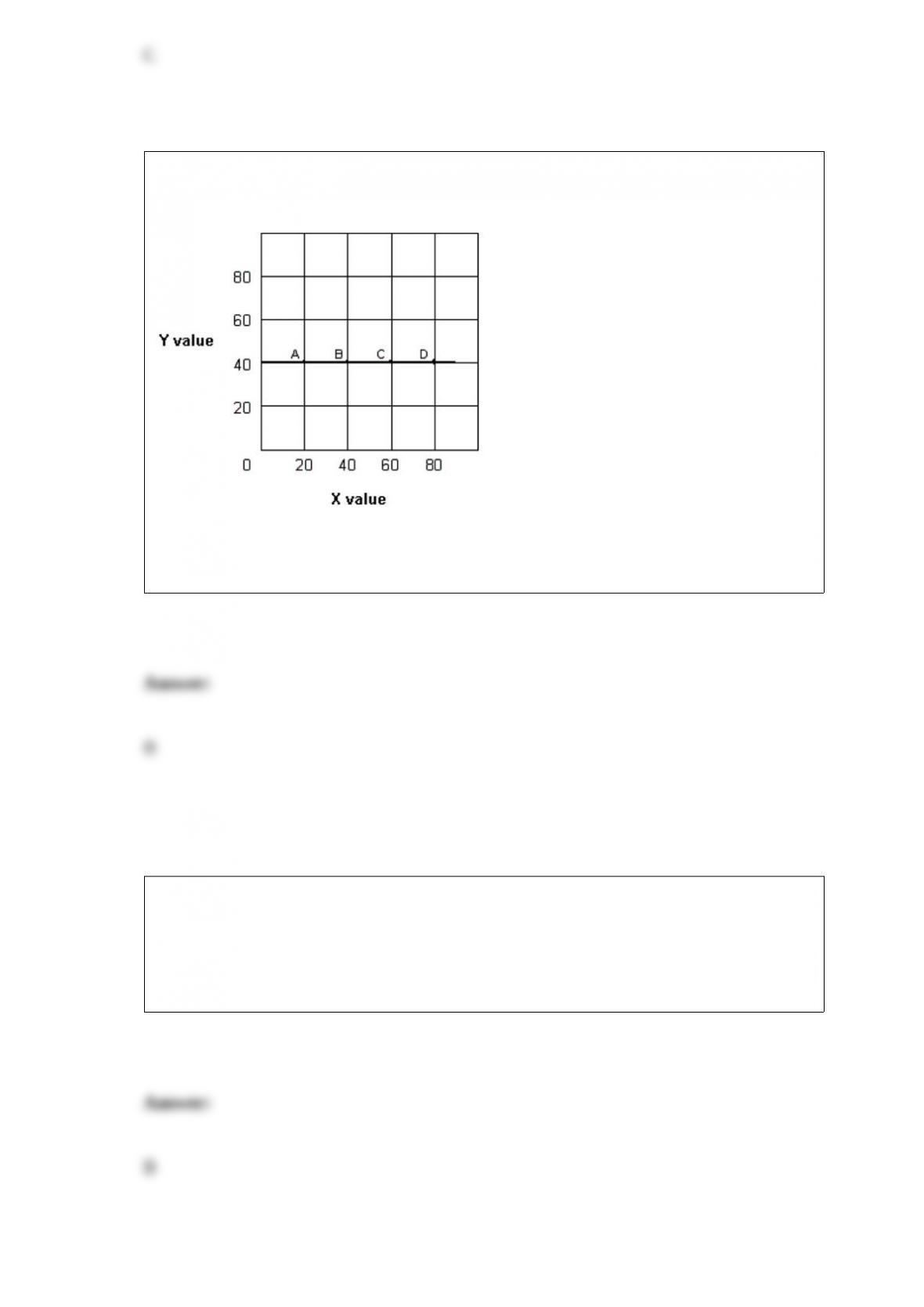
Exhibit 1A-4 Straight line
In Exhibit 1A-4, the slope of straight line A-D is:
a. positive. c. negative.
b. zero. d. variable.
Which barrier to entry results in the creation of a natural monopoly?
a. Legal barriers like government franchises.
b. Economies of scale.
c. Ownership of a vital resource.
d. Patents and copyrights.

The balance of trade is the value of a nation’s ____________.
a. goods and service exports times goods and service imports
b. goods exports subtracted from goods imports
c. goods imports subtracted from goods exports
d. net goods imports plus net capital inflows
The incentive to work is an ingredient of the negative income tax because:
a. if families do work, they will be eliminated from the program.
b. if families don’t work, they will be eliminated from the program.
c. the more income earned in the workplace, the higher the family’s after-tax income.
d. the more income earned in the workplace, the higher the payment from the
government.
e. the amount earned in the workplace is not subject to income taxes.
Socialism is correctly described by which of the following statements?
a. Central planning is used exclusively to answer the basic economic questions.
b. Markets are used exclusively to answer the basic economic questions.
c. Tradition is used exclusively to answer the basic economic questions.
d. Government ownership of many resources and centralized decision-making answers
the basic economic questions.

Leo’s Bakery reduces the price of wheat bread from $3 to $1 and finds that quantity
demanded increases from 100 to 122 loaves. Leo calculates that his price elasticity of
demand for wheat bread is:
a. 0.
b. 0.2.
c. 1.0.
d. 1.5.
e. 2.0
The kinked demand theory attempts to explain why an oligopolistic firm:
a. has relatively large advertising expenditures.
b. fails to invest in research and development (R and D).
c. infrequently changes its price.
d. engages in excessive brand proliferation.
If good A has a marginal utility of 30 and a price of $5, and good B has a marginal
utility of 10 and a price of $2, then:
a. good A is a better buy than good B.
b. good B is a better buy than good A.
c. goods A and B are of equal value to this consumer.
d. neither good A nor B is worth the money.
e. goods A and B should both be purchased.
At any price below the equilibrium price, the:
a. demand is greater than supply.
b. supply is greater than demand.
c. quantity demanded is greater than quantity supplied.
d. quantity supplied is greater than quantity demanded.
The law of demand is illustrated by a demand curve that is:
a. horizontal. c. vertical.
b. downward-sloping. d. upward-sloping.
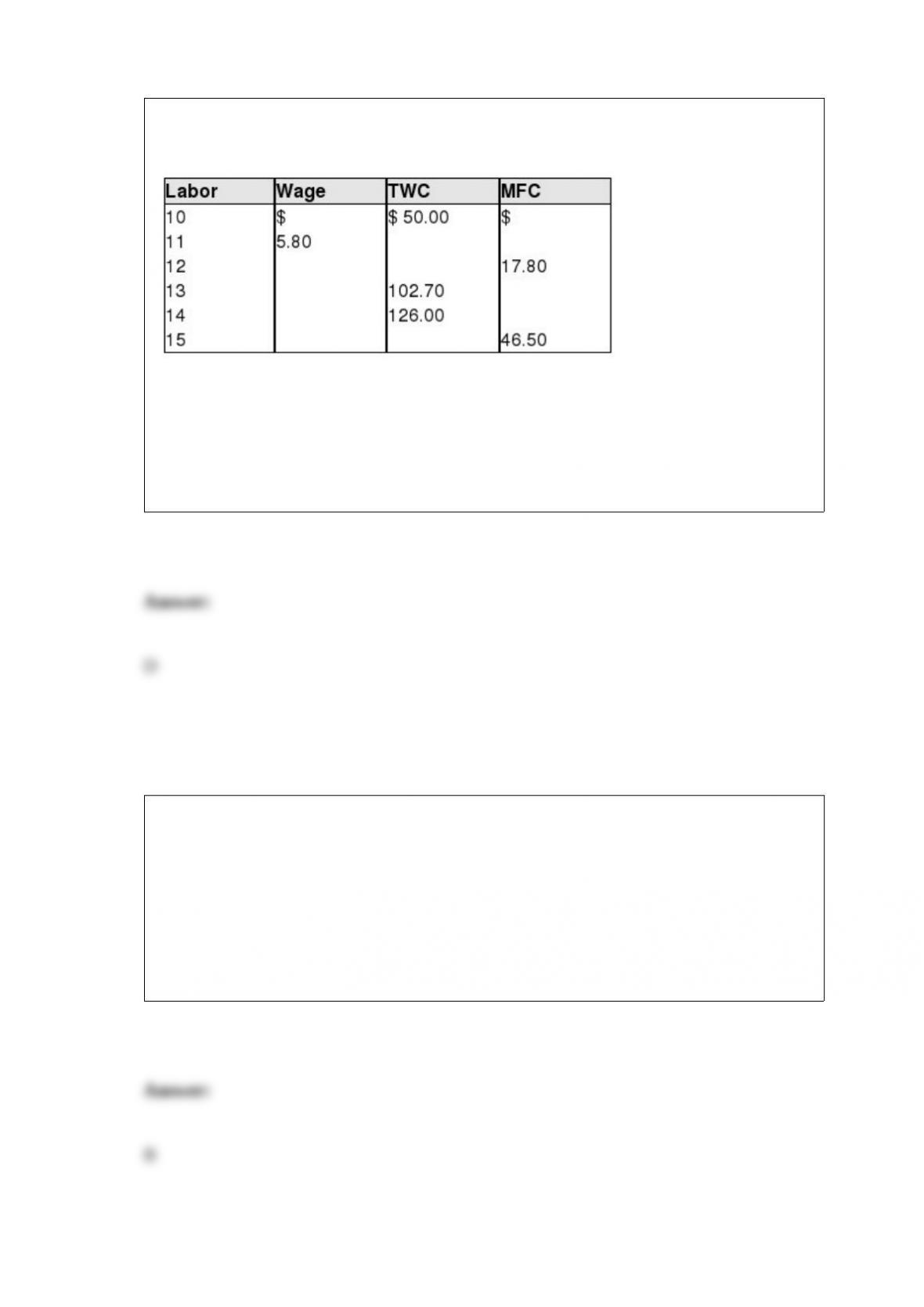
Exhibit 11-11 Labor wage and cost data
In Exhibit 11-11, the marginal factor cost of the 13th employee is equal to:
a. $102.70.
b. $17.80.
c. $7.90.
d. $21.10.
e. $17.80.
A farmer is deciding whether or not to add fertilizer to his or her crops. If the farmer
adds 1 pound of fertilizer per acre, the value of the resulting crops rises from $80 to
$100 per acre. According to marginal analysis, the farmer should add fertilizer if it costs
less than:
a. $12.50 per pound. c. $80 per pound.
b. $20 per pound. d. $100 per pound.

Nonprice competition, price leadership, and cartels are models in the ____ market
structure(s).
a. perfectly competitive
b. monopolistically competitive
c. oligopoly
d. monopoly
e. perfectly competitive and monopolistically competitive
The Robinson-Patman Act strengthened the merger provisions of the Sherman Antitrust
Act.
If the MRP is less than the wage, the firm should hire more labor.
The statement “It is better to suffer a little more unemployment than a little lower price”
is an example of normative economic analysis.
Discrimination lowers the average wage of members of one group of workers in spite of
laws that require equal pay for all workers.
Cartels are legal in the United States.
Marginal revenue product of labor measures the extra revenue generated to the firm
from the employment of an additional worker.

Under a fixed exchange rate system, a government is at risk of running out of foreign
currency reserves when the country’s imports exceed its exports.
A cartel is an agreement among firms to divide output of a product among members.
One of the strengths of a socialist economy, according to those who advocate such a
system, is that government intervention will enable a more equitable distribution of
income.
A price ceiling is set at $10, and the equilibrium market price is $8. Consumers will
actually pay $8.